
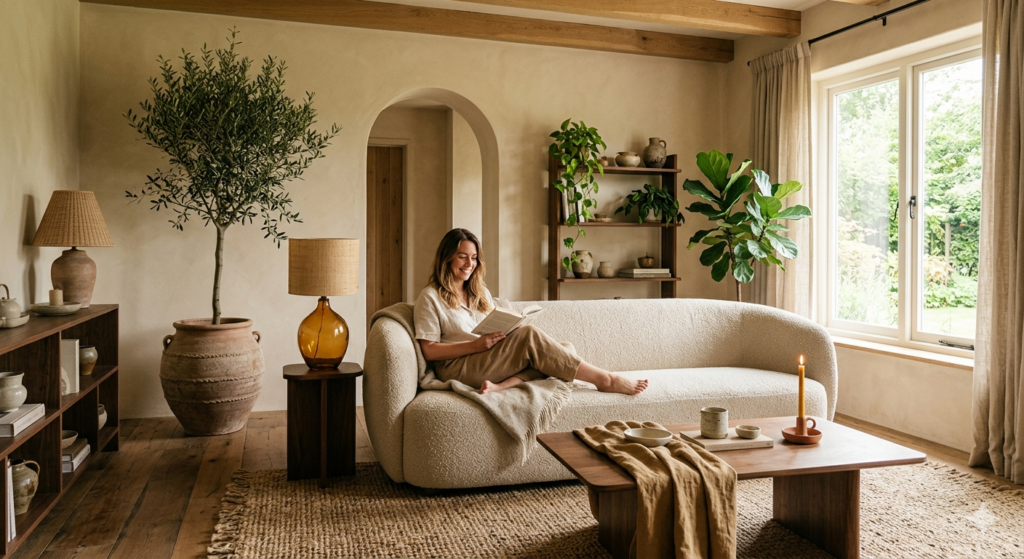
Why Homes Are Rejecting Grey in 2026
The cold grey era of interior design is quietly coming to an end.
For more than a decade, grey walls, monochromatic schemes, and stark minimalism dominated modern homes. It was praised for its cleanliness and sophistication. But increasingly, people are discovering that what looks serene in photos often feels emotionally flat in daily life.
In 2026, a new sensibility is rising: warm minimalism. It keeps the calm and clarity people loved about minimalism, but replaces the coldness with soul, texture, natural materials, and living elements that make a house feel like a true home.
The Fatigue With Cold Minimalism
The backlash did not happen suddenly. It built gradually as people lived with grey-walled rooms day after day. While the aesthetic photographed beautifully, many homeowners began to feel the emotional cost.
Rooms lacked depth. Light felt harsh. The spaces were hard to relax in. Families reported that their “modern” homes felt more like showrooms than sanctuaries. After years of uncertainty in the outside world, people started craving homes that offered comfort rather than just visual order.
Designers began hearing the same request repeatedly: “We want it simple, but we want it warm.”
This desire has sparked one of the most significant shifts in residential design in recent years.
The Rise of Earth Tones
The foundation of warm minimalism is a rich but restrained palette drawn from the earth:
- Warm beiges and creamy taupes
- Soft mushroom browns and toasted almonds
- Gentle terracottas and sandy neutrals
These colors are subtle yet full of life. Unlike flat grey, they respond to natural light, shifting gently throughout the day. A warm taupe wall can appear golden in morning light and deeply comforting at dusk.
When paired with natural wood — oak, walnut, and teak — in flooring, beams, and furniture, the effect becomes grounding and timeless. Wood brings warmth, texture, and a sense of history that synthetic materials cannot replicate.
This combination creates spaces that feel both edited and rich — simple without being sterile.
Plants: The Living Heart of the Home
No element better defines warm minimalism than the thoughtful integration of living plants.
In 2026 homes, plants are no longer optional decorations. They are essential design partners. Tall fiddle leaf figs and olive trees act as living sculptures. Trailing pothos and philodendrons soften hard edges. Smaller plants on tables and windowsills add life at every level.
Terracotta and clay pots have become especially popular. Their warm, earthy texture perfectly complements the new palette and adds natural imperfection that makes a space feel collected rather than staged.
The presence of plants does more than improve aesthetics. They improve air quality, reduce stress, and create a subtle but powerful connection to nature. In a world that feels increasingly digital and disconnected, bringing living greenery indoors feels both beautiful and necessary.
Light, Texture, and Human Comfort
Warm minimalism also pays close attention to light and texture. Designers maximize natural light through large windows and thoughtful layouts. In the evening, lighting becomes layered and warm — sculptural table lamps, wall sconces, and soft ambient sources replace harsh overhead lights.
Texture is equally important. Bouclé, linen, woven rugs, and matte finishes replace the smooth, glossy surfaces of the grey era. These materials invite touch. They make rooms feel approachable and comfortable rather than untouchable.
Furniture favors soft curves over hard geometric lines. Low-profile sofas, organic coffee tables, and flowing light fixtures create a sense of ease and flow.
The Alchemy of Atmosphere: Why the “Grey Era” Faded into the Golden Hour of 2026
The transition wasn’t a sudden renovation; it was a collective exhale. For years, we lived within the “Millennial Grey” cocoon—a palette that promised a sophisticated, frictionless life. But by the mid-2020s, the frictionlessness began to feel like a lack of grip. We were sliding through our own lives, living in spaces that looked like high-end renders but felt like waiting rooms.
As we move through 2026, the architectural soul of the home is being reclaimed. We aren’t just changing paint colors; we are undergoing a sensory rebellion.
The “Museum Fatigue” of the 2010s
To understand where we are, we must look at what we left behind. The grey era was born from a desire for “cleanliness” and “neutrality” in an increasingly chaotic digital world. However, the result was an accidental sterilization of the domestic experience.
-
The Emotional Flatline: Cool greys and stark whites absorb light without reflecting its character. In the winter, these rooms felt cavernous; in the summer, they felt clinical.
-
The Showroom Paradox: Homes became “Instagram-ready” but “life-resistant.” Every stray toy or coffee mug felt like a stain on a perfect canvas, creating a subtle, persistent undercurrent of domestic anxiety.
“A home should be a biography of its inhabitants, not a brochure for a furniture brand.” — This sentiment has become the unofficial manifesto for the 2026 design movement.
The Five Pillars of the “Warm Soul” Home
The shift toward Warm Minimalism is defined by a deliberate pursuit of haptic qualities—things that feel as good as they look.
| Element | The Old Way (2015-2023) | The New Way (2026) |
| Color | Cool Grey, Stark White, Navy | Ochre, Terracotta, Mushroom, Sand |
| Material | Polished Chrome, High-Gloss MDF | Reclaimed Oak, Travertine, Brushed Brass |
| Textile | Synthetic Velvet, Tight-Weave Polyester | Chunky Bouclé, Raw Linen, Sheepskin |
| Shape | Sharp 90-degree angles | Organic Curves, Arches, Kidney shapes |
| Greenery | Artificial or “Minimalist” (1-2) | Integrated indoor forests; “Living Walls” |
The Return of the “Hand-Touched” Object
One of the most profound shifts in 2026 is the rejection of mass-produced perfection. We are seeing a renaissance of imperfection.
-
Wabi-Sabi Integration: Homeowners are opting for handmade ceramics over factory-pressed sets. The slight wobble in a vase or the uneven glaze on a tile provides a visual “anchor” that reminds us of the human hand.
-
Patina over Polish: We no longer fear the scratch on the wooden table or the wear on the leather chair. These are seen as “merit badges” of a life well-lived. In 2026, a home that looks slightly “used” is a home that looks loved.
Biophilic Architecture: More Than Just a Fern
While the previous decade used plants as accents, 2026 treats them as infrastructure. We are seeing “internal courtyards” even in small apartments and built-in irrigation for indoor herb gardens.
This isn’t just about oxygen; it’s about the circadian rhythm.
Natural materials like clay and wood don’t just sit there; they “breathe.” They change temperature, they catch the light, and they age gracefully. When we surround ourselves with living things—whether it’s an ancient olive tree in a terracotta pot or a reclaimed hemlock ceiling beam—we synchronize our internal clocks with the natural world.
Lighting: The Final Frontier of Comfort
The 2026 home has declared war on the “Big Light.” The harsh, 4000K LED recessed lighting that defined the grey era is being swapped for layered luminosity.
-
The Low-Level Glow: Emphasis has shifted to floor lamps and “skirt-level” lighting that mimics the warmth of a fireplace.
-
Amber Hues: Smart lighting systems are now programmed to transition from a soft buttery yellow at noon to a deep, sunset orange by 8:00 PM.
-
The Candlelight Renaissance: The tactile ritual of lighting a beeswax candle has replaced the flick of a sterile switch, turning the end of a workday into a sacred transition.
A Sanctuary for the “Post-Digital” Soul
Why does this matter so much right now? Because in 2026, our external world is faster and more “AI-generated” than ever. When we step through our front doors, we aren’t looking for a high-tech hub; we are looking for a sensory sanctuary.
We are trading the “cool” for the “kind.” The grey walls told us to be quiet and orderly. The new warm home tells us to breathe, to touch, and to stay a while. The “Warmth Within” isn’t just a trend—it’s a homecoming.
