
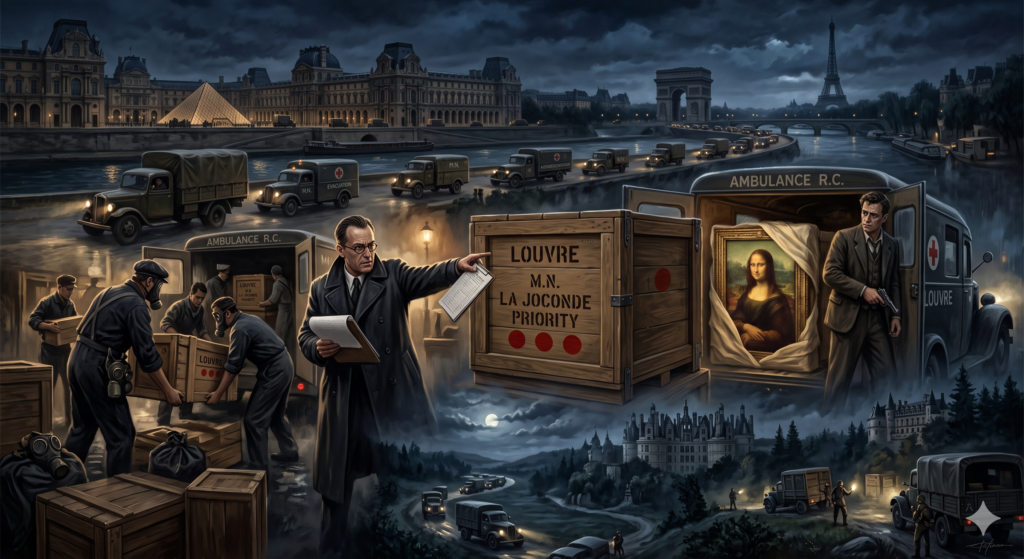
This is the true story of Europe’s greatest art heist in reverse. In August 1939, on the eve of World War II, a heroic French civil servant named Jacques Jaujard orchestrated a massive, midnight evacuation of the Louvre. Under the noses of the invading Nazi army, a secret network of curators smuggled thousands of irreplaceable masterpieces—including the Mona Lisa—into the French countryside, moving them from castle to castle for four years to keep the soul of Western civilization out of Adolf Hitler’s hands.
Part I: The Ghost in the Grand Galerie
The silence inside the Louvre on the evening of August 25, 1939, did not sound like peace. It sounded like a breath held so tightly the ribs might crack.
Jacques Jaujard stood at the end of the Grand Galerie, his polished leather shoes clicking softly against the parquet floor. Above him, the vast glass skylights filtered the bruised, purple twilight of a dying Parisian summer. For centuries, this room had been a vibrant, noisy sea of humanity—monarchs, revolutionaries, artists, and tourists all jostling for a glimpse of genius. Tonight, it was a staging ground.
“Monsieur Jaujard?”
A young curator, René Huyghe, stepped out from the shadow of a towering marble column. His shirt sleeves were rolled up, his forehead slick with sweat despite the evening chill. He held a clipboard like a shield. “The department store workers from the Grands Magasins du Louvre have arrived. The first delivery of poplar crates is being unloaded in the Cour Carrée.”
Jaujard nodded, his face an unreadable mask of calm. He was forty-four years old, a career civil servant with the elegant posture of a diplomat and the steely eyes of a general. While the politicians in Paris were still whispering about peace treaties and appeasement, Jaujard had spent the last year looking across the Rhine, watching the dark clouds gather over Europe. He had seen what happened to the masterpieces of the Prado during the Spanish Civil War. He knew that when dictators marched, art bled.
“And the coding system?” Jaujard asked, his voice low, steady, and devoid of tremor.
“The packers understand,” Huyghe replied, tapping his clipboard. “Every piece has been cataloged. A yellow circle for very valuable art. A green circle for works of major importance. And three red circles…” Huyghe hesitated, his eyes drifting down the long corridor toward a small, isolated alcove. “…for the world treasures. For her.”
Jaujard turned his gaze toward the far wall. There, framed by the velvet shadows, sat La Joconde. The Mona Lisa. Her smile, ambiguous and eternal, seemed to mock the frantic mortality of the men rushing about her feet.
“Begin with her,” Jaujard said softly. “Before the sun rises tomorrow, I want the walls of this palace stripped bare.”
Part II: The Ghost Fleet of Paris
By midnight, the Louvre had transformed into a frantic, highly organized anthill. Jaujard’s plan, meticulously drawn up in secret months prior, unfolded with military precision. The museum had been closed to the public under the guise of “urgent repairs,” but inside, a massive rescue operation was underway.
Curators, art students, security guards, and warehouse packers worked side by side. The air was thick with the scent of sawdust, pine wood, raw twine, and wood shavings. The rhythmic thwack-thwack of hammers nailing crates shut echoed through the high-vaulted ceilings like distant gunfire.
To move thousands of the world’s most fragile treasures required a logistical miracle. The total evacuation eventually involved moving 3,690 paintings and packing 1,862 massive wooden crates.
Massive, heavy canvases like Théodore Géricault’s The Raft of the Medusa could not simply be slipped into a briefcase. It was too large to fit into any standard vehicle. Workers carefully wrapped the monumental canvas in heavy flannel blankets and hoisted it onto the bed of an open-top flatbed truck.
As the truck carrying The Raft of the Medusa slowly navigated the narrow gates of Versailles later that night, the top of the canvas scraped against an overhead electrical wire. A brilliant shower of blue sparks erupted, instantly short-circuiting the power grid and plunging the entire town of Versailles into pitch blackness.
When word reached Jaujard via an anxious phone call, he didn’t panic. “Send out men with long wooden poles ahead of every convoy,” he ordered. “If they must lift the power lines of France by hand to let our history pass, then they will do so.”
Meanwhile, the evacuation of the sculptures presented an entirely different nightmare. At the top of the Daru staircase, the Winged Victory of Samothrace loomed like an ancient, breathless deity. Her stone wings were spread wide against the coming storm.
A team of twenty men erected a massive wooden scaffolding around her. Using a complex system of ropes, pulleys, and thick wooden ramps, they slowly, inch by inch, lowered the eleven-foot-tall, multi-ton Hellenistic masterpiece down the grand staircase. Every man held his breath; a single snapped rope would mean the utter annihilation of one of human history’s greatest achievements. When her base finally touched the ground safely, a collective sob of relief rippled through the weary crew.
Part III: The Lady in the Ambulance
While the great statues were being wrestled into crates, a far more delicate operation was taking place in the dark.
The Mona Lisa was carefully unhooked from her heavy frame. Because she was painted on a fragile poplar wood panel rather than canvas, any sudden shift in temperature or humidity could cause the wood to warp and crack, flaking Leonardo’s 400-year-old brushstrokes into dust.
Jaujard watched as she was wrapped in multiple layers of silk, placed inside a custom-made, heavily padded oak case, and then sealed inside an airtight, zinc-lined box. The crate was stenciled with the simple, anonymous letters MN for Musées Nationaux, alongside three bright red circles denoting the highest level of priority.
She was not put into a loud, jarring transport truck. Instead, Jaujard had requisitioned a private, smoothly suspended ambulance.
“You will not lose sight of her,” Jaujard instructed René Huyghe, who was assigned to ride in the back of the ambulance alongside the painting. “If the enemy comes, if the bombs fall, your life is secondary to that crate. Do you understand?”
Huyghe looked at the wooden box resting on the gurney, then up at Jaujard. “I understand, Monsieur.”
At 6:00 AM on August 28, while the citizens of Paris were still asleep in their beds dreaming of a peace that would never come, the gates of the Cour Carrée swung open. A ghost fleet of over two hundred vehicles—delivery vans, private cars, moving trucks, and ambulances—slipped out onto the misty banks of the Seine. They did not turn on their headlights. They drove south, scattering into the French countryside like autumn leaves blown before a hurricane.
Part IV: The Empty Palace
On June 14, 1940, the German army marched into Paris. The city was silent, declared an open town to save it from total destruction.
Two months later, on August 16, a sleek black staff car pulled up to the main entrance of the Louvre. Out stepped Count Franz von Wolff-Metternich. He was a tall, aristocratic German art historian who had been appointed by Adolf Hitler to head the Kunstschutz—the military unit tasked with preserving and cataloging for future seizure the cultural property of occupied territories.
Hitler had grandiose plans. He envisioned a spectacular, hyper-massive “Führermuseum” in his hometown of Linz, Austria, which would house every great piece of art in the world, properly stripped from the nations of Europe. The jewel of that museum was meant to be the collections of the Louvre.
Metternich walked up the grand steps, his boots echoing sharply in the cavernous, empty spaces. Waiting for him at the top of the stairs, dressed in a pristine suit with his hands folded neatly behind his back, was Jacques Jaujard.
The German officer looked past Jaujard into the galleries. He walked through the Salon Carré. He walked down the Grand Galerie.
The sight was ghostly. Thousands of empty, golden frames hung flat against the walls, staring out like blind eyes. On the velvet-lined walls where masterpieces once breathed, there was nothing but rectangular patches of pale, unfaded paint. On the floor, a few discarded scraps of twine and wood shavings remained. All that was left was the ghost of beauty.
Metternich stopped in front of the empty space where the Mona Lisa had hung. He stood there for a long time, his face unreadable. Jaujard watched him closely, his heart hammering against his ribs, his hand inside his pocket tightly gripping a small, brass key.
Metternich turned to Jaujard. “Where are they, Monsieur Jaujard?”
Jaujard took a slow breath. “The works were evacuated for their own protection against aerial bombardment, Count Metternich. Per the guidelines of the Hague Convention of 1907. They are scattered across various public repositories in the provinces.”
He did not give addresses. He did not give names.
Metternich stared at Jaujard. As an art historian, Metternich loved the masters as much as Jaujard did. He also knew that if the fanatical Nazi leadership—men like Hermann Göring and Joseph Goebbels—got their hands on the exact locations, the collections would be loaded onto trains to Berlin within twenty-four hours, likely destroyed or lost forever in the chaos of the war.
Slowly, a faint, wry smile crossed the German officer’s face. He let out a soft sigh. “It seems,” Metternich said, his voice dropping to a whisper, “that the climate in Paris is quite poor for delicate paint. It is good that they are breathing the fresh air of the countryside.”
To Jaujard’s astonishment, Metternich did not order torture, arrests, or a scorched-earth search. Throughout the occupation, Metternich actively colluded with Jaujard, intentionally misreporting the status of the hidden art to his superiors in Berlin, playing a dangerous bureaucratic game of delay and obfuscation to keep the treasures hidden in the shadows.
Part V: The Long, Dark Hide-and-Seek
For four long years, a desperate, secret game of hide-and-seek played out across the châteaux and abbeys of France.
The treasures could never stay in one place for too long. If German troop movements came too close, or if the collaborationist Vichy government grew too curious, Jaujard would send a coded telegram through a network of loyal, underground museum curators. Overnight, crates would be loaded back onto trucks and shifted to a new hiding spot.
The Mona Lisa became a nomad of the French countryside. She slept at the grand Château de Chambord in the Loire Valley, hidden beneath stacks of blankets. When the dampness of the valley threatened her wood panel, she was moved to the isolated Château de Amboise. When the war intensified, she was rushed down south to the Abbey of Loc-Dieu, then to the Château de Montal in the thick, camouflaged woodlands of the Lot region.
Conditions in these ancient stone castles were brutal for the paintings. There was no modern climate control. The winters were bitterly cold and damp; the summers were humid and oppressive.
In the Château de Montal, René Huyghe lived in a small, freezing room right next to the Mona Lisa’s crate. He set up a small cot directly beside her. Every hour, day and night, Huyghe would wake up to check the hydrometer readings, manually adjusting primitive electric space heaters to ensure the air around her stayed perfectly stable. He slept with a loaded pistol under his pillow, watching the door, terrified of a sudden Gestapo raid.
“We were not just protecting wood and pigment,” Huyghe would write years later in his journal. “We were keeping the soul of civilization alive while the world outside chose madness.”
Part VI: The Return of the Light
In August 1944, the bells of Notre-Dame rang out across a liberated Paris. The Nazi occupation was over.
But for Jacques Jaujard, the work was far from complete. Slowly, meticulously, the coded orders went out once more. The ghost fleet was reassembled, turning back toward the capital from every corner of France.
One by one, the crates returned to the Cour Carrée. They were opened with trembling, mud-stained hands by curators who had grown old and gray during the five years of war.
An final inventory was taken to check the status of the evacuated pieces:
-
The Winged Victory of Samothrace: Unharmed, re-erected at the top of the stairs.
-
The Venus de Milo: Safe and pristine.
-
The Raft of the Medusa: Flawless, with no canvas tears.
-
La Joconde (Mona Lisa): Intact, untouched, and smiling.
Not a single piece of the Louvre’s national collection was lost. Not a single canvas was torn. Not a single statue was chipped. In the greatest, most expansive art rescue operation ever attempted in human history, Jaujard’s network had achieved absolute victory.
On a bright morning in late 1945, the Mona Lisa was carefully lifted back onto her hooks in the Grand Galerie. The room was empty of tourists, just as it had been on that terrifying night in August 1939.
Jacques Jaujard stood in the exact same spot, his hands resting quietly in his pockets. The skylights above let in a clean, golden autumn sun, illuminating her face.
René Huyghe stepped up beside him, looking exhausted but deeply content. “She didn’t change at all, Monsieur. After all that dirt, all those freezing nights in the châteaux, she looks exactly the same.”
Jaujard looked at her lips, curved into that timeless, unbothered smile that had survived kings, emperors, revolutions, and world wars.
“She knew we would save her,” Jaujard said quietly, a rare, soft smile finally breaking across his own face. “Empires fall, René. But art is long.”
