
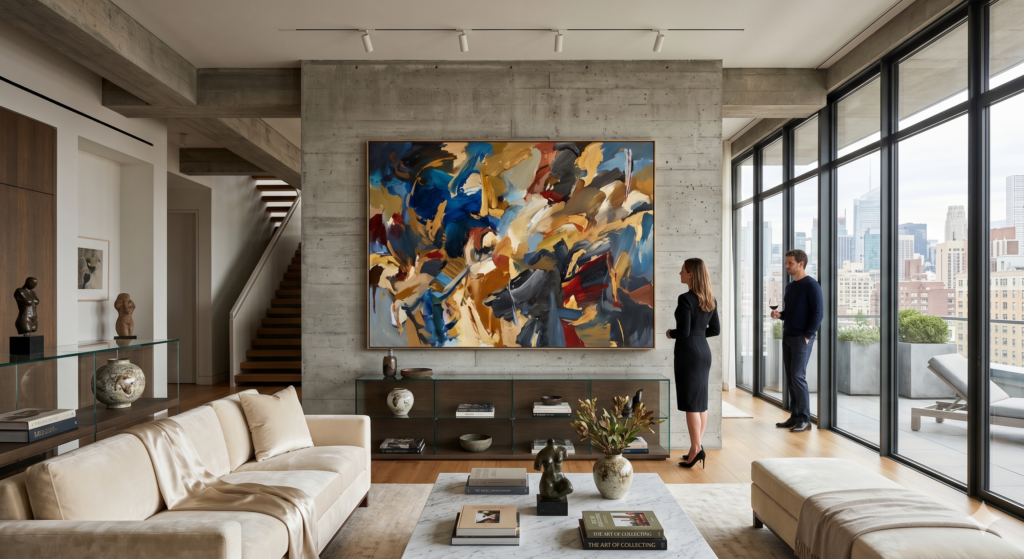
I. The Transmutation of Space: From Shelter to Sanctuary
A house, no matter how brilliantly engineered or expensively surfaced, begins its life as a purely physical construct. It is an arrangement of mass and void—a calculated composition of concrete foundations, structural steel, insulated glass, and spatial volumes designed to mitigate the forces of nature and provide a functional theater for human activity. In the vocabulary of real estate, it is an empty container. It possesses financial value, geometric utility, and geographic position.
Yet, without an emotional core, even the most architecturally significant property remains spiritually inert. It is an empty stage awaiting a script, a magnificent instrument that has not yet been tuned.
The element that fundamentally transmutes this physical structure into an emotional legacy asset is original fine art.
When a masterwork enters a residential space, it introduces an entirely new dimension that blueprints cannot calculate and raw square footage cannot measure. Art is not a decorative afterthought applied to cover an empty drywall surface; it is a vital, living asset class that alters the psychological gravity of an entire home. It shifts the environment from a structure of consumption to a repository of culture, history, and human soul.
To understand fine art as a “living asset” is to recognize that its return on investment is not merely realized upon its eventual liquidation at an auction house like Sotheby’s or Christie’s. Instead, its return is paid out daily in the currency of emotional resonance, intellectual stimulation, and familial identity.
By merging the worlds of high-end real estate and blue-chip fine art, we look beyond the traditional silos of publishing. We examine how a canvas or sculpture acts as the vital connective tissue that transforms a beautiful house into a timeless family estate.
II. The Psychology of the Living Asset: Why Canvas Commands Concrete
In the upper echelons of wealth, the acquisition of assets is driven by two distinct yet parallel motivations: the preservation of capital and the curation of identity. While prime real estate satisfies the need for tangible, unyielding physical wealth, blue-chip fine art satisfies the need for intellectual and emotional permanence. When these two asset classes are intentionally fused within a private residence, they create a powerful multiplier effect.
Art operates as a living asset because it acts as a mirror for the collector’s internal landscape. Unlike a mass-produced luxury fixture or a trendy piece of imported furniture, an original painting or sculpture contains the unique kinetic energy, intent, and historical context of its creator. It introduces an intellectual dialogue into the living space. A wall flanking a dining room ceases to be a mere partition; once it holds a masterpiece, it becomes a portal to a specific historical narrative, a philosophical inquiry, or a profound emotional state.
Furthermore, fine art serves as the ultimate anchor for family legacy. Long after the technological features of a smart home have become obsolete, and well after the interior design trends of a specific decade have faded, the art collection remains an unyielding pillar of the home’s identity.
It is the visual language through which a family communicates its values, its intellectual curiosity, and its cultural stewardship across generations. Children grow up under the gaze of these canvases; they absorb the textures, the colors, and the stories behind their acquisition. The art becomes inextricably woven into the fabric of their memories, transforming the real estate from a temporary piece of property into an irreplaceable ancestral home.
III. The Architectural Integration: Art-First Blueprints
Historically, art was treated as a secondary consideration in residential design. A family would purchase or build a home, move their furniture in, and then scout the remaining wall spaces to hang whatever paintings they happened to own. This haphazard approach is the antithesis of luxury.
In the modern paradigm of high-craft architecture, the relationship is entirely inverted. Today’s premier architects design residences around the art collection itself, recognizing that a masterpiece demands a structurally integrated stage.
This “Art-First” blueprinting method requires an absolute, seamless collaboration between the architect, the interior designer, the lighting engineer, and the art consultant long before the ground is broken or concrete is poured. Every programmatic movement through the house is calculated to create moments of artistic discovery and emotional pause.
-
Sightlines and Thresholds: Corridors are widened and elongated to create grand axial vistas. When a person turns a corner or moves from a low-ceilinged foyer into an expansive living volume, their eye is guided by the architecture directly toward a primary masterwork. The wall becomes the destination.
-
Structural Load Engineering: Modern collections frequently include monumental sculptures or massive, multi-paneled canvases that weigh thousands of pounds. Integrating these pieces requires early structural intervention. Foundations must be thickened, sub-floors reinforced with structural steel plates, and door frames widened simply to allow the physical transport and permanent installation of the artwork into the home’s core.
-
Spatial Volume Calibration: The dimensions of a room are calibrated to match the scale of the art. A large-format abstract expressionist canvas requires not only a massive wall surface but also a precise amount of physical setback distance, allowing the viewer to step back and absorb the composition without feeling claustrophobic.
IV. The Physics of Perception: Mastering Museum-Grade Lighting
The most common tragedy in luxury residential real estate is a multi-million dollar art collection illuminated by standard, residential-grade lighting. Poor lighting choice does more than obscure the visual details of a painting; it can cause irreversible physical degradation to a delicate canvas or textile over time. To truly unlock fine art as a living asset, a home must employ museum-grade lighting engineering hidden within the residential architecture.
The Eradication of Natural and Artificial Threats
The primary enemy of art is ultraviolet (UV) radiation and infrared heat. Direct sunlight will fade pigments, dry out oil layers, and make paper brittle within a matter of years. Therefore, art-centric architecture utilizes advanced glazing technologies.
Every window and skylight in proximity to an art placement must be specified with museum-grade UV-filtering laminates that block 99% of harmful rays. Furthermore, motorized, automated architectural shades are tied to astronomic clocks, dropping silently into place when the sun hits a critical angle to shield vulnerable canvases.
The Science of Artificial Illumination
When it comes to artificial lighting, the standard bulb is utterly deficient. High-end art-first architecture utilizes specialized LED fixtures engineered with an exceptionally high Color Rendering Index (CRI) of 95 to 98. This ensures that the light source contains the full, natural spectrum of color, allowing the viewer to see the exact hues, pigments, and undertones that the artist intended in their studio.
Furthermore, lighting designers utilize recessed contour projectors hidden flush within the ceiling. These advanced fixtures use optical lenses and custom-cut framing shutters to trim the light beam precisely to the geometric edge of a canvas. The result is a magical visual illusion: the light does not spill onto the surrounding wall surface, causing the painting to look as if it is glowing from within.
V. Anatomy of the Legacy Wall: Materials and Substructures
A true gallery wall inside a private residence is a complex piece of engineering concealed behind a smooth, flawless finish. In a standard home, walls are built using simple wooden or light-gauge steel studs covered in a single layer of half-inch drywall. If a collector attempts to hang a massive, heavy-framed oil painting or an unyielding steel relief sculpture on such a wall, they risk catastrophic structural failure.
To build an institutional-grade canvas wall within a home, architects specify a multi-layered assembly. The entire wall surface is backed directly with structural wood panels—such as three-quarter-inch marine-grade plywood—recessed behind high-density, fire-rated drywall.
By backing the entire wall with heavy structural plywood beneath the drywall, the artist or gallery team can secure a hanging bracket at any exact coordinate on the surface without needing to locate an elusive underlying stud. This offers absolute freedom for future curation and layout rotations.
The exterior surface finish of the wall is calibrated to complement, not fight, the art. Standard latex flat paint is replaced with museum-quality, Level 5 ultra-smooth finishes, deep matte mineral paints, or fine Venetian plaster. These surfaces absorb or diffuse ambient light softly, ensuring there are no ugly reflections or hot spots competing with the artwork’s surface texture.
VI. Microclimates: The Invisible Shield of Conservation
Fine art is a living asset because it reacts continuously to its physical environment. Canvas expands and contracts; wood panels warp; paper fibers absorb moisture; and paint layers can crack if exposed to sudden fluctuations in temperature and humidity. A luxury home acting as a serious gallery must integrate invisible, museum-grade environmental control networks.
Traditional residential HVAC systems operate on a crude cycle: they blast cold or hot air until a thermostat setting is reached, and then shut off completely. This creates jagged waves of environmental instability.
Art-centric architecture employs Constant-Volume Microclimate Systems. These systems operate continuously and silently behind the scenes, maintaining a strict, unyielding environmental baseline:
-
Temperature Stability: Maintained within a precise window of 68°F to 72°F (20°C to 22°C).
-
Relative Humidity Calibration: Held consistently between 45% and 55%. This prevents the drying out of canvas fibers while eliminating the threat of mold or moisture blooms on sensitive works on paper.
-
Multi-Stage Particulate Filtration: Air is pulled through advanced HEPA and carbon filtration banks to scrub out dust, gaseous pollutants, and volatile organic compounds (VOCs) that could form microscopic films on unprotected impasto surfaces.
The air delivery itself is engineered with absolute subtlety. Linear slot diffusers are integrated into architectural reveals at the floor or ceiling lines, allowing air to wash over the room at an incredibly low velocity. This prevents sudden drafts from vibrating canvases or altering local humidity levels near a specific piece.
VII. The Ultimate Return on Investment: Elevating the Real Estate Value Loop
For the custom home builder, the architect, and the luxury real estate professional, embracing the philosophy of fine art as a living asset is the ultimate branding differentiator. It elevates your business away from the functional metrics of construction and moves it into the rarefied world of high-value cultural curation.
When you present a home not merely as an arrangement of premium rooms, but as an impeccably engineered canvas designed to harbor a family’s greatest intellectual treasures, your market value undergoes a radical shift. You are no longer competing on a standard price-per-square-foot basis with the mass-market builders down the street. You are operating in an entirely different domain—the domain of generational legacy.
This is where the true synthesis between real estate and fine art occurs. When high-craft architecture and blue-chip art are integrated with absolute intent, they lock together to create an appreciating circle of value. The architecture frames and protects the art; the art contextualizes and ennobles the architecture. Together, they create a home that is truly unique, completely irreplaceable, and structured to endure for generations to come.
The Curatorial Takeaway: A home defined by structural mastery does not merely shelter wealth; it projects and protects human culture. When you build for art, you build for history.
