
There is a distinct kind of arrogance to the way Paris handles its own beauty. It doesn’t beg for your attention; it simply exists, wrapped in centuries of limestone, iron, and attitude, waiting for you to catch up.
In an era saturated with hyper-edited travel vlogs, manic voiceovers, and algorithmic pop soundtracks, a new 4K ambient walking tour titled simply ЛУВР offers something radically different. It treats the French capital not as a backdrop for an influencer’s wardrobe change, but as a living, breathing architectural symphony.
By stripping away the commentary and leaving only the raw, unvarnished ASMR of the city—the crunch of gravel underfoot, the distant hum of an accordion, the collective exhale of a Parisian summer afternoon—this slow-cinema exploration captures the true intersection of design authority and raw street culture.
The Cour Napoléon: Symmetry, Stone, and High-Renaissance Swagger
The journey begins in the epicenter of French institutional power: the Musée du Louvre.
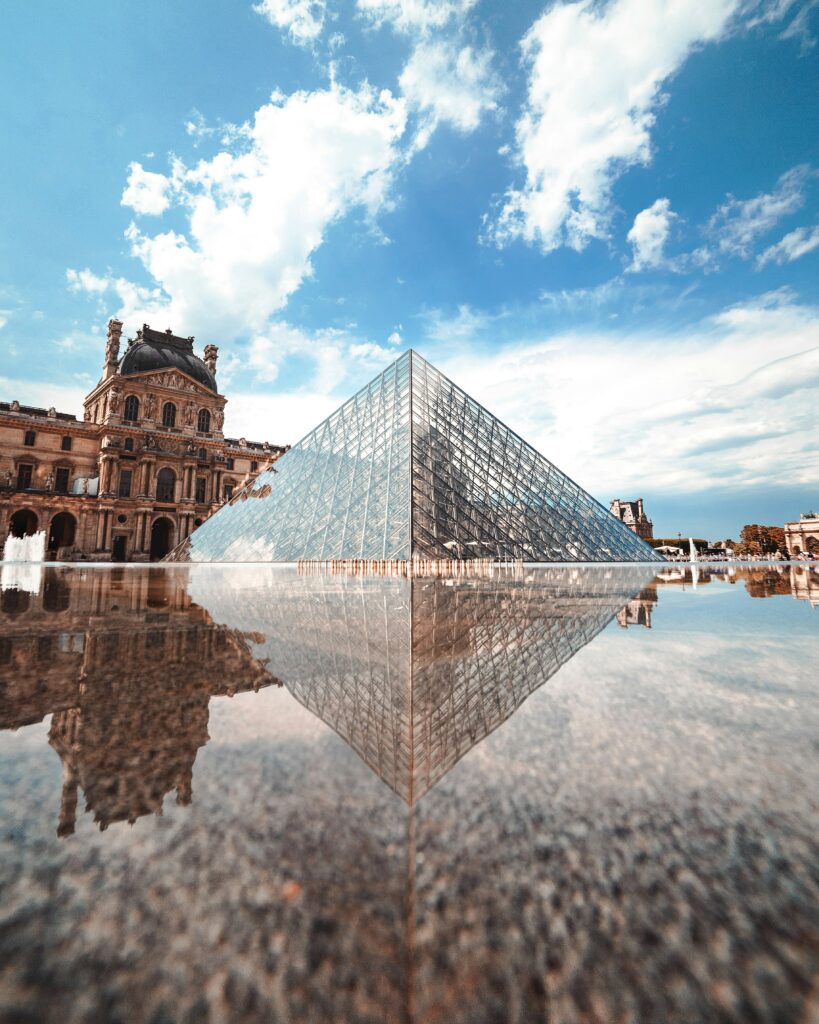
When you view the Louvre through a crisp, unhurried 4K lens, you aren’t just looking at a museum; you are analyzing a centuries-long architectural boxing match. The massive, deeply sculpted pavilions wrap around you like a heavy gilded frame. The stone is pierre de Lutetia—a warm, porous limestone quarried from beneath the city itself. It absorbs the afternoon sun and throws it back at you in shades of buttery cream and weathered charcoal.
Look closely at the rhythmic repetition of the windows, the Corinthian columns, and the allegorical statues staring down from the rooflines. This is classical architectural authority at its most imposing.
But then, the camera pans to the center of the courtyard, and the spatial narrative takes a violent, brilliant turn. I.M. Pei’s glass pyramid cuts through the Renaissance gravity like a diamond blade. It is an absolute masterstroke of structural minimalism. The contrast is pure rock-and-roll: heavy, opaque stone anchoring the earth versus transparent, weightless glass reflecting the shifting Parisian sky.
Without a narrator telling you what to think, the natural city sounds take over. You hear the crisp clack-clack of sneakers on cobblestones, the echo of laughter bouncing off the glass facets, and the splash of the surrounding fountains. It grounds the space, reminding us that this playground of kings is now entirely owned by the public.
The Tuileries Garden: Where Landscape Architecture Meets Human Connection
Leaving the stone-paved expanse of the Louvre, the tour transitions seamlessly into the green lungs of the Right Bank: the Jardin des Tuileries.
If the Louvre is about the permanence of stone, the Tuileries is about the orchestration of nature. Designed in the 17th century by André Le Nôtre—the undisputed king of landscape architecture—the Tuileries is the ultimate expression of the jardin à la française (French formal garden). It relies on a single, unbroken axial sightline stretching from the Louvre straight to the Arc de Triomphe, flanked by trees sculpted into clean geometric boxes that act as living green walls.
Through the lens of this walking tour, you experience the garden exactly as it was intended to be felt: as a series of grand outdoor rooms.
The soundscape shifts dramatically here. The hard echo of the cobblestones softens into the iconic, rhythmic crunch of fine gravel underfoot. This gravel sound is the literal heartbeat of Paris. It’s accompanied by the rustle of chestnut leaves and the low, musical murmur of people chatting in the famous sage-green iron chairs scattered around the grand circular basins.
There is a profound human connection baked into this spatial design. Watch the way people interact with the space. Lovers lean back against the angled iron slates; solo readers track the movement of the sun; children push miniature wooden sailboats across the water with long sticks. It is high-design layout facilitating raw, unfiltered human relaxation.
The Tuileries Fun Fair: Pop Art and Neon Carnival Energy
Just when you think you’ve settled into the elegant, classical rhythm of Haussmann-era Paris, the video delivers a brilliant jolt of cultural swagger. The camera turns toward the Fête des Tuileries—the vibrant summer fun fair that takes over the northern edge of the garden along the Rue de Rivoli.
To place a neon-drenched, bass-heavy carnival right next to the world’s most pristine classical garden is a beautifully chaotic juxtaposition. It’s high art meeting low-brow pop culture, and it works flawlessly.
The visual textures are striking: the matte, historic zinc roofs of Paris contrasted against the glossy, candied reds and electric blues of a giant Ferris wheel. The scent of blooming orange blossoms from the garden mixes with the sweet, spun-sugar aroma of barbe à papa (cotton candy) and hot churros.
Musically, the ambient audio tracks the mechanical groan of carnival rides, the sudden rush of air as a roller coaster drops, and the nostalgic, tinny music of vintage carousels bleeding into the ambient roar of city traffic. From a design perspective, the Ferris wheel acts as a temporary kinetic sculpture. As it spins slowly against the sky, it constantly re-frames your view of the Eiffel Tower and the Louvre. It’s a reminder that Paris isn’t a dead museum piece frozen in time—it is a living playground that knows exactly how to let its hair down.
Central Paris: The Rhythmic Pulse of the Streetscape
As the tour moves out of the parks and back into the grid of Central Paris, the camera captures the true daily choreography of the city.
Without commentary, you are forced to pay attention to the craftsmanship of the streetscape itself. Notice the magnificent wrought-iron balconies that wrap around the second and fifth floors of the apartment buildings—curves of black iron that look like calligraphy against the cream-colored facades. Notice the heavy, emerald-green wooden doors that guard private courtyards, accented with polished brass lion-head knockers.
The Flâneur’s Truth: To walk Paris without an agenda is to realize that the city’s finest art isn’t locked inside the galleries. It’s carved into the corbels beneath the balconies, forged into the Metro grates, and poured into the perfect crema of an espresso sitting on a tiny zinc table.
The audio in this final stretch is a rich tapestry of urban life: the sharp hiss of a city bus kneeling at a crosswalk, the rapid-fire cadence of conversational French drifting from a sidewalk terrace, and the low, resonant chime of distant church bells slicing through the afternoon air.
It’s an invitation to practice slow travel. It tells us that the ultimate luxury isn’t checking off a list of tourist traps as fast as possible. The ultimate luxury is having the time and the space to simply walk, listen, and let the city unfold around you.
How to Bring the Parisian Aesthetic Home
You don’t need a plane ticket to the Right Bank to capture the sophisticated, artful balance demonstrated in this walking tour. The Parisian look is all about mixing historical weight with modern, confident minimalism.
-
Embrace the Contrast: Pair a deeply ornate, vintage gold-leaf mirror with a sleek, ultra-modern low-profile sofa. Let the old and the new fight it out in your living room, just like I.M. Pei and the Louvre.
-
Prioritize Architectural Texture: Lean into natural, porous stones like travertine or limestone for your surfaces. Leave room for matte black iron accents to anchor the space.
-
Curate the Audio Space: Design your home not just for the eyes, but for the ears. Invest in high-quality ambient soundscapes, let the windows open to catch the natural breeze, and understand that sometimes, the best soundtrack is no commentary at all.
Paris is a state of mind—one that respects history enough to play with it, and values human connection enough to build beautiful spaces for it. Turn on the tour, turn up the natural city sounds, and let yourself get lost in the rhythm.
