
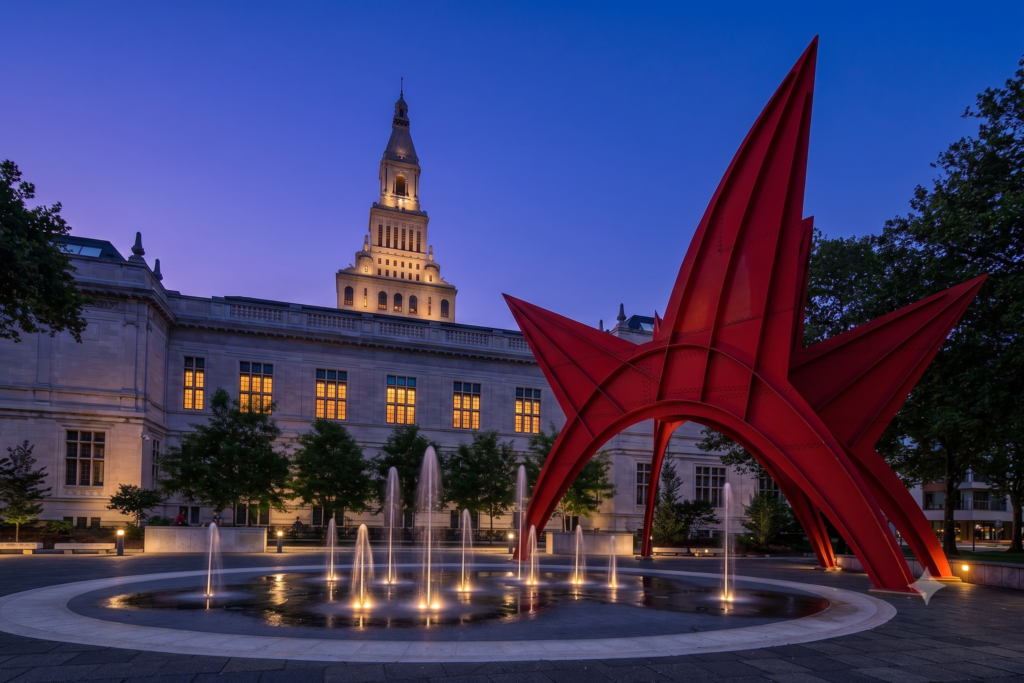
The Citadel of the Avant-Garde
The Definitive Chronicle of the Wadsworth Atheneum Museum of Art: History, Hauntings, High Society, and Subversive Genius
I. Introduction: The Castle on Main Street
HARTFORD, CT — To the casual observer walking down Main Street in Hartford, Connecticut, the building at number 600 looks like an architectural anomaly: a grim, sprawling, grey stone fortress complete with crenellated battlements and heavy gothic towers. It looks as though a piece of medieval Europe was somehow uprooted and dropped into the center of a modern New England insurance capital.
Yet, step past the threshold of this mock-medieval citadel and you enter a space that has spent nearly two centuries operating as one of the most radical, fearless, and boundary-pushing institutions in the history of global art.
This is the Wadsworth Atheneum Museum of Art. Founded in 1842 and opened to the public in 1844, it holds the absolute distinction of being the oldest continually operating public art museum in the United States. It beat the Metropolitan Museum of Art in New York, the Museum of Fine Arts in Boston, and the National Gallery in Washington, D.C., by decades.
But its antiquity is only half the story. The true definitive tale of the Wadsworth is one of conceptual whiplash. It is an institution built by Puritan descendants and industrial barons that somehow became the American epicenter of Surrealism, the birthplace of American ballet, and the home of an artistic legacy that permanently altered how the Western world defines culture.
Beneath its prestigious veneer lies a vast, dense chronicle of eccentric directors who moonlighted as stage magicians, high-society revolts, bullet-riddled collections, and persistent phantom footfalls that echo through the dark long after the public has gone home. This is the definitive story of the Wadsworth Atheneum.
II. The Genesis: Daniel Wadsworth and the Puritans’ Palace
To understand how this fortress came to be, one must look to its namesake: Daniel Wadsworth (1771–1848). Wadsworth was the ultimate product of Hartford’s old-money aristocracy. He was a descendant of Thomas Hooker, the Puritan reverend who founded the Connecticut Colony in 1636. His father, Jeremiah Wadsworth, had been a wealthy commissary general for George Washington’s Continental Army and a close personal friend of Alexander Hamilton. Daniel was raised in an environment of absolute civic duty, extreme wealth, and deep religious devotion.

In 1794, Daniel married Faith Trumbull, the niece of the legendary Revolutionary War painter John Trumbull. This marriage permanently tied Wadsworth to the emerging world of American fine art. Wadsworth was not merely a passive collector; he was an active patron with an eye for raw talent. He famously discovered a young, struggling painter named Thomas Cole and bought his early landscapes, effectively financing the birth of the Hudson River School—America’s first home-grown artistic movement.
By the early 1840s, Wadsworth decided that his private collection and his family’s prime real estate in downtown Hartford should be dedicated to the public good. He tore down his family’s ancestral home on Main Street and announced plans to erect a grand cultural center. He hired the preeminent architectural duo of the era, Ithiel Town and Alexander Jackson Davis, pioneers of the Gothic Revival style. They designed a granite “castle” meant to inspire awe, intellectual contemplation, and a sense of permanent historic gravity.
When it opened on July 31, 1844, it was dubbed an “Atheneum”—named after Athena, the Greek goddess of wisdom. It was not initially just an art gallery; it was a collaborative cultural ark. The original building housed:
-
The fine arts gallery (consisting initially of just 78 paintings and a handful of sculptures).
-
The Young Men’s Institute (which would later evolve into the Hartford Public Library).
-
The Connecticut Historical Society.
Wadsworth’s vision was clear: to civilize the rugged, industrializing landscape of New England by placing a temple of high culture directly in its heart.
III. Guns, Gold, and Tycoons: The Gilded Age Expansions
As Hartford exploded into an industrial and financial behemoth during the late nineteenth century, the Wadsworth Atheneum became the beneficiary of unimaginable Gilded Age fortunes. Two massive, historic bequests permanently elevated the institution from a regional gallery to a world-class powerhouse.
The Colt Bequest: Art Born of Gunpowder
The first major influx came from Elizabeth Hart Jarvis Colt, the widow of Samuel Colt, the legendary industrialist and inventor of the Colt revolver. When Elizabeth passed away in 1905, she left the museum a staggering collection that reflected both high art and military history.
The Colt collection brought hundreds of nineteenth-century European and American paintings to the museum. But more uniquely, it included Samuel Colt’s personal, unparalleled collection of firearms, prototype pistols, edged weapons, and suits of armor gathered from his travels across the globe. This created a bizarre, fascinating dichotomy within the museum: visitors could marvel at delicate American Romantic landscapes in one gallery, then step through a doorway to see the very machinery that won the American West and fueled the Civil War.
The Morgan Memorial: A Titan’s Gift
The second, and perhaps most impactful, benefactor was none other than J. Pierpont Morgan, the most powerful financier in human history. Morgan was a Hartford native, born in the city in 1837, and his father, Junius Spencer Morgan, had been an early trustee of the Atheneum.
Though J.P. Morgan spent most of his adult life operating out of New York and London, he never forgot his hometown. Following his father’s death, Morgan funded the construction of the magnificent Morgan Memorial wing, a sprawling, Renaissance Revival structure clad in pink Tennessee marble, designed by Benjamin Wistar Morris and completed between 1910 and 1915.
Upon the tycoon’s death, his son, J.P. Morgan Jr., fulfilled his father’s wishes by transferring a vast sea of treasures to Hartford: ancient Egyptian, Greek, and Roman bronzes; rare Renaissance decorative arts; and an unmatched collection of 18th-century French and German porcelain. The Wadsworth was no longer just an American gallery; it was an international repository of human civilization.
IV. The Spooky: The Haunting of the Atheneum
With nearly two centuries of history, thousands of deeply personal historical artifacts, and architectural wings built as mausoleums to dead tycoons, the Wadsworth Atheneum has long harbored a reputation for supernatural activity. Far from just modern campfire stories, the hauntings of the Wadsworth are backed by historical documentation, including sensational newspaper exposes dating back more than a century.
The Haunting Timeline
1891: Staff report spectral encounters and rustling papers.
1911: Major newspaper expose features sworn testimony from current/former guards.
1920s-Present: Security motion sensors trigger in locked, empty galleries.
The Newspaper Expose of 1911 and the Reverend’s Spirit
On July 10, 1911, several major Connecticut newspapers published an astonishing report detailing a collective, multi-decade haunting inside the old Gothic castle building. A group of current and former museum employees, described by reporters as “scholarly, level-headed, and rational folks,” gathered to officially share their unexplainable experiences.
The primary witness was Frank M. Johnston, who had served as a long-time assistant at the museum, alongside Alfred Clifford, the superintendent of the building at the time. Johnston testified that the strange occurrences had been escalating since at least 1891.
The most common phenomenon took place in the museum’s historic reading and newspaper room. Johnston recounted multiple instances where patrons would be sitting in absolute silence, only to hear the violent, distinct sound of a newspaper being rustled, folded, and aggressively flipped directly behind their heads. When the terrified readers spun around, the space behind them was completely empty. Johnston noted that the activity was so severe that on one occasion, a prominent local man and his young son were so startled by the invisible entity that they fled the reading room in a panic, sprinting out of the castle doors and down Main Street without stopping until they reached the city post office.
The employees collectively attributed the haunting to the spirit of Reverend Thomas Robbins (1777–1856), the eccentric first librarian of the Connecticut Historical Society, which was housed in the Atheneum. Robbins was a man obsessed with his books and papers, and he spent the final decades of his life pacing the halls of the Atheneum.
The museum held a large, striking oil portrait of Reverend Robbins, depicting a white-haired, saintly old man sitting at a desk covered in stacks of writing paper. Employees noted that the disembodied footsteps, slamming doors, and rustling papers always seemed to emanate from the vicinity of this painting.
According to museum lore, during a massive renovation in 1892, a superstitious laborer was warned to be careful when moving the portrait because it belonged to the “building’s ghost.” The worker scoffed, smiled, and deliberately dropped the painting. The canvas tore out of its frame and curled up violently on the floor. Though the painting was eventually salvaged and reframed, staff claimed that the specific, aggressive haunting of Reverend Robbins quieted significantly after his portrait was desecrated.
The Avery Phantom and the Eyes of Morgan
Despite the subduing of Reverend Robbins, the supernatural lore of the Wadsworth shifted to the newer wings as the decades rolled on. Night shift security guards patrolling the International Style galleries of the Avery Memorial wing have frequently reported the “Phantom Guard.” This spectral figure, dressed in an antiquated, mid-twentieth-century museum uniform, is seen walking down corridors ahead of modern guards. When followed into dead-end galleries, the figure vanishes completely.
Furthermore, late-night maintenance workers have long whispered about the bronze bust of J.P. Morgan located in the Morgan Memorial wing. Multiple generations of staffers have claimed that the heavy, deep-set metallic eyes of the financier seem to shiftingly track human movement through the room, as if the hyper-controlling tycoon is still keeping tabs on his investments from the ethereal plane. Motion sensors in the locked, pitch-black galleries continue to trip inexplicably at 3:00 AM, forcing guards to hunt for intruders through rooms occupied only by centuries-old canvas and marble.
V. The “Chick” Austin Era: Hartford’s Surrealist Revolution
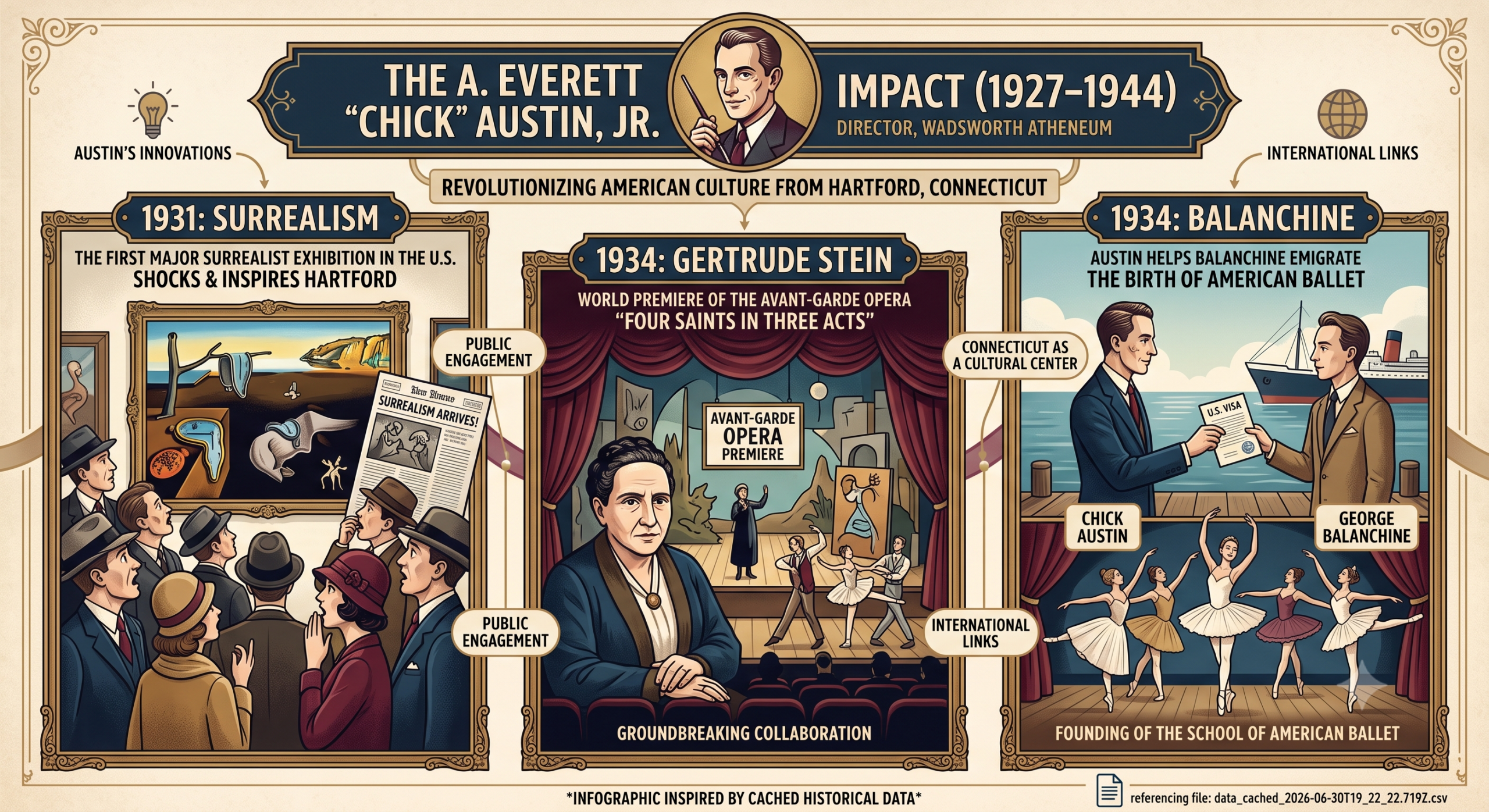
If Daniel Wadsworth gave the museum its body, a single extraordinary man gave it its wild, avant-garde soul. In 1927, the board of trustees made a decision that would inadvertently scandalize and completely revolutionize the city of Hartford: they appointed a 26-year-old Harvard graduate named Arthur Everett “Chick” Austin Jr. as the director of the museum.
Chick Austin was a force of nature. He was an aristocrat, an intellectual, a brilliant art historian, an actor, a set designer, and—most bizarrely—a highly accomplished stage magician who performed under the stage name “Professor Marvel.” Austin looked at the quiet, conservative insurance capital of Hartford and decided to transform it into the undisputed center of the international cultural avant-garde.
Armed with a newly established million-dollar acquisition fund left by banker Frank Sumner in 1927, Austin went on a shopping spree in Europe, purchasing masterworks that older, larger museums were too timid to touch.
1931: The Surrealist Shockwave
In the summer of 1931, Austin executed a massive coup. He organized and launched Newer Super-Realism, which stands in history as the very first major exhibition of Surrealist art in the United States.
Long before New York’s Museum of Modern Art embraced the movement, Austin filled the Wadsworth’s galleries with the mind-bending, Freudian dreamscapes of Salvador Dalí, Joan Miró, Max Ernst, and Giorgio de Chirico.
The local Hartford elite, who expected to see pastoral landscapes of cows and trees, walked into galleries containing melting clocks, levitating eyeballs, and distorted human anatomy. The exhibition caused an absolute media sensation. Traditionalists were outraged, critics were bewildered, and local newspapers alternately treated the show as a psychological threat or a hilarious, high-society practical joke played by their eccentric young director. Austin smiled, donned his top hat, and bought several pieces for the permanent collection—making the Wadsworth the first museum in the world to purchase a painting by Salvador Dalí.
1934: Picasso’s American Debut
Austin wasn’t done. In 1934, he cemented the Wadsworth’s position in modernist history by staging the first major comprehensive retrospective of Pablo Picasso’s work in the United States. The exhibition drew cultural icons from across the globe to Connecticut, firmly establishing Hartford as a mandatory stop for the international intelligentsia.
The Live Tiger and the “Pasteboard Palace”
Austin’s personal life was just as theatrical as his curatorial style. To raise funds and generate buzz for his modern exhibitions, he threw legendary, decadent costume balls. At one legendary gala, Austin managed to lease a live, full-grown tiger, housing it temporarily in the museum’s courtyard to shock guests as they sipped cocktails.
His home life was equally radical. In 1930, on Scarborough Street in Hartford’s West End, he constructed the Austin House. The exterior was a flat, spectacular illusion: an 86-foot-wide but mere 18-foot-deep facade modeled precisely after a 16th-century Palladian villa near Venice. Local residents, amused and bewildered by its bizarre dimensions, dubbed it the “pasteboard palace.”
Inside, the house was a total stylistic clash: the first floor featured glittering, opulent 18th-century Venetian Rococo silk-covered walls and gilded furniture, while the upper quarters were pure, stark, ultra-modern Bauhaus design. The house became a safe house and salon for the global elite; on any given weekend, one could find Salvador Dalí, Alexander Calder, Le Corbusier, Martha Graham, Aaron Copland, and Cecil Beaton drinking champagne in Austin’s living room.
VI. The Great Premiere: Cellophane, Operas, and the Birth of American Ballet
Chick Austin understood that a modern museum should not be a static tomb for paintings; it should be a living, breathing laboratory for all emerging art forms—film, photography, music, and theater. In 1934, he completed the construction of the Avery Memorial wing, which featured one of the first International Style museum interiors in America and a state-of-the-art theater. He used this theater to change performing arts history twice in a single year.

The Cellophane Opera: Four Saints in Three Acts
In February 1934, Austin opened the Avery Theater by hosting the world premiere of Four Saints in Three Acts, an avant-garde opera featuring a libretto by Gertrude Stein and music by Virgil Thomson. The production was an intentional assault on traditional operatic conventions:
-
The Cast: It featured the first entirely Black cast in American opera history, a radical social move for a segregated era.
-
The Set: The stage design was constructed almost entirely out of glowing, crinkling layers of newly invented industrial cellophane, creating a surreal, shimmering landscape.
-
The Script: Gertrude Stein’s text was a non-linear, hypnotic, and utterly nonsensical stream-of-consciousness piece, filled with lines like “Pigeons on the grass alas. Short longer grass short longer longer shorter yellow grass.”
The Hartford insurance executives and high-society patrons arrived in full formal evening wear. They spent the entire performance in a state of absolute, comedic bewilderment. Some walked out in a huff, while others cheered wildly. The premiere became an instant cultural milestone, widely regarded today as a watershed moment in the history of American theatrical design and performance art.
The Importation of George Balanchine
Perhaps the Wadsworth’s greatest hidden legacy is that the New York City Ballet was effectively born in Hartford, Connecticut. In 1933, Chick Austin met a brilliant, exiled Russian dancer and choreographer in Europe named George Balanchine. Recognizing Balanchine’s genius, Austin personally sponsored his immigration to the United States, providing the financial backing and logistical support needed to bring him across the Atlantic.
Austin’s plan was to establish Balanchine’s permanent dance academy directly inside the Wadsworth Atheneum. While logistical realities eventually shifted the permanent school to New York City, Balanchine honored his pact with Austin by utilizing the Avery Memorial Theatre for the historic first public performances of the Producing Company of the School of American Ballet in December 1934. It was on the Wadsworth stage that Balanchine premiered Serenade, the very first ballet he choreographed on American soil.
VII. Analysis of the Masterworks: The Collection’s Crown Jewels
Today, the Wadsworth Atheneum preserves a staggering collection of approximately 50,000 objects spanning 5,000 years of human history across five contiguous architectural wings. For any serious art lover or historian, the museum contains several undisputed masterpieces that form the core pillars of its global reputation.
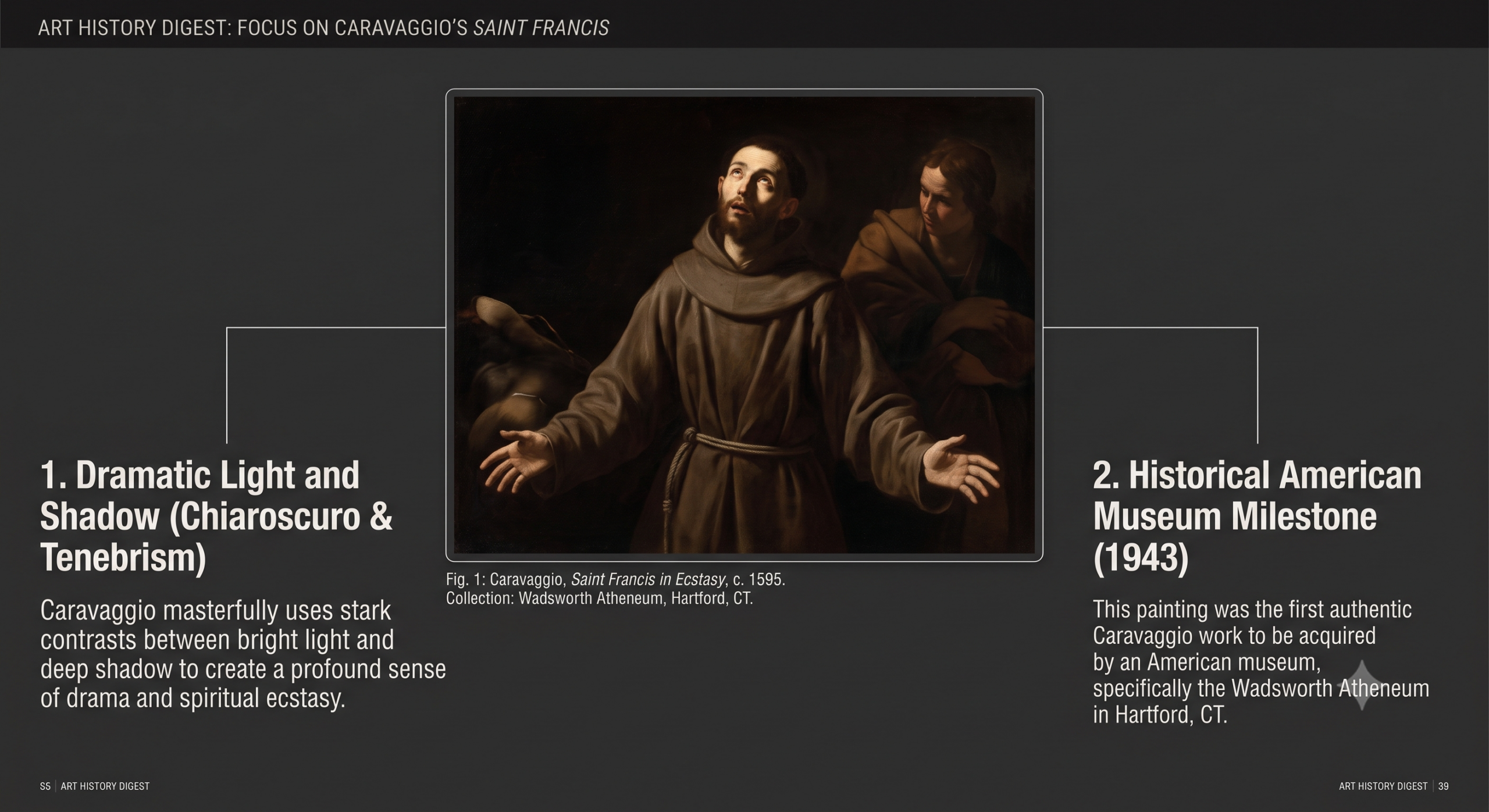
1. Caravaggio’s Saint Francis of Assisi in Ecstasy (c. 1595)
The absolute crown jewel of the European collection is Michelangelo Merisi da Caravaggio’s Saint Francis of Assisi in Ecstasy. Acquired by Chick Austin in 1943, this painting holds an immense institutional distinction: it was the very first authentic Caravaggio ever purchased by an American museum.
The painting captures Saint Francis at the pivotal moment of receiving the stigmata, cradled by a serene, glowing angel. Rather than utilizing a bright, heavenly sky, Caravaggio casts the scene in deep, brooding darkness, illuminated only by a single, dramatic shaft of light—a pioneering example of chiaroscuro and tenebrism that defined the entire Baroque era.
2. The Hudson River School Landscapes
Because Daniel Wadsworth was an intimate friend and patron of Thomas Cole, the Atheneum possesses what is universally regarded as one of the finest, most historically pristine collections of Hudson River School landscapes in existence.
Key pieces include Cole’s sweeping, romantic depictions of the untouched American wilderness and Frederic Edwin Church’s monumental Hooker and Company Journeying through the Wilderness from Plymouth to Hartford, in 1636 (painted in 1846). Church, a Hartford native who studied directly under Cole, captured the foundational mythos of the Connecticut colony with sublime, luminous precision, turning landscape painting into a vehicle for American identity.
3. Orazio Gentileschi’s Judith and Her Maidservant with the Head of Holofernes (c. 1621–1624)
Complementing the Caravaggio is an exceptional array of Southern Baroque masters, highlighted by Orazio Gentileschi’s dramatic rendering of the biblical heroine Judith. The canvas captures Judith and her maidservant in the immediate, tense aftermath of the decapitation of the Assyrian general Holofernes. The composition is filled with cinematic tension, as the two women freeze, looking off-canvas at an unseen sound, their figures rendered in exquisite, saturated jewel tones of gold and deep crimson.
4. Modernism and the Avant-Garde Holdings
True to the legacy of Chick Austin, the museum’s modern galleries host a spectacular lineup of revolutionary works. Visitors can stand before Piet Mondrian’s early geometric abstractions, crucial surrealist canvases by Joan Miró, and seminal works by Joseph Cornell and Balthus—all acquired at a time when the rest of the academic world viewed them with extreme skepticism.
VIII. The Contemporary Era: The MATRIX Program and Cultural Reclamation
The Wadsworth Atheneum has refused to let its history trap it in the past. Following Chick Austin’s departure in 1944, subsequent directors worked diligently to ensure the museum maintained its reputation as a dynamic incubator for living artists.
The MATRIX Program (Established 1975)
In 1975, under the direction of James Elliot, the Wadsworth launched the MATRIX program. MATRIX was a radical concept for its time: a dedicated, fluid, and fast-paced exhibition space specifically designed to showcase solo, experimental exhibitions by contemporary artists.
Rather than waiting years for a massive retrospective, MATRIX allowed the museum to react instantly to shifting cultural movements. Since its inception, MATRIX has hosted more than 180 consecutive exhibitions, giving many legendary contemporary artists—including Sol LeWitt, Andy Warhol, Willem de Kooning, Carrie Mae Weems, and Glenn Ligon—their very first major museum exposures.
The Amistad Center for Art & Culture
In 1985, the Wadsworth entered a vital new phase of civic engagement and cultural preservation by helping to establish The Amistad Center for Art & Culture. Operating as an independent, sister organization permanently housed within the Atheneum complex, The Amistad Center is a dedicated repository holding over 7,000 fine art pieces, historical artifacts, and archival documents that chronicle the African American experience from slavery to the contemporary moment. This partnership ensured that the museum’s mission expanded to tell a more complete, inclusive, and honest story of the American fabric.
IX. Conclusion: The Living Citadel
The story of the Wadsworth Atheneum is a narrative of beautiful contradictions. It is an institution wrapped in the solemn, dark stone of a medieval fortress that has spent its life acting as a neon beacon for the boldest and strangest ideas in human history.
From Daniel Wadsworth’s early puritanical drive to cultivate the minds of New England laborers, through J.P. Morgan’s global treasure-hoarding, to Chick Austin’s cellophane-wrapped, tiger-infused surrealist revolution, the Atheneum has proven that an art museum does not have to be located in New York, Paris, or London to shape the course of global civilization.
It remains a living, breathing monument. Whether you walk its galleries to study the precise, dark brushstrokes of Caravaggio, look for the quiet, phantom footsteps of Reverend Thomas Robbins echoing through the floorboards, or witness the boundary-pushing installations of the newest contemporary icon, the Wadsworth Atheneum stands as an enduring testament to the power of human creativity to surprise, shock, and illuminate the human condition. It is, and always has been, America’s quiet citadel of the avant-garde.
Monographic References and Sources
-
Primary Curatorial & Biographical Records: Chick Austin Modernizes a Connecticut Institution, hosted by Connecticut History (
https://connecticuthistory.org/chick-austin-modernizes-a-connecticut-institution-2/). -
Historical Ghost Lore Records: The Ghost of Wadsworth Athenaeum, documented by New England Legends Podcast (Episode 264), utilizing historical news archives dated July 10, 1911 (
https://ournewenglandlegends.com/podcast-264-the-ghost-of-wadsworth-athenaeum). -
Institutional Masterwork Records: Director Highlights and Exhibition Archives, The Wadsworth Atheneum Museum of Art, 600 Main Street, Hartford, CT (
https://www.thewadsworth.org). -
Architectural Records: Town, Ithiel, and Davis, Alexander Jackson. Gothic Revival Monograph Series: The Castle Design of 1842.
