
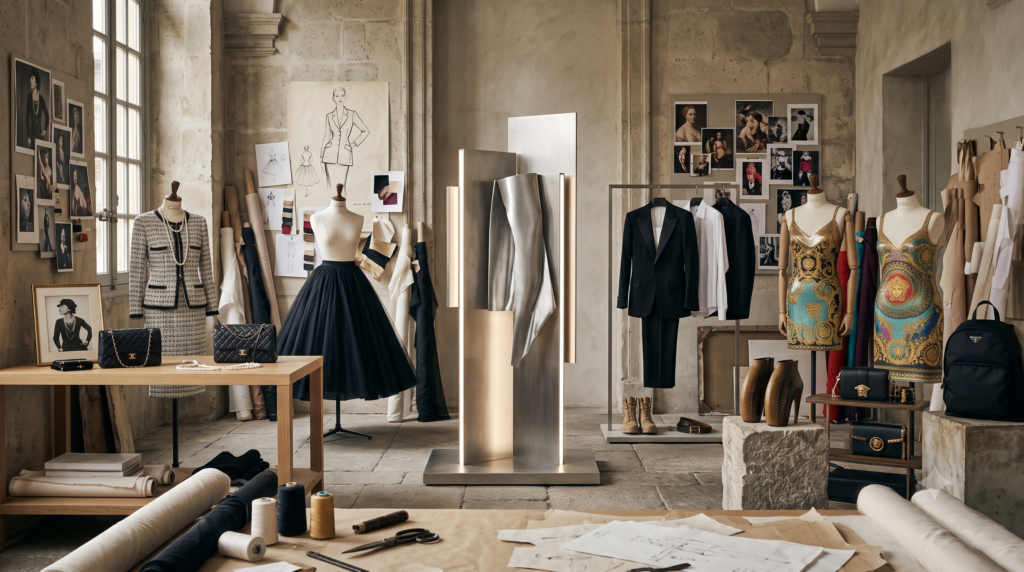
We have always believed that the spaces we inhabit should tell a story, but the most intimate space we ever occupy is the clothes on our back. At Home & Art Magazine, expanding our vision into the world of fashion isn’t a detour—it is a natural evolution. If interior design is the art of curating the rooms around us, fashion is the art of curating the self. It is a three-dimensional sculpture in constant motion, a tactile dialogue between fabric and human form that serves as our ultimate personal architecture.
Before we explore the contemporary creators pushing boundaries in modern design districts and sun-drenched ateliers, we must first pay homage to the foundation. The eleven master iconoclasts featured below did not just design garments; they created visual manifestos that altered human history, proving that while money can purchase luxury, only true artistry can command immortality. Welcome to the living gallery.
THE MASTERS OF THE MANIFESTO
How Fashion Conquered the Soul
Coco Chanel and the Liberation of Form
Before the twentieth century, women’s fashion was a gilded cage. It was an exercise in physical confinement—corsets that crushed ribcages, layers of heavy petticoats, and opulent, immobilizing fabrics designed to signal that the wearer was entirely decoupled from physical labor. It was beautiful, but it was an exquisite imprisonment.
Then came Gabrielle “Coco” Chanel. She did not approach fashion from a place of academic theory; she approached it from a place of visceral impatience. She looked at the hyper-ornamental, suffocating garments of the Belle Époque and saw an obsolete world. She wanted to move. She wanted to ride horses, step into motorcars, and breathe without fainting.
Her stroke of absolute genius was the weaponization of jersey. At the time, jersey was a fabric reserved strictly for men’s utilitarian underwear. It was cheap, fluid, and completely devoid of prestige. But Chanel recognized its kinetic potential. By draping jersey over the female form, she stripped away the rigid, artificial geometry of the past and replaced it with a liquid line that moved with the body rather than forcing the body to conform to the cloth.
She stole shamelessly from the wardrobes of her aristocratic lovers, borrowing the heavy tweed jackets of English dukes and the clean, seafaring stripes of French sailors. In doing so, she decoupled wealth from overt ornamentation.
In 1926, when American Vogue published a drawing of her simple, calf-length black dress in crêpe de Chine, they famously called it the “Ford of fashion”—a garment so clean, so democratic, and so universally striking that it transitioned across social classes. Prior to this moment, black was the color of mourning, reserved for widows and domestic servants. Chanel turned it into the ultimate expression of elite defiance, creating a blank slate that allowed the woman wearing it to become the focus, rather than the dress itself.
Chanel’s true legacy is the invention of the modern, independent uniform. She took the swagger of menswear, infused it with a razor-sharp French sensibility, and proved that true luxury is completely synonymous with freedom of movement.
Christian Dior and the Theater of Opulence
If Chanel’s mission was to strip away excess, Christian Dior’s mission was to bring the theater back with a vengeance. By the mid-1940s, Europe was a landscape of ash and rationing. War had starved the world of color, fabric, and joy. Fashion had become utilitarian, square-shouldered, and severely restricted by government regulations that limited the exact yardage of fabric allowed in a single garment.
In February 1947, inside a small, intensely perfumed salon on the Avenue Montaigne in Paris, Dior unleashed a collection that felt like a sensory explosion. Carmel Snow, the legendary editor of Harper’s Bazaar, looked at the clothes and exclaimed, “It’s quite a revolution, dear Christian! Your dresses have such a new look!”
The New Look was born. Dior rejected wartime austerity with absolute, unapologetic hedonism. He brought back the corset—reimagined as a soft tulle guêpière—to create a hyper-exaggerated, hourglass silhouette. He sloped the shoulders, cinched the waist until it was microscopic, and let the skirts erupt into massive, blooming shapes that used up to twenty yards of premium fabric.
It was an outrageous, scandalous expenditure of material in a time of scarcity. In some Parisian neighborhoods, women wearing the New Look were attacked in the streets by market vendors furious at the blatant display of waste. But Dior knew exactly what the human spirit was starved for: drama.
The centerpiece of this revolution was the Bar Suit—a cream silk jacket paired with a pleated black wool skirt. It was a masterpiece of internal engineering, padded at the hips to make the waist appear even smaller, creating an undulating rhythm that mimicked the curves of a classical sculpture. Dior’s work was deeply romantic, rooted in his love for his mother’s Belle Époque gardens at Granville. Where Chanel gave women the ability to run, Dior gave them the power to captivate. He restored Paris as the undisputed capital of global style and proved that in times of deep cultural trauma, beauty is a profound necessity.
Yves Saint Laurent and the Subversion of Power
In 1957, following Christian Dior’s sudden death, a painfully shy, twenty-one-year-old prodigy stepped into the spotlight to lead the historic house. His name was Yves Saint Laurent. He would spend the next four decades systematically dismantling the boundary between masculine power and feminine allure.
If Dior built the dream and Chanel built the wardrobe, Saint Laurent built the attitude. He was the first haute couture designer to look out the window of his salon and realize that the real energy of the world was happening on the streets. He watched the youth culture of the 1960s—the students, the beatniks, the political radicals—and realized that fashion could no longer exist in an elitist vacuum.
The single greatest hand Saint Laurent ever played occurred in 1966 with the introduction of Le Smoking. It was a traditional men’s tuxedo tailored specifically for the female body. Today, a woman in a tuxedo is a red-carpet staple; in 1966, it was a social earthquake.
A woman wearing Le Smoking was initially banned from entry at elite restaurants like the Côte Basque in New York, where hotel managers deemed trousers on a woman to be a violation of public decency. The socialite Nan Kempner famously took off her YSL trousers in protest and walked into the restaurant wearing only the velvet tuxedo jacket as a minidress.
Saint Laurent understood that garments possess an inherent political currency. By putting a woman in a perfectly cut tuxedo, he didn’t make her look like a man; he amplified her femininity by contrasting it against the sharp, austere lines of traditional masculine authority. It was predatory, elegant, and dangerous.
He was also the first to democratize high fashion with the launch of YSL Rive Gauche, opening a ready-to-wear boutique on the Left Bank of Paris to bring high-concept design to the masses. His references were vast and nomadic, looking to the paintings of Mondrian, the ballets of Russia, and the utilitarian safari jackets of Africa. He infused his clothing with a raw, literary sexuality that gave women a weaponized elegance, allowing them to enter rooms of power without asking for permission.
Gianni Versace and the Hyper-Glamour of the Street
The late 1980s and early 1990s witnessed a shift from the literary intellect of Paris to the high-octane, sun-drenched hedonism of Milan. The undisputed king of this era was Gianni Versace. Born in Calabria, southern Italy, surrounded by ancient Greek ruins and the bustling dress shop of his mother, Versace possessed a unique visual engine: a collision of classical mythology and raw street energy.
Versace did not believe in minimalism. He looked at the understated, beige intellectualism of his contemporaries and found it entirely boring. His genius lay in his ability to walk the razor’s edge between high culture and vulgarity—and make vulgarity look like the most exciting thing on earth. He took the iconic Medusa head—a mythological symbol of a creature so beautiful and terrifying that looking at her would turn you to stone—and made it the emblem of his house.
In 1982, Versace introduced Oroton, a revolutionary chainmail fabric made from micro-mesh links of brass or aluminum. It was a technical marvel that draped over the female body like liquid gold. It was heavy, metallic armor that moved with the fluid, sensual ease of silk. It became the ultimate uniform of the nineties jet-set, a material manifestation of wealth, power, and high-voltage sexuality.
Before Versace, runway models were anonymous hangers used to showcase clothes, walking with stiff, somber expressions. Versace changed that overnight. For his Fall/Winter 1991 show, he lined up Linda Evangelista, Naomi Campbell, Cindy Crawford, and Christy Turlington shoulder-to-shoulder, sent them down the runway lip-syncing to George Michael’s “Freedom! ’90,” and birthed the modern Supermodel phenomenon.
Versace didn’t just sell clothes; he sold a lifestyle of intoxicating, rock-and-roll excess. He understood that in the modern world, fashion could no longer exist separate from pop culture—it had to sit right at the center of the stadium, bathed in neon light.
The Avant-Garde: Reinvention and Rebellion
The path forged by the mid-century masters set the stage for a new generation of designers who treated the runway not just as a retail catalog, but as a site of profound performance art and conceptual commentary.
Alexander McQueen: The Beautiful Grotesque
No discussion of fashion’s transformative power can exist without Lee Alexander McQueen. The son of a London taxi driver, McQueen learned the trade through rigorous apprenticeship on Savile Row, mastering the cold, precise art of traditional tailoring before systematically blowing it up.
McQueen used fashion to explore his deepest psychological anxieties, historical traumas, and the thin line between humanity and nature. His shows were legendary pieces of performance art. In his Spring/Summer 1999 show, model Shalom Harlow stood on a rotating wooden platform while two robotic car-paint sprayers systematically assaulted her pristine white cotton dress with black and yellow paint. It was an agonizingly beautiful comment on the relationship between humanity, technology, and art. McQueen proved that fashion could evoke emotions far more complex than simple desire; he could evoke terror, grief, awe, and heartbreak.
Miuccia Prada: The Intellectual Subversion
While McQueen was exploring the dark, theatrical spaces of the mind, Miuccia Prada was reinventing the terms of modern luxury from her base in Milan. Armed with a PhD in political science, Prada took over her family’s stagnant leather goods company in 1978 and turned it into the ultimate destination for the global intelligentsia.
In 1984, she released the Prada Nylon Backpack. At a time when luxury was strictly defined by exotic crocodile skins and heavy gold hardware, making a premium bag out of industrial, waterproof nylon—the same material used for military tents—was an act of brilliant institutional critique.
Prada pioneered the concept of “ugly chic,” deliberately seeking out color combinations that were traditionally discordant—muddy browns, toxic greens, and wallpaper prints from the 1970s—using them to question why we find certain things beautiful and others repulsive. Her clothing is a continuous conversation with the wearer, designed for individuals who want their clothes to signal intellect rather than simple net worth.
Giorgio Armani and the Architecture of Fluidity
While the rest of the world was screaming for attention in the late 1970s and 1980s, Giorgio Armani conquered culture by turning the volume down. He looked at the traditional, heavily padded, rigid suits of the era and saw an unnatural cage.
Armani’s revolution was the invention of unstructured tailoring. He ripped out the heavy shoulder pads, the stiff canvas linings, and the restrictive internal padding of the classic suit, replacing them with fluid fabrics like linen, crepe, and unlined wool. The result was a garment that draped over the body like a second skin, creating a slouchy, effortless elegance that redefined power.
By softening the masculine silhouette and sharpening feminine tailoring, he created a uniform of relaxed authority. When he dressed Richard Gere for American Gigolo in 1980, he didn’t just change menswear—he shifted the global definition of sex appeal from overt bravado to quiet, sophisticated luxury.
Karl Lagerfeld and the Art of the Cultural Injection
Karl Lagerfeld was fashion’s ultimate mercenary, a man with a razor-sharp intellect who understood that a heritage house cannot survive on nostalgia alone. When he took the reins of a stagnant Chanel in 1983, the brand was widely considered a relic of the past, safe only for wealthy, conservative upper-class lunches.
Lagerfeld systematically injected the house with pure adrenaline. He took Coco Chanel’s iconic, polite tweed suit and tore it apart—shortening the hemlines into miniskirts, pairing the jackets with raw denim, wrapping models in heavy gold hip-hop chains, and emblazonment-tagging the interlocking double-C logo onto everything from surfboards to motorcycle helmets.
He pioneered the modern concept of the creative director as a cultural curator. His runway shows at the Grand Palais in Paris were legendary, immersive spectacles: a giant supermarket, a simulated space rocket launch, a literal beach with indoor waves. Lagerfeld proved that preservation is the enemy of art, and that a true master must be willing to vandalize tradition to keep it alive.
Cristóbal Balenciaga and the Sculpture of the Silhouette
If Christian Dior was the master of theater, Cristóbal Balenciaga was the master of absolute purity. Dior himself famously called Balenciaga “the master of us all,” while Coco Chanel admitted he was the only true couturier, capable of cutting, draping, and sewing a garment entirely with his own hands.
Balenciaga approached the human body not with a desire to cinch or distort it, but to manipulate the space around it. Throughout the 1950s, he introduced radical shapes that completely rejected the prevailing hourglass standard: the balloon jacket, the sack dress, the cocoon coat, and the dramatic envelope dress. He removed the waist entirely, allowing fabric to float away from the skin in sweeping, sculptural lines.
His work was architectural, severe, and deeply respected by the fashion elite. He used heavy, stiff fabrics like silk gazar to construct gravity-defying shapes that felt less like clothing and more like fine art. Balenciaga gave women an entirely new, intellectual relationship with their own physical space.
Vivienne Westwood and the Poetry of the Punk Revolution
Vivienne Westwood was the ultimate anti-establishment force. In the mid-1970s, from a tiny shop on London’s King’s Road, she single-handedly manufactured the visual identity of the punk movement. She took the underground rage of a generation and spun it into a defiant, confrontational aesthetic.
Westwood’s genius lay in her ability to marry raw, street-level rebellion with deep historical appreciation. She looked back at traditional British tailoring, royal tartans, and 18th-century corsetry, and completely subverted them. She ripped fabrics, exposed seams, added safety pins, and scrawled political slogans across pristine wool.
She turned the corset—historically a tool of female oppression—into an overt weapon of sexual liberation and power worn on the outside of the clothing. Westwood proved that fashion could be a visceral, loud political critique of class, gender, and the status quo, injecting the industry with a necessary dose of raw, unfiltered chaos.
Hubert de Givenchy and the Definition of Cinematic Cool
Hubert de Givenchy was the great aristocrat of style, a man whose work came to define mid-century elegance. While others sought shock value, Givenchy chased a devastatingly clean, uncomplicated perfection.
His legacy is inextricably bound to his lifelong creative partnership with Audrey Hepburn. Together, they invented the concept of cinematic branding. From the playful, boatneck lines of Sabrina to the iconic, sleek black column dress in the opening scene of Breakfast at Tiffany’s, Givenchy created a visual shorthand for modern, accessible glamour.
His designs stripped away extraneous clutter, favoring graphic lines, immaculate tailoring, and a sense of breezy, effortless poise. Givenchy understood that the ultimate luxury is restraint. He proved that the most unforgettable presence in a room is often the one that refuses to scream for attention.
The Wildcard: Louis Vuitton and the Art of the Journey
To view fashion strictly through the lens of the dressmaker is to miss one of its most powerful historical trajectories: the art of the vessel. While Louis Vuitton did not make the mid-century couture cut as a conventional dressmaker, the house commands an undeniable, permanent seat in the pantheon of global luxury legacy.
Old Louis himself did not begin his journey with textiles, silk thread, or hemlines; he began with wood, brass, and coated canvas. Arriving in Paris in the mid-nineteenth century, Vuitton established himself as the ultimate master artisan of trunkmaking. He engineered flat-topped, waterproof luggage that allowed the international elite to transport their massive, delicate crinoline gowns securely across steamships and locomotives without ruin. His interlocking “LV” monogram—originally drawn by his son Georges to ward off counterfeiters—became the very first universal seal of modern luxury travel long before the house ever stepped onto a Parisian runway.
The transition from artisanal luggage house to avant-garde apparel juggernaut didn’t truly explode until 1997, when the brand appointed American provocateur Marc Jacobs to launch its very first ready-to-wear fashion lines. Jacobs systematically stripped the dust off the heritage canvas, inviting contemporary fine artists like Takashi Murakami and Richard Prince to vandalize and paint over the iconic monogram. By treating the traditional leather canvas as a site for raw pop-art subversion, Vuitton proved that a heritage house could maintain pristine, century-old physical craftsmanship while dominating the cutting-edge of street-level cultural swagger.
The Ultimate Style Index
| Designer | The Core Philosophy | The Signature Manifestation | The Cultural Impact |
| Coco Chanel | True luxury cannot exist without the absolute freedom of physical movement. | The Little Black Dress; The Tweed Suit; No. 5 Perfume. | Liberated women from the physical confinement of the Belle Époque corset. |
| Christian Dior | Fashion is a grand, romantic theater designed to celebrate hyper-feminine opulence. | The Bar Suit; The Voluminous Corolla Skirt. | Revived the post-war European textile industry and restored Paris as the capital of style. |
| Yves Saint Laurent | True elegance requires a sharp, weaponized contrast between masculine power and feminine allure. | Le Smoking Tuxedo; The Safari Jacket; Ready-to-Wear. | Democratized luxury and aligned fashion with the political and social youth movements of the 1960s. |
| Gianni Versace | Luxury should be loud, high-voltage, unadulterated pop-culture hedonism. | The Oroton Metal Mesh Dress; The Baroque Medusa Print. | Fused high fashion with rock-and-roll celebrity and invented the Supermodel era. |
| Alexander McQueen | Clothes are a psychological armor used to explore the line between beauty and terror. | Precision Savile Row Tailoring; The Armadillo Boot. | Transformed the runway into a space for profound, avant-garde performance art. |
| Miuccia Prada | Fashion is a conceptual exercise that challenges traditional standards of beauty and status. | The Black Nylon Backpack; “Ugly Chic” Prints. | Redefined modern luxury as an intellectual statement rather than an overt display of wealth. |
| Giorgio Armani | Power Dressing doesn’t require rigidity; true authority drapes fluidly with the human body. | Deconstructed, Unlined Tailoring; The Neutral Greige Palette. | Stripped heavy interior structures from tailoring, reinventing corporate and Hollywood style. |
| Karl Lagerfeld | Heritage brands must evolve through creative vandalism and cultural adrenaline injections. | Subverted Chanel Tweed; Logomania; Immersive Grand Palais Runways. | Invented the playbook for the modern luxury creative director as an aggressive trend-curator. |
| Cristóbal Balenciaga | Fashion is a three-dimensional sculpture; garments should manipulate space around the body. | The Cocoon Coat; The Sack Dress; Heavy Silk Gazar Silhouettes. | Liberated the mid-century silhouette from the waistline, setting the standard for abstract couture. |
| Vivienne Westwood | Clothing is a direct, confrontational weapon against socio-political establishments. | Safety-Pinned Tartans; External Corsetry; Slogan Tees. | Formulated the entire visual identity of the Punk movement while subverting British tailoring. |
| Hubert de Givenchy | The purest forms of sophistication are built entirely on physical restraint and clean lines. | The Little Black Audrey Hepburn Dress; Clean Graphic Boatnecks. | Pioneered cinematic celebrity branding, transforming wardrobe styling into global iconography. |
