
Temp Image by Gemini
A Comprehensive Monograph on the History, Architecture, Collections, and Cultural Impact of America’s Oldest Collegiate Art Museum
Introduction and Mission
The Yale University Art Gallery (YUAG), situated in New Haven, Connecticut, stands as a foundational monument in the landscape of global cultural institutions. Founded in 1832, it holds the distinction of being the oldest college art museum in the Western Hemisphere. As an architectural cross-section of three distinct centuries and an encyclopedic repository of over 300,000 objects, the Gallery embodies a unique synthesis of academic rigor, architectural audacity, and public stewardship. Its philosophical framework is anchored to a simple yet radical paradigm: that direct engagement with original works of art is indispensable to a comprehensive education, an enriched civil discourse, and a deeper collective understanding of human history.
🎥 Featured Visual Monograph: A Tour of the Gallery
Video Overview: Produced by Connecticut’s Cultural Treasures, this short documentary offers a curated visual walkthrough of the Yale University Art Gallery. The feature highlights the museum’s dual role as a public sanctuary for world-class masterpieces and a dynamic, hands-on educational laboratory for Yale students and international scholars. Key segments include close-up examinations of foundational American Revolutionary art, ancient artifacts, and insight into the structural philosophy behind the museum’s historic space. (Runtime: ~5 minutes)
The core mission of the Yale University Art Gallery is to encourage appreciation and understanding of art and its role in society through direct engagement with original works of art. The Gallery acts as an active ecosystem for learning, research, and collaborative teaching, sparking dialogue among Yale students, faculty, visiting scholars, artists, and the broader global community. Unlike many elite cultural centers that isolate themselves behind commercial barriers, the Gallery maintains a policy of free public admission, ensuring that its immense cultural capital remains accessible to all. It operates under a fiduciary and philosophical obligation to preserve, interpret, and expand its collections in trust for future generations, while simultaneously serving as a dynamic platform for contemporary artistic expression and critical investigation.
“The museum shows ourselves to ourselves; it puts up a mirror. Slowing down to watch and wonder provides us with what we are really searching for—these aren’t just mute documents of history, but living, vital creations meant to be shared with the world.” — Educational Philosophy, Connecticut’s Cultural Treasures Video Monograph
Architectural Evolution: Three Centuries of Design
The Yale University Art Gallery is not merely a container for art; it is itself an architectural masterwork composed of three integrated buildings that represent distinct shifts in American architectural philosophy over nearly a century. To walk through the physical space of the gallery is to read the history of modern architecture from the high Victorian era to the mid-twentieth-century avant-garde.
Street Hall (1866)
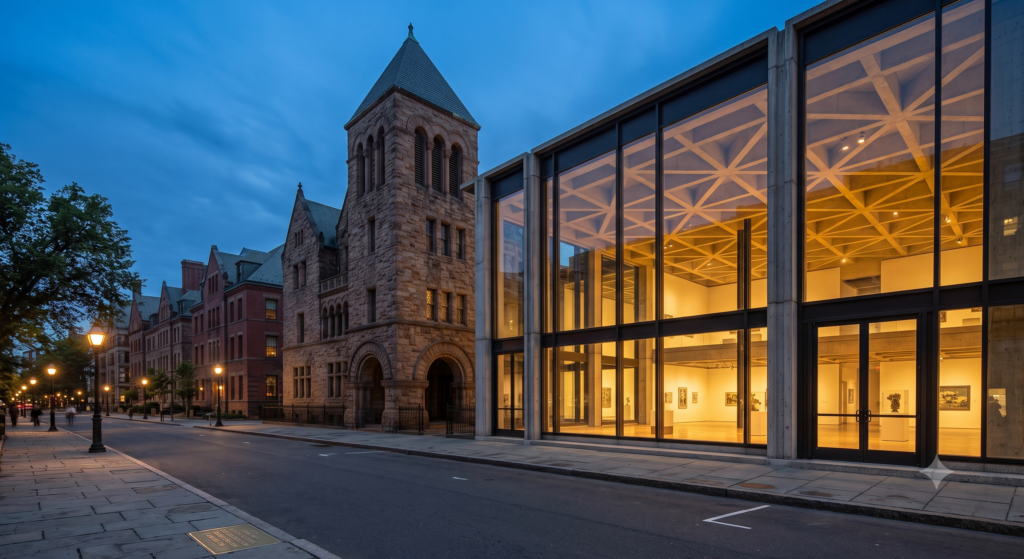
The oldest component of the current museum complex is Street Hall, designed by the American architect Peter Bonnett Wight and completed in 1866. Originally built to house the Yale School of the Fine Arts, Street Hall is a spectacular manifestation of the Gothic Revival style, heavily influenced by the architectural theories of John Ruskin. Ruskin advocated for honest craftsmanship, the expression of natural materials, and an architectural vocabulary rooted in medieval European forms.
Street Hall reflects this ethos with its polychromatic stonework, pointed arches, and deep-set lancet windows. For decades, it provided a sacred, contemplative space where students worked from plaster casts and studied early European masterworks, establishing a permanent architectural link between American higher education and the traditions of European art.
The Old Yale Art Gallery Building (1928)
By the early twentieth century, the gallery’s rapidly expanding collections demanded a larger, more specialized structure. The university commissioned Egerton Swartwout to design a new building, completed in 1928, now known simply as the Old Yale Art Gallery building. Swartwout executed the design in a magnificent Florentine Neo-Gothic revival style, featuring heavy ashlar masonry, graceful rusticated stone arches, and soaring, light-filled galleries designed to frame ancient and medieval sculptures.
A striking architectural bridge spans High Street, physically and symbolically linking the old spaces with the expanding footprint of the gallery. This building created a grand, institutional atmosphere, evoking the civic pride of Renaissance Italy while providing state-of-the-art climate control and lighting for its era.
The Louis Kahn Building (1953)
The architectural crown jewel of the complex is the modern wing designed by Louis Kahn, completed in 1953. This structure was Kahn’s first major institutional commission and is universally recognized as a watershed moment in the history of Modernist architecture. Kahn, who would go on to become one of the twentieth century’s most revered master builders, designed the gallery as a radical departure from the ornamental historicism of Street Hall and the 1928 building. Constructed of brick, concrete, glass, and steel, the building features an austere, windowless brick facade along its main street view, contrasting with a massive, continuous glass curtain wall facing the inner courtyard.
Internally, Kahn introduced structural innovations that transformed museum design. The most famous of these is the raw concrete tetrahedral ceiling grid. This three-dimensional space frame serves a dual purpose: it provides immense structural strength, eliminating the need for internal load-bearing walls, and acts as an integrated plenum housing the building’s electrical, lighting, and HVAC systems. By leaving the concrete exposed, Kahn celebrated the inherent beauty of industrial materials.
The open floor plans permitted by this structural system allow for infinitely adaptable gallery layouts, giving curators the freedom to reconfigure the space for every new exhibition. Kahn’s manipulation of light, mass, and space created a temple of modernism that honors the art it houses by presenting it in an environment of absolute structural clarity.
The Master Restoration and Spatial Integration
For decades, these three buildings operated as separate, often fractured entities, with internal barriers and incompatible modern alterations marring Kahn’s original vision and isolating the historic wings. In the early 2000s, Yale University embarked on a monumental, decade-long, multi-million-dollar restoration project led by Ennead Architects (formerly Polshek Partnership).
Completed in December 2012, this transformative project meticulously restored Louis Kahn’s masterpiece to its original mid-century luster, including the preservation of its innovative window-wall systems and exposed concrete. Concurrently, the firm retrofitted and unified Street Hall and the Old Yale Art Gallery building. The result was a seamless, continuous 69,900-square-foot exhibition space that allows visitors to journey effortlessly across three centuries of architectural history while exploring an interconnected narrative of global art.
Analysis of the Core Collections
The Yale University Art Gallery possesses an encyclopedic collection that rivals major metropolitan museums. Its holdings span from antiquity to the contemporary moment, offering an exhaustive overview of human creative expression across cultures and geographic boundaries.
| Curatorial Department | Approximate Volume | Primary Strengths & Historical Highlights |
| American Paintings & Decorative Arts |
45,000+ objects |
John Trumbull collection, Hudson River School, colonial silver, furniture. |
| Ancient Art |
13,000+ objects |
Dura-Europos excavations, Roman sarcophagi, Egyptian coffin panels. |
| European Art |
10,000+ objects |
Early Italian Renaissance, French Impressionism, Post-Impressionism. |
| Modern & Contemporary Art |
15,000+ objects |
Société Anonyme collection, Abstract Expressionism, Minimalist sculpture. |
| African, Asian, & Indo-Pacific Art |
25,000+ objects |
Yoruba sculpture, Chinese calligraphy, Japanese prints, ritual textiles. |
American Paintings and Decorative Arts
The bedrock of the gallery’s collection is its American art holding, which is widely regarded as one of the finest in the world. The collection was effectively initiated in 1832 when the patriot-artist John Trumbull sold twenty-eight paintings and sixty miniature portraits to Yale University. Trumbull, an aide-de-camp to George Washington, captured the seminal moments of the American Revolutionary War with unparalleled immediacy.
His iconic works, including The Declaration of Independence, The Death of General Warren at the Battle of Bunker’s Hill, and The Surrender of Lord Cornwallis at Yorktown, reside permanently in the gallery. These paintings are not merely artistic achievements; they are the primary visual documents of the founding of the United States. Trumbull’s deep connection to the institution is literal as well as artistic: he and his wife are buried in a crypt beneath the gallery floor, cementing his eternal presence alongside his masterworks.
Beyond Trumbull, the American collection traces the evolution of the nation’s identity through the nineteenth and twentieth centuries. It features spectacular landscape paintings from the Hudson River School, including works by Thomas Cole, Frederic Edwin Church, and Albert Bierstadt, which captured the sublime grandeur of the expanding American wilderness. The decorative arts collection is equally comprehensive, featuring an unmatched array of colonial silver, early American furniture, and craftsmanship that charts the socio-economic development of the early colonies and the emerging republic.
Ancient Art and the Excavations at Dura-Europos
The Ancient Art department preserves more than 13,000 objects from the Near East, Egypt, Greece, Etruria, and Rome. The collection is particularly renowned for its exceptional funerary and religious monuments. Visitors can examine Roman marble grave stelae, highly decorated sarcophagi, and beautifully preserved ancient Egyptian coffin panels designed to guide souls into the afterlife. These pieces are displayed within the atmospheric, Gothic-inspired galleries of the 1928 building, where natural light from historic windows accentuates the textures of ancient marble and limestone.
The crown jewel of the Ancient Art department is the material excavated from the ancient site of Dura-Europos, a cosmopolitan frontier city located in modern-day Syria. In the 1920s and 1930s, Yale University co-sponsored archaeological excavations at the site, uncovering an extraordinarily diverse multicultural society where pagan temples, a Jewish synagogue, and one of the world’s earliest Christian house-churches coexisted within the same city walls. The gallery houses the unique wall paintings recovered from the Dura-Europos Synagogue and the Christian baptistery, offering scholars and visitors an unparalleled glimpse into religious life, iconography, and cultural syncretism in the late Roman Empire.
European Art: From the Renaissance to Impressionism
The European collection provides an extensive survey of Western art from the late medieval period to the early twentieth century. The gallery is internationally famous for its holdings of early Italian Renaissance paintings, largely acquired through the Jarves Collection in 1871. This collection features pioneering masterworks by artists such as Giotto, Duccio, and Gentile da Fabriano, illustrating the profound shift from flat, symbolic medieval iconography to the humanistic, spatial realism of the Renaissance.
Moving forward through history, the collection boasts an exceptional selection of French Impressionist and Post-Impressionist masterpieces. Prominent among these is Vincent van Gogh’s The Night Café (1888), a painting of raw emotional intensity that Van Gogh described as one of the ugliest he had ever executed, using clashing greens and blood-reds to express the “terrible passions of humanity”. This masterpiece is complemented by seminal works from Claude Monet, Edgar Degas, Édouard Manet, and Paul Cézanne, giving students and the public direct access to the revolutionary movements that dismantled traditional academic painting in Europe.
Modern and Contemporary Art: The Société Anonyme
The Gallery’s Modern and Contemporary collection is an elite repository of twentieth-century avant-garde art. Much of its radical character can be traced to the historic donation of the Société Anonyme collection in 1941. Founded in 1920 by artists Katherine Dreier, Marcel Duchamp, and Man Ray, the Société Anonyme was America’s first museum of modern art, dedicated to promoting the most experimental trends in contemporary culture before they were accepted by mainstream institutions.
Through this donation, the gallery acquired invaluable works by Piet Mondrian, Wassily Kandinsky, Joan Miró, and Kazimir Malevich. The collection has continued to grow dynamically, incorporating monumental examples of Abstract Expressionism, including Jackson Pollock’s early experiments and classic drip paintings, alongside works by Willem de Kooning, Mark Rothko, and Helen Frankenthaler. Minimalist and Conceptual art are heavily represented by sculptures and installations from Donald Judd, Sol LeWitt, and Richard Serra. This ensures that the gallery remains on the cutting edge of contemporary artistic discourse, constantly challenging visitors to redefine their understanding of visual form.
The Gallery as an Educational Laboratory
At its core, the Yale University Art Gallery functions as a radical educational laboratory. The gallery operates under the conviction that object-based learning—the direct, unmediated analysis of a physical work of art—develops critical thinking, visual literacy, and empathetic understanding in ways that text-based learning cannot match.
The physical layout of the museum reflects this pedagogical priority. The building houses specialized study storage facilities, print rooms, and dedicated object-study classrooms where students and faculty from any academic discipline can request specific artworks to be brought out of storage for close examination.
On any given day, an undergraduate seminar from the history department might be analyzing colonial furniture to understand Atlantic trade routes; medical students might be standing before a Renaissance portrait, practicing diagnostic observation by studying the subtle physiological details of the subject’s face; and physics students might be analyzing the structural properties of Louis Kahn’s tetrahedral ceiling or using spectroscopy to study the pigment composition of an ancient artifact. This deep integration into the university’s multidisciplinary curriculum transforms the gallery from a passive storehouse of luxury objects into an intellectual engine fueled by collaborative research and critical inquiry.
Public Stewardship, Community Engagement, and the Conservation Lab
While the YUAG is rooted in the academic landscape of Yale University, it maintains an equally profound commitment to public stewardship and community engagement. By keeping its doors entirely free to the public, the gallery dismantles the socio-economic barriers that frequently isolate elite university campuses from their host cities. The gallery serves as an open civic forum for the city of New Haven and the state of Connecticut, hosting public lectures, film screenings, musical performances, and specialized educational programs for local K-12 public school students.
Integral to its stewardship is the preservation of its vast holdings, a responsibility managed by the gallery’s world-class conservation departments, housed in a state-of-the-art facility at Yale’s West Campus. Teams of specialized conservators utilize advanced scientific technology—such as X-ray fluorescence, infrared reflectography, and digital microscopy—to analyze, clean, and stabilize delicate artworks.
This work operates at the intersection of chemistry, art history, and fine craftsmanship. Conservators uncover lost underdrawings, reverse centuries of damaging restorations, and safeguard fragile materials from degradation, ensuring that these objects survive to educate and inspire future generations.
Conclusion
The Yale University Art Gallery represents a triumphant marriage of historic preservation, architectural genius, and encyclopedic curatorial vision. Across its three interconnected buildings, the museum chronicles the artistic achievements of global civilizations while serving as a vanguard for modern and contemporary art. Through its commitment to free public access, object-based pedagogy, and scientific conservation, the gallery honors its rich legacy while continuously redefining the role of a university museum in the twenty-first century. It stands as an enduring monument to the power of original art to spark human curiosity, foster intellectual discovery, and illuminate the complexities of the human condition.
Monographic References and Sources
-
Primary Visual Monograph: Yale University Art Gallery, produced by Connecticut’s Cultural Treasures
(http://ctculturaltreasures.org). -
Architectural and Curatorial Records: Yale University Art Gallery Institutional Archives and Curatorial Area Records (Ancient, American, European, and Modern Art Departments), 1111 Chapel Street, New Haven, CT.
-
Architectural Monograph: Kahn, Louis I., and Loud, Patricia Cummings. The Art Museums of Louis I. Kahn. Duke University Press, 1989.
