Fairfield | Litchfield | Hartford | Middlesex | New Haven | New London | Tolland | Windham
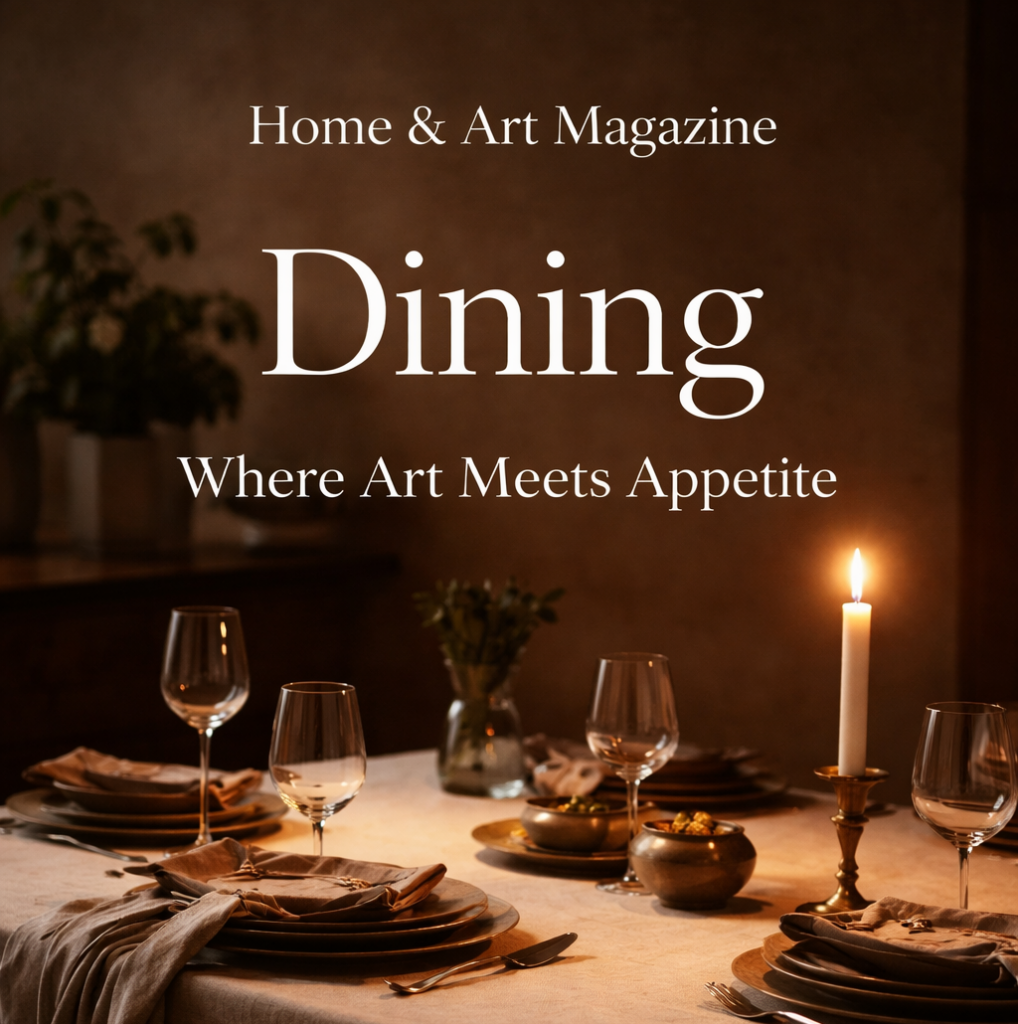
Dining is never just about food. Whether at home or in a restaurant, every meal is shaped by space, objects, light, and intention. The table becomes a place where design and experience meet—where what we see, feel, and share matters just as much as what we taste.
At Home & Art Magazine, dining is viewed as a living composition. From the quiet intimacy of a home table to the immersive atmosphere of a restaurant, each setting reflects choices in layout, materials, and mood. Plates, glassware, lighting, and surroundings all work together to create a complete experience.
This is where home and restaurant converge.
Dining at home is personal—an expression of routine, memory, and identity. Dining out is immersive—a designed experience shaped by chefs, spaces, and service. Yet both rely on the same principles: composition, atmosphere, and connection.
This page brings those ideas together. If you are looking for quick recipes, this isn’t the place. However, if you are interested in environmental psychology and how the design of a room changes the way we connect over food, this site offers a sophisticated, deeply reflective perspective. It’s perfect for designers, architects, or anyone who views hosting as a form of art.
Start Here
The experience of dining begins before the first bite—when the table is set, the light is right, and the moment is waiting.
1. The Table Before the Meal
There is a moment before every meal that is rarely acknowledged, but always felt.
It exists in the quiet pause between preparation and participation—when the table is set, the light has settled, and nothing has yet been touched. A glass holds a reflection. A plate marks a place. The air is still, carrying the faint anticipation of what is about to begin.
This moment does not belong exclusively to the home or to the restaurant. It occurs in both, though it is shaped differently in each. At home, it may arrive almost unnoticed: a plate set down, a chair pulled out, the soft adjustment of light as evening replaces day. In a restaurant, it is more deliberate—the table prepared in advance, aligned within a larger system of design, waiting to receive its next occupants.
In either case, the experience of dining begins here. Not with taste, but with arrangement. Not with consumption, but with intention.
The Unseen Beginning
We tend to think of dining as something that starts when food arrives. The first bite, the first sip, the first exchange of conversation—these are the markers we recognize. But by the time those moments occur, much has already been decided.
The position of the table in the room. The distance between one seat and another. The objects placed within reach, and those left out entirely.
These decisions—whether conscious or habitual—form the structure of the experience before it unfolds. At home, this structure is often invisible because it is familiar. The same table, the same chair, the same rhythm repeated day after day. Yet familiarity does not mean absence of design. It simply means the design has settled into routine.
In a restaurant, the structure is more apparent, though still rarely examined. The spacing between tables is intentional. The lighting has been calibrated. The objects have been selected, arranged, and standardized. Even before a guest is seated, the environment has begun to communicate. This is the unseen beginning of dining: a set of conditions that shape everything that follows.
Space Before Food
Before food enters the frame, there is space. It is easy to overlook, because space does not announce itself. It is not held, tasted, or consumed. But it defines the boundaries of the experience. It determines how close we sit to one another, how we move, how sound travels, how light falls across the table.
A meal eaten in a narrow, enclosed room carries a different feeling than one experienced in an open, expansive space. A table placed near a window invites a relationship with the outside world; one placed at the center of a room creates a different kind of focus. These differences are not secondary. They are foundational. Space shapes perception before any other element has the opportunity to do so.
Objects Waiting
Within this space, objects begin to gather.
A plate is placed—not randomly, but in relation to the edge of the table, to the position of the chair, to the anticipated movement of the person who will sit there. A glass is set slightly above and to the side. Cutlery is aligned, or not, depending on the intention of the setting. Individually, these objects are simple. Together, they form a composition.
Even in the most minimal arrangement, relationships exist. Distances are established. Alignments are created. The eye moves across the surface, registering order or variation. Nothing has been eaten, and yet something has already been experienced. The table has begun to speak.
Light and Atmosphere
Light enters next, though in truth it has been present all along.
It reveals what has been arranged. It softens or sharpens edges. It determines whether the experience feels intimate or exposed, calm or active. A single candle alters the perception of a table entirely. Shadows deepen. Surfaces warm. The pace of the moment seems to slow, even if nothing else has changed.
In contrast, bright, even lighting brings clarity. Details emerge. Colors become more distinct. The experience becomes more immediate, more functional. Neither condition is inherently better. Each produces a different kind of attention. What matters is that light is not neutral. It participates in the creation of the moment.
The Presence of Anticipation
What defines this pre-meal moment most clearly is not what is present, but what is about to arrive.
There is an anticipation that exists in the space between readiness and action. The table is complete, but the experience has not yet begun in its most recognizable form. This creates a tension—subtle, but perceptible. It is the same tension found in other forms of design: a stage before a performance, a gallery before viewers enter, a canvas before the first mark is made. Something has been prepared. Something is expected. Dining shares this structure.
Home and Restaurant, Reconsidered
It is common to separate dining into two categories: eating at home and eating out. One is seen as ordinary, the other as elevated. One is associated with routine, the other with occasion.
But this distinction begins to dissolve when we look at the moment before the meal. In both contexts, space is arranged. Objects are placed. Light is considered, whether intentionally or not. The experience is shaped before it is lived. The difference lies not in the presence of design, but in its authorship.
At home, the individual acts as both designer and participant. The arrangement reflects personal habits, preferences, and constraints. In a restaurant, the roles are divided. The environment is created by one set of individuals and experienced by another. Yet the underlying structure remains the same. Dining, in both cases, is constructed.
A Shift in Understanding
To recognize this is to shift how dining is understood.
It is no longer defined solely by food, nor by location. It becomes an intersection of elements:
Space, which provides the setting
Objects, which create the visual and tactile field
Light, which shapes perception
Arrangement, which organizes relationships
Together, these elements form the conditions in which the meal occurs. Food enters into this system, but it does not define it entirely.
The Moment Revisited
Return, then, to the table before the meal.
Nothing has changed in its physical state. The plate remains where it was placed. The glass still holds its reflection. The light continues to fall across the surface. And yet, once seen differently, the moment is no longer neutral.
It is no longer simply a pause before eating. It is the beginning of an experience that has already been shaped by a series of decisions—some deliberate, others inherited, many unnoticed.
To sit at the table is to enter into that constructed moment.
To dine is not merely to consume what is served.
It is to participate in everything that has been arranged before the first bite is taken.
2. The Table as Canvas
Before food is tasted, it is seen. Before it is seen, it is arranged.
The table, often understood as a surface of utility, is in fact something more deliberate: a field of composition. It operates according to the same visual principles that govern painting, photography, and design. Objects placed upon it are not simply functional—they are positioned in relation to one another, forming patterns of balance, contrast, and rhythm. What appears effortless is, in reality, structured.
Composition and Balance
Every table begins with placement.
A plate at the center establishes order. It anchors the composition, creating a focal point from which all other elements radiate. Move it slightly off-center, and the balance shifts. The eye adjusts. The arrangement becomes more dynamic, less formal.
Add a glass above and to the right, and a diagonal line emerges. Introduce cutlery on either side, and symmetry begins to take shape. The table becomes legible, not through instruction, but through visual cues.
Even the simplest arrangement contains these relationships.
Balance does not require symmetry, but it requires awareness. A table can feel stable or unsettled depending on how its elements relate. Too much uniformity may feel rigid; too much variation may feel unresolved. The most effective compositions exist somewhere between these extremes.
Negative Space
What is not placed on the table is as important as what is.
Negative space—the empty areas between objects—allows the composition to breathe. It creates clarity, giving each element room to exist without competition. Without it, the table becomes crowded, and the eye struggles to find focus.
In fine dining, this principle is often applied with precision. Plates are given space. Objects are limited. The absence of excess becomes part of the aesthetic.
At home, negative space may be less intentional, but its effects remain. A cluttered table, even with well-chosen objects, can feel overwhelming. A restrained one, even with fewer elements, can feel composed.
Space is not emptiness. It is structure.
Color and Contrast
Color directs attention.
A white plate against a dark surface draws the eye inward. A neutral tablecloth softens contrast, allowing food to become the primary focus. Introduce color through ceramics, textiles, or glassware, and the hierarchy shifts.
Warm tones create a sense of comfort and continuity. Cool tones introduce distance and clarity. High contrast emphasizes separation; low contrast creates cohesion.
Food itself participates in this system. The color of a dish interacts with the plate on which it is served and the objects surrounding it. A vibrant ingredient may stand out against a muted background, or it may blend into a more unified palette.
These relationships are not incidental. They influence perception before taste is even considered.
Plating as Visual Language
The plate is a canvas within the canvas.
Once food is introduced, composition becomes more intricate. Ingredients are arranged not only for practicality, but for visual coherence. Placement guides the eye. Height introduces dimension. Texture adds variation.
A dish may be centered, reinforcing stability, or offset, creating movement. Elements may be grouped or dispersed. Sauces may be applied with precision or allowed to flow more freely.
These choices form a visual language.
In restaurants, this language is often refined and consistent, reflecting a defined approach. At home, it may be more intuitive, shaped by habit or preference. Yet in both contexts, plating influences how a dish is received.
A carefully arranged plate suggests attention. A loosely assembled one suggests immediacy. Neither is inherently better, but each communicates something different.
Materials and Interaction
The materials that surround the plate contribute to the composition as much as the food itself.
Ceramics provide a base—matte or glossy, smooth or textured. Glass introduces reflection and light. Metal adds precision and line. Textiles soften and absorb.
Each material interacts with light differently, altering how the table is perceived. A glossy surface reflects, creating movement. A matte one absorbs, creating depth.
These interactions are continuous. As light shifts, as objects are moved, as food is added or removed, the composition evolves.
The table is not static. It is responsive.
Order and Variation
A table can be structured or relaxed, but it is never without pattern.
Formal arrangements emphasize order. Objects are aligned, distances are consistent, and symmetry is maintained. This creates clarity and predictability.
Informal arrangements introduce variation. Objects may be placed more freely, adjusted according to need. The composition becomes more fluid, but it still operates within a system of relationships.
The distinction is not between design and absence of design, but between different approaches to it.
Order and variation are not opposites. They are points along a spectrum.
Seeing the Table Differently
To view the table as a canvas is not to impose rigidity, but to recognize what is already present.
Every meal, regardless of setting, exists within a visual structure. Whether carefully designed or unconsciously arranged, the elements of composition are at work.
To notice them is to engage more fully with the experience.
The placement of a plate becomes intentional. The choice of objects becomes expressive. The arrangement of food becomes part of a larger composition.
Dining, in this sense, extends beyond taste. It becomes something that is seen, interpreted, and experienced as a whole.
Completion and Change
Unlike a painting, the table is not meant to remain unchanged.
The moment food is served, the composition begins to shift. Objects are moved. Portions are altered. The structure evolves as the meal progresses.
This impermanence is part of what defines dining.
The table is composed, experienced, and then undone. It exists briefly in its complete form before being transformed through use.
What remains is not the arrangement itself, but the memory of it.
To understand the table as a canvas is to recognize that dining is not only an act of consumption, but an act of composition.
Before the first bite is taken, something has already been created.
And in that creation, the experience has already begun.
3. Dining at Home
Dining at home is often mistaken for the ordinary version of dining—as if the restaurant is where experience happens and the home is where necessity takes over. But the opposite is often closer to the truth. If dining out is performance, dining at home is authorship. It is where the experience is not only received, but created from within.
The home table is one of the most revealing places in daily life. It holds routine, yes, but also memory, personality, mood, and ritual. It reflects not only how people eat, but how they live. The choice to light a candle on a Tuesday night, to use the good plates for no occasion at all, to sit at the table rather than on the sofa—these are not minor habits. They are expressions of value. They tell us what kind of experience a person believes a meal deserves.
At home, dining becomes personal in a way no restaurant can fully replicate. The room may be imperfect. The plates may be mismatched. The lighting may be improvised rather than designed. But precisely because the setting is shaped by real life rather than hospitality strategy, it carries emotional depth. It is not a concept. It is a lived space.
The Domestic Table as Self-Portrait
Every home develops its own dining language.
Some tables are formal even in everyday life, set with intention and consistency. Others are looser, shaped by schedules, children, conversation, work, or changing appetites. Some households gather at the same hour each evening. Others drift into the meal more organically, assembling when they can. In each case, a pattern emerges.
That pattern is more than habit. It is identity in repeated form.
A home table reveals how a household understands comfort, beauty, hospitality, and time. A ceramic bowl used every morning, a stack of linen napkins saved for company, a fruit bowl always left at the center—these details accumulate into a domestic aesthetic that is rarely announced but deeply felt.
In this way, the dining table becomes a kind of self-portrait. Not polished, not staged, but honest. It reflects what is cherished, what is practical, what has lasted, and what has been allowed to remain.
Ritual Versus Routine
One of the most important distinctions in home dining is the difference between routine and ritual.
Routine is repetition without reflection. Ritual is repetition with meaning.
The actions may look nearly identical from the outside. Setting the same place every night. Pouring water before sitting down. Clearing the table in a certain order. But when these gestures are performed with care, they transform the atmosphere of the meal. They separate dining from simple intake. They create a threshold.
This is one of the great overlooked powers of eating at home: the ability to elevate the ordinary without extravagance.
A meal does not need multiple courses or elaborate styling to feel intentional. It needs attention. The folded napkin, the bowl chosen instead of the container, the decision to pause before beginning—these acts reshape the emotional tone of the experience. They signal that the meal matters, even if it is simple.
And often, the simpler the meal, the more visible the ritual becomes.
Memory at the Table
No dining space gathers memory the way a home does.
Restaurants are episodic. They belong to occasions, discoveries, appointments, celebrations. But the home table is recurrent. It receives ordinary evenings, difficult conversations, holidays, quick breakfasts, late-night meals, solitary lunches, and long-awaited reunions. It becomes saturated with lived time.
Because of this, dining at home is never only about the present meal. It is always layered with what has happened before.
A certain soup may recall a parent. A tablecloth may signal a season. A chair may hold a family role long after the role itself has changed. Even the angle of late afternoon light in a dining room can become part of a household’s emotional architecture.
These associations are rarely dramatic, but they are powerful. They help explain why meals at home can feel comforting, disorienting, nostalgic, or grounding even before the first bite. The setting is not blank. It is charged with repetition and memory.
This is one reason home dining deserves to be taken seriously as an aesthetic experience. It is not only designed in the present; it is shaped by accumulation.
The Psychology of Eating at Home
At home, the meal is inseparable from the emotional climate around it.
Unlike a restaurant, where environment is often managed for the guest, the home reflects the realities of whoever lives there. Stress, celebration, fatigue, intimacy, distraction—all may be present at the table. The meal becomes part of this emotional field rather than a temporary escape from it.
And yet this is precisely what gives dining at home its depth.
A meal prepared after a long day can feel restorative not only because of the food, but because of the act of reclaiming order. Laying out a plate, pouring a drink, sitting down with intention—these gestures can reestablish calm. They create a small architecture of care within the broader mess of daily life.
This is especially true when dining alone. Solitary meals are often dismissed as purely functional, but they can be among the most revealing. When no one else is present, the table reflects what one offers oneself. Does the meal receive dignity? Does the setting invite presence? Or is the experience collapsed into convenience?
There is no moral hierarchy here—only meaning. The way one dines alone says something about rest, attention, and self-regard.
Hosting as Creative Expression
When others are invited in, home dining shifts again. The table becomes not only autobiographical, but relational.
Hosting is one of the most direct forms of creative expression available in domestic life. It combines atmosphere, food, pacing, object selection, and social intuition into a single experience. It is design made temporary and human.
The host does not simply provide a meal. The host composes an evening.
This composition may be elaborate or understated. It may rely on flowers and candlelight, or on nothing more than a beautifully set table and a thoughtful sequence of dishes. What matters is not luxury, but coherence. Guests feel when the room, the food, and the mood belong to the same idea.
That is where home dining begins to resemble art most clearly—not because it becomes decorative, but because it becomes expressive. The host shapes a feeling. The meal becomes a medium through which hospitality, personality, and care are communicated.
The Beauty of Imperfection
Unlike restaurant dining, home dining does not depend on polish. In fact, some of its deepest appeal comes from the opposite.
A restaurant aims for consistency. A home reveals character.
The plates may not match. The glasses may be inherited from different periods. The room may carry traces of the day—books, flowers, conversation, unfinished tasks. These imperfections do not necessarily diminish the experience. Often they enrich it. They locate the meal within real life.
This is where domestic beauty differs from hospitality beauty. It is less about control and more about resonance.
A home meal can feel complete not because everything is flawless, but because everything belongs. The objects are connected to history. The room has been lived in. The atmosphere carries specificity.
That specificity is not a weakness. It is the source of intimacy.
Dining In as Authored Space
To dine at home is to participate in an environment shaped by personal decisions, domestic rituals, and accumulated memory. It is to eat inside a space that already knows you.
This is why dining at home should not be positioned as the lesser counterpart to dining out. It is not the casual version of the experience. It is its most intimate form.
At home, every meal is influenced by design, whether consciously or unconsciously:
the placement of the table
the objects chosen for use
the light available or created
the rituals repeated over time
the emotional and cultural history carried into the room
All of these contribute to the experience long before food is tasted.
The home table may be quiet, but it is never empty of meaning.
And when seen fully, dining at home becomes what it has always had the potential to be: not merely routine, but a deeply authored space where identity, memory, and design meet at the table.
4. Dining Out
If dining at home is an authored interior life, dining out is a staged encounter. It is the moment when design, hospitality, and appetite meet in public. A restaurant does not simply serve food; it constructs an environment in which food can be experienced as event, atmosphere, and memory all at once. To enter a restaurant is to enter a finished idea.
The transition may be subtle or dramatic, but it is almost always intentional. The door opens. The light changes. Sound gathers or recedes. Materials shift underfoot. Even before a menu is touched, the guest has begun to absorb the logic of the space. This is one of the defining characteristics of dining out: the experience starts before the meal and extends beyond the plate.
A restaurant is not only a place to eat. It is a story you walk into.
The Designed First Impression
Restaurants are built on sequence.
Unlike home dining, which emerges from familiarity, restaurant dining depends on impression. The guest arrives without the accumulated intimacy of repetition. The space must therefore communicate quickly and clearly. It must tell the diner, almost at once, what kind of experience is about to unfold.
This communication happens through design.
A narrow entrance can heighten anticipation. A quiet vestibule can create separation from the street. An open room can signal ease and sociability, while a dimly lit interior can suggest intimacy or occasion. A host stand, a bar, a corridor, an open kitchen—each of these becomes part of the narrative architecture.
Restaurants understand that mood is rarely created by one element alone. It is built through coordination. The chair, the wall finish, the spacing between tables, the volume of music, the weight of the menu, the warmth of the light: each contributes to the total impression. When these elements align, the diner feels coherence before fully understanding why.
This is the first success of dining out: the ability to immerse the guest in a world that has already been composed.
Service as Choreography
If design provides the set, service provides the movement.
One of the most distinctive features of restaurant dining is that it is animated by people whose role is not simply to deliver food, but to shape the rhythm of the meal. Timing, attention, pacing, and gesture all matter. Good service is not only efficient; it is atmospheric. It determines whether the meal feels rushed, relaxed, theatrical, seamless, or fragmented.
This is why service is best understood as choreography.
Each interaction carries a practical function, but it also carries emotional tone. A menu offered at the right moment feels welcoming. A plate removed too quickly can feel disruptive. A pause between courses can feel elegant or awkward depending on how it is held. The diner may not consciously register each decision, but the body feels them.
Restaurants operate through layers of visible and invisible movement. Servers glide between tables. Runners appear and disappear. Glasses are refilled. Courses are paced in relation to one another. Questions are anticipated. Needs are resolved before they harden into inconvenience. When this happens well, the choreography disappears into ease. The guest experiences flow rather than mechanics.
And yet the mechanics are everything.
Behind the scenes, restaurant service depends on coordination, communication, and timing at extraordinary levels of detail. Front-of-house and back-of-house must move in relationship to one another. The meal is not just prepared; it is staged.
Atmosphere as Narrative
In restaurants, atmosphere is never accidental for long. Even spaces that appear casual or improvised are usually making choices—about how formal they feel, how warm they seem, how much energy they produce, how long they invite guests to remain.
Atmosphere is narrative made spatial.
A softly lit dining room with close tables and textured materials tells one kind of story: intimacy, discretion, softness, occasion. A bright room with open sightlines, harder surfaces, and lively sound tells another: movement, accessibility, urbanity, momentum. Neither is inherently superior. What matters is whether the atmosphere aligns with the experience being offered.
This alignment is what separates a coherent restaurant from one that feels disjointed. If the plating is refined but the room is careless, something fractures. If the service is formal but the space is chaotic, the meal loses clarity. Restaurants succeed when their components speak the same language.
That language may be minimal or extravagant. It may feel domestic, sculptural, rustic, cinematic, industrial, or ceremonial. But it must remain legible.
The diner does not need to name the design strategy in order to feel its effects. Atmosphere works below the level of analysis. It shapes posture, speech, expectation, and emotional openness. It tells the body how to behave before the mind has fully caught up.
The Public Ritual of Being Served
There is also a psychological distinction at the center of dining out: the diner is relieved of authorship.
At home, one prepares, arranges, hosts, cleans, adjusts, and manages. In a restaurant, those responsibilities are transferred. Someone else has selected the lighting. Someone else has composed the plate. Someone else is pacing the evening. This release can be one of the deepest pleasures of dining out.
To be served is not merely to receive food. It is to be placed within a ritual in which attention has been organized on your behalf.
This public ritual has social meaning. It turns a meal into an occasion, even when the occasion is modest. It allows for concentration on company, conversation, and perception. The diner becomes less maker than participant, less architect than inhabitant.
That shift changes the emotional quality of the experience. It can make a meal feel elevated, not because it is extravagant, but because the surrounding labor has been absorbed by others. One enters a structure already in motion.
This is part of why dining out can feel transformative. It offers not only new food, but a new arrangement of self in relation to labor, space, and time.
The Dining Room as Social Stage
Restaurants are not only immersive spaces; they are social ones. They place private acts in public view.
This changes the meaning of the meal. Conversation unfolds among strangers. Celebration becomes visible. Solitude becomes legible. Dress, behavior, timing, and even silence are framed differently when witnessed by others. A restaurant is therefore both intimate and performative. Diners are contained within their own tables, yet also part of a broader scene.
This duality gives dining out much of its charge.
A couple at a corner table, a family gathered around a large round top, a solo diner at the bar, a group in mid-celebration—each occupies a distinct emotional register, yet all are held inside the same environment. The room becomes a collection of overlapping narratives.
Design shapes how these narratives coexist. Distance between tables can create privacy or exposure. Sightlines can encourage watching or retreat. Acoustics can blur one table into another or preserve a sense of separateness. The room itself governs how public the private act of eating becomes.
And because restaurant dining unfolds in shared space, memory often attaches not only to the meal itself, but to the feeling of being within that scene.
The Kitchen as Visible Drama
Modern dining has increasingly dissolved the wall between preparation and presentation. Open kitchens, chef’s counters, and visible service stations have transformed what was once hidden into part of the dining experience itself.
This shift matters because it changes the status of food preparation. Cooking becomes not merely background labor, but visible craft. The guest watches flame, movement, coordination, precision. Plates are assembled, wiped, passed, and sent. Instructions move across the line. The kitchen becomes a kinetic extension of the dining room. Its energy enters the meal. This visibility also intensifies trust and fascination. When diners witness the process, they become more aware of the skill, pace, and discipline required to create what arrives at the table. Preparation becomes part of the story.
At the same time, the open kitchen reinforces a larger truth: dining out is as much about process as product. The experience derives meaning not only from what is consumed, but from how care, labor, and design are made visible or kept just out of sight.
Restaurants and the Memory of Place
If home dining is layered with repetition, restaurant dining is often memorable because of concentration.
A single evening at a restaurant may contain enough atmosphere, novelty, and emotional significance to remain vivid for years. The room, the lighting, the pacing of courses, the sound of the place, the way a particular dish arrived—all of it can collapse into a single enduring impression. This is why restaurants are often remembered as places rather than menus.
A person may forget the exact ingredients of a dish but remember the amber light on the table, the curve of a banquette, the sound of the room after the second course, the architecture of the bar, or the feeling of being there with someone specific. Dining out compresses sensory information into memory with unusual force because it is immersive by design.
Restaurants become markers in personal history. First dates, negotiations, reunions, solitary breakthroughs, anniversaries, farewells—these events are often inseparable from the rooms that contained them. The restaurant enters the memory not as backdrop, but as participant.
This is what the best restaurant design understands: the goal is not simply satisfaction. It is imprint.
Dining Out as Authored Experience
Ultimately, dining out is powerful because it gathers multiple forms of authorship into one coherent event.
The chef shapes flavor and presentation. The designer shapes atmosphere and space. The service team shapes rhythm and tone. The operator shapes sequence, identity, and flow.
The diner enters this authorship and completes it through presence. This is what distinguishes restaurant dining from food service alone. It is not merely transactional. It is experiential. The meal is framed, paced, lit, arranged, and delivered within a world that has been built to hold it. And when that world is coherent—when food, room, objects, and service move in the same direction—the result can feel larger than the sum of its parts.
Not because the restaurant is trying to imitate art, but because it is already functioning as one: a total composition of space, object, labor, and feeling. To dine out, then, is not simply to eat elsewhere. It is to enter a public work of design—one that is brief, sensory, social, and alive.
5. Space & Architecture: How Environment Shapes Experience
Dining does not happen in isolation. It happens in space.
Before a table is set, before objects are arranged, before food arrives, the room already exerts influence. It defines boundaries, directs movement, frames perception, and establishes the conditions in which the meal will unfold. We often focus on what is placed on the table, but the architecture surrounding it is just as decisive.
We do not only eat food. We eat in space.
The Room as Framework
Every dining experience is contained within a spatial framework.
At home, this may be a dedicated dining room, a corner of a kitchen, or a table positioned within a larger living space. In restaurants, it may be a tightly composed room, an open-plan hall, or a sequence of connected areas that guide the diner through different stages of the experience. Regardless of scale, the room defines orientation. It determines where attention is directed, how movement occurs, and how the table relates to its surroundings.
A table placed against a wall creates enclosure and focus. A table centered within a room creates exposure and presence. A table near a window introduces light and a relationship to the outside world. Each placement changes the experience before any object is added. Architecture is not background. It is the first layer of design.
The Shape of the Table, The Shape of Interaction
Within this spatial framework, the table becomes the primary site of interaction—but its form is not neutral.
A round table dissolves hierarchy. Without edges or defined ends, each person shares equal proximity to the center. Conversation tends to circulate more freely. Eye contact is easier. The experience feels inclusive, even when unspoken.
A rectangular table introduces direction. It establishes ends and sides, subtly organizing roles. The person at the head may become a focal point. Distance between participants can create pockets of conversation rather than a single shared exchange.
Long communal tables extend this effect further. They emphasize gathering over individuality, placing multiple parties within a shared field. This can create energy and connection, but also requires negotiation of space and attention. These forms do not dictate behavior entirely, but they shape it. The geometry of the table becomes the geometry of the social experience.
Movement and Flow
Dining is not static. It unfolds through movement—of people, of objects, of attention.
The success of a space often depends on how easily this movement occurs. In well-designed environments, flow is intuitive. Guests move from entrance to table without confusion. Service paths remain clear. Chairs can be adjusted without disruption. The transition between courses feels smooth because the physical environment supports it.
When flow is compromised, the experience becomes fragmented. Movement requires effort. Interruptions become more frequent. Attention shifts away from the meal and toward navigation. In restaurants, this is a matter of precision. Circulation paths are carefully planned. Distances are measured. Every step taken by staff is considered in relation to efficiency and invisibility.
At home, flow is less formal but equally important. The distance between kitchen and table, the accessibility of objects, the availability of space—all influence how easily a meal can be prepared and enjoyed. A well-organized space allows the experience to remain uninterrupted. A poorly organized one introduces friction, even in small ways.
Light as Spatial Definition
Light is one of the most powerful architectural tools in dining, yet it is often treated as secondary.
It does not simply illuminate space—it defines it. Natural light changes the character of a room throughout the day. Morning light may be directional and crisp, creating contrast and clarity. Afternoon light softens, spreading more evenly. Evening light fades, giving way to artificial sources that reshape the environment entirely.
Artificial lighting introduces control. It can be directed, diffused, dimmed, or intensified. It can create focus on the table or allow the room to recede into shadow. These choices affect perception. Low, warm light tends to create intimacy. It reduces visual noise, softens edges, and encourages slower, more reflective engagement. Bright, even light increases clarity and energy, supporting activity and efficiency.
Restaurants often use lighting strategically, balancing visibility with atmosphere. At home, lighting is more variable, but even small adjustments—adding a lamp, dimming a fixture, lighting a candle—can shift the entire experience. Light is not decoration. It is structure.
Sound and Spatial Atmosphere
Sound is another architectural element that shapes dining in subtle but significant ways.
Every room has an acoustic character. Hard surfaces reflect sound, increasing volume and creating echo. Soft materials absorb sound, reducing noise and creating a more contained environment. A quiet room allows for subtlety. Conversation can remain low, and small sounds become perceptible. This can create intimacy, but also a sense of exposure.
A louder room creates energy. Sound blends into a collective background, allowing for greater freedom of expression but reducing clarity. Restaurants often design for a specific acoustic effect. Materials are chosen to balance liveliness with comfort. Too much noise can overwhelm; too little can feel sterile.
At home, acoustics are less intentionally managed, yet they still influence behavior. We adjust how we speak, how we listen, and how we move in response to the sound of a space. The atmosphere of a meal is not only visual. It is auditory.
Open vs. Enclosed Space
The degree of openness in a dining environment significantly affects the experience.
An enclosed dining room creates separation. It establishes a boundary between the meal and the rest of the environment. This can enhance focus, making the meal feel more contained and intentional. Open-plan spaces integrate dining with other activities—cooking, living, movement. This increases connectivity, allowing multiple experiences to occur simultaneously. It can feel dynamic and social, but also less defined.
Outdoor dining extends this openness further. The environment becomes less controlled, influenced by weather, light, and ambient sound. The experience becomes more variable, but also more connected to its surroundings. Each configuration offers different possibilities. An enclosed space may encourage depth and attention. An open space may encourage fluidity and interaction. Neither is inherently better. Each shapes the experience in distinct ways.
Scale and Proportion
The size of a space also influences how dining is perceived.
A small room can feel intimate, drawing attention inward and encouraging closeness. A large room can feel expansive, creating distance and allowing for greater movement. Ceiling height plays a role as well. Low ceilings create a sense of enclosure, while high ceilings introduce openness and vertical space. These proportions affect not only how the room looks, but how it feels.
A compact space may intensify experience, making every detail more immediate. A larger space may diffuse attention, allowing the meal to exist within a broader field. Restaurants often manipulate scale intentionally, creating zones within larger spaces or compressing areas to enhance intimacy. At home, scale is usually fixed, but its effects remain.
Architecture as Experience
When considered together, these elements—layout, table shape, movement, light, sound, openness, scale—form the architectural foundation of dining.
They operate continuously, shaping perception whether or not they are consciously noticed. A well-designed space does not call attention to itself. It allows the experience to unfold without resistance. A poorly designed one interrupts, drawing focus away from the meal. Architecture, in this sense, is not separate from dining. It is embedded within it.
The Invisible Influence
Most diners do not analyze space while they eat. They do not name the geometry of the table or the acoustic properties of the room. And yet, these elements influence them regardless.
They affect how long a meal lasts. How comfortable the body feels. How easily conversation flows. How vividly the experience is remembered.
This is the quiet power of architecture: it shapes experience without demanding recognition.
Dining Within Designed Space
To understand dining fully is to recognize that it is always situated within an environment that has been shaped—by design, by habit, or by circumstance.
The table may be the focal point, but it is never alone. It exists within a room that frames it, a structure that supports it, and a spatial logic that guides how it is used. To dine, then, is not only to engage with food and objects, but to inhabit a space that has already begun to shape the experience. And in that sense, every meal is architectural.
6. Objects & Materials: The Language of the Table
If space provides the structure of dining, objects give it voice.
They are what we touch, what we see up close, what we interact with continuously throughout a meal. Plates, glasses, utensils, textiles—these are often described as tools, but they function as something more. They are carriers of meaning. They shape perception, influence behavior, and quietly communicate the tone of the experience. A meal is never encountered directly. It is always mediated through objects.
The Table as Material Composition
Every dining table is, at its core, a composition of materials.
Ceramic, glass, metal, wood, linen—each introduces a different sensory quality. Some reflect light, others absorb it. Some feel heavy and grounded, others light and delicate. Some emphasize precision, others variation. When these materials are brought together, they form a language.
A table composed of smooth porcelain, polished metal, and clear glass communicates refinement and control. A table built from textured ceramics, natural wood, and soft linen suggests warmth and tactility. A mixture of materials can introduce contrast, creating tension or balance depending on how they are arranged. These signals are not abstract. They shape how the meal is perceived before it is even tasted.
Ceramics: Weight, Texture, Presence
Ceramic objects—plates, bowls, serving dishes—form the foundation of most dining experiences.
They hold the food, but they also frame it. The weight of a plate affects how it is handled. A heavier piece can feel stable, deliberate, grounded. A lighter one may feel more casual, more immediate. Texture adds another layer. A smooth glaze reflects light evenly, creating clarity. A matte or irregular surface diffuses light, introducing depth.
Handmade ceramics carry variation. Slight asymmetries, subtle changes in glaze, small imperfections—these elements suggest process and human involvement. They remind the diner that the object was formed, not simply produced. Uniform ceramics, by contrast, communicate precision. They create consistency across the table, reinforcing order and predictability. Neither approach is inherently better. Each establishes a different tone. What matters is that the plate is not neutral. It participates in the experience of the food it holds.
Glassware: Light, Clarity, Transformation
Glass operates differently from other materials because it is both present and invisible.
Its transparency allows it to recede, yet it interacts powerfully with light. Reflections, highlights, and refractions create movement across the table, even when nothing else changes. The form of a glass influences perception as well. The curve of its bowl, the width of its opening, the thickness of its rim—all shape how a drink is experienced. Aroma, temperature, and texture are subtly affected.
A beverage served in a carefully chosen glass feels intentional. The same liquid, placed in a different vessel, may feel diminished or altered. This is not illusion. It is interaction. Glass transforms the act of drinking into part of the overall composition of the table.
Textiles: Softness, Absorption, Atmosphere
Textiles introduce qualities that hard materials cannot.
They soften edges, absorb sound, and add a tactile dimension that changes how the table feels. A linen napkin, folded or draped, introduces movement and flexibility into an otherwise structured arrangement. A tablecloth can unify the surface, creating continuity, or it can add layering and contrast.
Textiles also affect how light behaves. Unlike reflective surfaces, fabric diffuses light, reducing glare and creating a more subdued atmosphere. Their presence often signals care. A table without textiles can feel minimal, direct, even stark. A table with them can feel considered, composed, and intentional. Neither is inherently superior, but each communicates a different approach to the experience.
Metal: Precision, Line, and Weight
Cutlery and other metal elements provide structure.
They introduce linear clarity to the table. Forks, knives, and spoons define edges, frame the plate, and reinforce alignment. Their placement often determines whether a setting feels formal or relaxed. Metal also reflects light in a controlled way, adding highlights without dominating the composition.
Weight matters here as well. A heavier utensil can feel substantial, reinforcing a sense of quality. A lighter one may feel more casual or temporary. These details are subtle, but they contribute to the overall impression of the meal.
Objects as Emotional Cues
Taken together, these materials form more than a visual arrangement. They create an emotional environment.
A table set with care can signal welcome. A mismatched collection of objects can suggest informality or history. A minimal arrangement can feel calm or restrained. A layered one can feel abundant or expressive.
These signals are often received without conscious analysis. The diner may not name the materials or their relationships, but they respond to them nonetheless. Objects shape expectation. They prepare the diner for what the meal will be—formal or relaxed, intimate or social, deliberate or spontaneous.
Consistency and Contrast
The way objects relate to one another matters as much as the objects themselves.
A consistent set of materials creates cohesion. It reinforces a single tone, allowing the experience to feel unified. Contrast introduces variation. A rough ceramic plate paired with a polished glass, a soft textile against a hard surface—these combinations create visual and tactile interest. They can make the table feel dynamic, layered, and alive.
The balance between consistency and contrast determines whether a table feels controlled or expressive. In restaurants, this balance is often carefully curated. At home, it may emerge more organically, shaped by what is available, what has been collected, and what is chosen in the moment.
The Accumulation of Meaning
Over time, objects gather meaning.
A plate used repeatedly becomes familiar. A set of glasses used only for certain occasions acquires significance. A piece inherited or gifted carries memory beyond its material form. These associations influence how the object is perceived in the present. It is no longer just a plate or a glass. It is part of a narrative. In this way, the material language of the table becomes layered. It is not only about texture, weight, or appearance, but about history.
This is especially true in home dining, where objects remain over time. In restaurants, objects are selected for consistency and concept. In homes, they accumulate, forming a more personal and varied collection.
Touch and Experience
Dining is not only visual. It is tactile.
The feel of a plate in hand, the weight of a glass, the texture of a napkin, the balance of a utensil—these sensations contribute to the experience as much as sight or taste. A smooth surface invites a different interaction than a textured one. A heavy object requires a different gesture than a light one. These interactions occur continuously throughout the meal, shaping perception at a physical level. Objects are not passive. They participate in the act of dining.
The Table as a Language System
When all of these elements are considered together, the table becomes a system of communication.
Materials, shapes, textures, and arrangements form a vocabulary. They express tone, intention, and identity. They influence how the meal is approached, how it is experienced, and how it is remembered. This language does not require words. It operates through perception. A diner enters the space, sits at the table, and begins to understand the experience through what is placed before them.
Beyond Function
To see objects only as tools is to miss their role entirely.
They do more than hold food, contain liquid, or assist in eating. They shape the experience in ways that are both immediate and lasting. They influence how we perceive flavor. They affect how we move and interact. They carry memory and meaning. They transform the table from a surface into a composed environment.
Material as Meaning
In the end, the objects on a table are not separate from the act of dining. They are integral to it.
They translate intention into form. They make design tangible. They give the experience texture, weight, and presence. To dine, then, is to engage not only with food, but with the materials that surround it. And through those materials, to encounter a language that is always speaking—quietly, continuously—through the objects in front of us.
7. Culture & Ritual: Why We Gather
Dining is never only personal. It is cultural.
Long before individual preference enters the picture, the structure of a meal has already been shaped by history, geography, and shared behavior. The way food is served, the way people sit, the pace of a meal, the expectation of conversation or silence—these are not random. They are inherited patterns, repeated across generations, often without being questioned. To dine is to participate in a system larger than oneself.
The Cultural Framework of the Table
Every culture develops its own logic of dining.
In some, the table is central and fixed—a place where meals happen at defined times, with a shared understanding of structure. In others, dining is more fluid, occurring across spaces and moments, less tied to a single location or form. Some traditions emphasize individual plates, where each person receives a composed portion. Others center around shared dishes, where food is placed in the middle and distributed collectively. These choices shape not only how food is consumed, but how people relate to one another during the meal.
A shared table encourages interaction. It requires attention, movement, and cooperation. An individually plated meal creates autonomy, allowing each diner to engage at their own pace. Neither is simply a style. Each reflects a broader way of organizing social life.
The Ritual of Beginning
Across cultures, meals are often marked by a beginning.
This beginning may be formal or subtle—a spoken phrase, a moment of stillness, a gesture of gratitude, the simple act of waiting until everyone is seated. These signals create a transition. They separate the meal from what came before. Ritual begins here.
It establishes that the act of eating is not continuous with the rest of the day, but distinct from it. It creates a boundary, however brief, that gives the meal structure and meaning. In restaurants, this transition may be guided by service. Water is poured, menus are presented, orders are taken. At home, it may be quieter, embedded in habit rather than ceremony. In both cases, the beginning matters. It defines the tone of what follows.
The Pace of Time
Time behaves differently at the table depending on cultural context.
In some traditions, meals are extended. They unfold slowly, with multiple courses, pauses, and conversation woven throughout. Time expands, allowing the experience to deepen. In others, meals are more condensed. Efficiency is prioritized. The meal fits within a larger schedule, serving as a transition rather than a destination.
These patterns reflect broader relationships to time itself. A slower meal values presence, conversation, and duration. A faster one aligns with movement, productivity, and immediacy. Neither is inherently superior, but each produces a distinct experience. At the table, time is not just measured—it is felt.
Shared Food, Shared Meaning
One of the most powerful aspects of dining is the act of sharing.
When food is placed at the center of the table, it becomes a common resource. Diners reach, serve, pass, and adjust in relation to one another. The meal becomes interactive. This interaction carries meaning. It reinforces connection. It requires awareness of others. It creates a rhythm of giving and receiving that extends beyond the food itself.
In contrast, individually plated meals create a different dynamic. Each diner receives a complete portion, reducing the need for negotiation. The focus shifts inward, toward the individual experience of the dish. Both structures can support connection, but they do so differently. Sharing emphasizes relationship through action. Individual plating emphasizes experience through composition.
Dining as Social Structure
The table is also a site of social organization.
Where one sits, who is served first, how food is distributed—these details can reflect hierarchy, respect, or equality depending on context. In some settings, seating positions are fixed or meaningful. In others, they are flexible. These structures are not always explicit, but they influence behavior. A formal arrangement may guide interaction, creating clear roles and expectations. An informal one may allow for greater fluidity, but also requires negotiation. In both cases, the meal becomes a microcosm of social order.
Ritual in Everyday Life
Ritual is often associated with special occasions, but it is just as present in ordinary meals.
The repetition of small actions—serving in a certain way, using particular objects, following a familiar sequence—creates continuity. These gestures may seem insignificant, but over time they accumulate meaning. A daily meal taken at the same time becomes a point of stability. A dish prepared regularly becomes a marker of identity. A simple habit, repeated consistently, becomes a ritual. This is where dining intersects with lived experience most directly. It is not only the extraordinary meals that define culture, but the ordinary ones repeated over time.
Adaptation and Exchange
As cultures interact, dining practices evolve.
Techniques, ingredients, and forms of presentation move across boundaries. What was once specific to one region becomes integrated into another. Restaurants, travel, and media accelerate this exchange, introducing new ways of eating into existing frameworks.
This process creates variation. Traditional structures remain, but they are adapted. New rituals emerge alongside older ones. The table becomes a site of both continuity and change. This adaptability is part of what keeps dining dynamic. It allows for innovation without complete disconnection from the past.
Identity at the Table
Because dining is shaped by culture, it becomes a way in which identity is expressed and reinforced.
The foods chosen, the way they are served, the structure of the meal—all communicate belonging. They signal connection to a place, a history, a group. At the same time, dining can also be a space where identity is explored or redefined. New practices can be adopted, adapted, or combined. The table becomes a place of both preservation and experimentation. This dual role—holding tradition while allowing change—is one of the defining characteristics of dining as a cultural act.
The Continuity of Gathering
Across all variations, one element remains constant: people gather.
Whether in silence or conversation, in formality or informality, in private or public space, the act of coming together around food persists. It is one of the most consistent human behaviors across time and place. This continuity suggests something fundamental. Dining is not only about nourishment. It is about connection. It creates a shared moment within the flow of daily life. It brings individuals into relation with one another, even if only briefly.
Culture as Context
To understand dining fully is to see it within its cultural context.
The table is not an isolated object. It is part of a broader system of meaning that includes history, geography, and social practice. Each meal reflects these influences, whether consciously recognized or not. This context does not limit the experience. It enriches it. It provides depth, connecting the present moment to a larger continuum of human behavior.
Why We Gather
In the end, the question is not only how we eat, but why we gather at all.
The answer is not singular. We gather for nourishment, but also for connection. For routine, but also for celebration. For conversation, but also for presence. The table becomes the place where these motivations intersect. It is where culture is practiced, not as abstraction, but as lived experience. And in that sense, every meal—no matter how simple—participates in something larger: a shared, ongoing act of being together in the world.
8. The Blurring Line: Home ↔ Restaurant
For much of modern life, dining has been understood through contrast.
The home was private, habitual, familiar. The restaurant was public, occasional, designed. One was associated with routine, the other with experience. One belonged to daily life, the other to moments set apart from it. But this distinction is no longer stable.
The boundary between dining in and dining out is dissolving—not abruptly, but gradually, through a series of shifts in how spaces are designed, how meals are prepared, and how people think about the act of dining itself. What is emerging is not a replacement of one by the other, but a convergence.
The Restaurant Comes Home
Over time, elements once associated primarily with restaurants have entered the domestic space.
Plating, once reserved for professional kitchens, is now practiced at home—not as imitation, but as awareness. People consider how food is arranged, how color interacts, how the plate frames the dish. Lighting, too, has become more intentional. Candles, dimmed fixtures, layered light sources—these are no longer occasional additions, but tools used to shape atmosphere in everyday meals.
Objects have followed a similar path. Ceramics are chosen not only for function, but for form. Glassware is selected with attention to proportion and feel. Textiles are introduced to soften and define the table. Hosting has evolved alongside these changes. It is less about formality and more about experience—creating a moment that feels cohesive, considered, and specific. The home, in this sense, has become more aware of itself as a designed environment for dining.
The Restaurant Becomes Domestic
At the same time, restaurants have moved in the opposite direction.
Spaces that were once formal and rigid are becoming more relaxed, more tactile, more aligned with the qualities of domestic life. Materials are warmer. Seating is softer. Lighting is less theatrical and more ambient. Open kitchens reduce separation between preparation and dining, creating a sense of transparency. Communal tables encourage shared experience. Smaller dining rooms create intimacy rather than spectacle.
Even service, in many contexts, has shifted toward a more conversational, less hierarchical tone. The distance between guest and host narrows. Restaurants, increasingly, aim not only to impress, but to make people feel at ease. They borrow from the language of home.
Shared Principles, Different Contexts
As these shifts occur, it becomes clear that home dining and restaurant dining are not opposites, but variations of the same underlying structure.
Both rely on:
Space, to frame the experience
Objects, to give it form
Light, to shape perception
Ritual, to organize time
People, to animate the moment
The difference lies in authorship.
At home, the individual composes the experience. In a restaurant, the experience is composed for the individual. But the principles remain consistent. This recognition changes how both are approached.
The Rise of Intentional Dining
One of the most significant results of this convergence is a shift toward intentionality.
Dining is no longer treated as something that happens automatically. It is increasingly understood as something that can be shaped. At home, this may mean setting the table with care, even for a simple meal. It may mean choosing objects that align with a desired atmosphere, or adjusting light to create a certain mood.
In restaurants, it means ensuring that every element—from architecture to service to plating—contributes to a coherent experience. This does not necessarily lead to complexity. In many cases, it leads to clarity. A simple meal, thoughtfully arranged, can feel complete. A minimal space, carefully designed, can feel rich. The emphasis shifts from quantity to quality of attention.
Experience Over Location
As the boundary between home and restaurant softens, the focus of dining shifts away from location and toward experience.
The question becomes less “Where are we eating?” and more “How does this feel?” A meal at home can carry the same level of intention as one in a restaurant. A restaurant can evoke the comfort and familiarity of a home. The distinction becomes less about category and more about execution. This shift has implications for how dining is valued. It suggests that meaningful dining is not confined to certain places or occasions. It can occur anywhere, provided the elements align.
Hybrid Spaces and New Forms
This convergence has also given rise to hybrid forms of dining.
Spaces that are neither fully domestic nor fully commercial—private dining experiences, chef’s tables, pop-ups, and home-based restaurants—blur the boundary even further. In these environments, the intimacy of home and the structure of restaurant dining coexist. Guests enter spaces that feel personal yet curated, informal yet intentional.
These formats reflect a broader rethinking of what dining can be. They challenge the idea that experience must be tied to traditional categories, opening up new possibilities for how meals are shared and designed.
The Influence of Awareness
Underlying all of this is a growing awareness of dining as experience.
People are more attuned to the elements that shape a meal—space, light, objects, arrangement. This awareness moves across contexts, influencing both how homes are arranged and how restaurants are designed. What was once implicit becomes explicit.
The table is no longer just a surface. The room is no longer just a container. The meal is no longer just food. Each is recognized as part of a larger system.
A Unified Philosophy
From this convergence emerges a unified way of understanding dining:
It is not defined by where it happens, but by how it is composed. Whether in a kitchen, a dining room, a restaurant, or a temporary space, the experience is shaped by the same set of elements. The difference lies in how they are arranged, who arranges them, and for whom.
This perspective dissolves hierarchy. Dining at home is not lesser. Dining out is not inherently superior. Each offers a different mode of engagement with the same underlying principles.
The Table as Common Ground
At the center of this convergence remains the table.
It is the point where all elements meet—space, objects, light, people, and time. It is where private and public experiences intersect, where design becomes tangible, where ritual becomes lived.
Whether placed in a home or in a restaurant, the table functions in the same way: as a site of gathering, composition, and exchange. It is the constant within changing contexts.
Beyond Categories
To recognize the blurring line between home and restaurant is to move beyond simple categories.
Dining is not divided into two separate experiences. It exists along a spectrum, with infinite variation between the two ends. Some meals lean toward intimacy and familiarity. Others toward immersion and performance. Many exist somewhere in between. This flexibility is not a loss of clarity. It is an expansion of possibility.
Dining as Experience
In the end, what unites all forms of dining is not location, but experience.
A meal becomes meaningful when its elements align—when space, objects, light, and people come together in a way that feels coherent and intentional. This can happen anywhere. And as the distinction between dining in and dining out continues to dissolve, what remains is a single, shared understanding:
Dining is not a place we go. It is a way we experience the world.
9. Digital & Discovery & the New Dining Landscape
Dining no longer begins at the table.
Before a reservation is made, before a dish is ordered, before a space is entered, the experience often begins elsewhere—on a screen. Images, reviews, maps, menus, and recommendations shape perception long before the physical encounter takes place. This is the newest layer of dining: a digital pre-experience that influences expectation, choice, and memory.
Seeing Before Experiencing
In earlier forms of dining, the first impression occurred upon arrival.
Today, it often occurs in advance. A photograph of a table setting. A glimpse of a dining room. A plated dish captured in a moment of ideal light. These images circulate widely, forming a visual language that precedes the meal itself. We see before we taste.
This shift changes the sequence of engagement. The diner forms expectations based on composition, color, and atmosphere long before encountering the physical space. A restaurant may already feel familiar before it is visited. A dish may already carry an identity before it is served. This does not diminish the experience, but it reframes it. The meal becomes, in part, a confirmation—or contradiction—of what has already been imagined.
Curation and Choice
The act of choosing where to dine has also changed.
Where selection once relied on proximity, recommendation, or chance, it now occurs within a dense network of information. Reviews, ratings, photographs, editorial features, and personal recommendations converge to create a layered system of discovery. This system is not neutral.
It prioritizes certain spaces, certain aesthetics, certain narratives. It elevates some experiences while obscuring others. It shapes not only where people go, but how they interpret what they encounter. The diner becomes not only a participant in the meal, but a navigator of information. Choice becomes part of the experience.
The Visual Standard
As dining becomes more visible, design becomes more consequential.
Tables are arranged with an awareness of how they will appear in images. Lighting is calibrated not only for atmosphere, but for capture. Plates are composed with both physical and visual experience in mind. This does not mean that dining has become superficial. Rather, it has become more layered.
The visual dimension, once secondary, now operates alongside taste, texture, and atmosphere as a primary mode of engagement. A dish is not only eaten—it is seen, shared, and remembered through its image. This reinforces the idea that dining has always been visual, but now that visuality is extended beyond the immediate moment.
Memory and Documentation
Digital tools have also changed how dining is remembered.
Meals are documented—photographed, shared, archived. The experience does not end when the table is cleared. It persists in images, in reviews, in personal records. This creates a second layer of memory. The immediate, sensory memory of the meal exists alongside its digital trace. Over time, these traces accumulate, forming a personal archive of dining experiences.
This archive can be revisited, compared, and expanded. It allows diners to track preferences, recall places, and build a narrative of their own engagement with dining. At a broader level, these individual archives contribute to a collective one.
Restaurants as Data and Place
Restaurants now exist simultaneously as physical spaces and as entries within a digital system.
They are mapped, categorized, rated, and reviewed. They are searchable by location, cuisine, price, and aesthetic. They are compared and ranked within systems that extend far beyond their immediate geography. This dual existence changes how restaurants are understood. They are no longer experienced only through direct encounter. They are also experienced through information—through descriptions, images, and aggregated opinion.
For the diner, this creates both opportunity and complexity. Access increases. Discovery expands. But the experience becomes mediated by layers of interpretation before it is lived.
The Rise of the Informed Diner
With access to information comes a shift in the role of the diner.
The diner is no longer simply a guest. They are informed, selective, and often analytical. They arrive with expectations shaped by prior exposure. They compare experiences across contexts. They evaluate not only food, but design, service, and atmosphere.
This does not reduce enjoyment. It changes its nature. Awareness becomes part of the experience. A diner may notice how a space aligns with its images, how a dish matches its description, how the atmosphere corresponds to expectation. The experience becomes layered with recognition.
From Page to Platform
Within this evolving landscape, dining can be understood not only as a series of individual experiences, but as part of a larger system. A page—such as this one—becomes more than an article. It becomes a point of entry into a broader network of knowledge, reference, and discovery.
From here, dining can expand outward:
into individual restaurant profiles
into city-based guides
into explorations of materials, design, and culture
into curated pathways through different types of experience
The table becomes not only a physical site, but a conceptual one—linking spaces, ideas, and practices across contexts.
Toward a Living Archive
As these layers accumulate, dining begins to resemble an archive.
Not a static record, but a living one—continuously updated, expanded, and reinterpreted. Each meal contributes to it. Each space adds to it. Each image, review, and memory becomes part of a larger body of experience.
Within this archive:
patterns emerge
preferences develop
connections form between seemingly unrelated experiences
A restaurant in one city may relate to a table at home through shared design principles. A material used in one context may appear in another. A ritual practiced in one culture may echo in a different form elsewhere. The archive reveals these relationships.
Design in the Age of Visibility
For designers, restaurateurs, and hosts, this new landscape introduces both opportunity and responsibility.
Every element of a dining experience is now more visible, more shareable, and more comparable. Inconsistencies are more easily noticed. Coherence becomes more important. At the same time, the potential reach of a well-designed experience expands. A single table, a single dish, a single room can travel far beyond its physical location, influencing perception and inspiring replication. Design, therefore, operates across both physical and digital space.
The Expansion of Dining
What emerges from this shift is an expanded understanding of dining.
It is no longer confined to the moment of eating. It includes:
the anticipation created through images
the selection process shaped by information
the experience itself
the memory preserved and shared afterward
Dining becomes a continuum.
A System of Connection
Ultimately, the digital layer does not replace the physical experience of dining. It extends it.
It connects individual meals into a broader network. It allows experiences to be compared, revisited, and understood in relation to one another. It transforms isolated moments into part of a larger system. This system is not fixed. It evolves with each new entry.
Beyond the Table
And yet, even as dining expands into digital space, it returns to the same point. The table. The images, the reviews, the data—all lead back to a physical encounter: a place, a setting, a moment where objects, space, and people come together. The digital layer may shape expectation, but the experience is still lived in real space.
Dining, then, exists across two dimensions:
The physical, where the meal is experienced. The digital, where the meal is anticipated, interpreted, and remembered.
Between them, a new landscape emerges—one in which dining is no longer just an act, but a connected system of experience, discovery, and memory.
10. The Future of Dining of Dining & Return to the Table
The future of dining is not a single direction. It is a convergence.
It is shaped by shifting values, evolving technologies, changing social patterns, and a growing awareness of experience itself. It does not replace what dining has been—it reframes it, extending and refining the ways in which we gather, design, and participate in meals. To look forward is not to leave the table behind. It is to understand it more fully.
Sustainability and Responsibility
One of the most defining forces shaping the future of dining is sustainability.
The materials we use, the food we source, the waste we produce—these are no longer invisible aspects of the experience. They are increasingly central to how dining is understood and evaluated.
At home, this may appear in the form of conscious choices:
selecting materials that last
reducing excess
valuing quality over quantity
preparing meals with attention to origin and impact
In restaurants, sustainability extends across systems:
sourcing ingredients responsibly
designing menus around seasonality
reducing waste in preparation and service
choosing materials and practices that align with long-term balance
These shifts do not exist outside of design. They become part of it. A table set with fewer, better objects communicates intention. A meal prepared with awareness carries a different weight. Sustainability, in this sense, is not only ethical—it is experiential.
Technology and the Invisible Layer
Technology continues to reshape dining, often in ways that are subtle rather than overt.
Reservations are made through digital systems. Menus are accessed through screens. Kitchens operate with increasing precision. Payments occur without interruption. Information flows continuously in the background. At its best, technology recedes.
It supports the experience without dominating it. It allows the meal to remain the focus while reducing friction around it. The most effective technological interventions are those that are barely noticed. At the same time, technology also expands what is possible. New tools influence how food is prepared. New systems influence how restaurants operate. New platforms influence how diners discover and evaluate experiences.
This creates a dual condition: dining becomes more efficient, but also more complex.
Changing Patterns of Gathering
The way people gather is evolving.
Schedules shift. Work patterns change. Social structures adapt. These changes influence when, where, and how dining occurs. Meals may become more flexible, less tied to fixed times. Gathering may take new forms—smaller groups, more frequent meetings, or occasional larger events. The boundaries between work, leisure, and dining may blur.
At the same time, the desire to gather remains constant. If anything, it becomes more significant. As daily life becomes more fragmented, the act of sitting down together gains value. It becomes a deliberate pause—a moment of connection within a broader landscape of movement and distraction.
Experience Over Consumption
Across both home and restaurant contexts, there is a noticeable shift toward experience.
Dining is increasingly valued not only for what is consumed, but for how it is felt. A simple meal, thoughtfully arranged, may hold more meaning than an elaborate one executed without attention. A quiet table, well lit and carefully set, may resonate more deeply than a complex environment lacking coherence.
This shift aligns with a broader cultural movement from accumulation to intention. The emphasis moves away from quantity and toward quality of experience.
The Return of Presence
In a world shaped by speed and constant connection, dining offers something different: presence.
To sit at a table is to slow down, even briefly. It is to engage with objects, with space, with other people, and with oneself in a way that is immediate and tangible. This presence is not automatic. It must be allowed. The future of dining may depend less on innovation and more on the preservation of this quality—the ability to create moments that feel grounded, attentive, and complete.
Continuity Within Change
Despite all these shifts—technological, cultural, environmental—the core structure of dining remains intact.
A table is set. Objects are arranged. People gather. Food is shared.
The forms may change. The materials may evolve. The systems may become more complex. But the underlying act persists. This continuity is what allows dining to adapt without losing its identity.
Return to the Table
And so, after all the layers—space, objects, culture, technology, and change—the experience returns to where it began. A table. It may be in a home or in a restaurant. It may be elaborate or minimal. It may be shared with many or held alone. But it carries the same potential: to gather elements into a single, coherent moment.
The plate is placed. The glass is set. Light settles across the surface. Nothing has yet been tasted, and yet the experience has already begun.
The Last Understanding
To understand dining fully is to see that it is not defined by food alone.
It is defined by how space is shaped. By how objects are chosen and arranged. By how time is structured. By how people come together. It is defined by attention. Dining is not simply an act of consumption. It is an act of participation.
A Living Experience
Every meal, no matter how simple, exists within this larger framework.
It carries traces of culture, design, memory, and intention. It reflects choices—some deliberate, some inherited, many unnoticed. It becomes part of a continuous experience that extends beyond the moment itself. To dine is to enter that experience.
Where Art Meets Life
At its highest level, dining reveals something essential:
That art is not separate from life. It is embedded within it. In the arrangement of a table, in the composition of a plate, in the rhythm of a meal, design becomes lived experience. This is where home and restaurant converge. This is where object and space align. This is where gathering becomes meaningful.
The Table, Again
Return once more to the table before the meal. It is no longer empty. It is no longer neutral. It is a space prepared, a composition formed, a moment waiting to unfold. And in that moment lies the essence of dining:
Not just what is eaten, but how the world is arranged around it.
🍽️ Dining Websites
Michelin Guide https://guide.michelin.com Global authority on fine dining, known for its Michelin star restaurant ratings.
World’s 50 Best Restaurants https://www.theworlds50best.com Annual ranking of the most influential and innovative restaurants worldwide.
Yelp https://www.yelp.com Crowdsourced reviews for restaurants, bars, and local dining spots.
OpenTable https://www.opentable.com Online restaurant reservation platform with reviews and availability.
Resy https://resy.com Modern restaurant booking platform focused on curated dining experiences.
Tripadvisor https://www.tripadvisor.com Travel-based reviews covering restaurants, hotels, and attractions globally.
Google Maps https://maps.google.com Location-based discovery tool for finding nearby restaurants and reviews.