The Macro Trend: While highly speculative contemporary art and digital assets face extreme market swings, historic American representational art—anchored by foundational hubs like the Lyme Art Association—remains a premier asset class for capital preservation, maintaining a stable 4% to 6% compound annual growth rate.
The Bottom Line: Backed by a century of academic validation and a strictly finite supply, physical works from historic regional colonies function as highly predictable, low-risk hedges against inflation for modern wealth portfolios.
THE ACCORD OF LIGHT AND CANVAS
The Definitive Chronicle of the Lyme Art Association: History, Platt’s Masterpiece Architecture, and the Vibrant Continuum of the Old Lyme Art Colony
I. Introduction: The Shingle-Style Citadel on the Post Road
To travel along the historic Boston Post Road as it cuts through the coastal salt marshes and white-steepled villages of southeastern Connecticut is to encounter an environment where American history feels fundamentally preserved. Yet, as you enter the town of Old Lyme and approach the eastern banks of the Lieutenant River, you encounter a physical intersection that stands as a holy geography in the development of Western visual culture.
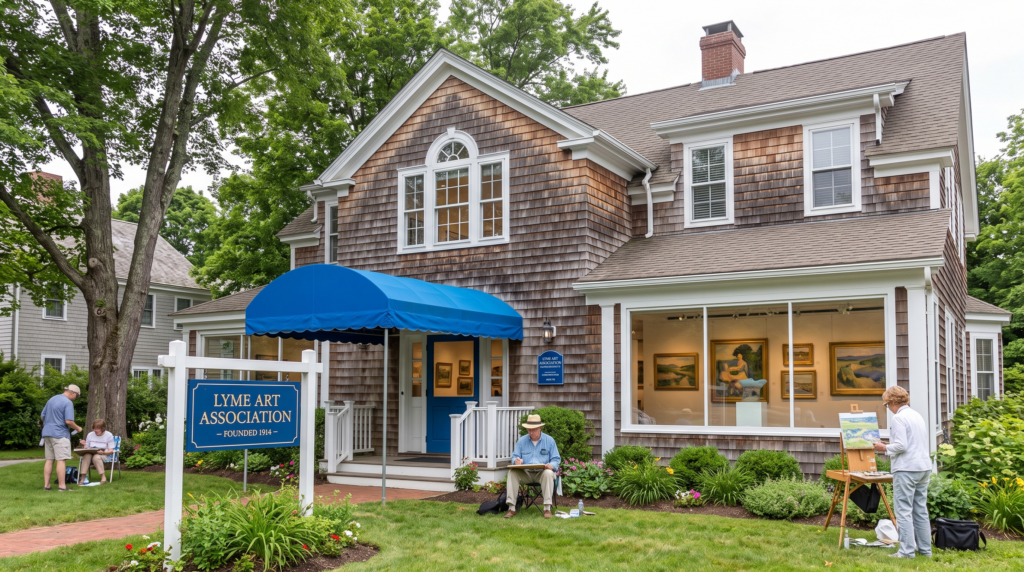
Directly adjacent to the historic Georgian boardinghouse of the Florence Griswold Museum sits an imposing, elegantly low-slung, shingle-style architectural masterpiece located at 90 Lyme Street. This is the Lyme Art Association.
Established officially in 1914 and housed within an exhibition gallery completed in 1921, this institution holds a singular, monumental distinction in the cultural tapestry of the United States: it was the very first artist-funded, artist-designed, and artist-run permanent gallery cooperative built specifically to showcase the visual output of an active American art colony.
While standard municipal art museums operate as historic repositories for dead masters and commercial galleries function as highly transactional gateways for elite brokers, the Lyme Art Association completely breaks out of these rigid models. For over a century, the association has functioned as a living, breathing laboratory and marketplace for the fine arts.
Designed by the legendary American architect Charles Adams Platt specifically to harness the shifting, volatile coastal light of New England, this sky-lit citadel was engineered by the painters themselves to liberate their work from the unpredictable domestic constraints of boardinghouse parlors and traveling commercial showcases.
Today, the Lyme Art Association stands not as a frozen monument to Gilded Age nostalgia, but as a hyper-vibrant, hyper-active visual epicenter. It serves as an open, democratic harbor for a highly selective group of professional contemporary artists, executing a continuous, rapid schedule of juried exhibitions, educational ateliers, and masterclasses. Crucially, it maintains its original foundational mandate: almost every single masterpiece hanging on its white-oak-clad and fabric-draped walls is an active work of living creation available for direct purchase by the public.
The definitive history of the Lyme Art Association is a dense chronicle of creative self-reliance, high-stakes financial gambles, architectural sorcery involving micro-angled overhead skylights, and a fierce, century-long determination to prove that an American art collective could permanently govern its own economic and creative destiny.
II. The Genesis: The Fracture of the Boardinghouse and the Drive for Autonomy
To fully comprehend why the artists of the Lyme Art Colony chose to risk their hard-earned capital to construct a permanent gallery, one must look to the specific institutional and economic growing pains that gripped the community between 1902 and 1914. Under the gracious, radical hospitality of Florence Griswold at her ancestral Lyme Street mansion, the colony had exploded from a quiet gathering of moody Tonalist landscape painters into the undisputed capital of American Impressionism. Master painters like Childe Hassam, Willard Metcalf, Henry Ward Ranger, and William Henry Howe had turned the salt marshes and pastures of Old Lyme into a continuous open-air workspace.
Starting in the summer of 1902, the artists began staging temporary, highly informal summer exhibitions inside the reading rooms and basements of the local Phoebe Griffin Noyes Library on Lyme Street. These library shows became an instant, sensational regional phenomenon. Wealthy industrialists, Gilded Age tycoons, and Manhattan art critics would board steamships and trains, traveling up the Connecticut shoreline explicitly to buy the short, flickering, and light-shattered Impressionist oil canvases while the paint was still chemically drying on the canvas.
However, by the early 1910s, the library exhibitions were falling victim to their own immense success. The crowds were suffocatingly dense, the natural lighting of the library basements was erratic and inadequate for viewing delicate Impressionistic pigments, and the physical space was far too small to accommodate the monumental influx of canvases being generated by the rapidly expanding colony.
Furthermore, the artists began to experience an intense desire for institutional autonomy. They grew increasingly weary of relying on third-party commercial art dealers in New York City who charged exorbitant middleman commissions, and they resented the idea that their work had to be packed up and shipped away to metropolitan centers to achieve academic validation.
The artists arrived at a radical conclusion: they did not need outside institutional gatekeepers. They possessed the talent, they possessed the buyers, and they possessed the collective determination to govern their own financial ecosystem.
In 1914, under the visionary organizational leadership of painters like William Henry Howe, Harry Hoffman, and Edward Rook, the group officially incorporated themselves as the Lyme Art Association. Their first strategic move was both deeply loyal and geographically brilliant: they purchased a prime, wooded parcel of land located immediately adjacent to Miss Florence’s beloved boardinghouse estate, ensuring that their new permanent gallery would be forever rooted next to the historic homestead that birthed their movement.
III. The Master Architect: Charles A. Platt and the Magic of the Sky-Lit Galleries
Armed with land but lacking a building, the association knew that the construction of their gallery required an architect who understood the unique, hyper-specific relationship between natural light and oil paint. In 1918, the association’s building committee made a curatorial coup by commissioning Charles Adams Platt (1861–1933) to design the gallery.
Platt was an absolute titan of American landscape and Renaissance Revival design, celebrated for constructing opulent country estates, the Freer Gallery of Art on the Smithsonian National Mall, and the magnificent campus layouts of the Phillips Academy. Crucially, Platt was not merely an architectural engineer; he had begun his creative life as a professional landscape painter and master etcher. He spoke the exact visual language of the artists, and he approached the Old Lyme commission not as a monument to his own architectural ego, but as a specialized piece of equipment designed to serve the canvas.
Platt worked in close, continuous collaboration with Childe Hassam and the association’s building committee, completely volunteering much of his professional time to ensure the project’s success. He rejected the cold, grand, and intimidating limestone neoclassical temple architecture that defined the urban museums of the era, recognizing that a massive stone palace would look violently alien within the historic, pastoral fabric of Old Lyme.
Instead, Platt designed a sprawling, T-shaped, low-slung building executed in the classic New England Shingle Style. He wrapped the exterior in weathered cedar shingles, incorporated a massive, hand-laid fieldstone chimney, and utilized a gentle, pitch-roofed silhouette that allowed the building to blend seamlessly into the surrounding apple orchards, looking more like an expanded, grand colonial barn or a warm homestead than a public institution.
The exterior architectural choices directly support the custom interior lighting engine. While the weathered cedar shingles and regional fieldstone chimney elements blend the facade into Old Lyme’s historic trail, the internal roof system turns the three contiguous gallery halls into a visual marvel. Platt installed double-glazed clear monitor skylights over the roofline, which trap direct rays and bounce them into a secondary inner ceiling of micro-angled translucent glass. This system perfectly diffuses harsh UV rays, flooding the galleries with an even, milk-like light.
For the first time in an American cooperative gallery, an artist could hang a painting at 9:00 AM and know that as the sun tracked across the sky toward twilight, the colors on the canvas would remain perfectly legible, illuminated exactly as the painter had viewed them while working outdoors en plein air.
IV. The Great Bazaar: Living Art as a Democratic Marketplace
When the front doors of Charles Platt’s shingle-style citadel were officially thrown open to the public on August 6, 1921, the event permanently reshaped the American art market. The opening exhibition was an absolute cultural stampede. Over 4,000 visitors packed the galleries within the first week alone, arriving via newly minted Ford Model Ts, trains from New York, and elegant carriages from Newport. The local newspapers described the opening as an event where high society and working-class citizens stood shoulder-to-shoulder, completely united by a mutual infatuation with light and color.
The structural rules of the association prioritized absolute artist independence over corporate hierarchy. First, they abolished elite gatekeepers, removing middleman gallery commissions and artificial market scarcity. Second, they operated a direct-to-consumer market where every artwork was explicitly priced with standard wall tags. Finally, they maintained a radical economic framework that took only a minimal commission back to the house, ensuring the maximum financial return went straight to the working painter.
The Lyme Art Association did not operate under the philosophy of modern museum curation, where objects are strictly to be looked at but never touched. Instead, it functioned as a sophisticated, high-end bazaar. Every single painting hanging on the walls bore a clean, transparent price tag. The artists had created a direct-to-consumer marketplace that completely bypassed the elite art dealers of Manhattan. If a prominent collector from Hartford or a local merchant fell in love with a depiction of mountain laurel blooming along the Lieutenant River, they did not have to negotiate through a high-society agent; they bought it directly off the wall.
This economic model was profoundly democratic and highly lucrative for the creators. The association charged a remarkably low commission on sales compared to commercial galleries, funneling the absolute lion’s share of the capital directly back into the pockets of the working painters. This financial self-reliance allowed the artists to live permanently within the Old Lyme community, buying up historic properties, building independent studios, and financing their work entirely through their own collective labor. The gallery became a vital civic space where the community directly financed the continuation of its own visual heritage, establishing an economic blueprint that independent artist associations across the country have spent a century attempting to replicate.
V. Real-Life Historical Anecdotes: The Cash Box and the Battle for the Wall
The century-long history of the Lyme Art Association is rich with fascinating, real-life historical events that illustrate the deep human passions, eccentricities, and financial grit of the colony’s founders. Far from a dry corporate chronicle, the association’s archives preserve a narrative of intense artistic camaraderie and fierce, internal creative battles.
1. The Great Depression Cash-Box Miracle
When the stock market crashed in October 1929, the American art market was instantly decimated. The wealthy industrial tycoons who had previously spent thousands of dollars acquiring Old Lyme landscapes saw their fortunes vanish overnight, and the artists of the association were suddenly confronted by the terrifying prospect of total financial ruin. The gallery’s bank accounts were drained, maintenance costs for Charles Platt’s massive shingle building were mounting, and the future looked absolutely bleak.
Refusing to let the economic cataclysm close their doors, the resident artists enacted a bold, grassroots survival strategy. They abolished all high-ticket admission fees and placed a heavy, hand-carved wooden lock-box directly inside the entrance vestibule. They launched a relentless schedule of “Thumb-Box” exhibitions—shows featuring tiny, highly affordable oil sketches that were no larger than a standard cigar box lid, priced at a mere ten to twenty dollars each.
Local residents, working-class townspeople, and regional travelers rallied to save the institution. They began dropping loose change, dollar bills, and modest checks into the wooden cash-box. The strategy was a staggering, grass-roots triumph. While grand commercial galleries in New York and Boston collapsed into bankruptcy throughout the 1930s, the Lyme Art Association stayed completely solvent, funded entirely by the small-scale, democratic purchases of ordinary citizens who refused to let the light go out in Old Lyme.
2. The Battle for the Wall: Impressionists vs. Modernists
While the association was built on a foundation of absolute collaborative unity, the mid-twentieth century brought a fierce, internal ideological war that threatened to rip the organization apart. Known in local lore as the “Battle for the Wall,” the conflict erupted in the 1940s and 1950s as a younger generation of artists began submitting works that completely rejected the soft, naturalistic rules of classic American Impressionism.
The ideological schism on Lyme Street separated the old guard from the vanguard. The traditionalists demanded total landscape purity and advocated for outright gallery bans against non-conformists. The younger generation counter-attacked with Cubist fragments, dark expressionistic strokes, and abstract geometries. This deep friction threatened to dissolve the cooperative until it was resolved through the implementation of a strict blind jury system.
The gallery hanging committees, dominated by the aging traditionalist disciples of Childe Hassam, were deeply horrified when they opened shipping crates to discover sharp, fractured Cubist compositions, bold geometric abstractions, and brooding, expressionistic canvases rendered in deep, dark pigments. The traditionalists viewed these modern movements as an absolute desecration of Charles Platt’s sky-lit cathedral of light, and they began systematically using their jury powers to reject modern submissions, banishing abstract works to the deep storage basements.
The younger avant-garde artists revolted. They staged raucous midnight meetings inside local barns, drafted furious manifestos, and threatened to launch a rival, splinter association down the road. Recognizing that an internal schism would bankrupt the cooperative, the association’s leadership executed a brilliant, pacifying structural reform: they established a completely reformed, highly rigorous Blind Jury System.
Under the new protocols, all artist signatures on submitted canvases were completely covered with opaque masking tape, and the judging panels were composed of equal numbers of traditionalists and modernists. The art had to stand entirely on its own material merit, completely decoupled from the identity or political alignment of the painter. This systemic reform permanently defused the visual civil war, transforming the Lyme Art Association from an exclusive sanctuary for impressionist purity into an open, evolving showcase for the full, complicated spectrum of American creativity.
VI. The Contemporary Continuum: The Vibrant Hub for Living Masters
The true, defining vitality of the Lyme Art Association in the twenty-first century is its absolute refusal to become a quiet museum of memory or a historical theme park. Under the progressive guidance of its modern directors and board of trustees, the association operates today as one of the most active, high-velocity visual centers along the eastern seaboard, executing an annual schedule of roughly ten major, consecutive juried exhibitions.
The core operational engine of the modern association remains its fiercely selective tier of Elected Artists. To achieve the status of an Elected Artist within the Lyme Art Association is a grueling professional achievement. Contemporary artists must systematically submit their work over multiple years to a highly competitive, peer-reviewed blind jury panel. The judges scrutinize submissions for absolute mastery over line, form, color theory, and material execution.
Once elected, these artists form the vanguard backbone of the association’s rotating exhibitions, which include:
-
The Annual Fitting Show: A historic, highly anticipated seasonal opening that showcases fresh, newly dry oil canvases, watercolors, and sculptures created during the winter studio months.
-
The Summer Juried Exhibition: A massive, multi-gallery showcase that draws submissions from professional creators across the entire United States, cycling through hundreds of works that capture the cutting-edge state of contemporary landscape, figurative, and abstract art.
-
The Visual Splendor of the Deck the Walls Show: A festive, high-volume year-end exhibition where the grand spaces of Charles Platt’s gallery are packed floor-to-ceiling with small-to-medium masterpieces, explicitly continuing the 100-year-old tradition of offering world-class fine art at accessible price points for holiday collectors.
VII. Analysis of the Exhibition Fabric: The Three Primary Galleries
To completely appreciate how the Lyme Art Association functions as a world-class exhibition venue, one must analyze the unique, fluid spatial architecture of its interior layout. Charles Platt structured the building into three primary, contiguous grand gallery spaces that flow into one another with absolute geometric harmony, allowing curatorial teams to run multiple independent exhibition engines simultaneously.
The exhibition path divides duties cleanly across the footprint. The Goodman Gallery Hall forms the grand, monumental entrance axis for primary seasonal installations. The Staehle Project Room handles intimate solo shows and experimental, small-scale alternative media, while the Center Gallery serves as the high-volume engine for regional and national thematic juried competitions.
1. The Goodman Gallery Hall
The central backbone of the building is the magnificent Goodman Gallery, a long, high-ceilinged rectangular hall that introduces visitors immediately to the grand scale of the architecture. The walls are wrapped in a heavy, natural-toned woven fabric over solid wood paneling, allowing curators to securely mount massive, heavy oil frames using a historic rod-and-hook hanging system that eliminates the need to constantly damage the underlying plaster walls. The Goodman space is dominated by the full, unfiltered power of Platt’s diffused skylight system, bathing the large-scale canvases in a pristine, perfectly distributed illumination that reveals the absolute true values of every pigment layer.
2. The Staehle Room and The Center Gallery
Flanking the main axis are the highly specialized side galleries, including the Staehle Room and the large Center Gallery. These spaces are engineered to provide a more intimate, reflective viewing experience.
The walls in these rooms are deliberately configured at varied angles, creating a series of quiet alcoves and viewing bays where a visitor can step out of the public traffic flow to study delicate watercolor washes, intricate hand-printed etchings, or small-scale bronze and marble sculptures mounted on custom white pedestals. By running these diverse spatial fabrics simultaneously, the association ensures that its exhibitions never feel monotonous, providing a dynamic, constantly changing visual environment that respects the scale and technical requirements of every artistic medium.
VIII. The Lyme Academy and Ateliers: Preserving the Technical Craft
Beyond its role as a premier public marketplace for fine art, the Lyme Art Association serves as a critical national sanctuary for the preservation of classical, foundational artistic training. Operating in close intellectual alliance with the broader Old Lyme cultural campus, the association hosts a continuous, year-round program of ateliers, studio workshops, and open-studio drawing sessions directly within its sky-lit spaces.
The educational philosophy of the association is fiercely anchored to the preservation of traditional, material craftsmanship. At a time when mainstream academic art programs have largely abandoned technical studio training in favor of purely conceptual theory and digital manipulation, the Lyme Art Association’s masterclasses remain spaces of absolute physical discipline:
-
The Study of Color Theory: Students are guided by working masters to mix their own pigments, analyzing the physical chemistry of natural earths, cadmiums, and mineral leads to understand how light chemically interacts with binding mediums.
-
The Sight-Size Drawing Method: Ateliers utilize the rigorous, nineteenth-century European method where objects or live models are cast in controlled directional light and drawn at an absolute 1:1 scale on high-grade rag paper, enforcing a brutal discipline of optical accuracy, edge control, and anatomical precision.
-
The Plein Air Expeditions: True to the ghost of Childe Hassam, instructors lead regular expeditions directly out onto the marshlands, riverbanks, and historic bridges of the property, teaching students the high-speed, volatile art of capturing the shifting New England light before the sun moves and permanently changes the color matrix of the landscape.
IX. Conclusion: The Living Palette of Old Lyme
The story of the Lyme Art Association is an extraordinary, enduring narrative of absolute artistic self-reliance, architectural genius, and cultural survival. Across its contiguous, shingle-wrapped campus—from the historic timber frames and micro-angled skylights engineered by Charles Platt to the vibrant contemporary canvases currently drying on its fabric-draped walls—the institution stands as a triumphant monument to the power of a creative collective to govern its own destiny.
By maintaining its strict, original 1914 mandate as an artist-run cooperative marketplace, the association entirely refuses to lapse into a quiet museum of historical memory. It remains a living, breathing, and intensely active engine of cultural production that chooses to reinvent its walls ten times every single year.
It stands as an irreplaceable national sanctuary where the barrier between the creator, the canvas, and the public is completely dismantled, serving as an open, light-flooded beacon where the timeless heritage of the Old Lyme Art Colony continues to grow, mutate, and illuminate the complexities of the American creative spirit for every generation that crosses its historic threshold.
Monographic References and Sources
-
Primary Curatorial Area Overviews: The Elected Artist Roster and Exhibition Tracking Database, Lyme Art Association, 90 Lyme Street, Old Lyme, CT.
-
Architectural Design Records: Platt, Charles Adams. The Mechanics of Diffused Light: Original Architectural Blueprints and Skylight Specifications for the Lyme Art Gallery (1918–1921), Institutional Archives, Old Lyme, CT.
-
Historical Correspondence & Minutes: Hoffman, Harry. The Board Meeting Records and Financial Chronicles of the Lyme Art Association Building Committee (1914–1925), Historical Curation Archives.
-
Exhibition Area Reviews: The Art of the Northeast and Annual Fitting Show Curation Files, Gallery Installation Briefs, Lyme Art Association.
-
Biographical & Economic Profiles: Standard, Joe. The Thumb-Box Miracle: Grassroots Survival of Independent Artist Cooperatives During the Great Depression, New England Cultural Economics Review.
