
THE GUILD OF THE FLOCK
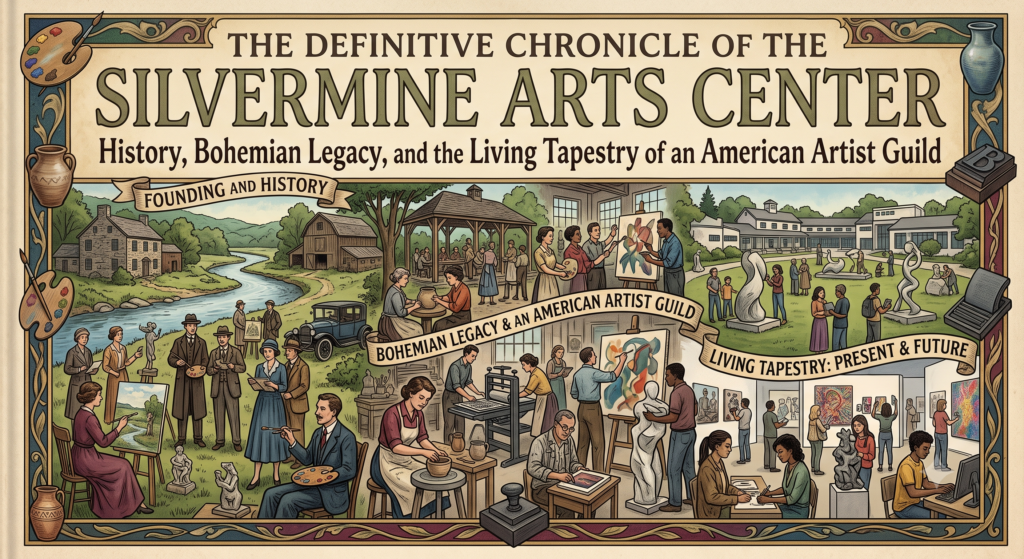
The Definitive Chronicle of the Silvermine Arts Center: History, Bohemian Legacy, and the Living Tapestry of an American Artist Guild


I. Introduction: The Sanctuary on the Silvermine River
To travel along the winding, narrow blacktop of Silvermine Road as it snakes through the dense, residential woodlands of New Canaan, Norwalk, and Wilton, Connecticut, is to step into a landscape that has spent more than a century resisting the rigid compartmentalization of the modern world. In this historic pocket of Fairfield County, where the Silvermine River cuts a path through ancient granite outcroppings and cascades over hand-poured colonial mill dams, sits an institution that operates as a living testament to the radical concept of an artistic collective.
This is the Silvermine Arts Center. Established in the foundational opening decades of the twentieth century, Silvermine holds an absolute distinction in the cultural topography of North America: it is one of the oldest continually operating, fully integrated artist communities and guilds in the United States.
Most art centers are static commercial galleries or institutional schools that import curated cultural assets from metropolitan centers. Silvermine completely rejects this passive role. Operating for over one hundred years under a fluid, multi-disciplinary mission that blends a professional artist guild, a dynamic public exhibition complex, and a sprawling, hands-on educational laboratory, Silvermine functions as an active engine of cultural production. It is an estate built around the conviction that art is not a luxury product to be silently consumed, but a communal, life-altering labor to be shared, practiced, and integrated directly into the everyday fabric of society.
Housed within a rustic yet sophisticated four-acre campus composed of historic, award-winning barns, mid-century modernist studio pavilions, and light-filled gallery halls, the Silvermine Arts Center stands as a monument to a bohemian counter-cultural movement that survived the pressures of suburbanization. The permanent core of the institution is its legendary Guild of Professional Artists, a highly selective, peer-reviewed collective of over 300 professional creators working across every imaginable medium—from traditional stone carving and high-key oil painting to cutting-edge conceptual printmaking, digital media, and avant-garde ceramics.
The definitive story of Silvermine is a sprawling, colorful chronicle of progressive sculptors who fled the suffocating social expectations of New York City, late-night printmaking sessions fueled by local applejack brandy, an architectural evolution that integrated historic barn framing with modernist lines, and a century-long legacy of creative independence that permanently demonstrated that a modern art sanctuary could thrive within the wooded heart of New England.
II. The Visionary Spark: Solon Borglum and the “Knocker” Rebellion
To trace the true genesis of the Silvermine Arts Center, one must look to the specific socio-artistic rebellion that occurred in the summer of 1908. The central figure of this movement was the celebrated sculptor Solon Hannibal Borglum (1868–1922). Borglum was a man of the rugged American West; born to Danish immigrant parents, he had spent his youth ranching in Nebraska before traveling to Paris to study sculpture, where he achieved international renown for his raw, intensely dynamic bronze renderings of horses, cowboys, and Native Americans.
By the early 1900s, Borglum found himself living and working in New York City. He quickly grew intensely claustrophobic under the rigid, hyper-commercialized, and socially conservative constraints of the metropolitan art market. He grew tired of the stuffy academic salons and the competitive posturing of Manhattan galleries. Seeking space, physical labor, and a direct connection to the unvarnished landscape, Borglum climbed onto his horse in 1906 and rode out into the rural backcountry of Fairfield County.
He discovered a ruined, long-abandoned colonial textile mill site situated along the rocky banks of the Silvermine River, on the boundary line where New Canaan meets Norwalk. Borglum purchased a historic stone barn on the property, cleared out the decades of agricultural debris, and established his permanent studio.
He did not remain isolated for long. Borglum possessed an intensely magnetic, generous personality, and his move to the Connecticut wilderness sparked a chain reaction. Within two years, an extraordinary vanguard entourage of painters, illustrators, sculptors, and writers—pioneers like Johnny Gruelle (the brilliant illustrator who created the Raggedy Ann doll right in the Silvermine valley), Addison Millar, Richard Daggy, and D. Putnam Brinley—purchased neighboring farmhouses and abandoned barns.
In the summer of 1908, this group established a weekly ritual that would alter American art history. Every Sunday morning, the artists would gather inside Solon Borglum’s stone studio barn. Each creator would bring their latest, unfinished canvases or raw clay maquettes and prop them against the rugged timber walls. The group would sit on upturned crates and hay bales, smoking pipes and consuming local provisions, while engaging in a collective art critique.
The critique sessions were characterized by absolute, unvarnished honesty. The artists did not indulge in empty, polite high-society compliments; they tore each other’s work apart, questioning compositions, dissecting color balances, and pushing one another to break away from safe academic clichés.
Because of the aggressive, unforgiving nature of these sessions, the group proudly dubbed themselves “The Knockers.” This weekly ritual transformed the valley from a loose collective of summer homes into a hyper-focused intellectual furnace. The artists discovered that by submitting their individual egos to the collective, honest judgment of the guild, their creative output accelerated.
When Solon Borglum tragically passed away in 1922 due to complications from appendicitis, his devastated disciples chose to turn their informal rebellion into a permanent monument. That exact same year, they officially incorporated themselves as the Silvermine Guild of Artists, ensuring that Borglum’s ethos of collaborative discipline and creative independence would outlive his physical presence.
III. Architectural Evolution: The Metamorphosis of the Campus
The physical architecture of the Silvermine Arts Center is a beautifully preserved material history of the community’s shifting creative needs. The epicenter of the modern four-acre campus remains the Sara Victoria Hall, a complex that began its life as a simple, historic wooden barn. Following the incorporation of the Guild in 1922, the artists recognized that they needed a dedicated, permanent space to mount their annual exhibitions and stage public performances.
Rather than commissioning a sleek, classical gallery that would look alien in the rural valley, the guild members banded together to manually expand and retrofit the historic barn framing on the property. Operating with their own hands—mixing concrete, hoisting heavy white oak tie-beams, and nailing down wide-plank floorboards—the artists constructed a sprawling, rustic exhibition hall that retained the open timber architecture of its agrarian past while introducing vast, north-facing studio windows that flooded the space with natural light.
The architecture naturally transitions between generations. The historic barn cores include the Sara Victoria Gallery Hall, defined by its exposed white oak tie-beams, hand-poured fieldstone chimneys, and warm, domestic acoustics. These seamlessly connect to the modernist extensions built in the 1950s and 1960s to support the School of Art. These modern pavilions are built on polished raw concrete foundations with expansive glass curtains and exposed structural iron skeletons that emphasize high-ceilinged, industrial adaptability.
These structures are a masterclass in regional mid-century modernist architecture. They abandon the heavy timber walls of the old barns in favor of flat roofs and massive window walls that look out onto the mature maple and hemlock forests surrounding the property.
The interior architecture is raw, functional, and intensely tactile: the printmaking studios feature heavy, industrial iron cast presses; the ceramics wings are lined with heavy gas-fired kilns and rows of throwing wheels; and the sculpture studios are built on thick, raw concrete slabs engineered to support the dead-weight of massive marble, granite, and iron blocks.
A major multi-million-dollar renovation project seamlessly linked these diverse structures together. The architects constructed sleek, minimalist glass breezeways that connect the historic barn galleries to the modern studio pavilions, creating a continuous, fluid indoor-outdoor campus where a student can walk directly out of a bronze-casting foundry and step immediately into a pristine, white-walled gallery displaying national abstract art.
IV. Eccentricities and Bohemian Folklore: Raggedy Ann, Pageants, and the Applejack Press
Life within the early Silvermine Art Colony was a beautiful, chaotic spectacle that scandalized and delighted the conservative local agricultural communities of Fairfield County. The artists viewed their valley as an independent state of absolute creative license, and their everyday lives were punctuated by eccentric rituals and collaborative performance arts.
1. The Birth of Raggedy Ann in the Silvermine Valley
One of the most fascinating cultural achievements of the early colony occurred inside a small, shingled home located just down the road from the guild center. The artist Johnny Gruelle (1880–1938) was a central, beloved member of “The Knockers.” In 1915, his young daughter Marcella brought him an old, faceless cloth rag doll that she had discovered rotting in her grandmother’s attic.
Gruelle, amused by the doll’s worn texture, sat down at his drawing table and sketched a whimsical, highly distinctive face on the cloth, drawing round shoe-button eyes, a red triangle nose, and a wide, looping smile. He reached for a nearby volume of poetry by James Whitcomb Riley, combining the titles of two poems—”The Raggedy Man” and “Little Orphant Annie”—to christen the creation: Raggedy Ann.
Tragically, Marcella passed away later that year from an infected vaccine. Immersed in absolute grief, Gruelle threw himself into writing and illustrating the Raggedy Ann Stories as a permanent monument to his daughter’s memory. The books, entirely written and drawn within the Silvermine valley, used the surrounding landscapes, stone walls, and local animals as the visual backdrop for the adventures, turning a local family tragedy into a timeless global literary and material icon.
2. The Great Forest Pageants of the 1920s
During the roaring twenties, the Silvermine Guild became famous for staging massive, avant-garde outdoor theatrical pageants to raise funds for their gallery construction. These pageants were not simple community theater pieces; they were massive, highly sophisticated multi-media spectacles that drew thousands of spectators from New York City and across New England.
The artists transformed the rolling woods and rocky outcroppings of the Silvermine River into an open-air amphitheater. They designed and hand-painted massive, surrealist scenic backdrops that hung from old oak trees, constructed elaborate historical costumes out of burlap, silk, and industrial paper, and composed original avant-garde musical scores that were performed by live orchestras hidden within the riverbank foliage.
The entire colony participated: prominent, internationally recognized painters dressed as medieval knights, wood nymphs, and abstract geometric shapes, dancing and reciting poetry under the stars. The pageants became a legendary regional phenomenon, permanently establishing Silvermine’s reputation as a place where the high arts could break completely out of the museum frame and play within the wild architecture of nature.
3. The Ritual of the Applejack Press
The printmaking department of Silvermine holds a long-standing, legendary underground reputation for its historic, late-night creative marathons. During the mid-twentieth century, the printmakers established a highly elite, informal collective known as the “Applejack Press.”
During the freezing depths of the Connecticut winter, a group of master printmakers would lock themselves inside the studio for forty-eight-hour marathons, working relentlessly to cut woodblocks, etch copper plates, and run heavy rag paper through the manual presses.
To withstand the sub-zero temperatures and keep their hands fluid, the artists would fuel their sessions with potent, home-distilled local applejack brandy—a high-proof spirit that had been manufactured in the hidden illegal stills of the Naugatuck and Silvermine valleys since colonial times.
The sessions were intense, alcohol-fueled, and characterized by an explosion of competitive creative energy. The prints produced during these winter marathons—frequently characterized by dark, raw, and deeply expressive woodcut lines that captured the psychological weight of the era—remain highly prized historical relics within the museum’s archival collection.
V. Curatorial Master-Analysis: The Five Gallery Spaces
The core architectural and programmatic brilliance of the Silvermine Arts Center is found by analyzing the configuration of its exhibition spaces. Housed within the sprawling expansion of the historic Sara Victoria Hall complex, the center features five distinct, highly specialized gallery spaces that operate simultaneously. This multi-tiered gallery framework allows the curatorial team to execute a complex, deeply layered exhibition program that challenges, educates, and inspires the community.
The multi-exhibition structure divides roles seamlessly across the campus. The Permanent Guild Hall features the ongoing creations of the 300 selective local guild members. The Horizon Vault is engineered to host sprawling national and international traveling exhibitions and experimental, site-specific installations. The remaining three spaces—The Director’s Apex, The Center Room, and The Riverfront Gallery—focus on rapid, three-week rotations, ranging from solo member retrospectives to emerging experimental media and regional thematic competitions.
1. The Permanent Guild Hall: The Vanguard Local Engine
The first and largest space is dedicated to exhibiting the ongoing visual output of the Silvermine Guild of Professional Artists. To secure membership in this guild is a notoriously difficult, high-stakes academic achievement; artists must submit their complete bodies of work to a rigorous, multi-stage blind review panel composed of independent museum curators, art historians, and established masters.
The resulting exhibition space houses a continually shifting, hyper-diverse collection of world-class fine art. Because the guild is composed of over 300 creators working across the country, this gallery serves as an absolute cross-section of contemporary visual culture, placing monumental abstract welded-iron sculptures side-by-side with hyper-realistic landscape paintings, conceptual video art installations, and exquisite, hand-thrown porcelain vessels.
2. The Horizon Vault: The National Installation Space
The second gallery space is engineered explicitly to host major, large-scale traveling exhibitions and site-specific installations by national and international contemporary artists. This space features soaring, double-height ceilings and a complete absence of load-bearing interior partition walls, allowing artists to completely reconfigure the environment from scratch. It is within this space that Silvermine hosts its historic, annual Art of the Northeast exhibition—a highly prestigious, juried competition that has served for decades as a vital launchpad for the most radical new ideas emerging from the New York and New England art scenes.
VI. The Masterworks: The Material Legacy of the Permanent Collection
While Silvermine functions primarily as a living, fluid exhibition space, the center preserves a spectacular permanent collection of historic works that document the development of twentieth-century American modernism. For any serious scholar or art lover, the archive contains several pivotal treasures that demonstrate the international caliber of the community:
1. Solon Borglum’s Bronze and Plaster Legacy
The spiritual foundation of the permanent collection is a magnificent repository of original sculptures, drawings, and working plaster maquettes executed by the founder, Solon Borglum. Key pieces include his historic bronze renderings of Western life, which reject the smooth, polished, and idealized aesthetics of classical European sculpture in favor of a rough, heavily textured, and expressive surface treatment.
Borglum left his thumbprints and tool marks clearly visible in the bronze, a radical technique that allowed the viewer to feel the intense, physical labor of the artist manipulating the raw material—a methodology that directly anticipated the birth of modern abstract expressionism.
2. The Printmaking Archive: Gabor Peterdi and the Modern Line
The printmaking collection of Silvermine is universally recognized by graphic historians as one of the finest regional archives in New England, due heavily to the long-standing influence of the legendary master printmaker Gabor Peterdi (1915–2001). Peterdi, a Hungarian-born titan of graphic art who founded the printmaking department at Yale University, was a massive, driving intellectual force within the Silvermine community for decades.
The museum preserves an exhaustive collection of his revolutionary intaglio prints, engravings, and color etchings. Peterdi’s work is characterized by an absolute, unmatched mastery over the copper plate; he used acid lines, aquatint textures, and complex multi-plate registration systems to translate the organic chaos of the natural world—the intricate skeletons of winter trees, the crashing velocity of ocean waves—into a clean, powerful, and monumental language of abstract lines.
VII. The Silvermine School of Art: The Living Laboratory
The true, defining vitality of the Silvermine Arts Center is found within its role as an active, continuous educational incubator. The Silvermine School of Art is the largest independent, non-degree-granting art school in the state of Connecticut, providing professional, high-grade studio instruction to over 4,000 students annually. The educational philosophy of Silvermine is anchored to the concept of the Studio Master System. The school completely rejects the traditional academic model of large lecture halls, placing students directly inside functional, working studios under the intimate guidance of professional, practicing guild masters.
The architectural layout of these Master Studios serves specific tactical disciplines across the campus. The Foundry Studio is equipped with multi-ton gas furnaces for liquid bronze casting and structural steel welding. The Ceramics Center houses rows of manual throwing wheels and high-temperature reduction kilns. The Intaglio Lab utilizes heavy, high-pressure mechanical iron cast printing presses for printmakers, while the Atelier Pavilion is configured with expansive north-lit window arrays for live figurative drawing and paint studies.
The school operates as a multi-generational, democratic laboratory. On any given evening, inside the brightly lit modern pavilions, one can find a prominent corporate executive from Stamford sitting side-by-side with a local high school student and a retired grandmother from Westport—all clad in clay-splattered aprons, working their manual wheels, operating heavy iron presses, or wielding oxygen-acetylene torches to weld steel plates.
By providing a space where the absolute technical secrets of material craft—the delicate chemistry of ceramic glazes, the complex mathematics of printmaking acid dilutions, the anatomical structural discipline of figurative drawing—are kept alive and passed down directly through hand-to-hand human contact, Silvermine serves as a vital wall against the digital alienation of the modern era.
VIII. Conclusion: The Living Palette of the Forest
The story of the Silvermine Arts Center is an enduring narrative of collaborative resilience, radical hospitality, and creative defiance. Across its contiguous four-acre campus—from the historic, hand-hewn white oak timbers of the Sara Victoria Gallery Hall where “The Knockers” once smoked their pipes and launched their artistic rebellion, to the sleek glass-and-steel modern studio pavilions where thousands of students actively manipulate raw clay and metal—the institution honors its rich legacy by remaining stubbornly focused on the future.
By maintaining its unique, tripartite identity as a professional guild, a world-class exhibition center, and a living studio school, Silvermine refuses to become a frozen monument of historical nostalgia. It is an institution that chooses to reinvent itself every single season, using its five gallery spaces to amplify the voices of the living artist and push the boundaries of human visual expression.
It stands high on its hill along the rushing waters of the Silvermine River, not as a quiet repository of the past, but as a welcoming, dynamic, and wonderfully unpredictable beacon of human curiosity, discovery, and community learning for generations to come.
Monographic References and Sources
-
Primary Curatorial Area Overviews: The Guild Membership Review Archives and Permanent Art Collections Database, Silvermine Arts Center, 1037 Silvermine Road, New Canaan, CT.
-
Institutional Historical Records: Gruelle, Marcella C. The Knockers and the Colony: Letters and Diaries from the Silvermine River Valley (1906–1925), Historical Curation Monograph Series, Silvermine Guild Archives.
-
Biographical Masterwork Records: Borglum, Solon Hannibal. The Rough Surface: Plaster, Clay, and the West, Technical Sculptural Monographs, Yale University Press Academic Reprints.
-
Graphic Art Archives: Peterdi, Gabor. The Intaglio Line and the Chemistry of Acid: Engraving Masterworks of the Silvermine Printmaking Collective, Graphic Arts History Review.
-
Architectural Reconstruction Profiles: The Mid-Century Modern Studio Pavilions and Barn Conversions of Silvermine, Connecticut Architectural Preservation Review, December 2014.
