
THE HEART OF THE NAUGATUCK VALLEY
The Definitive Chronicle of the Mattatuck Museum: History, Masterworks, and the Cultural Memory of the Brass City
I. Introduction: The Anchor on Waterbury Green
To understand the Mattatuck Museum, one must first understand the visual and auditory landscape of Waterbury, Connecticut, at the height of the Industrial Revolution. Known globally as the “Brass City,” Waterbury was the undisputed capital of the American brass manufacturing industry. For more than a century, its skyline was dominated by massive brick factory complexes, soaring smokestacks, and the relentless, mechanical thrum of stamping mills and foundries. It was a city that clad the world in brass buttons, supplied the timing gears for millions of pocket watches, and forged the structural components that fueled the rapid expansion of American infrastructure.
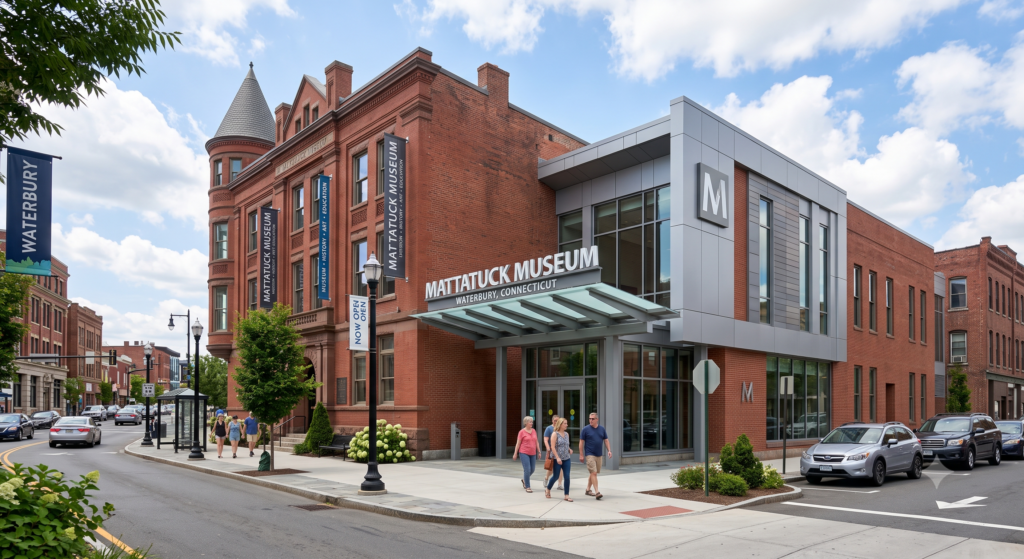
Yet, directly adjacent to this roaring industrial theater, on the edge of the historic Waterbury Green, sits an institution that operates as the keeper of the region’s soul. Housed within a beautifully renovated, post-modern architectural landmark at 144 West Main Street, the Mattatuck Museum stands as a unique, dual-focused anchor of cultural memory.
Unlike institutions that compartmentalize their collections into strict silos, “The MATT”—as it is affectionately known to locals and the global academic community—is a hybrid space where fine art and regional social history form a singular, continuous narrative.
Founded in 1877 as a historical society, the Mattatuck Museum has spent nearly a century and a half evolving into one of Connecticut’s premier visual destinations. Its permanent collections preserve more than 8,000 objects of fine art, sculpture, and photography, alongside a staggering multi-million-piece archival repository that documents the lived experiences of the diverse immigrant communities who built the Naugatuck Valley.
The definitive story of the Mattatuck Museum is a sprawling, multi-layered chronicle of industrial barons and revolutionary artists, featuring a world-renowned collection of 20,000 historic buttons, an unrivaled collection of Connecticut modernists, a monumental $9 million architectural expansion, and a persistent, deeply poignant haunt of a long-dismantled historic bedroom chamber where visitors still claim to feel the phantom grasp of the past.
II. The Genesis: The Mattatuck Historical Society and the Reclamation of Identity
The museum’s origins trace back to a meeting of prominent local citizens in the late nineteenth century who grew deeply concerned that Waterbury’s meteoric rise as an industrial powerhouse was obliterating its early history. In 1877, they chartered the Mattatuck Historical Society. The name “Mattatuck” was chosen deliberately; it was the original Algonquian name for the region before English puritan settlers established the town of Waterbury in the late seventeenth century. The word translates roughly to “a place of few trees” or “the river or meadow that is well-watered,” evoking the pristine, pre-industrial landscape of the Naugatuck River valley.
Initially, the society functioned as a traditional, Gilded Age cabinet of curiosities, collecting early colonial land deeds, Native American stone tools, and ancestral family bibles. The most foundational document in its archive remains the original Indian Deed to the Ancient Proprietors of Mattatuck, dated December 2, 1684—a priceless legal document that bears the pictographic marks of local indigenous sachems and effectively established the permanent borders of the colony.
In the early decades of the twentieth century, the society’s trustees made a bold choice to expand their mandate into the realm of fine arts. They began acquiring oil paintings—initially with more enthusiasm than critical discrimination. However, by the 1950s, the institution enacted a highly calculated, precise collection policy that defined its modern brilliance: they decided to focus their fine art acquisitions exclusively on artists who were born in, worked in, or drew their subject matter from the State of Connecticut.
By creating this strict geographic parameter, the Mattatuck Museum built a visual archive that permanently demonstrated that Connecticut was a central incubator for the development of American art, capturing the evolution of the nation’s identity through a localized lens. At the dawn of the twenty-first century, this mandate was enlarged to embrace all of American Art, providing a broad, national context for its deep holdings in regional masterworks.
III. Architectural Metamorphosis: From the Masonic Temple to the New MATT
The physical evolution of the Mattatuck Museum is a lesson in creative adaptive reuse. For much of its early history, the collection bounced between various temporary municipal spaces. The museum’s modern era began in 1986 when it acquired a massive, historic structure facing the Waterbury Green: the old Masonic Temple.
Designed in the early twentieth century, this heavy brick-and-limestone building possessed a grand, theatrical interior featuring soaring ceilings and dramatic interior balustrades. The museum hired the celebrated post-modern architect César Pelli to assist in configuring the interior galleries, turning a secret fraternal meeting palace into a public home for fine art.
However, by the late 2010s, the museum’s director, Robert Burns, and the board of trustees recognized that the aging Masonic structure could no longer accommodate the institution’s explosive growth or its community-driven programming. They launched a major $9 million capital campaign to execute a total architectural transformation. They selected the renowned, Hartford-based firm S/L/A/M Architects to design a radical expansion and modernization of the site.
The project, completed with a grand unveiling in 2021, added a spectacular, light-filled 14,000-square-foot modern pavilion that completely reoriented the museum’s presence on the West Main Street corridor. The architects wrapped the new addition in sleek, variegated metal panels and massive, floor-to-ceiling glass curtain walls that look directly out onto downtown Waterbury. This transparent design was a deliberate philosophical move: it dismantled the old, opaque institutional walls, visually inviting the community to look inside the galleries while allowing the city’s historic cityscape to serve as a backdrop for the art within.
The expansion added a state-of-the-art, multi-purpose educational lab, a soaring public atrium, and a highly unique, accessible rooftop terrace that offers sweeping, panoramic views of the Waterbury Green, the iconic regional clocktower designed by McKim, Mead & White, and the surrounding rolling hills of the Naugatuck Valley. The interior galleries were entirely gutted and rebuilt with museum-grade climate control and lighting systems, creating a fluid, three-floor chronological journey through five centuries of fine art and industrial social history.
IV. The Spooky: The Ghost of the Connecticut Room
With a history stretching back to 1877 and an archival collection that houses the deep personal effects of thousands of dead regional citizens, it is no surprise that the Mattatuck Museum has generated its own share of paranormal folklore. Far from a generic haunted house tale, the supernatural reputation of the museum centers on a specific, real-life architectural space that existed inside the old museum layout: The Connecticut Room.
The Connecticut Room was a meticulously constructed, historic period room exhibit designed to replicate an authentic, late eighteenth-century New England domestic interior. It was built using original wood paneling, floorboards, and stone hearths salvaged from a dismantled colonial home in the region. The room was furnished with pristine, period-accurate decorative arts, centered around a massive, heavy four-poster wooden colonial bed frame.
Over several decades, museum security guards patrolling the dark galleries at night, along with daytime docents and regular visitors, began reporting a series of unexplainable occurrences within this specific space. The most common report was acoustic: people standing in the hallway would hear the distinct sound of heavy leather shoes pacing across the wide-plank colonial floorboards inside the room, even when the entrance was securely roped off and empty.
More uniquely, multiple independent witnesses reported intense tactile sensations near the historic four-poster bed. Visitors reported standing near the display and feeling a sudden, distinct, and gentle grasp on their hands—described by one witness as a quick, light touch mimicking a small child trying to get a parent’s attention.
In the early 2000s, local paranormal research teams were permitted to conduct overnight investigations inside the darkened galleries. Utilizing electromagnetic field meters, thermal imaging cameras, and electronic voice phenomenon recorders, both groups independently registered anomalous activity focused squarely on the historic bed frame, concluding that the spirit of a historic male entity remained profoundly attached to the physical woodwork of the furniture.
When the museum underwent its massive 2021 renovation, the period rooms were dismantled to clear space for the new, modern open-floor plan galleries. While the physical room is gone, long-time museum staffers still whisper about whether the entity attached to those ancient colonial timbers was laid to rest, or if it still wanders the newly built metal-and-glass corridors of West Main Street.
V. Curatorial Masterpieces: Analyzing the Fine Art Holdings
The fine art collection of the Mattatuck Museum operates as an elite visual timeline of American creativity, heavily anchored by the revolutionary artists who drew their breath from the soil of Connecticut. If you are navigating its newly configured galleries, these are the undisputed masterworks and movements that form the core pillars of its global reputation:
1. The Early American and Hudson River School Pioneers
The chronological journey begins on the first floor, where the museum houses an exceptional collection of eighteenth- and nineteenth-century American paintings. The collection features early, severe portraits by artists like William Jennys, whose raw, unvarnished depictions of prominent Connecticut families reject European idealization in favor of a gritty, New England realism.
Moving into the mid-nineteenth century, the collection transitions into the grand, light-drenched landscapes of the Hudson River School. Key pieces include works by John Frederick Kensett and Frederic Edwin Church. Kensett, a leader of the Luminist movement, painted compositions of the Connecticut shoreline and Long Island Sound that utilize glass-like, mirror-smooth water surfaces and vast, soft-lit skies to turn landscape painting into a vehicle for transcendental spiritual contemplation. Church, a Hartford native and a global titan of landscape art, is represented by early compositions that demonstrate his unmatched ability to capture the dramatic, atmospheric play of natural light breaking over New England hillsides.
2. The Connecticut Impressionists
The museum boasts world-class holdings of American Impressionism, born out of the historic art colonies of Old Lyme and Cos Cob. Works by William Glackens and his contemporaries fill these spaces with vibrant, light-flecked energy. Rather than focusing on European urban life, these painters used short, flickering brushstrokes and high-key primary colors to capture the rugged beauty of the Connecticut countryside, the blinding light of regional winters, and the domestic quiet of New England gardens.
3. The Modernist and Surrealist Vault
The true strength of the Mattatuck’s modern department lies in its deep, highly personal connections to the avant-garde movements that took root in western Connecticut during the mid-twentieth century. The museum preserves an exceptional cache of art and archival materials from the legendary Surrealist power couple Kay Sage and Yves Tanguy.
Tanguy, a French Surrealist master, and Sage, a brilliant American Surrealist painter, fled Europe during World War II and established a permanent home and studio in Woodbury, Connecticut. The Mattatuck’s holdings provide an invaluable look at their creative lineage, showcasing Sage’s brooding, architectural dreamscapes alongside Tanguy’s organic, hallucinatory landscapes.
Complementing the Surrealist collection are works by the undisputed giants of American Modernism:
-
Alexander Calder: The pioneer of kinetic sculpture, Calder maintained his primary home and studio in Roxbury, Connecticut. The museum features his iconic wire sculptures and mobiles that dance and pivot in response to natural air currents.
-
Anni and Josef Albers: The Bauhaus masters who fled Nazi Germany and revolutionized American design education at Yale University are heavily represented by their geometric, color-theory masterworks.
-
The Post-Modern Masters: The collection includes crucial post-modern and conceptual works by Jasper Johns, Sol LeWitt, Kiki Smith, and the monumental, complex photography of Doug and Mike Starn.
VI. The Miniature Marvel: The Waterbury Button Museum
While the fine art galleries command international academic respect, the Mattatuck Museum possesses a secondary, completely unique permanent exhibit that draws collectors and historians from across the globe: The Waterbury Button Museum. Housed permanently within a custom-designed gallery space, this collection features over 20,000 miniature works of art from around the world.
The existence of this world-class collection is directly tied to Waterbury’s industrial heritage. In the nineteenth century, the Waterbury Button Company (later known as the Waterbury Companies), founded in 1812, was the primary manufacturer of metal buttons for the United States military, providing the brass fasteners for uniforms during the War of 1812, the Civil War, and both World Wars. In the 1970s, the company donated its vast, historic sample archives to the Mattatuck Museum, forming the foundation of the current exhibit.
The collection is an extraordinary visual history of fashion, politics, and material culture reduced to a miniature scale. Visitors utilizing specialized magnifying lenses can examine:
-
Presidential Campaign Buttons: Including incredibly rare, authentic stamped brass campaign buttons created for Ulysses S. Grant’s 1868 presidential campaign, manufactured directly on the Waterbury foundry lines.
-
Military and Royal Livery: Buttons forged for European royal houses, South American revolutionaries, and every branch of the United States Armed Forces, tracking the shifting technology of metal casting and enamel work across three centuries.
-
Artistic Miniatures: Hand-painted porcelain, intricately carved mother-of-pearl, and delicate, hand-blown glass buttons from across the globe, illustrating that even the most mundane utilitarian object can be elevated into a venue for exquisite fine craftsmanship.
VII. Social History and the Industrial Archive: Waterbury in 50 Objects
The Mattatuck Museum separates itself from traditional art museums by its deep integration into the working-class social history of its community. This focus is anchored by the Orton P. Camp Jr. History Exhibit, a permanent social history gallery that chronicles the demographic and economic transformations of the Naugatuck Valley.
The conceptual brilliance of this department is perfectly realized through its landmark permanent exhibition, A History of Waterbury in 50 Objects. Inspired directly by the British Museum’s famous History of the World in 100 Objects project, this expansive, three-floor exhibition curates fifty hyper-specific artifacts from the museum’s deep holdings to tell the raw, honest story of the city from its pre-colonial indigenous roots to the contemporary challenges of the twenty-first century.
Key items chosen from the archives include original stamped brass sheet rolls from Plume & Atwood foundry records, early pocket watch timing gears from the Waterbury Clock Company, the foundational 1684 Indian Deed to the Ancient Proprietors of Mattatuck, and vintage immigrant factory ledgers paired with union strike placards.
The exhibition acts as a physical history of American industrial labor. The museum preserves over 125 distinct archival collections spanning over 700 linear feet, including the complete, pristine operational records of manufacturing giants like the Plume and Atwood Company (records spanning 1874–1957) and the Great Brook Manufacturing Company (1856–1911).
By displaying these actual factory ledger books, patents, sheet brass rolls, and union strike placards alongside the fine art galleries, the museum forces an honest conversation about the human cost of the Gilded Age fortunes that built the cultural institutions of New England. It celebrates the master machinists, the immigrant laborers from Ireland, Italy, and Eastern Europe, and the contemporary African American and Hispanic communities who transformed Waterbury into a vibrant, multi-ethnic civic fabric.
VIII. Conclusion: The Vibrant Laboratory
The story of the Mattatuck Museum is an enduring narrative of civic survival, adaptive reuse, and radical educational stewardship. Across its newly unified, modern campus facing the Waterbury Green, the museum chronicles the artistic and industrial achievements of the Naugatuck Valley while serving as a bold vanguard for contemporary American art.
Through its multi-million-piece archive, its world-renowned button vaults, and its award-winning educational programs that give local public school students hands-on access to original objects, the museum honors its rich 1877 legacy while continuously redefining the role of a regional museum in the twenty-first century.
It remains a living, breathing laboratory of human curiosity. Whether you are standing on its open rooftop terrace watching the sunset over the church spires of the city, studying the abstract brushstrokes of Josef Albers, or reflecting on the historic tools that won the American West, the Mattatuck Museum stands as a triumphant monument to the power of a community to preserve its identity, interrogate its past, and illuminate the complexities of the human creative spirit.
Follow us on Facebook and Instagram for updates.
Museum Hours
Monday: CLOSED
Tuesday: 11 am – 5 pm
Wednesday: 11 am – 5 pm
Thursday: 11 am – 5 pm
Friday: 11 am – 5 pm**
Saturday: 11 am – 5 pm
Sunday: 11 am – 4 pm
Admission
$20 Adults
$16 Seniors
$13 College Students (with ID)
$11 Children 6-18
FREE Members (Join now!), Military & Children Under 5
The Mattatuck Museum offers four electric vehicle charging parking spaces in our lot on Park Place. FREE for museum members.
Monographic References and Sources
-
Primary Curatorial Records: The Permanent Fine Art and Sculpture Holdings Database, Mattatuck Museum, 144 West Main Street, Waterbury, CT.
-
Historical Legal & Foundational Records: The Indian Deed to the Ancient Proprietors of Mattatuck (December 2, 1684), Institutional Archives, Mattatuck Museum.
-
Archival Collection Finding Aids: Weissman, Caleb. M-1 Plume and Atwood Company Records & M-2 Waterbury Button Company Business Ledger Archives, Department of Archives and Special Collections, Mattatuck Museum.
-
Exhibition Documentation: A History of Waterbury in 50 Objects Monograph Series, Curatorial Area Briefs, Mattatuck Museum.
-
Paranormal & Oral History Transcripts: The Ghostly Phenomenon of the Connecticut Period Room Exhibit, Regional Folklore and Acoustic Witness Collections, archived via YouTube Digital Media.
