
THE BEACON ON THE HILL
The Definitive Chronicle of the Bruce Museum: History, Architectural Metamorphosis, and the Intersecting Worlds of Art and Science
I. Introduction: The Paradox on Greenwich Harbor
To the casual observer driving along the relentless, asphalt ribbon of Interstate 95 through southwestern Connecticut, the town of Greenwich presents a polished facade of modern corporate architecture, historic stone walls, and elite residential enclaves. Yet, if one looks slightly upward where the land rises sharply above the tidal waters of Greenwich Harbor, an imposing structure stands like a sentinel. This is the Bruce Museum, an institution that operates as a triumphant geographical and conceptual paradox.
Housed within a park filled with mature trees and native flora, the museum sits high on a hill, presenting a building that is simultaneously a mid-nineteenth-century Victorian mansion and a twenty-first-century architectural masterpiece of light and glass.
Founded upon a unique bequest in the early twentieth century, the Bruce Museum holds an unusual position in the global landscape of cultural institutions. Most museums are built to be highly specialized silos—temples dedicated strictly to the preservation of fine art, or cavernous halls engineered exclusively for natural history and scientific specimens. The Bruce Museum entirely rejects this compartmentalized worldview.
Operating under the guiding operational ethos of “Where Art Meets Science,” the Bruce functions as a unified, multidisciplinary laboratory of human curiosity. Under a single roof, a visitor can pivot effortlessly from contemplating a revolutionary modernist oil canvas by Pablo Picasso to standing before a dazzling, chromatically explosive wall of rare geological minerals or analyzing the biological adaptations of avian species.
Following a massive, transformative $67 million physical expansion and total reimagining completed in 2023, the museum more than doubled its physical footprint, expanding from a modest 32,000-square-foot regional gallery to a world-class, 74,500-square-foot cultural citadel. This expansion, which added the magnificent William L. Richter Art Wing, has fundamentally rewritten the institution’s destiny. It has transitioned the Bruce from a venue primarily reliant on traveling exhibitions into a permanent repository for global masterworks.
The definitive story of the Bruce Museum is a sprawling chronicle of textile magnates, pioneering American Impressionists, scientific collectors who scoured the globe for crystal formations, and an architectural triumph that translates the deep geological heritage of Connecticut into a sanctuary of natural light.
II. The Genesis: Robert Moffat Bruce and the Victorian Mansion
The history of the museum is inextricably bound to the life and eventual public philanthropy of Robert Moffat Bruce (1822–1909). Bruce was a spectacularly wealthy textile merchant and a prominent member of the New York Cotton Exchange. He represented the rising class of industrial barons who made immense fortunes in Manhattan but sought the serene, clean air of the Connecticut shoreline to construct their private estates. In 1858, Bruce purchased a majestic, imposing private residence situated on a prime 100-acre parcel of wooded land overlooking Greenwich Harbor.
The original house, constructed in 1853, was a classic manifestation of the Victorian Second Empire style. It was a heavy, vertical stone structure defined by a steep, slate mansard roof, dormer windows, and ornate decorative moldings. For fifty years, the house operated as a private sanctuary of wealth.
However, as Bruce approached the end of his life, his view of his property experienced a profound shift. He became convinced that the private luxury of the Gilded Age should be transformed into a permanent instrument for public enlightenment.
In 1908, Robert Moffat Bruce executed a deed that shocked his contemporary elite peers. He deeded his entire mansion and the surrounding acreage to the Town of Greenwich. Crucially, the transfer carried a strict legal stipulation: the house and land had to be utilized in perpetuity as “a natural history, historical, and art museum for the use and benefit of the public.” Bruce passed away the following year in 1909, leaving the town with a massive Victorian house and a radical mandate.
The town did not wait long to fulfill Bruce’s vision. In 1912, the museum mounted its very first public exhibition, featuring works by an extraordinary group of local artists who had formed a visual collective nearby. For the next fourteen years, until 1926, the Bruce Museum served as the permanent headquarters for the Greenwich Society of Artists, hosting its annual exhibitions and establishing a permanent, unbreakable link between the industrial town and the vanguard of American painting.
III. The Dual Philosophy: Where Art Meets Science Under One Roof
The defining identity of the Bruce Museum is its absolute refusal to prioritize art over science, or science over art. While other elite institutions built separate, isolated campuses to explore these fields, early directors of the Bruce—including visionary figures like Ray Owen, Paul Howes, and Jack Clark—firmly believed that human curiosity is a unified force. They recognized that the same creative, analytical spark that drives a painter to study the refraction of light on water drives a physicist or a mineralogist to analyze the crystalline lattice of a gemstone.
This duality creates a highly unique, cross-disciplinary curatorial ecosystem. In a traditional art museum, a painting of a landscape is viewed purely through the lens of aesthetic history, composition, and brush technique. At the Bruce, that same landscape can be contextualized by an adjoining exhibition exploring the actual geomorphology, mineral content, and environmental shifts of the region depicted.
The museum preserves approximately 31,000 objects across its fine art, decorative art, natural history, ethnology, and historical departments. By showcasing these fields in immediate physical proximity, the museum breaks down the artificial boundaries of academic specialization, encouraging visitors to become holistic, engaged learners who see patterns of beauty and structure across both the natural and human-made worlds.
IV. The Master Architecture: The $67 Million Metamorphosis
The physical transformation of the Bruce Museum stands as one of the most brilliant achievements in modern American museum design. Over the course of the twentieth century, the original 1853 Victorian mansion had undergone numerous, piecemeal alterations. A major renovation in 1992 had essentially embedded the historic house inside a 33,000-square-foot modern structure. However, this configuration suffered from severe spatial and contextual flaws.
The entrance to the museum faced directly north toward Interstate 95, forcing visitors to ascend a steep, awkward set of stairs while being bombarded by the relentless, deafening roar of highway traffic. The museum was physically isolated from the very public park that surrounded it.
To solve this crisis, the museum’s leadership launched an ambitious capital campaign and selected the internationally acclaimed, New Orleans-based architectural firm EskewDumezRipple (EDR) to design a massive expansion and complete reorganization of the site. The design directors pored over the deep history and physical landscape of southwestern Connecticut, seeking an architectural vocabulary that would allow the building to connect viscerally to its specific place. They focused intensely on the region’s geological heritage: Greenwich was historically a place of rock quarries—foundries that provided the granite used to construct the foundations of both local estates and the rising skyscrapers of New York City.
The architects submitted two conceptual schemes inspired by local precedents, which they titled “Quarry” and “Lace.” Rather than choosing one over the other, they masterfully synthesized the two ideas into the final design of the new 42,000-square-foot William L. Richter Art Wing.
1. The Quarry Facade
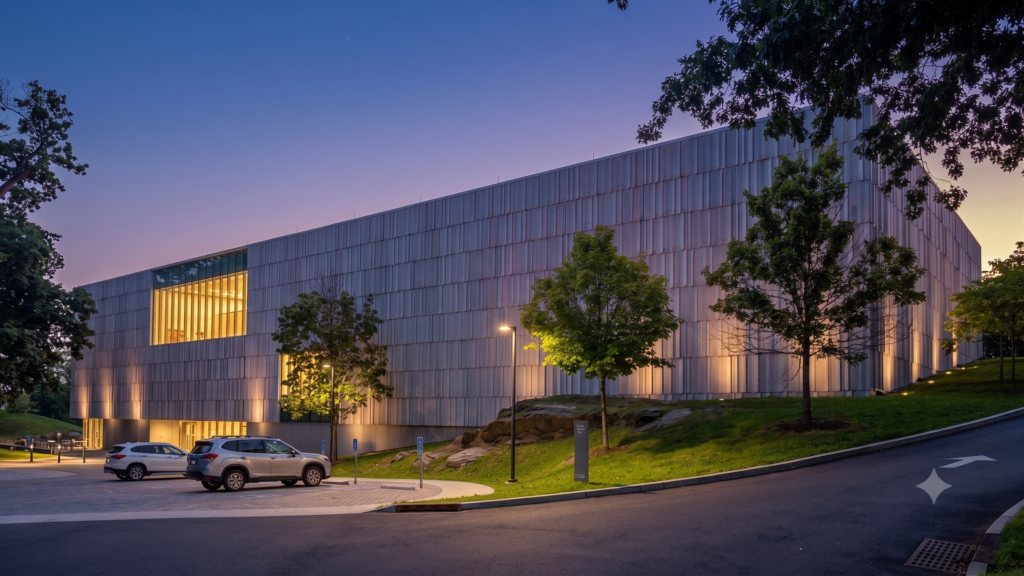
The exterior skin of the new wing is a stunning, tactile reinterpretation of a chiseled stone quarry. While using solid, quarried stone for the entire facade proved to be prohibitively expensive, the architects collaborated with precast concrete specialists to engineer a custom formwork. They created a series of unique, variegated precast concrete panels that perfectly replicate the striated, layered, and multi-textured face of a cut granite quarry.
The panels feature delicate vertical striations and varying textures that mimic the graphic contrast of naturally weathered earth. As the sun moves across the Connecticut sky throughout the day, the shifting angles of light and shadow continuously alter the appearance of the building’s face, making the exterior skin appear as a living, changing geological formation.
2. The Lace Wall Paradox
To balance the heavy, monumental mass of the quarry walls, the architects drew inspiration from another classic New England landscape feature: the loosely stacked stone fences built by early agrarian settlers as they cleared boulders from their fields. Known historically as “lace walls,” these low structures were constructed so loosely that they were famously described as being “as much air as they are stone.”
The architects translated this transparent quality into the main entrance facade of the Richter Wing. They arranged a series of precast concrete sticks within a structural stainless-steel frame. This creates a magnificent, screen-like lattice that allows natural daylight to filter through the exterior facade in a soft, dappled pattern, which is then refracted internally by a massive wall of frosted glass. The building literally breathes light, striking an extraordinary balance between monumental permanence and ethereal weightlessness.
3. Spatial Re-Orientation and the Landscape
The masterstroke of the EskewDumezRipple design was the total re-orientation of the museum’s entrance. The architects completely abandoned the noisy, northern highway-facing approach. Working in close collaboration with the renowned landscape architecture firm Reed Hilderbrand, they created a new, serene public entrance oriented directly toward the south and east, facing the rolling green expanses of Bruce Park.
Visitors now approach the museum through a carefully curated landscape of native flora and restored regional habitats. They enter a soaring, double-height, light-filled lobby that features a monumental public staircase following the natural slope of the hill.
Between the historic Victorian house and the new Richter Wing, the architects carved out an open-air light court and courtyard. Conceived as a living “diorama of the site,” this courtyard pulls the surrounding park directly into the core of the architecture, serving to orient and calm visitors as they move out of the public spaces and into the quiet collection galleries.
V. The Curatorial Canvas: Art Collections from Cos Cob to Global Modernism
The expansion of the Bruce Museum has ignited a complete revolution in its ability to display fine art. Prior to the construction of the Richter Wing, the museum’s limited gallery spaces meant it functioned primarily as a venue for temporary, traveling exhibitions; its own permanent treasures were frequently relegated to deep storage. Today, the third floor of the new wing houses over 14,000 square feet of pristine, variously proportioned gallery spaces engineered specifically to showcase a staggering array of permanent and promised masterworks.
1. The Cos Cob Art Colony Nucleus
The historical bedrock of the Bruce Museum’s fine art collection is its unparalleled holding of American Impressionism, centered around the legacy of the Cos Cob art colony. In the late nineteenth and early twentieth centuries, the Holley House in the nearby Cos Cob section of Greenwich became a legendary gathering place for the pioneers of American avant-garde painting. Master painters like Childe Hassam, John Henry Twachtman, J. Alden Weir, and Elmer Livingston McRae gathered there to break away from stiff academic traditions and paint en plein air, capturing the specific, shimmering quality of New England light bouncing off tidal rivers and historic orchards.
Because the Bruce Museum hosted the annual exhibitions of the Greenwich Society of Artists during this golden age, it systematically acquired seminal works directly from the painters. The collection includes an elite nucleus of paintings, watercolors, sketchbooks, and intimate notebooks by figures like Leonard Ochtman, Mina Fonda Ochtman, and George Wharton Edwards. These works are not merely aesthetic triumphs; they are visual documents of the precise moment when American painting liberated itself from European constraints, using rapid brushstrokes and high-key color palettes to celebrate the raw topography of the Connecticut shoreline.
2. The Modernist Explosion
Following the grand reopening of the expanded campus, the Bruce Museum unveiled an astonishing influx of fine art gifts and loans from prominent local collectors, instantly elevating the institution onto the global stage. The permanent and promised collections now boast masterworks by the undisputed titans of European and American modernism, tracing the trajectory of visual culture from 1850 to the contemporary moment.
Visitors navigating the light-filled galleries can stand before exquisite canvases by Pierre-Auguste Renoir, Henri Matisse, Paul Cézanne, and Pablo Picasso. The American modern canon is equally spectacular, featuring defining works by Winslow Homer, John Singer Sargent, and Andrew Wyeth.
A primary highlight of the new galleries is a promised gift of a pivotal, luminous portrait painted by John Singer Sargent in 1885 during his historic summer in the Cotswolds—the exact creative period that yielded his masterpiece Carnation, Lily, Lily, Rose. Furthermore, the museum holds the immense curatorial distinction of displaying the very last painting ever executed and attributed to Edward Hopper, offering scholars an invaluable look at the final, quiet thoughts of America’s master of architectural isolation and light.
The sculpture galleries have experienced an equal transformation. A dedicated, light-filled sculpture gallery featuring expansive window walls houses a magnificent collection of works by Elie Nadelman. Nadelman’s sleek, stylized, and elegantly contorted figures are illuminated by natural daylight, positioned against windows that offer sweeping views of Bruce Park and the distant glitter of the Long Island Sound.
VI. The Cabinet of Curiosities: The Science and Mineral Collections
If the third-floor galleries of the Richter Wing celebrate the heights of human artistic creation, the science galleries of the Bruce Museum explore the jaw-dropping sculptural genius of the natural world. The museum’s scientific holdings have long been recognized for their regional importance, but recent philanthropic gifts have transformed them into an international destination for geologists and naturalists.
1. The Robert Wiener Mineral Gallery: Nature’s Sculpture
The transition from the fine art galleries to the science wing is marked by a deliberate, highly dramatic shift in atmospheric design. While the art spaces are flooded with soft, diffused natural daylight, the Robert Wiener Mineral Gallery is a realm of deep, velvety darkness. Gifted to the museum by the prominent real-estate investor and collector Robert Wiener, this permanent gallery is engineered so that the architecture completely disappears, leaving only the specimens to illuminate the space.
The collection features custom, internal fiber-optic lighting systems embedded within darkened glass cases. Inside, some of the largest, most structurally perfect mineral crystals in the world glitter with intense, chromatically dazzling energy. Visitors can analyze giant, architectural formations of quartz, deep azure azurite, velvety green malachite, metallic sprays of stibnite, blood-red hematite, and layered, translucent gypsum.
Curated explicitly as “nature’s sculpture,” the gallery presents these geological wonders not merely as dry scientific data, but as profound visual compositions born of heat, pressure, and deep time, challenging viewers to see the direct connection between the geometric abstractions of modern art and the subterranean architecture of the earth.
2. Avian Collections and Permanent Science Galleries
Paralleling the mineral treasures is the museum’s historic, world-class avian collection. Initiated by early directors who meticulously documented the wildlife of the Atlantic flyway, the museum preserves an exhaustive archive of regional bird specimens, nests, and eggs.
The permanent science galleries utilize state-of-the-art interactive technology and historic, meticulously restored habitat dioramas to explore the complex ecosystems of the Connecticut shoreline and the Long Island Sound. These dioramas allow visitors to examine the hyper-specific biological adaptations of local species, tracing how changes in the regional environment directly impact the biodiversity of the area.
The global scope of the science department was spectacularly inaugurated during the grand reopening via a major, custom-curated international exhibition dedicated to the biology, evolution, and southern hemisphere habitats of penguins. This exhibition featured an expansive window wall that visually tied the specialized scientific displays directly back to the outdoor ecosystem of Greenwich Harbor, fulfilling Executive Director Robert Wolterstorff’s vision of creating an architectural and curatorial synergy where art and science enhance and illuminate one another.
VII. Real-Life Historical Anecdotes: The Highway and the Hermit
The definitive history of the Bruce Museum is enriched by several fascinating, real-life historical events that illustrate its resilience and deep integration into the changing landscape of Connecticut.
1. The Great Highway Bifurcation of 1957
One of the most dramatic and disruptive events in the physical history of the museum occurred in 1957 during the construction of the Connecticut Turnpike (I-95). When Robert Moffat Bruce originally deeded his estate to the town in 1908, the mansion was surrounded by a pristine, continuous 100-acre wilderness park that stretched gracefully down to the water.
In the mid-1950s, state infrastructure planners mapping the trajectory of the new interstate drew a line that sliced directly through the heart of the historic property. The construction of I-95 permanently bifurcated the original 100-acre estate, leaving the Bruce Museum sitting on a truncated hill, physically severed from a massive portion of its original parkland.
This historical trauma explains why the museum spent decades suffering from intense vehicular noise and difficult public access. The 2023 EskewDumezRipple expansion was, in many ways, a profound architectural act of healing, deliberately turning the building’s back on the interstate bifurcation and re-weaving its physical identity back into the surviving remnants of Bruce Park.
2. The “Wrapped” Mansion Mystery
Another fascinating architectural anomaly of the Bruce involves the physical preservation of Robert Moffat Bruce’s original 1853 home. During the massive 1992 renovation, curators and engineers faced a fierce debate over whether to demolish the old Victorian Second Empire house or preserve it. They chose a highly unusual, almost surreal compromise: instead of tearing it down or building a detached wing, the architects literally “wrapped” the historic stone house inside the new structure.
They built the modern museum walls directly around the exterior masonry of the mansion, leaving only the uppermost portions, including its distinctive slate mansard roof and chimneys, visible from the outside. To walk through certain internal corridors of the pre-2023 museum structure was an uncanny experience; visitors would look at a gallery wall, only to realize they were looking at the original, external stone window frames of the 1853 private residence, transformed into an interior partition. The 2023 master plan preserved this layered architectural history, using a light court to elegantly bridge the gap between the original Victorian core and the precast concrete quarry walls of the Richter Wing.
VIII. Conclusion: The Beacon on the Hill
The story of the Bruce Museum is an enduring narrative of visionary civic giving, multidisciplinary audacity, and architectural genius. Across its contiguous spaces—from the historic slate mansard roof of Robert Moffat Bruce’s Gilded Age sanctuary to the chiseled precast concrete panels of the Richter Art Wing—the institution stands as a physical manifestation of human curiosity. By maintaining its strict, dual commitment to both art and science, the Bruce breaks down the false dichotomy between the aesthetic and the analytical, proving that both fields are vital pathways toward understanding the complexities of our changing world.
Through its brilliant re-orientation toward Bruce Park, its light-filled galleries hosting global modernist masters, and its dark, glittering mineral vaults, the Bruce Museum has honored its historic 1908 mandate while completely redefining the role of a regional museum in the twenty-first century. It stands high on its hill overlooking Greenwich Harbor, not as a static repository of the past, but as a welcoming, dynamic beacon of discovery, inspiration, and community learning for generations to come.
Monographic References and Sources
-
Primary Architectural Profile: The Bruce Museum Expansion and Renovation Project Analysis, EskewDumezRipple (EDR) Architecture Archives, New Orleans, LA.
-
Institutional Historical Records: The Legacy and Bequest of Robert Moffat Bruce, Historical Curation Archives, The Bruce Museum, Greenwich, CT.
-
Critical Architectural Review: “Greenwich’s Bruce Museum Reopens with a Triumphant Redo,” National Review, June 3, 2023.
-
Exhibition and Collection Mapping: The William L. Richter Art Wing and Robert Wiener Mineral Gallery Permanent Installation Briefs, The Bruce Museum.
-
Landscape Architecture Profile: Bruce Park Habitat Restoration and Museum Integration, Reed Hilderbrand Landscape Architecture Notes, Cambridge, MA.
