
THE SANCTUARY OF THE LIVING CANVAS
The Definitive Chronicle of The Aldrich Contemporary Art Museum: History, Radical Evolution, and Fascinating Real-Life Encounters
I. Introduction: The Rebellion Against the Fixed Frame
In the pristine, historic landscape of Ridgefield, Connecticut, along a stretch of Main Street dominated by classic New England architecture, sits an institution that operates as a direct challenge to the traditional concept of a museum. Most art museums are built to be cultural vaults—permanent, climate-controlled fortresses designed to safeguard an unchanging collection of dead masters for eternity. They are spaces where history is fixed, frames are bolted to the walls, and the past is worshipped.
The Aldrich Contemporary Art Museum turns this paradigm entirely on its head.
Founded in 1964, The Aldrich holds a rare and uncompromising position in the global art ecosystem: it is one of the very few independent, non-collecting contemporary art museums in the United States, and the only museum in the state of Connecticut solely dedicated to the acquisition and display of contemporary art.
To say that The Aldrich is “non-collecting” means something radical in practice: the museum has no permanent collection. It owns no vaults of hidden canvases, no multi-million-dollar oil paintings locked away in dark basements, and no permanent exhibits.
Instead, the entire institution functions as a shifting, breathing laboratory for the immediate present. Every single gallery space within its walls changes constantly, cycling through a relentless rhythm of temporary exhibitions that showcase emerging artists, newly created, thought-provoking works, and experimental installations that have often never been seen anywhere else on Earth.
To walk into The Aldrich is to step onto a high-wire act of absolute curatorial risk. Because the museum is not anchored by the safety net of a famous historical collection, its survival depends entirely on its ability to anticipate the cultural zeitgeist. It is an institution built not on preservation, but on trust in the living artist.
Over its history, this fearless approach has allowed a quiet, suburban Connecticut museum to serve as the launching pad for some of the most iconic titans of modern culture. Long before they became household names, revolutionary figures like Eva Hesse, Robert Smithson, Frank Stella, Jack Whitten, Olafur Eliasson, and KAWS had their first major solo museum exposures within this specific geography.
The definitive story of The Aldrich is a chronicle of a high-fashion mogul who liquidated his personal fortune to fund a dream, a historic building that transitioned from a Revolutionary War outpost to a temple of the avant-garde, and a series of fascinating, hallucinatory, and real-life artistic encounters that regularly blur the line between reality and illusion.
II. The Visionary Spark: Larry Aldrich and the Pop Art Liquidations
The existence of this vanguard sanctuary is due entirely to the eccentric drive and aesthetic obsession of its namesake: Larry Aldrich (1906–2001). Born in Manhattan as Larry Orlevich to Russian Jewish immigrants, Aldrich did not begin his adult life in the halls of academia or art history. At the age of 18, while preparing to attend Columbia University to pursue a traditional career in law, he took a summer job as a salesman for a local dress manufacturer.
He discovered he possessed an innate, genius-level understanding of fabric, silhouette, and the rapidly shifting desires of the American public. Within two years, he had organized his own fashion firm, and by the 1940s and 1950s, the “Larry Aldrich” label was an absolute titan of Seventh Avenue, producing sophisticated women’s apparel that competed directly with Parisian couture.
As his fashion empire generated immense capital, Aldrich developed a secondary obsession: art collecting. Prompted and encouraged by his wife, Wynn Payne, Aldrich began making bold art purchases in the late 1930s. He initially amassed a world-class collection of European Impressionist and Modern masterworks, filling his private residences with pristine original canvases by Claude Monet, Paul Gauguin, Pablo Picasso, Joan Miró, and Marc Chagall.
By the 1950s, however, Aldrich grew bored with looking backward. He realized that the same creative electricity that drove the silhouettes of fashion was happening in the raw, gritty lofts of the burgeoning New York contemporary art scene. He befriended Alfred H. Barr Jr., the visionary director of the Museum of Modern Art (MoMA), and began directly funding a purchase program at MoMA specifically to buy works by totally unknown, emerging contemporary artists, stipulating that no single work could cost more than $1,000.
As Aldrich’s personal holdings of cutting-edge contemporary art swelled, he realized that mainstream institutions were too slow, too rigid, and too bogged down by bureaucratic tradition to properly showcase the explosion of new media. He decided he needed to build his own museum—one that would be completely unbound by the past.
To fund this unprecedented gamble, Aldrich executed a move that stunned the art world: he put his entire, prized collection of classic modern masters up for auction. In a historic sale through Parke-Bernet in 1963, he liquidated his Picassos, Mirós, Chagalls, and Klees, generating a massive cash fortune of $1.3 million. He took this capital, walked away from the historic European canon, and invested it into a small, historic town in Connecticut where he maintained a summer residence, establishing the Larry Aldrich Museum in 1964.
III. Architectural Transformations: From “Old Hundred” to the Modern Pavilion
The physical footprint of The Aldrich is itself a fascinating historical palimpsest, representing a literal bridge between the birth of the American republic and the contemporary moment. The museum originally opened within a landmark structure known locally as “Old Hundred,” located at 258 Main Street.
Built in 1783 by two lieutenants returning home from the Revolutionary War, this heavy-beamed, post-and-beam classic New England structure possessed a remarkably eclectic civic history. Over its two centuries of existence before Larry Aldrich purchased it, “Old Hundred” had served sequentially as a grocery store, a hardware depot, a private residence, and a Christian Science church.
When Aldrich retrofitted the interior to hold avant-garde art, it created a striking aesthetic friction. Visitors walked across wide-plank, historic New England floorboards and beneath colonial-era hand-hewn timber rafters to view the raw, challenging Minimalist sculptures of Eva Hesse or the bold Pop Art silk-screens of Frank Stella.
By 1981, the museum’s leadership made a monumental, permanent philosophical choice: they voted to sell off the museum’s existing permanent collection entirely. They realized that to keep a permanent collection clean, insured, and safely stored was draining the vital resources needed to fulfill Larry Aldrich’s true mandate—championing the immediate present. From that moment on, The Aldrich officially became a pure, non-collecting institution.
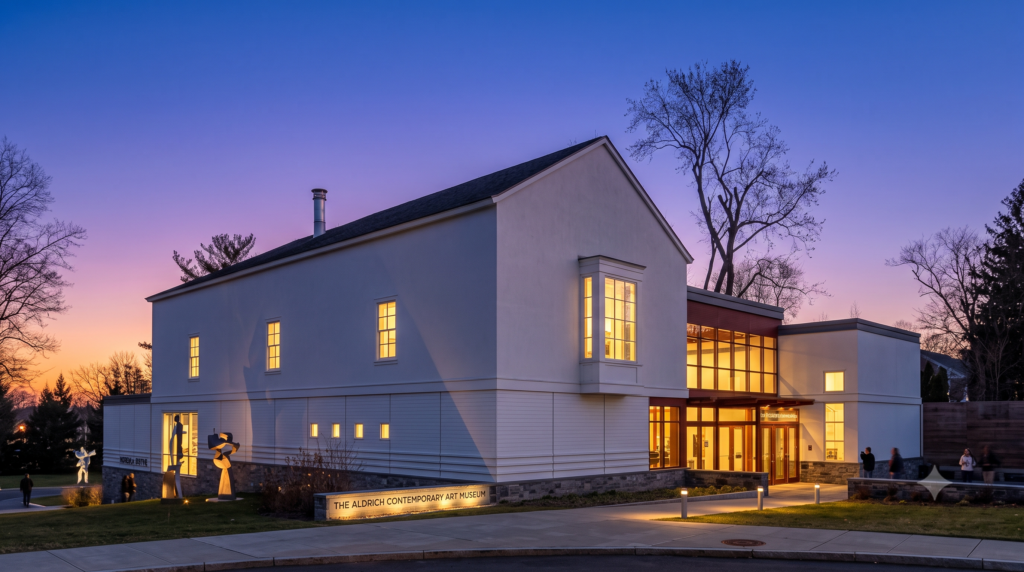
As the twenty-first century arrived, the structural limitations of the historic “Old Hundred” building could no longer keep pace with the massive scale of late-twentieth-century installation art. The museum commissioned the architect Charles Mark Hay to design a completely new, state-of-the-art museum pavilion directly adjacent to the historic house.
Opened in June 2004, the new 17,000-square-foot facility is an award-winning masterclass in contextual modern architecture. Hay designed the exterior lines of the building to echo the traditional pitch-roofed gables and massing of classic New England barns and farmhouses, but executed the structure in sleek, contemporary materials.
The interior features two full floors of sprawling, high-ceilinged, and completely open galleries that allow for infinitely adaptable layouts, while the historic “Old Hundred” building was preserved to serve as the museum’s administrative core.
This spatial evolution reached another milestone with a $3.25 million project that vastly expanded the museum’s outdoor footprint, adding an amphitheater, a dedicated pollinator pathway, and a completely renovated sculpture garden engineered to showcase heavy, site-specific outdoor installations right on the Ridgefield soil.
IV. Fascinating and Hallucinatory Artistic Encounters
Because The Aldrich has operated for over sixty years as a laboratory where artists are given total freedom to intervene within the architecture and grounds, the museum’s history is peppered with extraordinary, real-life artistic events that sound like hallucinations but are entirely true facts of record. The non-collecting nature of the space means that artists do not merely hang pictures; they transform the environment into an immersive psychological realm.
1. Andrea Dezsö’s Haunted Ridgefield (2011)
In late 2011, the museum launched a highly unique, site-specific exhibition that directly engaged with the regional folklore, fears, and historic ghost stories of Connecticut. Created by the Transylvania-born contemporary artist Andrea Dezsö, the exhibition was titled Haunted Ridgefield and was mounted as part of the museum’s celebrated Main Street Sculpture Project.
Dezsö, deeply inspired by the documented ghost stories and unexplained local lore of the state, constructed a series of giant, multimedia “tunnel books” and intricate, labor-intensive diorama panels that were installed directly inside the windows of the historic 1783 “Old Hundred” administrative building.
Visible to the public from the street outside, the installation opened precisely on Halloween night—a date Dezsö chose because she described it as the specific time when humanity can “trespass across the barrier between the world of the living and the world of the dead.”
The historic building was populated by strange, child-like, and surreal creatures cut from delicate panels, surrounded by dark motifs of nature, spider webs, and invasive creeper plants. To blur the line between art and reality, Dezsö extended the artwork directly into the physical architecture of the 1783 building itself, carving intricate, Victorian-like decorative fretwork, deadly beautiful corbels, and bracket ornaments that she mounted onto the exterior porch.
For months, passing traffic and late-night pedestrians on Main Street were confronted by a historic colonial structure that appeared to be physically manifesting the hallucinations and psychological shadows of its own past.
2. Nickola Pottinger’s Fos Born and the Jamaican “Duppies”
The museum’s dedication to showcasing deeply spiritual and unvarnished explorations of the uncanny is further exemplified by the solo exhibition of New York-based artist Nickola Pottinger. Pottinger’s practice is rooted in a highly personal, speculative procedure that borders on spiritual channeling.
She constructs complex, humanoid reliquary sculptures that she refers to explicitly as “duppies”—a direct reference to the chimeric, night-walking spirits and ghosts of Jamaican folklore.
Pottinger’s “ghosts” possess an intensely raw, physical presence that staff and visitors have described as both deeply hypnotic and quietly unsettling. She creates these spirits by using an anarchic panoply of materials that intentionally toe the line between trash and treasure: discarded furniture, animal bones, bird cages, gilded Yagua leaves, and actual teeth.
Crucially, she drapes these structures in a deeply personal material matrix: a thick, pigmented paper pulp that she creates by manually grinding her own family documents, personal rubble, and first drafts using her mother’s handheld kitchen mixer.
Pottinger has stated that she does not enter her studio with a rational plan to sculpt a specific form; instead, she experiences a literal channeling process while working with her hands that takes her to an entirely different mental space, building up the sculptures only to physically break or throw them down before reconstructing them again.
Displayed across three contiguous rooms at The Aldrich, these textured, organic spirit-vessels carry a heavy, relic-like energy, inviting viewers into an intimate space where family history and the supernatural are permanently braided together.
V. The Historical Titans: Eva Hesse and the Risk of the New
The true, definitive caliber of The Aldrich can only be fully measured by looking back at the historic risks the museum took when those risks were dangerous to an academic reputation. Because Larry Aldrich established a museum completely unburdened by a permanent collection, the curators were free to act as absolute talent scouts, hunting for ideas that mainstream institutions dismissed as unformed or anti-art.
The most profound example of this occurred in the late 1960s with the championing of Eva Hesse. Hesse was a young German-American artist who was completely dismantling the stiff, industrial, and geometric rules of male-dominated Minimalism. Rather than constructing cold cubes out of steel or copper, Hesse began using highly unstable, organic, and industrial materials like fiberglass, latex, cheesecloth, and rope. Her work was fleshy, absurd, deeply psychological, and intentionally fragile—she knew the latex would eventually oxidize, yellow, and crumble over time.
Mainstream museums refused to touch her work because they couldn’t guarantee its physical permanence; it was a conservative conservator’s worst nightmare.
The Aldrich stepped forward and gave Hesse some of her earliest, most critical museum exposures, recognizing that the temporary nature of her materials was precisely what made her work a vital expression of the human condition.
The same institutional fearlessness applied to Robert Smithson, the pioneer of Earthworks. Long before he constructed the monumental Spiral Jetty in the Great Salt Lake, Smithson was exploring his radical theories of “Entropy”—the natural slide of all matter into chaos—by exhibiting his early “Non-Sites” (bins of raw rocks and earth paired with maps) inside the historic rooms of The Aldrich.
By providing a venue where an artist could bring the physical, dirty reality of the earth indoors, The Aldrich permanently altered the trajectory of American sculpture.
VI. The Museum as a Pure Creative Incubator
The contemporary operational philosophy of The Aldrich is anchored to the concept of the museum as a pure, active laboratory. Because the exhibition roster is in a state of perpetual velocity, the building operates under a distinct physical tension. On any given day, an entire wing of the museum might be completely walled off, echoing with the sounds of circular saws, pneumatic nail guns, and artists arguing with engineers as a site-specific installation is built from scratch directly into the drywall.
This intense artist-centric focus means that the traditional barrier between the creator and the public is dismantled. Under the direction of curators like Chief Curator Amy Smith-Stewart, the museum operates as an active incubator for artists at critical, transitional moments in their careers.
The museum does not wait for an artist to be validated by the commercial market of New York or Europe; it steps into the studio when an artist is taking a terrifying, unproven leap into a new medium or a massive scale expansion.
This creates a highly unique environment for the visitor. When you walk through the Charles Mark Hay pavilion, you are not consuming a curated, historical narrative that has been pre-digested by generations of art critics. You are standing on the front lines of visual experimentation, confronted by objects and ideas that are raw, urgent, and unmapped.
VII. Conclusion: The Eternal Present
The story of The Aldrich Contemporary Art Museum is an enduring testament to the power of a single, radical idea: that art is a living, breathing human act that belongs strictly to the present moment. Across its contiguous campus—from the historic 1783 timbers of “Old Hundred” where Andrea Dezsö’s handmade monsters peeked through the windows, to the vast, light-filled modern galleries holding Nickola Pottinger’s hand-ground paper “duppies”—the institution honors its founding legacy by refusing to leave a permanent footprint.
By maintaining its strict, non-collecting mandate, The Aldrich remains forever young. It is an institution that intentionally chooses to reinvent itself every single season, casting off its immediate past to clear the walls for the next wave of human curiosity and creative dissent. It stands as a vital national monument to the beauty of risk, serving as an irreplaceable sanctuary where the living artist is always present, always protected, and always free to challenge how we define our shared reality.
Monographic References and Sources
-
Primary Curatorial Records: Nickola Pottinger: Fos Born Exhibition Curation and Material Specifications, The Aldrich Contemporary Art Museum, Ridgefield, CT.
-
Historical Legal & Foundational Records: The Larry Aldrich Purchase Program and Museum Founding Charter of 1964, Institutional Archives, 258 Main Street, Ridgefield, CT.
-
Architectural Records: Hay, Charles Mark. The Modern Barn: Contextual Architecture and Light Diffusion in the 2004 Aldrich Exhibition Pavilion, Architectural Review Series.
-
Exhibition Documentation: Andrea Dezsö: Haunted Ridgefield, Main Street Sculpture Project Archives, November 2011, The Aldrich Contemporary Art Museum.
-
Biographical Profiles: Larry Aldrich: The Seventh Avenue Mogul Who Capitalized Contemporary Art, Fashion and Fine Arts Historical Review.
