
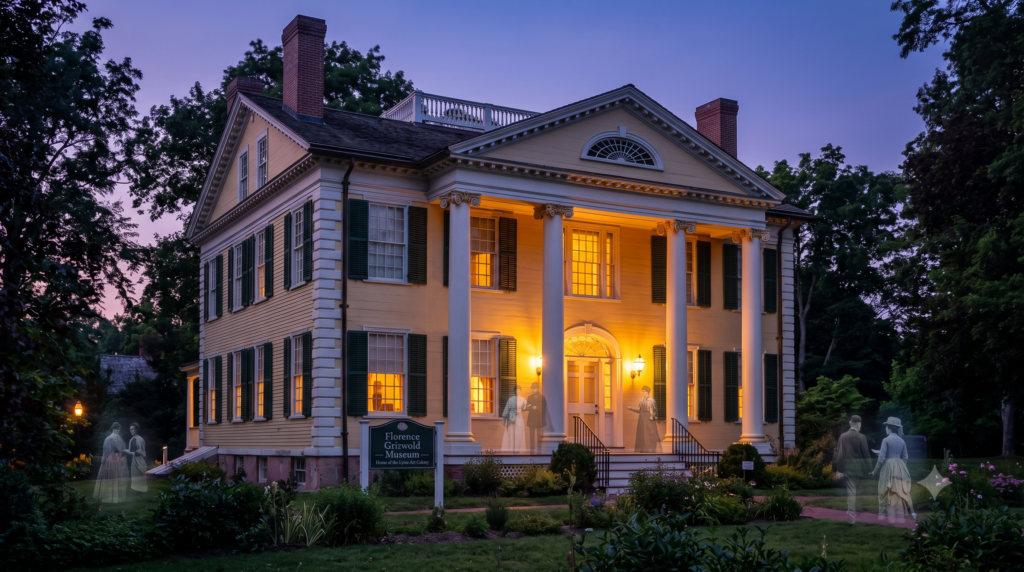
THE GIVERNY OF AMERICA
The Definitive Chronicle of the Florence Griswold Museum: History, Masterpieces, and the Eccentric Ghosts of the Lyme Art Colony
I. Introduction: The Ancestral Mansard on the Lieutenant River
To the uninitiated traveling down the tree-lined expanse of Lyme Street in Old Lyme, Connecticut, the building at number 96 looks like the quintessential archetype of New England patrician elegance. It is a stately, double-chimney, late Georgian-style mansion fronted by a monumental, pristine white-clapboard pedimented portico supported by four soaring fluted columns. Housed within a rolling thirteen-acre estate that slopes gently down to the brackish waters of the Lieutenant River, the structure exudes an aura of quiet, ancestral New England decorum.
Yet, beneath this immaculate, high-born classical facade lies the history of an absolute cultural revolution. This house was not a static mausoleum for the wealthy elite; it was the ultimate incubator, playground, and communal laboratory for the radical movement that permanently changed the course of visual expression in the Western Hemisphere.
This is the Florence Griswold Museum. Known universally to art historians as the “Giverny of America,” this specific geography stands as the undisputed, hallowed birthplace of American Impressionism.
At the turn of the twentieth century, between the years of 1899 and the late 1930s, this historic house operated as a boisterous, chaotic, and intensely collaborative boardinghouse for artists. Run by a single, self-reliant, and fiercely independent proper Victorian spinster named Florence Ann Griswold—known affectionately to her legions of subversively brilliant guests simply as “Miss Florence”—this estate hosted over 135 of America’s finest painters. It became the largest, most coherent, and most famous art colony in the United States.
What occurred within these walls was an unprecedented artistic phenomenon. Rather than confining their creative impulses to temporary stretched flax canvas, the resident artists—pioneers like Childe Hassam, Willard Metcalf, Henry Ward Ranger, and Henry Rankin Poore—turned the very structural fabric of the house into an artistic canvas. They painted directly onto the wooden door panels, the baseboards, and the large mantels of the dining room and hallways, creating a permanent, architectural ensemble of forty-three unique painted panels that represents the most complete, physically integrated material expression of an American art colony in existence.
But the definitive story of the Florence Griswold Museum is not merely a dry academic timeline of short, flickering brushstrokes and pigment analyses. It is a dense, colorful chronicle of a high-society matriarch who went broke feeding her beloved “boys,” late-night spelling bees, elaborate practical jokes involving baying hound dogs, and a lingering, spectral aura of eccentric artists who loved this salt-marsh paradise so deeply they refused to vacate the premises upon their deaths. This is the definitive narrative of the house where American art learned to capture the light.
II. The Gentle Fall of the House of Griswold: Financial Necessity Meets High Culture
To fully comprehend how this pristine mansion transformed into a bohemian sanctuary, one must examine the socio-economic collapse of the Griswold family line. Florence Ann Griswold was born into the absolute upper crust of Connecticut aristocracy on Christmas Day, 1850. Her ancestral lineage was impeccable: she was a direct descendant of Matthew Griswold, the founding puritan settler who secured land on the eastern shore of the Connecticut River in the 1640s. Her father, Captain Robert Harper Griswold, was a wildly successful and wealthy packet ship master who sailed the high seas on elite New York-to-London trade routes.
In 1841, Captain Griswold purchased the grand late-Georgian mansion on Lyme Street. Designed in 1817 by the celebrated regional architect Samuel Belcher, the house was a manifestation of seafaring wealth, decorated with imported silks, expensive European furniture, and pristine porcelain. Florence and her sisters grew up in an environment of absolute comfort, receiving elite educations in music, French, and literature.
However, the late nineteenth century brought a swift, brutal economic decline for the Griswold estate. The advent of steamships rendered the old packet sailing ships obsolete, wiping out Captain Griswold’s career. Misfortune compounded upon misfortune, and by the time the Captain passed away, the family fortune had completely evaporated.
Left with an enormous, tax-heavy mansion and absolutely no liquid capital, Florence, her mother, and her sisters were forced to adapt to survive. They did what many impoverished Gilded Age gentlewomen did: they opened a school for young ladies within the home. When that venture failed to generate a sustainable income, Florence made a choice that pushed the boundaries of proper Victorian domesticity: she began placing advertisements in local newspapers to sell homegrown pansy and rose plants, and she opened her ancestral home to summer boarders.
At first, the boarders were standard tourists seeking respite from the oppressive summer heat of New York and Boston. But the destiny of the house shifted permanently in the blazing summer of 1899. An artist named Henry Ward Ranger, a leading practitioner of the Tonalist style of landscape painting, arrived in Old Lyme. Looking at the salt marshes, the weathered historic farmhouses, the rugged stone walls, and the dramatic, shifting light where the Connecticut River meets the Long Island Sound, Ranger recognized an American equivalent to the Barbizon forest of France. He knocked on Miss Florence’s door, fell in love with her gracious, unpretentious hospitality, and declared that the Griswold house would become the home base for a new, uniquely American art colony.
III. The Tonalist Dawn and the Impressionist Explosion
When Henry Ward Ranger returned to Old Lyme in the spring of 1900, he brought a vanguard entourage of his closest artist friends. The initial iterations of the Lyme Art Colony were dominated by the Tonalist aesthetic. The Tonalists were obsessed with mood, atmosphere, and spiritual mystery. They rejected bright, garish primaries, preferring instead to paint landscapes saturated in a limited, tightly controlled palette of muted ochres, olive greens, deep umbers, and moody grays. They coated their completed canvases in heavy layers of tinted yellow varnish to give the paintings an artificially aged, golden-hour twilight glow that evoked a sense of quiet nostalgia.
But the conceptual soul of the colony experienced a sudden, seismic shockwave in the summer of 1903 with the arrival of Childe Hassam. Hassam was an established, internationally revered master who had spent years working in Paris, completely absorbing the radical, light-shattering techniques of French Impressionists like Claude Monet and Auguste Renoir. Hassam took one look at the moody, dark Tonalist canvases drying in Miss Florence’s outbuildings and essentially threw open the windows to let the sun shine in.
Hassam brought a robust, brilliant Impressionistic manner to Old Lyme, utilizing bright, unblended primary colors and thick, short, stabbing brushstrokes that seemed to vibrate and flicker with energy on the canvas. Rather than looking backward through a golden, nostalgic haze, Hassam painted outdoors in the open air, capturing the immediate, blinding brilliance of natural light bouncing off the white clapboard of the local Congregational church and the wild, untamed mountain laurel blooming along the riverbanks.
Hassam’s high-key, energetic color palette completely seduced the younger artists staying at the boardinghouse. Within two summers, the Tonalist dominance evaporated, and Old Lyme transformed into the undisputed capital of American Impressionism. Miss Florence’s estate became an absolute beehive of creative kinetic energy. Artists converted old chicken coops, barns, and riverside outbuildings into rustic studios, waking up at dawn to scatter across the local pastures with their easels strapped to their backs, chasing the shifting New England light.
IV. The Funny and Weird: The Wiggle Game, The Knockers’ Club, and Boardinghouse Chaos
Life inside Miss Florence’s boardinghouse was far from an austere, quiet academic retreat. It was a boisterous, often hilarious fraternity house for high-spirited, eccentric adult creatives. Miss Florence, operating with infinite patience, essentially adopted these men, referring to them affectionately as “her boys” and giving them absolute freedom to treat her ancestral home as a giant playground.
The Infamous “Wiggle Game”
Every evening, after consuming a massive, hearty dinner cooked by Miss Florence and served on credit, the artists would gather in the parlor to blow off steam. Their favorite competitive activity was a bizarre puzzle-game known as the “Wiggle Game.”
The rules were deceptively simple: one artist would take a blank piece of paper and draw three or four completely random, wavy, disconnected lines. The paper would then be passed to the next artist, who was given a strict time limit to use those exact lines as the mandatory foundation for a complete, highly detailed, and usually incredibly funny or satirical drawing. The artists competed fiercely to see who could come up with the most absurd, clever, or grotesque visual solutions. Miss Florence meticulously saved these drawings, binding them into a massive, preserved scrapbook of wiggles that offers a rare, intimate look at the brilliant, unvarnished humor of America’s master painters operating away from the stiff expectations of New York galleries.
Whistling Mary and the Dining Room Tribunal
Because the artists would become so intensely absorbed in their outdoor painting sessions along the Lieutenant River, they would frequently lose all track of time, completely ignoring the clock and letting Miss Florence’s meticulously prepared hot meals go cold. To solve this, the boardinghouse utilized a colorful local woman known to history as “Whistling Mary.”
Whenever breakfast, lunch, or dinner was plated and ready, Mary would step out onto the grand side porch of the mansion armed with a massive, gleaming tin horn. She would blast a deafening, echoing signal across the salt marshes and pastures, alerting the scattered artists that it was time to drop their palettes, pack up their oils, and sprint back to the house for sustenance.
Once inside the dining room, the atmosphere transformed into a comedic, high-stakes art critique tribunal known as the “Knockers’ Club.” Painted directly onto the brick of the dining room fireplace was the official crest of this exclusive, self-appointed group. The “Knockers” were the established, core artists of the colony who took it upon themselves to ruthlessly critique and mock the work of any new or overly arrogant painter who joined the table. Rather than utilizing their names, each artist in the club was represented on the dining room walls by a specific, humorous symbol. The critiques were brutal, witty, and deeply therapeutic, serving to deflate elite artistic egos and maintain a spirit of absolute egalitarian camaraderie within the house.
V. The Spooky: Spectral Oils and the Phantom Music of Miss Florence
With a history so deeply saturated in intense emotional expression, bohemian lifestyle, and a profound, near-religious obsession with the physical landscape, the Florence Griswold Museum has long harbored a reputation for unexplainable, supernatural activity. The hauntings reported by modern staff, curators, and overnight caretakers are uniquely artistic, characterized by aesthetic residue and acoustic echoes from the boardinghouse’s golden age.
The Scent of Turpentine in Dead Winter
One of the most persistent, unexplainable phenomena reported by museum security guards and curatorial staff involves the sense of smell. During the deep, freezing depths of the Connecticut winter, when the historic house is locked tight, completely empty of public visitors, and under strict climate-control protocols that forbid the use of any volatile chemical compounds, people have suddenly stepped into the historic hallways only to be hit by an overwhelming, vivid wave of fresh linseed oil, turpentine, and wet oil paint.
The scent is not a stale, dusty odor; it is the sharp, aromatic smell of a studio actively in use. The scent frequently manifests near the old attic stairs, where Miss Florence famously divided the cramped upper quarters into tiny, rustic bedrooms for her impecunious young guests. It is as if the intense, creative output of the over 135 artists who slaved over their canvases under those rafters left a permanent, chemical scar on the ambient atmosphere of the house, replaying itself across time when the building falls silent.
The Midnight Piano of the Empty Parlor
Miss Florence was an accomplished pianist, and during the boardinghouse era, she would close out almost every single evening by sitting at her grand piano in the parlor, playing classical music, ragtime, or leading the artists in boisterous, alcohol-fueled sing-alongs.
Long after her death in 1937, multiple caretakers and neighbors walking past the dark, locked mansion late at night have reported hearing the faint, distinct, and highly expressive sound of piano keys being struck within the empty parlor. The music is described most frequently as a melancholic, beautifully rendered Chopin nocturne. When security teams investigate, entering the pitch-black room with flashlights, the music instantly cuts out, and the piano’s heavy wooden fallboard is always found firmly closed and locked over the keys.
The Shifting Shadows of the Dining Room Panels
The dining room, entirely paneled in forty-three original paintings executed directly onto the wood by the artists, is the hotbed of the museum’s eerie lore. Night-shift guards have long whispered that the room possesses a heavy, highly charged atmosphere. During nights of a full moon, when the bright moonlight streams through the historic multi-pane windows and bathes the painted walls, observers have claimed that the painted figures—the grazing cows, the silhouetted trees, and the small figures walking down Lyme Street—seem to possess a depth and a subtle, shifting quality that defies traditional optics.
The most specific legend centers around Willard Metcalf’s masterpiece May Night (1906). Though the actual canvas resides in a gallery, the site where Metcalf conceived the piece—the front lawn of the mansion—is viewed by locals as a place where the barrier between past and present is paper-thin. People walking the grounds at night have reported catching fleeting glimpses of a tall, slender woman dressed in a long, white Victorian evening gown drifting silently through the historic orchards, vanishing into the mist of the Lieutenant River just as you turn to look directly at her.
VI. Technical and Curatorial Master-Analysis: The Architectural Masterpieces
The true material genius of the Florence Griswold Museum is found by looking closely at the doors and walls of the historic house itself. The collection of painted panels is not a random assortment of decorative doodles; it is a highly competitive, masterfully executed physical archive of a living art colony.
The Genesis of the Panel Tradition: The Bow Bridge Duel
The historic tradition of painting on the fabric of the house began purely by accident and a flash of creative bravado in the summer of 1900. Henry Ward Ranger, having claimed the master bedroom of the house, decided to decorate the right-side wooden panel of his bedroom door. He painted a moody, deep Tonalist landscape depicting the Bow Bridge, the rustic wooden structure that crossed the Lieutenant River directly behind the house.
Ranger, proud of his work, stepped into the hallway and issued a direct challenge to his close friend and rival painter, Henry Rankin Poore. He challenged Poore to paint a complementary scene on the left-side panel of the exact same door that matched his sophisticated composition, color palette, and atmospheric tone. Poore rose to the challenge beautifully, painting a striking composition titled Hound Dog Baying at the Moon. The painting integrated perfectly with Ranger’s bridge landscape, setting an incredibly high bar for material craftsmanship.
Once word spread through the boardinghouse, a wave of creative competition exploded among the guests. Every artist wanted to leave their permanent mark on the house, and once the bedroom doors were completely filled, the colony officially moved their brushes into the grand dining room, transforming it into a complete, immersive artistic installation.
Henry Rankin Poore’s The Fox Chase (1901–1905)
The grandest, most famous single panel in the entire house is the monumental, eight-foot-long overmantel painting located directly above the dining room fireplace, executed by Henry Rankin Poore with minor interventions by his peers. Titled The Fox Chase, this painting is a brilliant, highly sophisticated masterpiece of inside-art humor and caricature.
The painting is a parody of the traditional English fox-hunting prints that hung over the fireplace. Rather than showing aristocratic red-coated British lords on horseback, Poore depicts a chaotic, literal stampede of the Lyme Art Colony artists themselves, running down Lyme Street in a state of absolute, madcap hysteria, chasing a lone fox into the salt marshes.
The level of caricatured detail is extraordinary: Childe Hassam is depicted near the front of the pack, completely ignoring the fox, instead painting frantically on a canvas while running at full speed. Henry Ward Ranger is shown as a massive, commanding figure, standing in the middle of the road like an orchestra conductor, trying to direct the chaotic traffic of his bohemian disciples. Miss Florence herself is subtly included, standing on the distant porch of her mansion, watching her unruly guests slide into the mud with an expression of amused resignation.
The painting is a technical masterclass in narrative composition, tying the entire spatial architecture of the dining room together and serving as a permanent, immutable testament to the sense of joy, mutual critique, and unadulterated madness that fueled the colony’s everyday life.
VII. The Legend of May Night: The Painting That Saved Miss Florence
No chronicle of the Florence Griswold Museum is definitive without telling the story of the great financial crisis of 1906 and the masterpiece born of it. By the spring of that year, Miss Florence’s absolute refusal to enforce proper business practices had brought her to the absolute brink of total bankruptcy. She was a terrible businesswoman: she routinely charged her artists such shockingly low rent that it failed to cover the cost of the groceries she bought for them. If an artist was broke and couldn’t pay, she would simply extend them infinite credit, smile, and refuse to let them leave hungry. She bought high-grade provisions on credit from local merchants, piling up a mountain of personal debt to ensure her guests had everything they needed to create.
Recognizing that their beloved patron was about to lose her ancestral home to the banks, a brilliant, struggling artist named Willard Metcalf decided to execute a high-stakes creative gamble. He spent weeks working deep into the night on the front lawn of the estate, painting a large canvas titled May Night (1906).
The painting is an absolute triumph of American Impressionism. It captures the front portico of the Griswold mansion bathed in a thick, ethereal, and shimmering silver moonlight. The columns glow with a ghost-like brilliance, and two mysterious, silhouetted women in evening gowns drift across the shadow-flecked lawn. It is an image of profound poetry, capturing the essence of old New England romance and the fading grandeur of the Griswold line.
When the canvas was dry, Metcalf walked into the parlor and offered May Night to Miss Florence as absolute payment for his entire, massive back-rent debt. Miss Florence stood before the painting, tears in her eyes, and made a choice that typified her extraordinary character: she flatly refused to accept it. She looked at Metcalf and said:
“Willard, this painting is far too valuable for me to take. It is the finest thing you have ever executed. Take it to New York, sell it, and it will make your career.”
Metcalf obeyed. In 1907, May Night was exhibited at the Corcoran Gallery of Art’s inaugural exhibition of contemporary American art in Washington, D.C.. It won the prestigious First Prize and the Corcoran Gold Medal, and it became the first-ever contemporary American painting purchased by the Corcoran Gallery, commanding a historic price of $3,000—an astronomical fortune for an American landscape at the time.
The massive media coverage launched Metcalf into international superstardom. True to his bond, Metcalf funneled a significant portion of his newfound wealth back to Old Lyme, completely wiping out Miss Florence’s debts and permanently saving the boardinghouse from the auction block. Art had literally stepped forward to save the sanctuary that birthed it.
VIII. The Contemporary Era: The Krieble Gallery and the Unified Campus
The Florence Griswold Museum has refused to remain frozen in time as a static historic house museum. Following Miss Florence’s passing in 1937, a dedicated coalition of former art colony artists, local preservationists, and trustees formed the Florence Griswold Association, working over multiple decades to systematically repurchase and reunite the pieces of her original property that had been divided and sold off.
The modern crown jewel of this spatial preservation strategy is the Robert and Jane Krieble Gallery, completed in 2002. Designed by the internationally acclaimed, award-winning firm Centerbrook Architects & Planners, this state-of-the-art, 10,000-square-foot pavilion sits a comfortable distance away from the historic house, nestled directly along the banks of the Lieutenant River.
The architecture of the Krieble Gallery is a brilliant exercise in context-sensitive design: it features a long, low, horizontal profile wrapped in vertical wood siding that evokes the form of a traditional New England riverfront barn or artist’s studio, while utilizing vast curtain walls of glass that look out onto the marshlands, allowing visitors to instantly compare the paintings on the walls with the living landscape that inspired them.
Internally, the Krieble Gallery provides world-class, museum-grade climate control and lighting systems that allow the museum to host changing exhibitions of global caliber. The museum’s holdings received a massive expansion in 2001 with the donation of the legendary Hartford Steam Boiler Inspection and Insurance Company collection—a pristine, 190-piece corporate treasury of historic American art. This gift, paired with the museum’s preeminent Lyme Art Colony Collection, elevated the institution into a premier national center for the study of American art, bridging the gap between eighteenth-century portraiture and early twentieth-century modernism.
IX. Conclusion: The Living Palette
The story of the Florence Griswold Museum is an enduring narrative of radical hospitality, architectural transformation, and creative genius. Across its contiguous thirteen acres, the site bridges the gap between historic memory and living contemporary engagement. It stands as a physical manifestation of an era when a group of high-spirited artists looked at a changing, industrializing nation and chose to retreat to a salt-marsh paradise to capture the fleeting, absolute beauty of light and air.
By preserving the original Georgian boardinghouse with its forty-three chiseled, painted panels, restoring Miss Florence’s beloved historic gardens and orchards, and hosting avant-garde contemporary scholarship within the glass walls of the Krieble Gallery, the museum honors its rich legacy while continuously redefining what a historic artists’ colony can be in the twenty-first century. It remains a sanctuary where, as Miss Florence famously noted in 1937, “Lyme and art are synonymous.” It is a living palette that continues to educate, inspire, and illuminate the complexities of the American creative spirit for every generation that crosses its historic threshold.
Monographic References and Sources
-
Primary Curatorial Area Overviews: The Historic Painted Panels and Doors of the Griswold House, Collections Management Archive, Florence Griswold Museum, Old Lyme, CT.
-
Institutional Historical Records: Cummings, Hildegard. Boardinghouses, Spinsters, and Subversion: The Story of Miss Florence and the Lyme Art Colony, Academic Curation Monograph, Florence Griswold Museum.
-
National Preservation Records: Florence Griswold House: National Historic Landmark Designation and Restoration Guidelines, National Trust for Historic Preservation.
-
Biographical Masterwork Records: Standard, Joe. The Panel Paintings of the Lyme Art Colony: Artistic Competition and Masterpiece Lineage, Tour America’s History Review Series.
-
Acoustic & Residual Paranormal Transcripts: The Ghostly Chopin and Turpentine Signatures of 96 Lyme Street, Connecticut Paranormal and Folklore Archive Reports.
