
THE INCUBATOR OF THE REPUBLIC
The Definitive Chronicle of the New Britain Museum of American Art: History, Masterworks, and the Spectral Echoes of Industrial Genius
I. Introduction: The Radical Innovation of the Hardware City
To understand the birth of the New Britain Museum of American Art (NBMAA), one must first look to the smoky, roaring foundry lines of New Britain, Connecticut, during the nineteenth and early twentieth centuries. Dubbed the “Hardware City,” this dense industrial hive was the global epicenter of tool and hardware manufacturing, giving birth to manufacturing titans like Stanley Works, North & Judd, and Landers, Frary & Clark. It was a city populated by thousands of newly arrived immigrant laborers, master machinists, and intensely wealthy industrialists who amassed vast capital by churning out millions of food choppers, planes, hinges, and locks.
Yet, beneath this gray, soot-stained skyline, a cultural experiment was underway that would permanently alter how the United States valued its own creative identity.
Founded in 1903, the New Britain Museum of American Art holds an absolute, trailblazing distinction in cultural history: it was the very first institution in the United States dedicated strictly to acquiring and preserving American art.
To modern observers, an institution specializing in American art sounds commonplace. But in 1903, the choice was viewed by the elite gatekeepers of high culture as an act of absolute provincialism, if not an outright joke. At the dawn of the twentieth century, the American art market was crippled by a massive inferiority complex. The cultural arbiters of New York, Boston, and Paris firmly believed that “true” fine art could only be produced by European old masters or contemporary French academicians. To buy works by American artists was viewed as a secondary, low-stakes hobby for those who couldn’t afford European imports.
The NBMAA shattered that paradigm. Operating with the same gritty, self-reliant ingenuity that defined its local factories, this small Connecticut museum quietly beat New York’s Whitney Museum of American Art to the punch by nearly three decades. By establishing the country’s first specialized American purchase fund, the museum created an institutional sanctuary where the visual history of the American experience—from early colonial stiffness through the grand romanticism of the wilderness to the explosive abstractions of the modern era—could be charted cohesively.
Today, the museum preserves an encyclopedic treasury of over 11,000 objects. Spanning five contiguous historical wings on the edge of the historic Walnut Hill Park (beautifully designed by Frederick Law Olmsted), the NBMAA stands as a monument to the radical notion that a young, industrial republic was capable of producing a visual language entirely its own.
II. The Financial Spark: John Butler Talcott and the Met’s Subversive Advice
The genesis of the museum’s specialized collection traces back to a specific legal document executed in April 1903. John Butler Talcott (1824–1905), a highly successful New Britain industrialist, former mayor, and president of the New Britain Institute, established an endowment bequest of $20,000. Under the terms of the trust, the interest from this gold was to be used exclusively to acquire original modern oil paintings either by native or foreign artists.
To manage this newly formed art committee, three prominent local citizens stepped forward: Marcus White, superintendent of the New Britain State Normal School; Charles F. Smith, president of Landers, Frary & Clark; and William F. Brooks, an accomplished local architect and watercolorist. Aware that $20,000 was a drop in the bucket compared to the multi-million-dollar purchasing power of European-focused tycoons like J.P. Morgan, the trio drafted a letter seeking advice from the highest authority in the land: the Metropolitan Museum of Art in New York City.
The letter landed on the desk of Bryson Burroughs, the acting curator of paintings at the Met. Burroughs returned a reply that was both pragmatic and profoundly subversive. He noted that if the New Britain trustees attempted to buy European paintings with their modest fund, they would inevitably end up with third-rate, uninspired salon scraps and highly suspect old master copies. Instead, Burroughs offered an alternative that changed history: he explicitly told the trustees not to buy third-rate European copies, but to invest exclusively in American art. He explained that it was highly cost-effective, its quality was rapidly accelerating, and they would be capturing the visual history of their own nation before the rest of the world realized its true worth.
Burroughs didn’t just write letters; he actively pointed the New Britain trustees in the right direction, dispatching them to the famed Macbeth Gallery in midtown Manhattan—the first gallery in New York dedicated solely to promoting American artists. This created a direct, institutional pipeline. Guided by Burroughs, the NBMAA began systematically buying up works by the most vital, cutting-edge painters of the era. Long before academic institutions validated them, the Hardware City was purchasing the works of Childe Hassam, John Singer Sargent, Mary Cassatt, and the gritty, urban realists of the Ashcan School. A regional library basement was quietly transforming into the vault of the American republic.
III. The Architectural Evolution: From the Landers Mansion to the Chase Family Building
As the collection swelled with monumental oil canvases and decorative arts, it quickly outgrew its cramped quarters within the municipal New Britain Institute building. The solution to this spatial crisis came through the tragic financial collapse and ultimate philanthropy of a wealthy Gilded Age widow: Grace Judd Landers.
Mrs. Landers was married to Charles Smith Landers, heir to the massive Landers, Frary & Clark manufacturing dynasty. In 1929, upon the death of the widow of William H. Hart (the legendary president of Stanley Works), Grace purchased a magnificent, sprawling stone mansion located at 56 Lexington Street. The house was an architectural marvel completed around 1910, fusing elements of the Spanish Mission style (featuring white stucco walls and orange Spanish clay roofing tiles) with the chiseled gables and overhanging eaves of the Craftsman movement.
Grace Landers fully intended to leave the museum a massive, multi-million-dollar cash endowment. However, the Wall Street Crash of 1929 decimated her liquid fortunes, wiping out her bank accounts within months. Refusing to let her lack of cash stall the museum’s future, she executed a bold move in 1934: she bequeathed her entire, prime-estate Spanish Mission mansion to the Art Museum of the New Britain Institute.
Renovated by committee member and architect William F. Brooks, The Landers House officially opened to the public on July 1, 1937. Walking through its domestic, light-filled rooms, visitors viewed world-class American Impressionism displayed over historic fireplaces and within elegant, sun-drenched wood-paneled parlors, lending the collection a uniquely intimate, lived-in atmosphere.
For nearly seventy years, the Landers House served as the beloved face of the museum. However, by the dawn of the twenty-first century, director Douglas Hyland recognized that the institution’s explosive collection growth required a grand, modern evolution. Following a successful $27 million centennial fundraising campaign, the museum commissioned the award-winning firm Ann Beha Architects to design a state-of-the-art expansion.
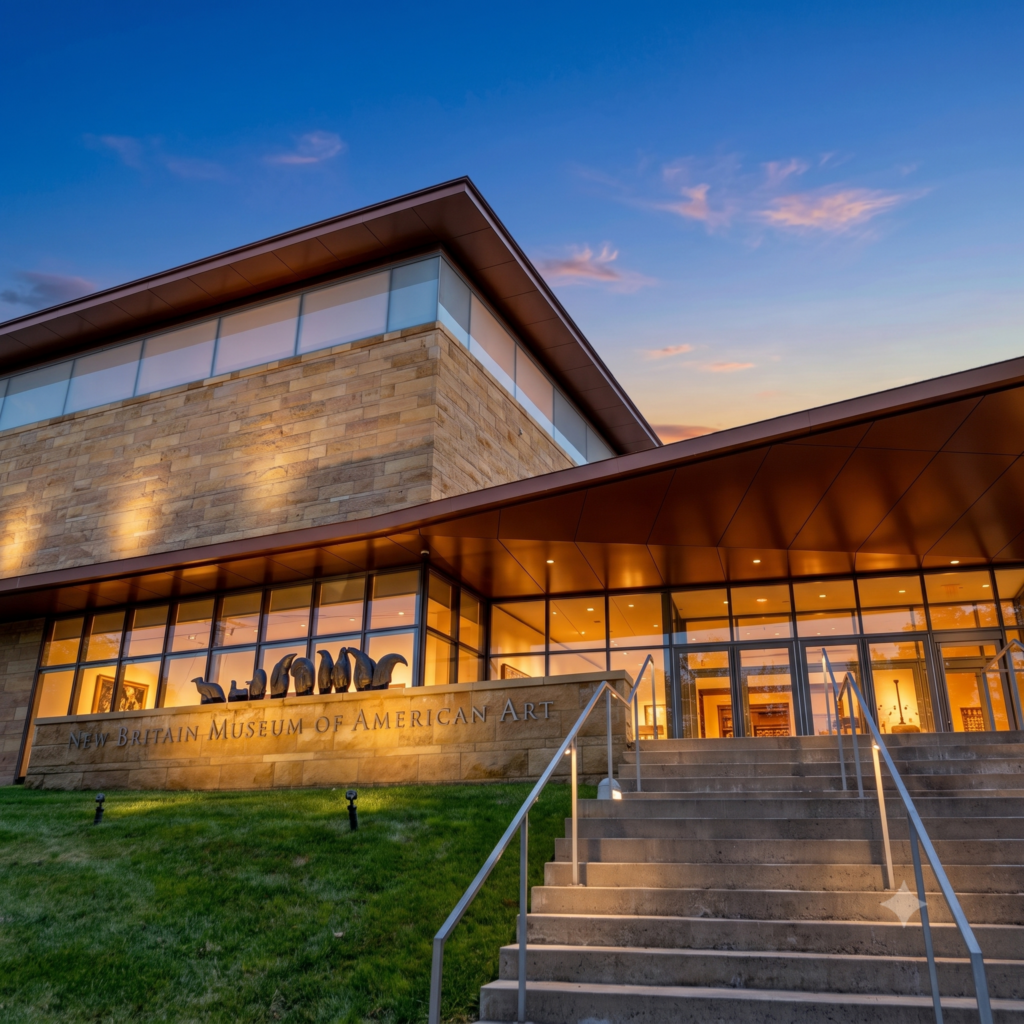
Completed in 2006, the Chase Family Building added a spectacular, light-filled 43,000-square-foot modernist structure wrapped in glass, limestone, and zinc. Rather than obliterating the historic structure, the architects seamlessly connected the Chase Building to the original Landers House. This architectural synthesis allowed the Landers House to be preserved and transformed into an expansive education lab, library, and interactive multi-disciplinary children’s center, while the Chase Family Building provided massive, high-ceilinged galleries engineered for a chronological journey through five centuries of American masterpiece curation.
IV. The Spooky & Weird: Ghostly Echoes of the Factory Barons
With a century-old mansion constructed for a Stanley Works president and a collection composed of deeply personal historic objects, the NBMAA has long harbored whispers of paranormal phenomena. Unlike the traditional gothic phantoms of European ruins, the hauntings reported at the New Britain Museum are deeply tied to the industrial psychology and material culture of the Hardware City.
1. The Heavy Footsteps of William H. Hart
The original Landers House building was built explicitly for William H. Hart, the hard-driving, hyper-organized industrialist who spent decades as the president and driving engine of Stanley Works. Hart was a man of absolute routine and strict order, who walked his estate with a firm, heavy-heeled gait.
Long after the mansion was converted into public art galleries, night security guards and late-night maintenance crews working in the basement and attic storage areas began reporting the distinct, unexplainable sound of heavy, deliberate boot-heels pacing the hardwood floors of the closed upper galleries.
The phenomenon is notably persistent during the installation periods of new exhibitions. Superstitious museum workers have long whispered that the spirit of the old industrial barony still patrols the rooms, checking the alignments of the walls and ensuring that the structural integrity of his beloved Lexington Street mansion is being rigorously maintained.
2. The Uncanny Energy of the Colonial Portal Portraits
The museum’s oldest galleries house a spectacular collection of eighteenth-century colonial portraits. Painted during an era when portraiture was viewed as a literal, permanent record of a human soul’s earthly presence, these works utilize thick, dark varnishes and severe, deep-set gazes.
Museum docents and evening cleaning staff have frequently reported an intense, heavy feeling of being watched when working alone in the Colonial galleries. More peculiarly, multiple generations of staff have claimed that during the high-humidity shifts of the New England summer, the eyes of certain colonial subjects appear to subtly track human movement across the room.
Paranormal investigators often cite the Stone Tape Theory to explain this phenomenon: the notion that the ancient plaster and original hand-carved wood paneling of the historic Landers House act as a natural recording device, absorbing the intense emotional and creative energy of the thousands of lives that have passed before them. This material matrix of ancient plaster and chiseled oak wood serves as a residual repository for decades of high-vibrational art, manifesting as physical spatial pressure and phantom acoustic echoes.
3. The “Supernatural America” Residual Vibrations
The museum’s connection to the bizarre was highlighted when it served as a key hosting venue for groundbreaking exhibitions focusing on spiritualism and mediumship in American history. The show brought together historical spirit-photographs by William H. Mumler, Ouija boards, and paintings literally credited to the intervention of spirits, such as the seance-precipitated portraits created by the famous mediumistic Bangs Sisters.
During the run of these exhibitions, docents and security teams reported an unusual spike in minor, inexplicable electrical disruptions within the galleries: motion sensors tripping in empty, dark rooms at 2:00 AM, gallery lights subtly dimming and flickering without mechanical explanation, and sudden, cold drafts slicing through rooms with highly regulated climate-control systems. When the spirit-infused objects were deinstalled and returned to their home archives, the building’s atmospheric baseline instantly returned to normal, proving that objects heavily imbued with historic human belief carry an undeniable, residual energy.
V. Curatorial Masterpieces: The Visual Tapestry of a Nation
The core brilliance of the NBMAA lies in its chronological layout, allowing a visitor to walk through the physical spaces of the Chase Family Building and read the psychological development of the United States like a visual novel.
The Colonial Foundation: Linear Stiffness and Ambition
The collection begins with the severe, hyper-detailed portraits of the pre-Revolutionary era. Works by pioneering artists such as John Smibert, Ralph Earl, and John Singleton Copley dominate these early walls. These paintings are free of European fluid bravura; instead, they utilize crisp, linear precision and meticulous renderings of fabrics, buttons, and property deeds. These are visual documents of a rising mercantile class intent on carving an empire out of the New England wilderness, projecting their newfound wealth and political determination through absolute material clarity.
The Hudson River School: The Sublime Landscape
Moving into the nineteenth century, the galleries open up into the breathtaking, light-drenched landscapes of the Hudson River School. The NBMAA holds an unparalleled selection of works by Thomas Cole, Frederic Edwin Church, Asher B. Durand, and Albert Bierstadt.
These paintings utilize the aesthetic concept of The Sublime—the idea that the natural world is a direct manifestation of the divine. Canvases depict sweeping, luminescent vistas of the Catskill Mountains, glowing Connecticut River valleys, and dramatic, storm-swept coastlines. They capture a nation infatuated with the concept of Manifest Destiny, treating the raw, western wilderness as a pristine, new Eden to be both revered and systematically conquered by industrial progress.
American Impressionism: The Light of Old Lyme
As the nineteenth century drew to a close, American artists returned from Paris having absorbed the lessons of Claude Monet, but they adapted the style to capture a uniquely American light. Because of New Britain’s close geographical proximity to the Old Lyme Art Colony and the Cos Cob art colonies, the museum secured world-class masterpieces of American Impressionism.
Vibrant, light-flecked canvases by Childe Hassam, John Henry Twachtman, and J. Alden Weir fill these galleries. Rather than focusing on French urban boulevards, these works celebrate the rugged rocky coastlines of New England, the blinding white snowscapes of Connecticut winters, and the quiet, sun-dappled beauty of local orchards, transforming everyday American topography into a realm of poetic contemplation.
VI. Deep-Dive Analysis: Thomas Hart Benton’s The Arts of Life in America
The undisputed artistic crown jewel and conceptual anchor of the New Britain Museum of American Art is a monumental series of five mural panels titled The Arts of Life in America, executed in 1932 by the legendary American Regionalist master Thomas Hart Benton.
The Historic Acquisition
Originally commissioned by the Whitney Museum of American Art for their library reading room in New York City, these massive, tempera-and-oil-on-canvas panels were painted at the absolute height of the Great Depression. The five panels are divided into regional and cultural themes: “Arts of the West,” which explores cowboys, rodeo culture, and frontier life; “Arts of the South,” tracking sharecropping, gospel revivals, and agricultural toil; “Indian Arts,” dealing with Indigenous traditions, rituals, and colonial friction; “Arts of the City,” focusing on jazz clubs, speakeasies, and industrial grit; and “Political Business,” which forms the satirical core of Gilded Age greed.
When the Whitney remodeled its galleries in 1953, they made the decision to sell the murals. Recognizing that these panels constituted one of the most significant achievements in the history of public American art, the directors of the NBMAA moved instantly, purchasing the entire suite and constructing a dedicated, custom-engineered gallery wing explicitly to showcase Benton’s sweeping, panoramic vision.
Technical and Stylistic Brilliance
Benton was a radical populist who rejected European abstraction in favor of a heroic, muscular realism rooted in the everyday lives of ordinary working-class citizens. To construct The Arts of Life in America, Benton utilized a complex, highly labor-intensive methodology: he sculpted three-dimensional clay models of every single figure in the composition, illuminating them with directional candles to map the precise muscular play of light and shadow before touching a brush to the canvas.
The murals are characterized by their undulating, rhythmic energy. Benton utilizes a swirling, cinematic composition style where figures are elongated and contorted with an almost baroque elasticity. The panels do not depict elite high culture; instead, they capture the raw, unfiltered vernacular arts of the American masses. In “Arts of the West” and “Arts of the South,” Benton depicts cowboys branding cattle, folk singers strumming guitars around campfires, Southern sharecroppers picking cotton, and intense, wild-eyed tent-revival preachers screaming to the heavens. In “Arts of the City,” he captures the kinetic, chaotic vibration of urban life during Prohibition, featuring jazz musicians blasting saxophones, factory workers operating massive machinery, high-rolling gangsters drinking in hidden speakeasies, and young flappers dancing the Charleston.
The Subversive Political Undercurrent
While the murals celebrate the vitality of American life, Benton infuses them with a biting, satirical critique of American hypocrisy. In the central panel, “Political Business,” Benton lays bare the systemic corruption of the era. He depicts fat-cat politicians screaming empty slogans, Klansmen lurking in shadows, and greedy Wall Street executives counting money bags while ordinary citizens stand in breadlines.
By placing this monumental, unvarnished mirror before the American public, Benton created a masterwork that refuses to sanitize history. Displayed in the grand, light-swept spaces of the NBMAA, The Arts of Life in America serves as a continuous, vital reminder that American culture is not defined by its elite academies, but forged in the sweat, music, struggles, and triumphs of its everyday working people.
VII. The Vanguard Transition: Expanding the American Story
The New Britain Museum of American Art has refused to allow its historic pioneering status to transform it into a stagnant monument of nostalgia. In the contemporary era, the institution has undergone a profound, highly calculated intellectual expansion. Recognizing that the definition of “American Art” was historically limited by gender and racial biases, recent directors have enacted an aggressive acquisition policy aimed at diversifying the collection.
During the transformative tenures of recent directors, the museum has significantly increased representation by executing targeted acquisitions and staging major solo retrospectives focusing on women artists, African American masters, Indigenous creators, and LGBTQ+ visual trailblazers.
Visitors walking through the Chase Family Building now see the historic colonial portraits and Hudson River landscapes juxtaposed with the powerful, racially charged post-modern silhouettes of Kara Walker, the monumental abstract glass works of Dale Chihuly, the narrative quilts of Faith Ringgold, and contemporary Native American artists who use their art to interrogate the ongoing legacy of colonialism.
By expanding its boundaries to include every voice that has contributed to the American fabric, the NBMAA honors its foundational 1903 mandate. It remains a living, breathing, and delightfully unpredictable educational laboratory on the edge of Walnut Hill Park. It stands as an enduring monument to the power of visual art to spark human curiosity, foster intellectual discovery, and illuminate the continuous, ever-evolving complexity of the American spirit.
Monographic References and Sources
-
Institutional Operational Overviews: About the New Britain Museum of American Art and Its Permanent Collection, NBMAA, 56 Lexington Street, New Britain, CT.
-
Biographical and Historical Records: O’Shaughnessy, Tracey. “Hyland Fling: The Legacy and Expansion of Douglas Hyland at the NBMAA.” Connecticut Magazine, November 2009.
-
Architectural Monograph & Historic Preservation Records: “The Landers House (1910): Mission Style Fused with Craftsman Design.” Historic Buildings of Connecticut, December 2015.
-
Exhibition Area Reviews: Supernatural America: The Paranormal in American Visual Culture, Exhibition Curation Records, New Britain Museum of American Art.
-
Foundational Corroborative Archives: “Art Purchase Fund Created: The Gift of John Butler Talcott.” Waterbury Evening Democrat, April 14, 1903.
