
THE CONCRETE CATHEDRAL OF LIGHT: THE DEFINITIVE CHRONICLE OF THE YALE CENTER FOR BRITISH ART
I. Introduction and Founding Legacy
Directly across the street from the main modernist campus of the Yale University Art Gallery sits a quiet, metallic masterpiece of twentieth-century architecture: the Yale Center for British Art (YCBA). Established in 1966 through an unprecedented gift from philanthropist and Yale alumnus Paul Mellon (Class of 1929), the institution was built around a singular, massive distinction: it houses the largest and most comprehensive collection of British art anywhere in the world outside of the United Kingdom.
The YCBA serves as an active, international research center and public museum. Its mission transcends the simple aesthetic display of pastoral landscapes or aristocratic portraiture; it interrogates the very concepts of empire, industrialization, and artistic migration that transformed Britain from an agrarian island into a global superpower. Admission to the YCBA is entirely free to the public, operating under a firm ethos of open cultural stewardship.
II. The Ultimate Architectural Work of Louis I. Kahn
The YCBA holds a deeply poetic spot in architectural history: it was the final building designed by the legendary modernist master Louis I. Kahn. Kahn passed away in 1974 before the structure was fully realized, and the design was completed by architects Pellechia & Meyers, opening its doors to the public in April 1977.
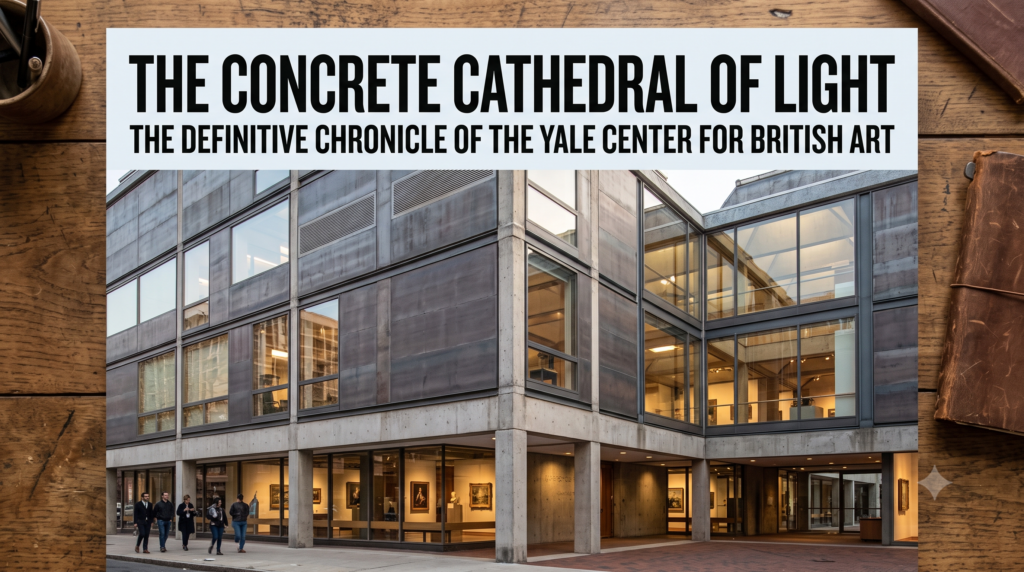
Kahn designed the exterior of the center to respect the commercial fabric of New Haven. The street-level floor integrates active storefronts, while the upper exterior walls are clad in matte pewter-finish stainless steel panels and clear glass windows. On a grey, overcast New England day, the building blends into the sky; on a bright afternoon, it reflects the surrounding historic brick architecture.
Internally, Kahn abandoned industrial coldness in favor of a warm, deeply humanistic palette of materials: raw concrete structural frames, smooth travertine stone floors, and towering, monumental partitions clad in unblemished white oak panels. The building is structured around two massive, sky-lit interior courtyards:
-
The Entrance Court: A soaring, four-story concrete hall that introduces visitors to the grand scale of the space.
-
The Library Court: A three-story space featuring a monumental concrete cylinder housing a spiral staircase that acts as the physical and aesthetic anchor of the building.
The entire building is illuminated via a complex roof system of double-glazed plexiglass skylights equipped with automated louvers. This layout bathes the galleries in a continuous, soft, diffused natural daylight, precisely as Kahn intended, allowing visitors to view oil canvases under the changing conditions of natural external light.
Kahn structured the YCBA around a mathematical structural grid composed of 20 by 20-foot concrete modules. By exposing the structural concrete framework rather than hiding it behind drywall, Kahn forced the building to show its honest skeleton. The interior walls are not load-bearing; they are magnificent, independent partitions clad in premium white oak that sit loosely within the concrete grid. This permits curatorial teams to reconfigure entire floors seamlessly. The true architectural sorcery happens at the roofline, where the specialized V-shaped skylights diffusers trap harsh, direct UV rays and bounce them internally.
III. The Spooky & Eccentric: Strange Secrets of the British Archives
While the Yale Center for British Art lacks clanking chains and weeping phantoms, its reputation for the uncanny resides deep within the eccentric psychology of British history, its bizarre collectors, and the hyper-calculated modernist design of Louis Kahn.
1. The Chimerical Angst of the Grotesque “Wally Birds”
Step away from the romantic landscape oil paintings and into the decorative arts cases, and you will find yourself staring directly into the unsettling, smirk-filled gaze of the Martin Brothers’ pottery. The center holds an array of these highly coveted, deeply strange late-Victorian ceramic tobacco jars known colloquially as “Wally Birds.”
Created by a trio of eccentric brothers in London, these birds are intensely anthropomorphic; they leer, wink, and scowl with deeply human expressions of smugness, anxiety, or disdain. Yale art historians note that these peculiar creations inflict an uncanny psychological trick on the viewer. Walking through the open, quiet galleries, visitors frequently report the unsettling sensation of being intensely watched, only to realize they are being scrutinized by a row of grotesque, smirking ceramic creatures that seem to capture a distinctly Victorian brand of existential dread.
2. William Blake’s Literal Visions of the Paranormal
The center boasts an incredible repository of works by the radical poet, mystic, and artist William Blake. To understand the YCBA’s deepest connection to the paranormal, one must understand that Blake did not view his supernatural subjects as metaphors—he claimed to see them clear as day pacing around his studio.
The collection’s records detail Blake’s late-night sessions with the astrologer John Varley, where Blake would suddenly shout, “He is here!” and begin frantically sketching the spirits that materialized in the room. The YCBA preserves the conceptual lineage of these encounters, including Blake’s maddeningly bizarre universe where he famously painted The Ghost of a Flea after a spiritual entity informed him that fleas were actually inhabited by the souls of bloodthirsty, blood-drinking men who were trapped in tiny insect bodies.
3. The Phantom of the Final Blueprint
The building itself harbors a deeply melancholic, near-ghostly aura born of its architectural creation. As noted, the YCBA was the final masterpiece of Louis Kahn. Kahn was famously obsessive about how light interacted with his materials, spending hours checking how natural light would bounce off raw concrete and white oak panels.
In March 1974, Kahn was traveling back from India to New York carrying the final design blueprints for the YCBA. He suffered a fatal heart attack in the restroom of Penn Station. Because he was an eccentric genius who carried no identification on his person, his body lay unclaimed in a city morgue for days while the blueprints for the center remained locked in his briefcase. When the building opened posthumously in 1977, early curatorial staff whispered that the sterile, mathematically perfect geometric design felt less like a museum and more like a beautifully crafted concrete sarcophagus built to honor a master who died holding its keys.
IV. Analysis of the Masterworks and Core Collections
The permanent holdings of the Yale Center for British Art span from the fifteenth century to the contemporary moment, containing roughly 2,000 paintings, 200 sculptures, 20,000 drawings and watercolors, 31,000 prints, and over 35,000 rare books and manuscripts.
The Titans of British Romanticism
The core strength of the painting collection lies heavily in the golden age of British painting, spanning from the birth of William Hogarth (1697) to the death of J. M. W. Turner (1851).
-
J. M. W. Turner: The center houses a spectacular array of Turner’s revolutionary, light-obsessed marine and landscape works. Prominent among these is Dort or Dordrecht: The Dort packet-boat from Rotterdam becalmed (1818), an immense canvas that showcases Turner’s early mastery over glowing, atmospheric golden light, previewing the near-abstract dissolution of form that would define his late, radical career.
-
John Constable: The YCBA holds an unparalleled repository of works by Constable, the painter who transformed the depiction of the English countryside. The crown jewel is his monumental Hadleigh Castle, The Mouth of the Thames—Morning after a Stormy Night (1829). Painted shortly after the death of his beloved wife, the heavily textured, dark canvas uses rugged brushstrokes and brooding shadows to turn a crumbling medieval ruin into a profound, deeply personal psychological landscape of grief and resilience.
-
Thomas Gainsborough & Sir Joshua Reynolds: The collection excels in the grand manner portraiture of the eighteenth century. Works such as Gainsborough’s The Gravenor Family (1754) illustrate the rigid socio-economic boundaries and class systems of Georgian society, where elite sitters chose to be painted alongside their massive country estates to project absolute political and territorial authority.
-
George Stubbs: The Mellon collection is internationally renowned for its holding of British sporting and animal art, highlighted by George Stubbs’s anatomical masterwork A Lion Attacking a Horse (1762), which uses intense naturalism to capture the sublime, terrifying power of the natural world.
Rare Books, Manuscripts, and Global Interrogations
Beyond the monumental oil canvases hanging on its oak walls, the YCBA houses a vast Department of Rare Books and Manuscripts containing approximately 35,000 volumes. This collection is a visual history of print culture, exploration, and scientific inquiry stretching back to the 15th century.
The department holds iconic illustrated “color-plate” books from the famed J.R. Abbey collection, historic drawing manuals, early maps, atlases, and extensive archival material documenting the private press movements of the 19th century, such as William Morris’s Kelmscott Press masterworks.
In recent years, the center has undergone a profound intellectual evolution. Rather than treating British art as an isolated, national story, curators use the vast print and portrait archives to showcase that British art is fundamentally an international, transnational story. Deep research into works like Isaac Sailmaker’s The Island of Barbados (ca. 1694) has recontextualized the collection, highlighting how the leisure, manor houses, and wealth depicted in high-society British portraits were inextricably linked to systems of colonial exploitation, transatlantic trade, and imperial expansion across the globe.
V. The Modern Metamorphosis: Recontextualizing Five Centuries of Art
The physical nature of Louis Kahn’s architecture requires constant, meticulous stewardship. Following an extensive structural conservation project designed to update the building’s infrastructure, preserve its iconic roof window-louver systems, and protect its raw concrete finishes, the Yale Center for British Art officially reopened its doors to the public on March 29, 2025.
This grand reopening ushered the center into a new era, unveiled via a revolutionary, fully reimagined permanent collection installation titled In a New Light: Five Centuries of British Art. For the first time in the institution’s history, the exhibition completely dismantles the artificial boundary between historic and modern holdings. The permanent display unites 500 years of historic paintings side-by-side with bold, contemporary British acquisitions—juxtaposing the classic animal paintings of George Stubbs with the provocative modern compositions of artists like Tracey Emin and Cecily Brown.
The exhibition completely shatters the historical glass ceiling of the museum. For the first time, historic 18th-century portraiture is hung directly alongside provocative, contemporary British art. This juxtaposition forces an honest conversation about the true source of the wealth depicted on those historic canvases.
Visitors looking at elegant portraits of British merchant families are now guided to look at rare maps, colonial logbooks, and contemporary installations that expose how the idyllic English country lifestyle was directly funded by global imperialism, sugar plantations, and the transatlantic slave trade. By opening up sweeping interior vistas across Kahn’s open floor plans, the installation challenges visitors to chart their own intellectual path, transforming the Yale Center for British Art from a quiet repository of old-world nostalgia into a vanguard institution interrogating the complicated, global reality of our shared history.
Monographic References and Sources
-
Institutional Announcement Records: Yale Center for British Art Reopens to Public on March 29, 2025, Office of Public Information, YCBA, New Haven, CT.
-
Collection Area Overviews: Department of Rare Books and Manuscripts Institutional Holdings, Yale Center for British Art.
-
Biographical & Design Records: Cadwell, Michael. Strange Details: The Reinforced Concrete and Blueprint History of Louis Kahn’s Yale Center for British Art. MIT Press, 2007.
-
Architectural Monograph: Kahn, Louis I., and Brown, Jules David. The Final Building: The Construction and Skylight Diffuser Design of the Yale Center for British Art. Yale University Press, 1977.
