
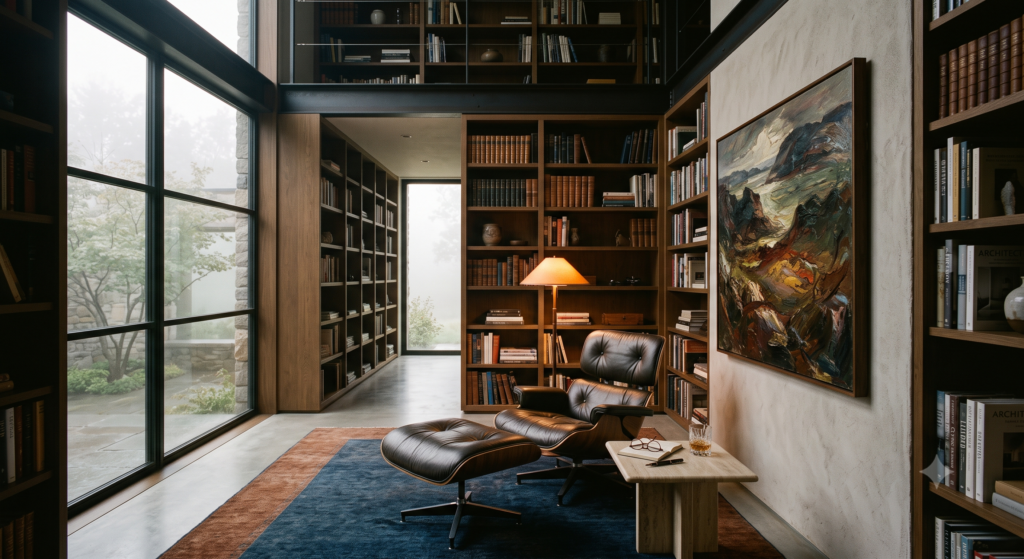
The Macro Reality: No one builds a business empire simply to possess corporate infrastructure. While public equities, venture capital, and commercial supply chains comprise the mathematical majority of global wealth, they function exclusively as the engine.
The Paradigm: A diversified portfolio naturally redirects up to 33% of its capital into non-commercial hard assets: trophy residential real estate and fine art. This allocation represents the transition from wealth generation to wealth preservation—building a sovereign, armor-plated physical sanctuary designed to anchor the family legacy.
The Exhaustion of the Engine Room
Walk into any penthouse boardroom on Wall Street, a Silicon Valley venture incubator, or a high-velocity trading floor, and you will encounter the exact same phenomenon: the aggressive, loud, and unyielding machine of modern capitalism. The corporate world is inherently transactional, digital, and hyper-volatile. It requires a state of perpetual psychological defense, where a founder, executive, or investor is constantly exposed to shifting interest rates, technological disruption, market panics, and public scrutiny.
Whether managing billions in public equities or scaling a global logistics network, the environment demands absolute analytical detachment.
Capital generated within this arena is purely numeric—abstract lines of data flashing across a glowing screen. It possesses immense power but lacks physical reality. You cannot touch a stock option; you cannot seek shelter inside a corporate bond.
Because human beings carry a deeply rooted evolutionary need for stability, the subconscious goal of high-stakes commerce is always to convert that liquid, volatile, digital power into something tangible, silent, and permanent. The business engine is built to be traded, leveraged, or optimized; the sanctuary is built to last centuries.
The Mechanics of the Household Sovereign
When capital transitions into luxury residential real estate, its psychological and financial function changes fundamentally. A premier family compound is not merely a piece of premium property, nor is it just a line item on an asset sheet. It operates as a physical vault. It is the single territory on earth where an individual can exercise absolute, unfiltered sovereignty.
Inside this perimeter, the home functions as structural armor. It separates the family unit from macroeconomic chaos, grounding wealth in an asset class that cannot be erased by a market flash-crash, a banking liquidity freeze, or a sudden algorithmic adjustment on Wall Street.
This explains why the ultra-wealthy will pay a massive premium for homes they may only visit three weeks out of the year. They aren’t paying for square footage; they are paying for the permanent right to opt out of the world’s chaos at a moment’s notice. The home converts abstract financial success into a localized, controlled domain where private life is completely shielded from public noise.
Why Capital Craves the Aesthetic Premium
There is a fundamental truth governing the high-end property and collectible markets: People don’t buy ugly because ugly has no permanence.
When an investor lines the walls of a sanctuary with museum-grade representational masterworks—whether sourcing from historic regional colonies like the Connecticut shoreline’s Lyme Art Association or elite contemporary ateliers—they are utilizing what economists call the Aesthetic Premium.
Fine art is human emotion made permanent. It turns cold plaster walls and architectural concrete into an active reflection of a family’s identity, taste, and historical values. Furthermore, art represents an entirely independent monetary ecosystem. While fiat currencies inflate and corporate entities dissolve, a certified masterpiece preserves capital because it possesses a strictly finite supply backed by centuries of academic validation.
The migration of this capital follows a precise, predictable path:
-
Liquidity Conversion: Surplus capital is systematically harvested from private companies, corporate dividends, or public stock tranches.
-
Structural Settlement: The capital is anchored into prime geographic real estate, transforming fluid cash into a multi-generational physical estate.
-
Cultural Grounding: The estate is populated with finite, curated visual art. The presence of fine art transitions a piece of real estate from an ordinary luxury house into a soulful, permanent sanctuary.
The Multi-Generational Portfolio Blueprint
To see how the world’s most successful family offices intentionally balance growth with preservation, analyze the standard diversification layout of a legacy estate:
The Ultimate Anchor
The grandest illusion of modern capitalism is that the pursuit of wealth is open-ended—that the game is simply about accumulating the largest possible number before the clock runs out. In reality, the architecture of the entire global financial system exists to serve a deeply personal, intensely private human core.
No titan of industry builds an empire for the sake of an empty spreadsheet or a vacant mansion. Every corporate strategy, every real estate trade, and every off-market art acquisition is simply a tool used to fund, protect, and shelter a legacy.
Markets will continuously pivot, digital trends will vanish, and corporate engines will rise and fall. But the pinnacle of human desire across centuries remains fixed: the absolute right to sit inside a safe, beautiful room, look at something inspiring, and share it with the people you love.
The business engine is how we conquer the world. The home, the art, and the family are why we bother to do it.
External Verification and Case Studies
To observe how global corporate wealth naturally flows into private physical sanctuaries, consider the documented estate allocations and collecting behaviors profiled by leading institutional media:
-
The Financial Risk Mitigation: In the market briefing Inside the Risks of Investing in Art, wealth advisors and art-finance heads from top international institutions outline how fine art has transitioned from a simple passion play into a critical, non-correlated tool for modern wealth planning and credit leveraging.
-
The Curation of the Sanctuary: In the private estate walkthrough Inside the Bold and Colourful Home of a Modern Art Collector, international collectors demonstrate the ultimate culmination of the 33% Paradox—showing how multi-generational craftsmanship, curated historic pieces, and highly secure architecture come together to establish a true family legacy domain.
