
Before you begin…
Click the video embedded right below this intro — it’s a 12-hour deep blues mix made for nights exactly like this. Let it play low in the background. Dim the lights. Light a fire if you have one. Pour your favorite whiskey, bourbon, or whatever warms you. Roll something smooth if that’s your thing. Then settle in.
This is a slow, late-night story. Read it unhurried. Let the rain, the turntable, and the blues carry you. Many people fall asleep halfway through with the video still playing… and that’s perfectly fine. That’s how this story was meant to be experienced.
Chapter 1 – “The Rain Don’t Know How to Leave”
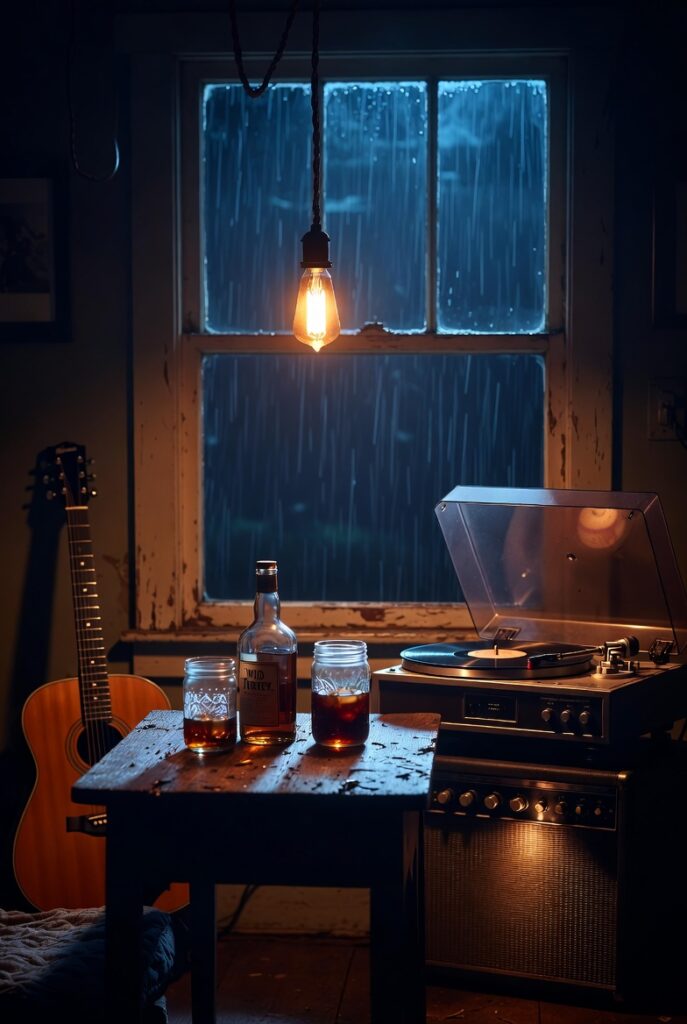
The rain came down in steady, stubborn sheets, the kind that sounded like brushes on a snare drum—soft, relentless, never in a hurry to end. It hammered the tin roof of the old shotgun house on Bayou Road, turning the gutters into rusty rivers. Inside, the only light was a single bare bulb swinging over the kitchen table and the warm amber glow from a half-empty bottle of Wild Turkey 101.
Jackson “Jack” Moreau sat hunched in the same straight-backed wooden chair his daddy had worn smooth over forty years of morning coffee and midnight regrets. His calloused fingers kept time against the scarred tabletop while Robert Johnson’s voice drifted from the old turntable in the corner:
“I went down to the crossroads, fell down on my knees…”
The needle rode the grooves with a familiar hiss, the way old pain rides the heart—scratchy, honest, impossible to ignore. Jack was forty-three now, hair more salt than pepper, shoulders still strong from years of loading trucks and bad decisions. Two divorces behind him, one estranged daughter, and a string of bar gigs and construction jobs that never quite added up to a life.
Tonight the road had brought him home anyway.
He poured three fingers into a jelly jar, the cheap whiskey catching the light like liquid gold. No ice. Ice was for people who still cared about comfort. This was medicine—burning, truthful medicine. He took a slow sip and let it sit on his tongue the way his granddaddy taught him. The blues shifted into Lowell Fulson, then Lightnin’ Hopkins—songs about leaving, about women who could break a man cleaner than any bottle ever could.
The screen door creaked open behind him, hinges complaining like an old harmonica. He didn’t turn around. He knew that sound. He’d been hearing it in his sleep for fourteen years.
Lila Moreau—still carrying his last name because neither of them had ever bothered with the paperwork—stepped inside, shaking rain from her dark hair. She was forty-one, beautiful in the way only real life can make a woman: laugh lines, a little weight in the hips, eyes that had seen too much but hadn’t gone hard. She wore an old denim jacket he recognized from their first apartment.
She didn’t speak at first. Just stood there letting the rain drip onto the linoleum, taking in the scene: the bottle, the record player, the man who used to be her whole damn world. “You always did play the saddest music when you were trying to feel something,” she said finally, voice low and smoky as the cigarette she wasn’t smoking.
Jack gave a tired half-smile that didn’t reach his eyes. “Figured if I was gonna drown tonight, I might as well have a good soundtrack.” Lila crossed the room and sat down across from him without being asked. No hug. No accusations. Not yet. She looked at the bottle, then at him. He slid the jar toward her. She picked it up, took a long pull straight from it, and made the same face she’d made the very first time he shared whiskey with her behind the levee when they were nineteen and bulletproof.
“Still tastes like regret and bad ideas,” she said, wiping her mouth with the back of her hand.
“Some things don’t change.”
The record changed. Bessie Smith now—raw, powerful, cutting straight through the rain:
“I love you baby, but I sure do hate your ways…”
Lila let out a short, sad laugh. “We were terrible for each other, Jack.”
He nodded slowly, staring into the amber liquid like it might have answers. “Yeah. But we were home for each other too.”
Silence settled between them, comfortable and heavy at the same time. Outside, thunder rolled low and distant, like a bass line under everything. Inside, the turntable kept spinning, the rain kept falling, and two people who had spent more than a decade running in opposite directions found themselves sitting at the same scarred kitchen table again.
Jack reached over and turned the volume up just a notch. The blues swelled, wrapping around them like an old blanket—warm, frayed, smelling of cigarette smoke and second chances. Neither of them knew what tomorrow would look like. They didn’t talk about Ruby. They didn’t talk about the empty years or the other bodies that had tried (and failed) to fill the space between them. The three of them just sat there, passing the jar back and forth, letting the music say the things that still hurt too much to speak out loud.
For the first time in years, the old shotgun house didn’t feel like a place Jack had failed to escape.
It felt like the only place he’d ever really belonged.
Chapter 2 – “Forty-Three Miles of Regret”
The whiskey was working now, loosening the rusted hinges on memories neither of them had wanted to touch in years. Jack stared at the jelly jar in his hand like it was a rear-view mirror. Lila watched him, quiet, waiting. The rain had eased into a soft patter, but the blues on the turntable hadn’t let up.
“You ever think about that last night?” he asked, voice rough.
Lila took a slow breath. “Every time it rains.”
Fourteen years earlier
The same kitchen. The same scarred table. But the light was harsher—midday sun slicing through the screen door—and the air was thick with shouting instead of rain.
“You always run, Jack! Every damn time it gets hard you find a road!” Lila’s voice cracked like a breaking bottle. She was thirty, pregnant with their second child that they would lose two months later, and exhausted from loving a man who couldn’t sit still.
Jack stood by the door with a duffel bag at his feet and his old Telecaster slung across his back. “I’m not running. I’m trying to make something. Tulsa’s got work—real work. I can send money back. We can finally get ahead instead of drowning in this damn bayou.”
Ruby, eight years old, barefoot in a faded sundress, stood on the porch steps clutching her stuffed rabbit. She didn’t cry. She just watched her daddy the way kids do when they already know the world is breaking.
The turntable was spinning one last time before he left. Big Bill Broonzy’s “Key to the Highway” filled the house—sad, defiant, full of leaving:
“I got the key to the highway, Billed out and bound to go…”
Jack had played along on his guitar until the fight got too loud, then just let the record finish the argument for him. Lila had thrown a coffee mug at the wall. It left a scar that was still there tonight, faded but visible if you knew where to look.
“I swear to God, Jack Moreau, if you walk out that door tonight, don’t you come back thinking this house will still be waiting with open arms.”
He kissed Ruby on the forehead, smelled her baby-shampoo hair, and whispered, “Daddy’s gonna make it right, baby girl. I promise.”
Then he walked out.
The last thing he heard as the truck door slammed was Lila turning the record over and playing the B-side even louder, like she was trying to drown out the sound of his engine fading down Bayou Road.
Back in the present
Lila traced the old coffee-mug scar on the wall with her fingertip. “You promised her. I heard you.”
Jack poured them both another measure. The bottle was getting dangerously low. “I meant it when I said it. Then Tulsa turned into Oklahoma City, then Denver, then wherever the next paycheck was. Every time I thought about calling, it had been too long. Every time I thought about coming home, I figured you’d both be better off without me.”
Lila gave a bitter little laugh. “We weren’t. Ruby used to sleep with your old work shirt under her pillow until she was fourteen. I used to play this same damn record when I missed you so bad I couldn’t breathe.”
She looked straight at him, eyes shining but not spilling over. Not yet.
“You left us with nothing but a key to a highway that never brought you back. And now here you are, fourteen years and two divorces later, sitting at my kitchen table like the blues just called you home.”
Jack reached across and touched her wrist—light, careful, the way you touch something you’re afraid might vanish. “Maybe they did. Or maybe I finally got tired of every road sounding the same without you on the other end.”
Outside, a freight train whistled low and lonely in the distance, harmonizing with the Muddy Waters track now playing low on the turntable. Inside, the silence between them stretched like a long blues solo—full of notes they still didn’t know how to play.
Ruby’s name hung in the air, unspoken for now. The empty years. The other women. The other men. All of it sat at the table with them, drinking their whiskey and listening to the music.
Jack finally spoke again, barely above a whisper.
“I still got that key, Lila. But I don’t know if it opens anything anymore.”
She didn’t answer right away. Instead she took his hand, turned it palm-up, and traced the calluses that had built up over a thousand nights playing in bars for tips and forgetfulness.
“We’ll find out,” she said. “But not tonight. Tonight we just sit with it.”
The record ended. The needle lifted, clicked, and started over again on its own—old turntables sometimes do that when they know the night isn’t done with you yet.
Chapter 3 – “Second Sip, Same Burn”
The needle dropped again on the turntable, this time sliding into a slow, smoky Etta James groove—“At Last” playing like it was mocking them. Jack stared at their hands on the table—his rough, hers still familiar—and felt the whiskey doing its slow, dangerous work. The first bottle of Wild Turkey was bone dry. He stood without a word, walked to the old cabinet above the fridge, and pulled out another one. Still cheap. Still honest.
“Second sip, same burn,” he muttered, twisting the cap.
Lila gave a small smile. “Story of us.”
He poured generous measures into the jelly jars. The kitchen smelled of rain, old wood, and that particular whiskey bite that always reminded them both of younger, stupider nights. They clinked jars without ceremony and drank.
Lila spoke first, voice softer now, the edges worn smooth by the alcohol.
“You want to know what the years did to me, Jack? Really?”
He nodded.
She looked past him, out the rain-streaked window. “There were men. Three serious ones. One was kind—steady job at the mill, good with Ruby. He wanted to marry me. I said yes one night after too much wine, then took it back the next morning. He didn’t sound like you when he laughed. None of them did.”
Jack’s jaw tightened, but he stayed quiet.
“I dated a musician once,” she continued, a wry twist to her lips. “Thought maybe that was the problem—I needed someone who understood the road. He played decent blues, but every time he touched me I kept hearing your damn guitar instead. After six months I told him the truth. He called me haunted. I told him he had no idea.”
She took another sip, eyes glistening in the low light.
“Some nights I’d put on your old records after Ruby went to bed. I’d sit right here, same chair you’re in now, and drink alone. I hated you so much I could taste it. Then I’d miss you worse. The missing always won.”
Jack let out a long breath. The Etta James record gave way to a raw, late-night John Lee Hooker shuffle—foot-stomping, lonely, perfect.
“My turn,” he said. “There were women. Too many. Some warm, some wild, some just there to kill the quiet. One almost stuck—waitress in Tulsa named Carla. She had your eyes, almost. Laughed easy. But every time she laughed it sounded… wrong. Too bright. Too clean. It wasn’t the sound I grew up loving in this kitchen.”
He reached across and brushed a rain-damp strand of hair from Lila’s cheek. His thumb lingered.
“Your laugh still lives in my chest, Lila. Like a song I can’t get out of my head. I’d wake up next to someone else and hear it anyway. That’s when I knew I was fucked.”
The air between them thickened. The whiskey hummed in their blood. John Lee Hooker sang about boogie chills and late-night needs while the rain kept its steady backbeat on the tin roof.
Lila leaned in first. Or maybe he did. Their faces were close enough that he could smell the whiskey on her breath, feel the warmth of her skin. Fourteen years of missing collided right there at the scarred kitchen table. Their lips almost touched—close enough to feel the pull, the old familiar gravity.
Then Lila placed two fingers gently on his chest and pushed back, just an inch.
“Not yet,” she whispered. “We’re still too good at breaking each other.”
Jack closed his eyes, forehead resting against hers for a moment. “I know.”
They stayed like that, breathing the same air, the almost-kiss hanging between them like a unresolved chord. The tension was sweet and painful, the kind that makes a blues song worth listening to twice.
She finally pulled away, picked up her jar, and raised it.
“To almosts,” she said.
“To almosts,” he answered.
They drank. The record spun on. Outside, the rain kept time. Inside, two battered hearts sat side by side—closer than they’d been in years, but still careful, still remembering how easy it is to bleed.
Chapter 4 – “Ruby’s Record”
Midnight crept in like a slow minor chord. The second bottle was half gone, the kitchen thick with smoke from Lila’s occasional cigarette and the weight of everything they’d almost said. The turntable had moved on to Freddie King—“Going Down”—raw guitar crying through the speakers when three sharp knocks hit the screen door like a backbeat.
Jack and Lila froze.
Another knock. Harder this time.
Lila stood first. Jack followed, legs a little unsteady from the whiskey. She opened the inner door. The porch light caught a young woman standing in the rain, soaked to the bone, hair plastered to her face, eyes burning with fourteen years of absence.
Ruby.
Twenty-two now. Tall like her father, with her mother’s sharp cheekbones and the same restless fire that once made Jack pack a bag and chase highways. She carried an old black hardshell guitar case—Jack’s first good Telecaster, the one he’d left behind—the handle gripped tight like a weapon.
“Well,” Ruby said, voice cutting through the rain. “Ain’t this cozy.”
She stepped inside without waiting for an invitation, water pooling on the linoleum. Her boots left muddy tracks across the floor her mother had mopped a thousand times while wondering where her husband was. She set the guitar case down with a heavy thud.
“Got your address from Aunt May,” she told Jack, not looking at him yet. “Figured if you were finally back, I might as well see it for myself.”
Lila moved toward her daughter. “Ruby, baby—”
“Don’t.” Ruby held up a hand. Her eyes finally met Jack’s. “You look older than I remember. Guess the road’ll do that.”
Jack swallowed hard. The Freddie King track wailed on, guitar bending notes that felt too perfect for the moment.
“Been a long time,” he said quietly.
“Fourteen years, three months, and twelve days,” Ruby answered. She knew the math cold. “I kept count until I got tired of counting.”
The three of them stood in the small kitchen like strangers at a funeral. The turntable kept spinning, the blues filling the silence they couldn’t. Jack reached over and turned it down, but not off. Some things you don’t turn off.
Lila grabbed an old towel and handed it to Ruby. Their daughter took it but didn’t dry her face—just held it, dripping.
“You two drinking and listening to sad music again?” Ruby asked, eyeing the bottle and jelly jars. “Classic. Real fucking classic.”
Jack pulled out a third chair. “Sit. Please.”
Ruby hesitated, then dropped into it. She looked smaller suddenly, the anger cracking at the edges. Lila poured her a small measure of whiskey without asking. Ruby stared at it, then knocked it back in one hard swallow, coughing once.
“Burns the same,” she muttered.
Jack’s voice was rough. “That guitar… you kept it.”
“Mom gave it to me when I was sixteen. Said it was yours. I learned to play on it. Wrote a lot of angry songs about a daddy who chose the highway.” She looked straight at him. “They’re pretty good. Got a couple hundred thousand streams on the internet. Not that you’d know.”
Lila sat back down, eyes moving between them. The rain had picked up again, drumming harder on the tin roof. Inside, the air felt electric—three generations of hurt and love and music all crammed into one small kitchen.
Ruby reached down, popped the latches on the case, and pulled out the old Telecaster. The wood was worn where Jack’s hands had once lived. She plugged it into the small practice amp she’d carried in her backpack, flipped it on, and without another word started playing.
A slow, stinging blues riff filled the room—her own, not a cover. Raw. Honest. Full of every birthday he’d missed, every phone call that never came.
Jack’s eyes stung. Lila’s hand found his under the table.
When Ruby finished the verse, she looked at her father, chin lifted.
“Your turn,” she said, sliding the guitar across the table. “Show me if you still remember how to bleed.”
The turntable had gone quiet. Now the only music in the house was whatever came next from the three of them.
Chapter 5 – “Devil at the Levee”
The air in the kitchen had grown too thick, too small for three broken hearts and one old Telecaster. Ruby’s challenge still hung in the room like a bent blue note. Jack looked at the guitar, then at his daughter, and nodded once.
“Porch,” he said. “This needs air.”
They moved outside single file—Jack with the guitar, Lila carrying the bottle and three fresh jelly jars, Ruby trailing with the half-empty amp and her guarded silence. The rain had softened to a drizzle, but the bayou behind the house was alive with the low croak of frogs and the distant rumble of thunder. The back porch sagged under their weight, the same wooden planks where Jack had taught a tiny Ruby her first three chords on a toy guitar.
They settled into mismatched chairs. Jack tuned the Telecaster by ear, the strings humming under his fingers like they remembered him. The whiskey made his hands slower, but the muscle memory was still there. He started simple—a slow, minor-pentatonic walk in E that every bluesman knows in his bones. Nothing flashy. Just honest.
Ruby watched him, arms crossed. Then she began to sing.
Her voice was lower than Lila’s, rougher around the edges, carrying the same ache that lived in every Robert Johnson record they’d ever played. She didn’t look at her father while she sang the verse she’d written at nineteen, drunk on cheap wine after another missed birthday:
“Daddy left on a Sunday, said the road would make him whole, Left me with a Telecaster and a big empty hole. He chased that devil at the crossroads, While I grew up playing his shadow on the wall…”
The words cut clean. Jack’s fingers faltered for a second, then kept going, supporting her like a good rhythm section should. Lila sat perfectly still, tears finally slipping down her cheeks—silent at first, then shoulders shaking as fourteen years of holding it together finally cracked.
Jack played through it, eyes closed, letting the guitar say what his voice couldn’t. When Ruby finished, the last chord rang out over the dark water. For a long moment, only the bayou answered.
Lila spoke through the tears, voice raw. “I used to rock you to sleep singing that man’s songs, Ruby. Never thought I’d hear you turn them against him.”
Ruby wiped her face with the sleeve of her wet hoodie. “They stopped being his songs a long time ago. They became mine.”
Jack set the guitar across his lap. He looked older in the porch light—every mile and every regret carved into his face. He took the bottle from Lila, poured three healthy measures, and passed them like communion.
“I got no defense,” he said quietly. “I chased that devil and lost everything that mattered. Every town looked the same after a while. Every stage felt empty. I’d call sometimes, but I’d hang up before it rang. Too scared to hear how much you hated me.”
He took a long pull straight from the bottle before handing it to Ruby.
“But I never stopped loving you. Not for one damn day. Even when I was too broken to show it.”
Ruby stared at the whiskey, then drank. She handed the bottle to her mother. Lila took a sip, then reached over and rested her hand on Ruby’s knee. The three of them sat in a crooked circle—father, mother, daughter—passing the bottle while the drizzle fell like soft brushes on a snare.
Old wounds got lanced that night. Words came out sharp and ugly and necessary. Ruby told him about the father-daughter dances she sat through alone. Lila spoke about the nights she’d cried in the car so Ruby wouldn’t hear. Jack listened without defending himself, just playing soft fills on the guitar between confessions, turning their pain into something that almost sounded like music.
At one point Lila laughed through her tears—short, surprised, real—when Ruby imitated Jack’s old habit of singing off-key in the shower. For a moment the devil at the levee felt farther away.
The bottle got lighter. The sky started to hint at the coming dawn. Jack played one last gentle riff, a new one he made up on the spot—something hopeful trying to break through the minor chords.
Ruby looked at him, eyes red but softer. “You still suck at the high notes.”
Jack smiled, tired and grateful. “Some things never change.”
Chapter 6 – “Love Letters in Minor Keys”
Dawn crept over the bayou in pale gold and bruised purple, the kind of light that makes everything look honest whether you want it to or not. The three of them sat on the porch wrapped in old quilts Lila had dragged outside, the whiskey bottle now just a memory. Ruby’s eyes were heavy, but she wasn’t ready to sleep. None of them were.
“Shoebox is still under the bed,” Lila said quietly. “Same place.”
Jack nodded. They moved inside like sleepwalkers, the old Telecaster leaning against the wall like a tired witness. Lila disappeared down the short hallway and returned with a battered cardboard shoebox held together by yellowed tape and rubber bands. She set it in the middle of the kitchen table like it might explode.
Ruby pulled her chair closer. “I never knew this existed.”
“You weren’t supposed to,” Lila said with a tired smile. “Some things parents hide until the right night.”
Jack lifted the lid. Inside were folded letters, Polaroids with curled edges, ticket stubs, and a dried corsage from their senior prom. The faint smell of old paper and Lila’s old perfume rose up like a ghost.
They started slow.
Lila picked up the first letter—written on notebook paper, Jack’s handwriting still boyish and reckless. She read it out loud, voice soft:
“Lila Mae, If I don’t marry you I’m gonna die stupid. Meet me at the levee tonight. I’ll bring my guitar and two stolen beers. We’ll dance where nobody can see us mess up. Yours even when I’m broke, Jack”
Ruby let out a surprised laugh. “You stole beer for Mom?”
“Stole a lot of things back then,” Jack admitted, grinning despite himself. “Mostly time I should’ve spent being responsible.”
He pulled out a Polaroid: nineteen-year-old Jack and Lila in the very same kitchen, her arms around his neck, both of them laughing while he tried to dip her. The turntable in the background was the same one still sitting in the corner. On the back, in Lila’s handwriting: “Our first real fight and make-up. He played ‘Stormy Monday’ until I forgave him. July 2003.”
They passed the photos and letters like sacred relics. Jack read one he’d written from a payphone in Shreveport three months after Ruby was born:
“Baby girl, Tell Ruby her daddy loves her bigger than the Mississippi. I’ll be home in two weeks. Got a steady gig and everything. Don’t give up on me yet. P.S. Play her my records so she knows my voice.”
The room got quiet. Lila touched the faded ink. “You were home in six weeks. Then gone again.”
Ruby reached deeper into the box and found a small stack tied with a blue ribbon—Lila’s letters to Jack during one of his longer absences.
She read one aloud, her voice cracking just a little:
“Jack, Ruby said her first word today. It was ‘Dada.’ I hate you for missing it. I love you for giving her to me. Come home before we forget what you sound like. —Your almost-widow”
Jack rubbed a hand over his face. The weight of every promise he’d broken sat heavy on his shoulders. But there was beauty in the box too—silly notes, dirty jokes on bar napkins, a cassette tape labeled “Songs for When You’re Mad at Me” that still had Jack’s terrible singing on it.
They played one letter like a song. Lila read while Jack picked soft notes on the Telecaster, turning the old words into something living.
Young love poured out of the box—wild kitchen dances at 2 a.m., plans to buy a little land and raise chickens and kids, nights they swore they’d never be like their parents. Broken promises right beside them. The laughter. The fire. The way they used to fit together like a perfect blues turnaround.
Ruby looked at her parents, eyes shining. “You two were crazy.”
“We were alive,” Lila said simply.
Jack set the guitar down and took both their hands across the table.
“I wrote a lot of those letters on the road thinking they’d fix what I was busy breaking,” he said. “Turns out the only thing that ever worked was sitting right here in this kitchen.”
The sun was fully up now, painting the room in warm light. The shoebox sat open between them—full of minor keys and major memories, proof that they had once been young and stupid and beautifully, painfully in love.
Chapter 7 – “The Morning After the Blues”
Sunlight sliced through the kitchen window like a harsh spotlight after a long set. The three of them looked exactly like what they were: survivors of a night that had emptied two bottles of whiskey and one old shoebox of ghosts.
Jack’s head throbbed in time with an imaginary slow blues shuffle. Lila sat with her forehead resting on her folded arms. Ruby, younger and meaner with a hangover, was the only one moving. She had already made a pot of coffee strong enough to wake the dead.
“Drink,” Ruby ordered, sliding two chipped mugs across the table. “Black. No mercy.”
Jack took his mug with both hands, the heat grounding him. The Telecaster still leaned against the wall, silent now, strings still humming from the night before. No records played. The only sound was the drip of the old coffee maker and the distant call of morning birds over the bayou.
Lila lifted her head, eyes puffy. “I feel like Bessie Smith ran me over with a train.”
“Sounds about right,” Jack muttered.
Ruby didn’t sit. She stood with her arms crossed, looking from one parent to the other like a judge who’d already heard all the excuses.
“So,” she said. “What now?”
The question landed heavy. Jack stared into his coffee. Lila traced the rim of her mug with a fingertip.
“I’m not here to watch you two flirt with getting back together and then blow it up again,” Ruby continued. Her voice was tired but steady. “I drove three hours in the rain because I was sick of wondering. So tell me—what does home mean to you now? Because this house still feels like it’s waiting for something that might never show up.”
Jack spoke first, voice rough from whiskey and truth.
“Home stopped being a place a long time ago. I thought it was the next town, the next gig, the next woman who didn’t know all my failures. Turns out home was the sound of your mama’s laugh in this kitchen. The way the screen door slams. The smell of coffee and rain on tin. I just… kept driving past it.”
Lila looked at him for a long moment.
“I stayed because leaving felt like quitting,” she said. “But staying hurt too. I made this house a home for Ruby when you couldn’t. Some days I hated every inch of it because it reminded me of you. Other days it was the only thing that kept me breathing.” She glanced at Ruby. “I don’t know if I have room for you in it again, Jack. Not the old way.”
Ruby pulled out her chair and sat down hard.
“Then make a new way,” she said. “I’m not asking for a fairy tale. I’m asking if you’re both willing to stop running. I’ve got my own life—music gigs, a crappy apartment, songs that hurt to sing. But I’m tired of pretending I don’t come from here.”
Silence stretched. Coffee steam rose between them like fragile hope.
Jack reached over and took Lila’s hand. She let him.
“I’m not asking for everything back,” he said quietly. “I just want to stop leaving. Maybe start small. Fix the porch steps. Play some music that ain’t all heartbreak. See if we can stand each other without whiskey doing all the talking.”
Lila gave a small, careful smile. “One day at a time. No promises bigger than tomorrow morning.”
Ruby watched them, guarded but softening. “I’m staying a few days. Not because I think this fixes everything. But because I want to see if you’re serious.”
The morning light grew brighter, unforgiving but clean. No grand declarations. No sudden happy ending. Just three exhausted people sitting at a scarred kitchen table making small, trembling decisions about what home could still become.
Jack stood, walked to the turntable, and put on a record—Lowell Fulson, gentle this time, almost hopeful. The music filled the room softly, not drowning anything out, just keeping them company.
Chapter 8 – “One More for the Road”
By late morning the coffee had gone cold and the house felt too small again. Jack stood up, keys in hand, and looked at the two women who held every piece of his heart.
“Crossroads,” he said simply. “The old one out on Highway 61. Let’s go stand where the song says the devil waits. See if he’s still got business with us.”
Lila raised an eyebrow but didn’t argue. Ruby grabbed the Telecaster case like it was armor. Ten minutes later they were in Jack’s old Chevy pickup—the same one he’d driven away in fourteen years ago, now rustier and wiser. Ruby rode in the middle, squeezed between her parents like she used to when she was small. The radio stayed off. The only music was the tires on wet asphalt and the low growl of the engine.
The drive took twenty minutes through country that hadn’t changed much: sugarcane fields, cypress trees draped in Spanish moss, shotgun houses with laundry flapping like surrender flags. No one spoke much. The hangover had settled into a quiet ache that matched the mood perfectly.
They turned onto the narrow two-lane road where legend said Robert Johnson met the devil. The intersection sat unmarked except for a faded crossroads sign and a lone oak tree that had seen a hundred years of bad decisions. Jack pulled over onto the gravel shoulder. The three of them climbed out into the warm midday air.
No thunder. No black rider on a pale horse. Just three people standing in the middle of nowhere with their shadows stretching long across the blacktop.
Jack walked to the center of the intersection, hands in his pockets. “This is where I always pictured it happening. Sold my soul for a little talent and a long road. Turns out the devil don’t need a signature. He just lets you keep driving until you forget where home is.”
Ruby set the guitar case on the hood of the truck and opened it. She didn’t plug in the amp—just played acoustic, fingers finding a haunting minor riff that drifted across the empty fields.
Lila stood beside Jack, arms crossed against a breeze that smelled of damp earth and distant rain. “I used to drive out here sometimes after you left. Sit in my car and scream at the sky. Asked the devil why he took you and left me with all the pieces.”
Jack looked at her. “Did he answer?”
She shook her head. “He just let me sit with it. Same as always.”
Ruby stopped playing and walked over. Her boots scuffed the asphalt where the two roads crossed.
“I’m tired of crossroads,” she said. “I’ve been standing in the middle of them my whole life—choosing between hating you and missing you. Between Mom’s sadness and my own music. I’m done choosing.”
She looked straight at her father.
“So which way are you walking this time, Jack? Back toward us, or down another highway?”
The question hung in the warm air. Jack closed his eyes, feeling the sun on his face, the weight of every mile he’d ever run. When he opened them again, his voice was steady.
“I’m walking back to the house. Not because it’s easy. Because it’s the only direction that ever felt like music instead of noise.” He turned to Lila. “If you’ll have me. Not as the man who left. As the man who’s finally done leaving.”
Lila studied him for a long time. Then she reached out and took his hand. “One day at a time. Like we said this morning. But yeah… come home, Jack.”
Ruby let out a long breath she’d been holding since she was eight years old. She picked up the guitar again and played a new riff—something brighter, still blues but with a little lift at the end, like hope trying to break through.
No magic happened at the crossroads that day. No sudden lightning or deals with the devil. Just three people making a quiet choice where two roads met.
They stood there a while longer, letting the moment settle. Then Jack started the truck, turned it around, and pointed it back toward Bayou Road.
Chapter 9 – “Bottle Empty, Heart Full”
The Chevy rolled back down Bayou Road as the afternoon light turned golden and forgiving. When they stepped inside the shotgun house, the kitchen felt different—smaller, warmer, like it had been waiting for this exact moment. The empty Wild Turkey bottles still sat on the table like sentinels. The shoebox of letters remained open. The Telecaster leaned against the wall, patient.
No one reached for more whiskey. The bottle was empty, and for once that felt right.
They sat down together, the same three chairs, the same scarred table. This time the silence was softer.
Jack spoke first, voice low and steady.
“I got to let some things die tonight. The version of me that thought running was freedom. The fear that I’d never be enough for either of you. I’m burying that man right here.” He placed his hand flat on the table. “I’m willing to fight for the man who stays. Who fixes what he broke. Who learns how to be a daddy again, even if it’s clumsy and late.”
Lila nodded slowly, tears gathering but not falling.
“I have to let go of the anger I kept polished like a trophy. It protected me, but it kept me lonely too. I’m willing to fight for this house, for Ruby, and… maybe for us again. Not the fairy-tale us. The real one. The one that argues and plays sad records and still chooses each other in the morning.”
Ruby pulled out her phone, opened the voice memo app, and set it in the middle of the table like a witness.
“I’ve been recording bits of this night,” she said. “Not to keep score. To keep proof that we showed up.” Her voice cracked. “I’m willing to fight for a version of my family that isn’t perfect, just present. I don’t need you two to be in love again. I just need you to stop disappearing from each other… and from me.”
She slid the Telecaster across to her father.
“One last song,” Ruby said. “Together. Rough. Real. No audience but us.”
Jack took the guitar. His fingers found the strings like old friends. Lila moved her chair closer until their shoulders touched. Ruby hit record.
They started slow, hesitant. Jack played a gentle, rolling blues in G—nothing flashy. Lila’s voice came in first, a little scratchy from the long night, but warm:
“I’ve been down that lonesome highway… Lord knows I’ve been gone too long…”
Jack joined on the next line, their voices blending rough and imperfect, years of hurt and love making the harmony cracked but true. Ruby sang the third part, her stronger, younger voice wrapping around both of them like a bridge.
They sang an old standard they all knew—“I’d Rather Go Blind” mixed with pieces of their own words, making it their own. Off-key in places. Laughing when Jack missed a chord. Crying when the lyrics hit too close. The three voices rose and fell together in that small kitchen while golden light poured through the windows and the bayou kept its quiet watch outside.
When the last chord faded, Ruby stopped the recording. She didn’t play it back. Not yet. She just held the phone like something sacred.
Jack set the guitar down and looked at them both.
“I love you,” he said. Simple. No whiskey courage. Just truth. “Both of you. That’s all I got left, and it’s enough.”
Lila leaned in and kissed his cheek—soft, careful, full of tomorrow instead of yesterday.
Ruby stood and wrapped her arms around both of them. For the first time in fourteen years, the Moreau family held each other without running, without ghosts pulling them apart.
The bottle was empty. The heart was full.
Chapter 10 – “The Record Keeps Spinning”
One Year Later
The shotgun house on Bayou Road had learned how to breathe again.
Spring brought fresh coats of white paint on the porch rails and new screens that didn’t complain when the door slammed. Jack had kept his promise—one day at a time. He worked construction four days a week and played small gigs on the weekends, always home by midnight. No more long highways. The old Chevy sat in the driveway more than it moved.
Lila kept her job at the clinic but came home lighter. She and Jack still argued—about money, about who left dishes in the sink, about how loud the turntable got after ten. But the fights ended with laughter now, or at least with tired kisses and the same scarred kitchen table they’d always returned to.
Ruby came home most weekends. Her music had grown—deeper, richer, less angry. She’d released a song called “Bottle Empty, Heart Full” that was climbing the regional blues charts. The voice memo from that long night sat at the heart of it, woven in like a hidden track only the three of them could fully hear.
Summer
The back porch became their church.
On warm Saturday nights they’d sit with sweet tea instead of whiskey most of the time, the Telecaster passed around like a family Bible. Jack’s fingers had loosened up. Lila sang harmony without hesitation. Ruby brought new songs she’d written about forgiveness that didn’t sound preachy—just true.
One humid evening, an old neighbor wandered over, drawn by the music. He sat on the steps listening, then said, “Y’all sound like you been through something.”
Jack looked at Lila, then at Ruby, and smiled slow. “We have. Still going through it. But the music’s better on this side.”
Fall
The first cold front brought rain again—steady, familiar, drumming on the tin roof like old brushes on a snare. Jack and Lila sat at the kitchen table listening to the same Robert Johnson record that had started everything. This time Ruby was there too, curled up on the couch with her notebook.
No one ran. No one reached for the bottle to drown anything.
Jack reached across the table and took Lila’s hand. She let him. Ruby looked up from her writing and smiled—small, private, proud.
The needle hit the end of the side, lifted, and dropped again on its own. The record kept spinning.
Winter
Christmas was quiet and perfect in its imperfection.
They cooked too much food. Ruby brought a new boyfriend who played decent slide guitar. Jack burned the cornbread but nobody minded. After dinner they gathered around the turntable and played every song that had carried them through the hard years—Bessie, Etta, Freddie, Muddy, and a few of Ruby’s originals.
At midnight Jack stood up, a little stiff from the cold, and looked at his wife and daughter.
“I drove forty-three miles of regret to get back here,” he said. “Took me fourteen years to make the trip worth it. Thank you for leaving the light on.”
Lila kissed him properly this time—no almost, no pulling away. Ruby rolled her eyes but grinned through it.
Outside, the rain had turned to soft sleet. Inside, the house held them warm.
The shotgun house on Bayou Road still wasn’t perfect. The roof still leaked in one spot when the wind came from the south. Jack still got restless some nights. Lila still had days when the old anger flickered. Ruby still carried scars.
But they were home.
And the turntable kept spinning—playing the blues the way life plays them: sad and sweet, painful and beautiful, full of leaving and returning, breaking and mending.
Some nights you could hear three voices drifting out over the bayou, rough around the edges but singing together anyway.
Because that’s what the blues are for.
That’s what love is for.
That’s what home finally became.
The End
-Story by Steve Schappert
