
Houses are built to be flipped. Homes are built for generations. Discover the movement bringing texture, character, and life back to the blueprint.
The modern luxury home is facing a profound psychological crisis. Walk into almost any high-end property delivered over the last decade, and you will likely find yourself standing in an upscale optical illusion: soaring ceilings, vast spans of polished white quartzite, uniform recessed lighting, and a sea of muted, monochromatic gray and beige. It is flawless. It is immaculate.
And it is entirely dead.
For years, the real estate and interior design industries operated under a rigid, corporate mandate: neutralize to maximize. Homeowners were told to strip away personality, paint over historical character, and hide their lives behind closed doors to protect future resale value. The ideal home became a pristine, unblemished showroom—a sterile backdrop designed for an imaginary future buyer rather than the human beings living inside it today.
But a quiet rebellion is underway. The era of the uniform, “sad beige” showroom has officially collapsed. Homeowners, collectors, and visionary builders are aggressively reclaiming their spaces. They are discovering that you do not need to sacrifice financial smart equity to possess a home with a heartbeat.
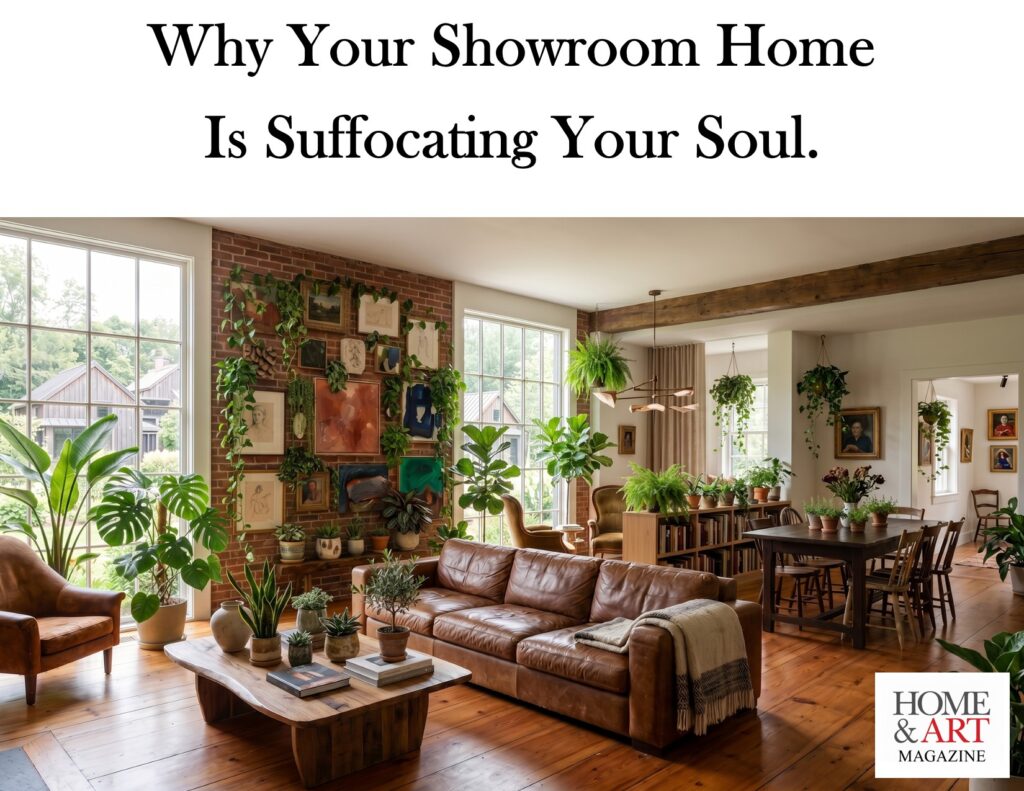
The future belongs to the “meet-in-the-middle” compromise: an architectural blueprint where pristine, gallery-white walls act as a versatile canvas for a rich, maximalist ecosystem of original fine art and lush, living flora.
The Architecture of Financial Fear
The transition to extreme minimalism wasn’t born out of a genuine artistic movement; it was driven by the commoditization of real estate. When houses are treated strictly as transactional volume, unique architectural details and bold artistic choices are flagged as financial liabilities. Developers realized that flat drywall, open-concept boxes, and sterile palettes were cheaper to mass-produce and easier to flip to the broadest possible demographic.
The casualty of this trend was human emotion. Human beings do not thrive in sterile environments. We are sensory creatures wired to respond to depth, texture, nature, and history. Living in a home devoid of personal narrative is the architectural equivalent of sensory deprivation.
When every room looks like an upscale hotel lobby, the concept of a “sanctuary” dissolves. We find ourselves living in spaces that feel temporary, hollow, and detached from our personal legacies.
The luxury market is pushing back. High-net-worth buyers are experiencing acute showroom fatigue. They are no longer asking how easy a home will be to sell to the next person; they are asking how deeply the home will sustain their own well-being today. Reclaiming the soul of a property requires breaking free from the minimalist lie, without making reckless financial compromises.
The Gallery Walls: Protecting Smart Equity
The greatest fear of any luxury homeowner is over-customizing a property to the point of devaluing the asset. This is where the wisdom of the museum gallery format changes the game.
The solution to cold minimalism is not painting your walls a chaotic, permanent color that will alienate future buyers. The solution is embracing a highly disciplined, warm gallery-white backdrop. By utilizing museum-grade, soft-undertone white paints, the architectural bones of the home remain pristine, spacious, and universally appealing.
This creates an unassailable financial foundation. To a future buyer, the home presents a clean, premium canvas of unlimited potential. To the current homeowner, it represents the ultimate stage.
Gallery-white walls serve a distinct psychological purpose: they clear the visual noise of the world. They catch natural light beautifully, expand the perceived square footage of a room, and create an atmosphere of curated calm. But a canvas is nothing without the paint. The magic happens when we transition from the architectural shell to the emotional layers inside.
Art with a Pulse: The Curation of Story
In the showroom era, art was treated as an afterthought—a literal space-filler purchased by the square foot to match the throw pillows. Massive, generic canvas prints with zero emotional depth were hung on walls simply to absorb sound in echoing, hollow, open-concept spaces.
True fine art, however, is not interior decoration. It is the cultural megaphone of a home. It dictates the energy, sparks the conversation, and anchors the room’s identity.
Against a clean, gallery-white backdrop, a dense, maximalist collection of original artwork comes alive. When you cluster original paintings, sketches, and sculptures together, the environment instantly shifts. Pieces that showcase visible brushstrokes, rich physical textures, and intentional imperfections tell a human story. They remind us of the artist’s hand, the creative struggle, and local cultural gravity.
A home filled with authentic art ceases to be a sterile box; it becomes a living, breathing chronicle. If a future buyer prefers a different aesthetic, the art collection moves with you, leaving the immaculate wall intact. By treating art as the foundational heartbeat of a design rather than a final accessory, we breathe life back into the architecture without risking a dime of resale value.
The Biophilic Infusion: Living Sculptures
If art provides the soul of the home, nature provides its pulse. The second pillar of the modern movement is the aggressive, intentional integration of indoor flora.
For too long, houseplants were relegated to small pots tucked away on lonely windowsills. Today’s premier designers are treating plants as living, architectural sculptures. Massive, towering Monsteras, soaring Bird of Paradise fronds, and cascading English Ivy are being deployed to break up the rigid lines of modern architecture.
The visual contrast of deep, glossy green foliage against a crisp, white gallery wall is the ultimate signature of luxury. Plants introduce organic movement, shifting shadows, and a raw sense of vitality that no static piece of furniture can replicate.
Beyond the undeniable aesthetic impact, the biophilic infusion serves a vital wellness function. Living plants clean the air, soften room acoustics, and fundamentally lower human cortisol levels. They turn a stark room into a vibrant ecosystem. A space overflowing with living flora feels occupied, loved, and deeply connected to the natural world—even in the dead of winter.
Building the Connected Ecosystem
The worlds of fine art, premium real estate, and intentional community development are not separate industries—they are interconnected pillars of a singular lifestyle vision.
Art captures our imagination and reminds us of who we are. Real estate provides the protective canvas where those values manifest. Natural styling ensures those spaces remain vibrant and healthy.
We must reject the sterile, mass-produced compromises of the past decade. You do not have to choose between a smart investment and an inspired life. By keeping your walls neutral, your art soulful, and your spaces overflowing with life, you master the ultimate real estate paradox.
The future belongs to spaces with character, homes with depth, and environments built with true structural intention. It is time to step out of the showroom and build a life completely inspired.
Explore The Blueprint
If you are ready to explore this philosophy in practice—whether by collecting original fine art, finding a home with true architectural character, or exploring sustainable legacy developments—scan the code on your card to connect with our ecosystem.