
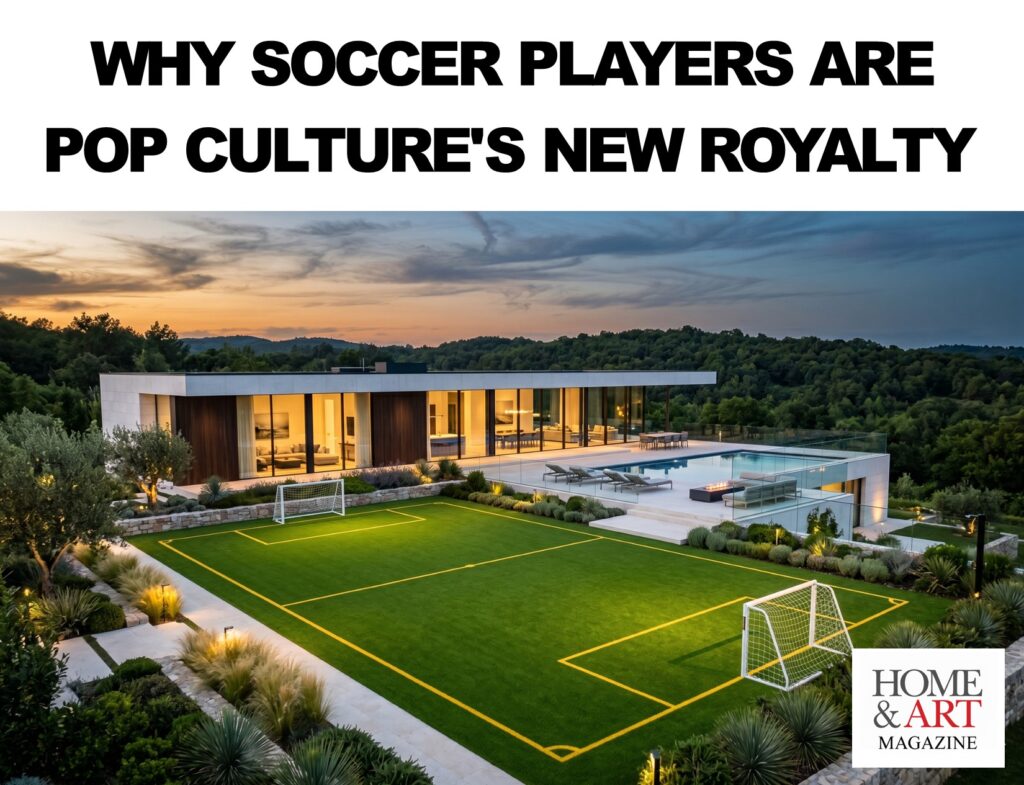
The story of soccer in the United States has long been told through the lens of box scores and tournament brackets. But if you strip away the temporary noise of stadium loudspeakers, a deeper, structural shift becomes visible. Soccer has systematically broken out of the sports pages to become a major cultural force—radically rewriting how affluent Americans invest their capital, curate fine art, and architect their homes.
As the 2026 World Cup turns North America into the epicenter of the global game, we are witnessing a permanent generational handoff. Here is a quick glimpse of Soccer reality:
Super Bowl: 125.6 million viewers
World Cup: 6 Billion projected viewers
I. The 13-2 Awakening
The Roots of a Cultural Collision
In the autumn of 1977, a newly formed youth squad from Brookfield, Connecticut, walked onto a patchy local field and was promptly dismantled 13-2 by a neighboring team from Danbury. Brookfield Soccer Club founding member Steve Schappert said, “I dont even know how we scored the 2 points, I think the other team threw them in.” The scoreline wasn’t an accident; it was an ethnographic map of American soccer’s true origins. While suburban pioneers were building clubs from absolute scratch, learning the rules as they went, right down the road were communities of Portuguese, Brazilian, and Italian immigrants who had been playing fluid, telepathic football since they could walk.
Back then, the domestic television landscape was a desert. If you wanted to see professional soccer, your dial was locked into the New York Cosmos on a local broadcast, just to catch a glimpse of a fading, mythical king. When Pelé arrived in New York, he explicitly recognized that his mission was cultural architecture rather than just scoring goals. As he addressed the international press corps during his introductory media conference at the 21 Club in Manhattan in June 1975:
“I came to America to make this beautiful game popular… You can cap championships, but you cannot cap the love of a game.” –Learn more on Wikipedia
The Design Evolution
That late-1970s era—characterized by heavy knit cotton jerseys, stitched leather balls, and hand-painted club pennants—is increasingly driving the aesthetic of high-end home offices, dens, and custom residential bars. Homeowners are moving past the glossy, neon-lit sports basements of the past in favor of a warmer, deeply nostalgic design language that feels integrated into the home’s main footprint.
This look relies on authentic, timeless materials that echo the physical reality of the sport’s roots:
-
Deep Heritage Tones: Using rich hunter greens, classic navy blues, and chalk-whites on accent walls to subtly mimic the pitch lines under stadium floodlights.
-
Tactile Textures: Incorporating rich, oil-rubbed walnut paneling and distressed cognac leather seating that naturally patinas and wears over time, mirroring the look of a vintage ball.
-
Narrative Displays: Utilizing genuine vintage club artifacts, historic local league photography, and classic stadium typography as focal points.
By prioritizing these historic elements, these spaces function less like standard “fan caves” and more like sophisticated, private heritage lounges that tell an authentic story of American soccer’s early days.
The design language relies on tactile materials that honor the era: raw iron accents, distressed cognac leathers that mimic a classic laced ball, and deep hunter-green wool throws that subtly evoke the pitch under floodlights. Homeowners are taking mid-century European football club banners, historic monochrome photography of local factory leagues, and vintage stadium typography and integrating them directly into timber-framed home libraries and custom residential bars.
II. The Daughters of Title IX
The Vanguard of the Revolution
The explosive expansion of the American soccer ecosystem was not a top-down corporate mandate; it was a civil rights revolution fueled by young women. When Title IX was passed in 1972, mandating equal athletic opportunities in federally funded education, gridiron football was a single-gender fortress consuming massive chunks of school budgets. Athletic directors desperately needed a high-roster, field-ready sport to balance the gender scales. Soccer was the perfect vessel.
The momentum built quietly for two decades until it shattered popular culture in the summer of 1999, when the U.S. Women’s National Team captured the world’s imagination. When icons like Mia Hamm and Brandi Chastain broke onto General Mills’ iconic orange Wheaties boxes, it signaled a permanent shift in corporate and cultural validation.
“I took every opportunity as a responsibility to not only help our sport grow but also to support female athletics. I felt it was important. And it was also a way for me to say thank you to all the people that invested in me and who, whether I knew them or not, made changes to compete at this level — whether it was playing in college and the birth of Title IX and making sure that not only did I have access to being able to play in college but I had access to an education.” Mia Hamm, Time Magazine
By 2026, girls’ varsity high school soccer has climbed to nearly 400,000 active players nationwide, standing firmly as the third most popular sport for young women in America.
The Design Influence
In luxury residential architecture, this means the single-gender “trophy room” of old is dead. Modern family estates are designed to honor multi-athlete households where daughters and sons command equal architectural real estate. Designers are moving away from cluttered plastic shelves, instead creating beautifully lit, minimalist recessed wall niches lined with brushed brass or unlacquered bronze to display medals, historic tournament credentials, and tournament artifacts as structural design elements within the central home gallery.
III. The Co-Ed Spiral
The Family Takeover of the American Weekend
Because soccer embraced both boys and girls simultaneously, it did something no single-gender sport could dream of: it completely monopolized the American family’s weekend calendar. In a household with a son and a daughter, football or baseball forced families to split their allegiances. Soccer allowed the entire family unit to pack into the car, head to a single multi-field complex, and spend forty-eight continuous hours embedded in the culture of the pitch.
This family-wide appeal contributed to a significant demographic shift in American youth sports. Sunil Gulati, a Columbia University economics professor and former President of the United States Soccer Federation, highlighted soccer’s unique family dynamic in interviews:
“The football culture in America is deeply rooted, but soccer has a different kind of growth because it welcomes the entire household. It creates a shift where the parents’ weekend belongs entirely to the field.”
Youth Soccer Growth Over Decades
Organized youth soccer has seen explosive, sustained growth since the establishment of US Youth Soccer (then the United States Youth Soccer Association) in 1974:
- Starting point: Just over 100,000 registered players in 1974.
- Peak registrations: Rose to nearly 3 million players under the US Youth Soccer umbrella by the 2010s.
- This represents roughly a 2,900%+ increase (nearly 30-fold growth) over several decades.
Note on current figures: US Youth Soccer reports nearly 2.5 million players registered annually in recent years, with total organized youth participation (including other organizations like AYSO and US Club Soccer) remaining substantial. Broader soccer participation (ages 6+) across indoor/outdoor play has continued to trend upward overall, reaching millions more when including casual/recreational players.
This growth was fueled by multiple factors:
- The sport’s accessibility (lower equipment costs compared to football or hockey).
- Strong appeal to families and girls (Title IX played a major role).
- Immigration influences and the 1994 World Cup hosted in the US.
- Suburban expansion and organized club systems.
Participation has faced some plateaus and challenges in recent years (e.g., pay-to-play barriers, specialization pressure, and competition from other activities), but soccer remains one of the top team sports for American youth.
Dads and granddads who grew up living and dying by autumn football have been lovingly but systematically dragged onto sideline lawn chairs by their children and grandchildren, fundamentally breaking the multi-generational transmission chain of the NFL.
The “Blokecore” Fashion Revolution
The Runway on the Terraces
While traditional American sports stars dominate regional truck and domestic beer commercials, the global soccer ecosystem has staged a hostile takeover of the luxury lifestyle market. This cultural collision birthed “Blokecore“—a massive style movement that extracts vintage 1980s and 90s replica jerseys from the muddy terraces of European stadiums and drops them directly onto high-fashion runways and urban streets.
Paired with straight-leg denim, trench coats, and classic leather terrace sneakers like the Adidas Samba, the soccer kit is no longer mere fan gear; it is a legitimate luxury style statement. Elite players have shifted the definition of an athlete from a localized sports hero to a global fashion canvas and front-row fixture at Paris Fashion Week.
Architectural Execution: The Athletic Transition Suite
This high-intensity family lifestyle has forced a radical transformation of the luxury home’s floor plan, completely redefining the classic American mudroom into a high-end, functional transition space designed to handle heavy athletic utility without sacrificing luxury.
IV. Pop-Culture’s New Royalty: Soccer Players
The Luxury Endorsement War
If soccer players are pop-culture’s new royalty, then the Beckham family remains its undisputed, multi-generational ruling dynasty. Long before the current crop of modern athletes began conquering fashion house front rows, David and Victoria Beckham single-handedly drafted the blueprint for the athlete-as-luxury-commodity crossover. Today, “Brand Beckham” has evolved from a high-stakes power couple into a full-scale corporate empire, defending its territory in the luxury endorsement wars across multiple generations.
While Sir David continues to anchor massive, legacy lifestyle partnerships with the likes of Tudor and Adidas, and Victoria cements her eponymous label as a staple of Paris Fashion Week, the torch is aggressively being passed. From Romeo modeling for elite fashion campaigns to 14-year-old Harper already being positioned as the future face of modern teen skincare, the Beckhams treat the luxury landscape not just as a playground for endorsements, but as a hereditary birthright—proving that while trends in the cultural shift fade, the family business of being iconic is built to last.
Victoria Beckham’s Runway Collection Highlights is highly relevant here, as it offers a deep-dive analysis into how Victoria continues to evolve her luxury fashion brand on the Paris stage, a central pillar of the modern Beckham family empire.
While traditional American sports stars dominate regional truck and domestic beer commercials, elite soccer players have staged a hostile takeover of the global luxury lifestyle market. They have shifted the definition of an athlete from a localized sports star to a high-end fashion canvas and art curator.
Consider the off-field economic footprints of the modern vanguard:
-
Cristiano Ronaldo: Pulls in over $65 million annually off the pitch alone, operating as a human conglomerate backed by luxury brands and tech giants.
-
Kylian Mbappé: Commands the luxury market as a premier global ambassador for Dior and Hublot, regularly shifting the trajectory of Paris Fashion Week.
-
Lionel Messi: Subsidized his historic move to North America through a revolutionary revenue-share model with Apple TV and Adidas, permanently altering the corporate mechanics of sports broadcasting.
The athletic elite explicitly view their sport as a gateway to high design. International footballer and noted style icon Héctor Bellerín detailed this merging of athletic wealth and design culture in a design profile for GQ Magazine in February 2020:
Héctor Bellerín on the subtle art of developing a personal style
“Comfort is key for me when it comes to dressing and this collection merges that with sustainability. My style has changed dramatically. It’s more mature and comfort-focused today. I don’t really buy new clothes anymore. I try and buy secondhand and get more coveted pieces that will last forever. Longevity and circularity are key. In the past I wasn’t as informed as I am today and now I try to recycle pieces, rework them and exchange them.” – GQ Magazine
The Design Influence
This luxury crossover has bled directly into the residential interior market. High-end fashion houses are no longer just making jerseys; they are designing high-end home goods specifically for this soccer-centric elite. We are seeing luxury labels release monogrammed leather ball trunks, minimalist soccer-inspired lounge chairs, and custom-woven cashmere throws featuring abstract interpretations of pitch lines, allowing homeowners to nod to the sport through pure luxury materiality.
V. The 6-Billion-Person Wave
The Private Residential Museum
The true scale of soccer’s ascension becomes undeniable when contrasted against the traditional titans of American sports broadcasting. The Super Bowl is an undeniable, hyper-lucrative domestic holiday. In February 2026, Super Bowl LX pulled in a final verified tally of 125.6 million viewers domestically via Nielsen metrics. Yet, outside of North America, that massive engine hits a hard border, with global audiences chapters behind the global game.
Soccer knows no borders. With the expanded 48-team, 104-match format splashing across North American stadiums for the 2026 World Cup, the pressure and global visibility are unmatched. Speaking directly to media networks about the unforgiving reality and unique weight of the global tournament stage,
French star Kylian Mbappé stated:
“A World Cup isn’t like a club tournament with two-legged knockout ties—here, one bad game sends you packing. You have to keep your emotions in check.” –AS USA
Official data and projections place the cumulative global audience for this tournament cycle at 6 billion people. The final match alone is expected to draw over 1.5 billion concurrent viewers—more than ten times the size of the Super Bowl.
The Design Influence
This unmatched global scale has driven an unprecedented wave of private equity and ultra-high-net-worth capital into the soccer ecosystem, creating a new class of elite sports-baron collectors who are redefining the concept of the “Private Residential Museum.”
In properties from the rolling hills of Litchfield County to the waterfronts of Miami, collectors are working alongside world-class residential architects to design sprawling, climate-controlled art wings. The objective is strict contextual contrast: hanging a multi-million dollar contemporary painting or an abstract expressionist work in the exact same view line as an incredibly rare, museum-grade piece of soccer heritage. The sport is no longer relegated to a television screen; it is woven into the architectural fabric of fine art display.
VI. The Art of the Artifact
High-End Memorabilia Curation
Ultimately, the soccer boom in America was not built by top-down corporate mandates or slick marketing campaigns. It was forged in the grassroots dirt of the late 1970s, born out of a beautiful, chaotic collision between suburban clubs trying to find their footing and deep-rooted immigrant communities keeping their traditions alive.
When the dust settles on the 2026 World Cup, the true legacy left behind won’t just be stadium infrastructure; it will be a permanent maturation of the American identity, captured through how we curate our most personal spaces.
In modern high-end real estate and interior design, sports memorabilia is no longer hidden away in dark basements or generic “sports caves.” Elite interior design firms treat rare, historic sports artifacts exactly like fine art textiles or sculptural objects. By utilizing museum-grade framing, anti-reflective glass, and custom recessed lighting, homeowners are integrating these pieces directly into central galleries and timber-framed libraries, allowing the game’s heritage to serve as a legitimate design statement.
The Curation Ledger
Treating the game’s roots as legitimate fine art requires absolute restraint and museum-grade execution. For a sophisticated home gallery or office, the artifact must be elevated beyond simple memorabilia:
By treating these pieces with the architectural reverence typically reserved for classical sculpture or fine art paintings, the home becomes an authentic reflection of a historic cultural shift. It honors the journey from those patchy, grass-stained fields of 1978 straight to the pinnacle of modern luxury design.
