
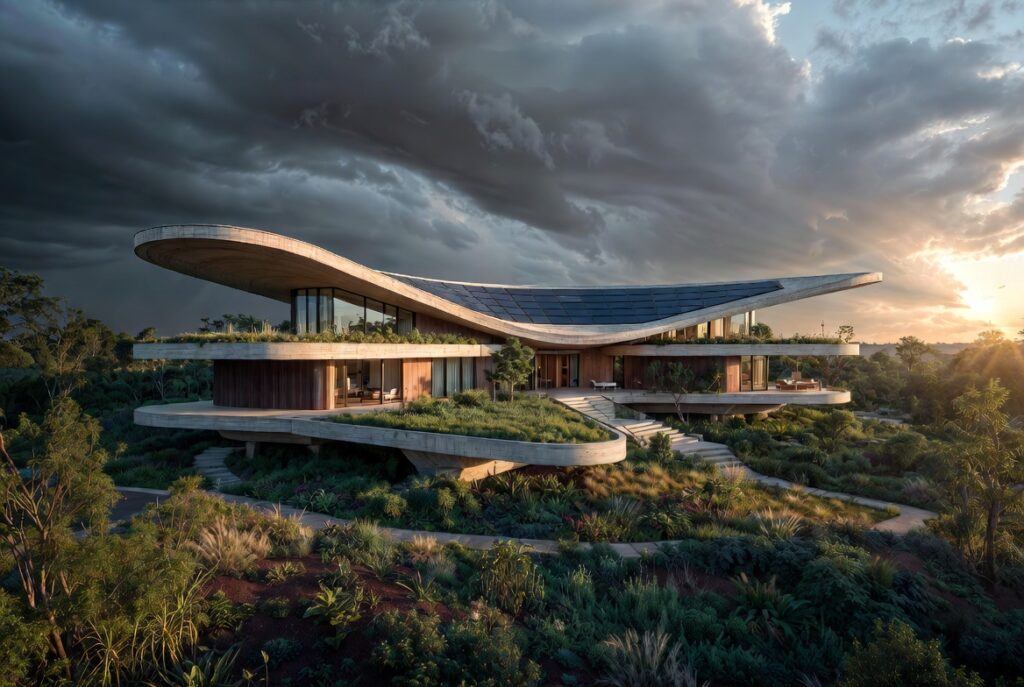
How Designers and Artists Are Reimagining Living Spaces for an Era of Extreme Weather
The dream home of the future may not be defined by marble countertops, oversized closets, or smart appliances.
It may be defined by whether it can survive a flood.
Across architecture, interior design, landscaping, and contemporary art, climate anxiety is beginning to reshape the way people think about home. Rising temperatures, wildfires, storms, droughts, and flooding are no longer distant environmental concerns discussed mainly by scientists and policymakers. They are becoming everyday design problems.
And increasingly, they are changing what beauty looks like.
From fire-resistant gardens in California to elevated coastal homes in Florida and cooling materials in overheated cities, homeowners and designers are beginning to merge survival with aesthetics. Climate adaptation is no longer hidden behind walls or confined to engineering plans. It is becoming part of the visual language of modern living.
The result is a new design movement where resilience itself becomes beautiful.
Extreme Weather Is Changing the Meaning of Home
For generations, homes were designed primarily around comfort, status, and location.
Today, many homeowners are asking a different question first: Is this place safe?
The shift is being driven by the increasing visibility of climate disasters. Flooded neighborhoods, smoke-filled skies, prolonged heat waves, and collapsing insurance markets are changing the emotional relationship people have with their homes.
In some parts of the United States, climate risk has already begun influencing property values and migration patterns. Buyers increasingly research flood zones, wildfire exposure, and energy efficiency before making decisions.
Designers say these concerns are now shaping renovation requests as well.
Homeowners are asking for:
- Heat-resistant materials
- Backup energy systems
- Flood-tolerant flooring
- Fire-conscious landscaping
- Better insulation
- Shaded outdoor spaces
- Natural ventilation
But unlike earlier generations of disaster-proof construction, today’s climate-conscious homes are also deeply design-focused.
People no longer want survival features that feel industrial or unattractive.
They want resilience integrated seamlessly into everyday life.
The Rise of Cooling Design
One of the biggest emerging trends is climate-responsive cooling.
As global temperatures rise and summers become more intense, designers are rethinking how homes manage heat. In many cities, air conditioning alone is no longer seen as a sustainable long-term solution due to energy costs and environmental impact.
Instead, architects are borrowing ideas from older forms of design that existed long before modern cooling systems.
Thicker walls, shaded courtyards, cross-ventilation, reflective roofing, deep overhangs, and strategically placed trees are all returning to modern architecture.
Natural airflow is becoming fashionable again.
Interior designers are also shifting toward cooler color palettes and breathable natural materials like linen, clay plaster, terracotta, and stone. Heavy synthetic materials that trap heat are increasingly being replaced with textures that feel organic and temperature-sensitive.
Even paint technology is evolving. Reflective exterior coatings designed to reduce heat absorption are becoming more common in warm-weather regions. Some newer materials can significantly lower indoor temperatures by reflecting solar radiation away from buildings.
Climate adaptation is influencing not only how homes function, but how they feel physically.
The emotional appeal of cool, shaded, grounded spaces is becoming central to luxury design.
Fire-Resistant Landscaping Becomes Beautiful
Wildfires are also transforming residential design, particularly across the American West.
For years, fire-resistant landscaping was viewed mainly as a practical safety measure. Gravel, sparse planting, and defensive spacing often created harsh-looking outdoor environments.
Now, landscape architects are redesigning those spaces with aesthetics in mind.
Drought-resistant native plants, sculptural succulents, stone pathways, decomposed granite, and low-water gardens are becoming major design trends. What was once considered purely functional now carries a distinctly modern visual appeal.
Climate-smart landscaping is increasingly associated with sophistication rather than sacrifice.
Native planting is especially important. Many homeowners are moving away from water-hungry lawns toward landscapes built around regional ecosystems. In dry climates, this means replacing imported grass with plants naturally adapted to heat and drought.
The result is a quieter, more environmentally responsive form of beauty.
Gardens are becoming less about control and more about coexistence with local conditions.
Flood-Proofing Is Reshaping Coastal Architecture
In flood-prone areas, resilience is beginning to define architecture itself.
Elevated homes, water-resistant materials, floating structures, and modular construction methods are becoming increasingly common in coastal communities vulnerable to storms and rising sea levels.
Architects say many clients now ask how quickly a home can recover after a flood — not simply whether flooding can be prevented entirely.
That mindset represents a major psychological shift.
Rather than imagining homes as fixed, permanent shelters protected from nature, many climate-conscious designers now think in terms of flexibility and adaptation.
Materials matter enormously in this new approach.
Concrete, terrazzo, tile, steel, and treated wood are increasingly favored in vulnerable areas because they can better withstand moisture exposure and require less replacement after storms.
Interior layouts are changing too. Mechanical systems, electrical panels, and valuable storage are often elevated above flood levels. Lower floors may be designed intentionally for easy cleanup rather than permanent occupancy.
These decisions are practical, but they also shape visual identity.
Climate-resilient homes often feature open layouts, durable textures, elevated forms, and stripped-back materials that create a distinctly contemporary aesthetic.
Sustainability Is Becoming More Emotional
For years, sustainable design was marketed largely through environmental statistics.
Lower emissions. Reduced waste. Energy efficiency.
Today, the conversation feels more emotional.
People increasingly want homes that feel connected to nature rather than separated from it.
This shift is influencing everything from material selection to lighting choices. Natural textures, reclaimed wood, handmade ceramics, untreated stone, and organic fabrics are appearing in homes not only because they are environmentally conscious, but because they create psychological comfort.
Designers say many clients want interiors that feel grounding during an era of instability.
In response, homes are becoming softer, warmer, and more sensory-driven.
Large windows maximize natural light. Indoor plants blur the boundary between interior and exterior space. Earth tones replace colder minimalist palettes. Outdoor living areas become extensions of the home rather than decorative afterthoughts.
Climate anxiety is not only changing infrastructure.
It is changing atmosphere.
Artists Are Responding to Climate Fear
Contemporary artists are also exploring the emotional impact of environmental instability.
Across galleries and installations, climate-conscious art increasingly incorporates recycled materials, salvaged objects, ash, soil, water imagery, and themes of fragility.
Some artists work directly with environmental waste, transforming discarded plastics, damaged wood, or industrial debris into sculpture and installation work. Others focus on documenting disappearing landscapes or visualizing future climate scenarios.
But the tone of climate art is shifting.
Earlier environmental art often emphasized catastrophe and warning. Increasingly, artists are exploring adaptation, repair, and coexistence instead.
That same philosophy is beginning to appear inside residential spaces.
Homeowners are displaying handmade objects, reclaimed materials, and locally sourced art not only for visual reasons but because these objects symbolize sustainability, care, and permanence.
The home itself becomes a reflection of environmental values.
Luxury Is Being Redefined
Perhaps the biggest transformation is happening in the idea of luxury itself.
For decades, luxury homes emphasized excess: oversized spaces, imported materials, dramatic consumption.
Now, climate realities are reshaping what aspirational living looks like.
A naturally cool home may feel more luxurious than a glass mansion that overheats in summer.
A drought-resistant garden may carry more prestige than a massive lawn requiring constant irrigation.
Solar panels, shaded courtyards, insulated windows, and resilient materials are increasingly seen as intelligent investments rather than compromises.
Quiet sustainability is replacing visible excess.
Even high-end architecture is becoming more restrained, grounded, and environmentally aware.
The aesthetic emerging from climate-conscious design is not futuristic in the way earlier generations imagined. It is often earthy, natural, tactile, and deeply connected to local landscapes.
Homes are beginning to look less like machines designed to dominate nature and more like structures attempting to cooperate with it.
Designing for an Uncertain Future
No design solution can fully eliminate climate risk.
Architects and planners increasingly acknowledge that adaptation, not perfection, is the realistic goal.
But the growing climate design movement reflects something larger than disaster preparation.
It reflects a cultural shift in how people understand home itself.
For much of modern history, architecture aimed to separate people from natural forces. Air conditioning removed dependence on climate. Synthetic materials replaced local resources. Homes became increasingly sealed off from the outdoors.
Now, many designers are reversing that logic.
The future home may be more open to natural airflow, more responsive to weather, more rooted in regional materials, and more aware of environmental limits.
That does not necessarily mean sacrificing beauty.
In many ways, it is creating a new version of beauty altogether.
One defined not by perfection or excess, but by resilience, adaptability, and care.
The climate-proof home is no longer just an architectural experiment.
It is rapidly becoming the next chapter of modern living.
