
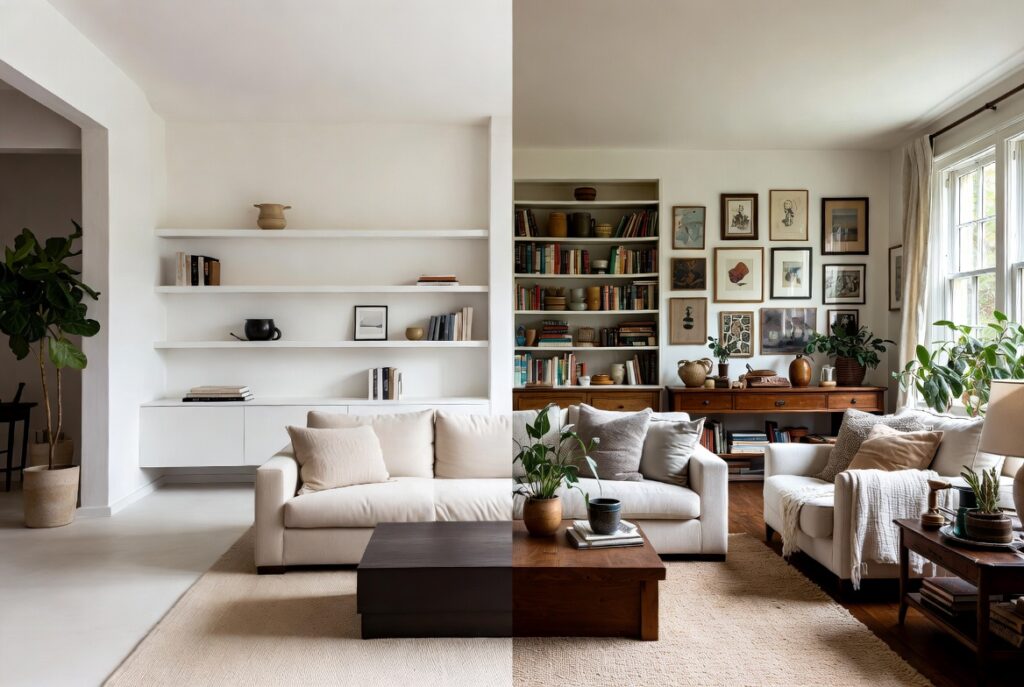
Why Handmade Interiors Are Replacing Luxury Minimalism
For nearly a decade, the aspirational home looked remarkably the same no matter where you lived. Whether it appeared in a Brooklyn townhouse, a Los Angeles apartment, or a suburban renovation account on Instagram, the formula rarely changed: white walls, pale oak floors, boucle furniture, neutral ceramics, and carefully styled shelves with exactly three art books and a sculptural vase.
The aesthetic was polished, calming, and highly photogenic. It was also strangely impersonal.
Now, a different kind of home is taking over.
Across interior design, homeowners are rejecting the hyper-curated minimalism that dominated the 2010s and replacing it with spaces that feel layered, handmade, and emotionally lived in. Vintage furniture with scratches and uneven finishes is being chosen over mass-produced sets. Walls are painted in muddy greens, warm browns, and earthy reds instead of gallery white. Handmade pottery sits next to inherited objects. Quilts, flea-market lamps, framed sketches, and crowded bookshelves are returning to rooms that once seemed designed mainly for social media.
The new dream home is less about perfection and more about presence.
The Backlash Against Algorithmic Design
Designers say clients increasingly want interiors that feel personal instead of pristine. The language people use has shifted noticeably over the past few years. Words like “luxury” and “minimal” are being replaced by requests for homes that feel “warm,” “collected,” “grounded,” or “human.”
The trend reflects a broader cultural fatigue with polished digital living. After years of algorithm-driven aesthetics and aspirational content, many people appear to be craving homes that reflect actual life rather than idealized performance.
Social media helped create the era of perfect interiors, but it also accelerated the backlash against them.
During the pandemic years, millions spent more time than ever inside their homes while simultaneously broadcasting those spaces online. Kitchens became video-call backgrounds. Living rooms doubled as offices. Entire industries emerged around home organization, neutral decor, and “clean girl” aesthetics. Platforms rewarded visually consistent spaces that photographed well and projected calm control.
But eventually, many interiors began to feel interchangeable.
A growing number of homeowners now say they are tired of homes that resemble luxury rental listings more than personal spaces. In response, people are embracing interiors filled with visible personality: mismatched dining chairs, thrifted artwork, handmade ceramics, stacked records, aging wood, and objects with stories attached to them.
What once might have been considered clutter is increasingly interpreted as character.
Handmade Objects Become Emotional Anchors
Independent artists and craftspeople are among the biggest beneficiaries of the shift. Ceramicists, textile artists, woodworkers, and painters report rising interest from buyers searching for one-of-a-kind pieces rather than factory-produced decor. Consumers who once purchased matching home collections online are increasingly buying smaller numbers of meaningful objects made by real people.
The appeal lies partly in texture and imperfection. Handmade objects carry subtle inconsistencies — uneven glaze on pottery, visible brushstrokes in paintings, natural wear in reclaimed wood — that make spaces feel less sterile. In an era dominated by digital experiences and mass manufacturing, those imperfections are becoming emotionally valuable.
There is also an intimacy to handmade work that mass production struggles to replicate. Buyers often know the artist’s story, follow their work online, or purchase directly from local markets and studios. The object becomes more than decor; it becomes part of a relationship between maker and owner.
In many homes, these pieces now function almost like emotional anchors. A hand-thrown mug used every morning or a vintage table repaired over time carries memory and familiarity in ways disposable furniture rarely can.
Why Economics Are Changing Interior Design
The movement away from showroom-perfect homes is not driven solely by aesthetics. Economic pressure is also reshaping how people think about interiors.
Younger homeowners and renters are navigating high housing costs, elevated interest rates, and uncertainty about long-term financial stability. Instead of purchasing entire furniture sets designed around trends, many are investing slowly in secondhand finds, vintage pieces, or handmade work that can move with them through different stages of life.
Estate sales, flea markets, antique fairs, and online resale platforms are experiencing renewed popularity. Vintage furniture, once associated primarily with collectors or older generations, has become central to contemporary interior culture. Mid-century cabinets, worn farmhouse tables, and antique mirrors are now styled alongside contemporary art and modern lighting.
Part of the appeal is sustainability. Consumers increasingly understand that disposable furniture contributes heavily to waste and overconsumption. Older furniture, especially solid wood pieces, is often better constructed than newer mass-market alternatives. Restoring and reusing items has become both environmentally conscious and aesthetically desirable.
The slow accumulation of meaningful objects also feels financially smarter to many consumers than constantly replacing trendy decor every few years.
Homes as Emotional Refuge
But the emotional component may be even more important than the environmental one.
Many people are seeking homes that provide comfort and identity during a period marked by burnout, political instability, economic anxiety, and constant online exposure. In uncertain times, domestic spaces often become emotional refuges. Design historians note that periods of social disruption frequently produce renewed interest in craftsmanship, nostalgia, and tactile materials.
That pattern is visible now in everything from the popularity of handmade quilts to the resurgence of dark wood furniture and traditional paint colors. The rise of cottage-inspired interiors and collected maximalism points toward a cultural desire for warmth and familiarity.
Even luxury design is changing. High-end interiors increasingly feature textured plaster walls, artisanal stoneware, visible natural materials, and custom handmade pieces. Designers are intentionally creating spaces that appear evolved over time rather than instantly assembled.
The visual language of wealth itself is shifting.
For years, luxury often meant emptiness: expansive neutral rooms with little visual noise. Today, luxury increasingly signals individuality — a home filled with books, original art, handmade lighting, or carefully sourced vintage objects that cannot easily be duplicated.
The Return of Lived-In Spaces
This transition is especially noticeable among younger creatives and homeowners who reject the idea that homes should function primarily as content. Rather than styling spaces exclusively for photographs, many are designing around rituals and hobbies: reading corners, music rooms, ceramic studios, layered kitchens, oversized dining tables meant for gatherings.
Homes are becoming less performative and more participatory.
The return of visible life inside interiors also reflects changing attitudes toward domestic perfection. For years, organization culture promoted the idea that every object should be hidden, streamlined, or aesthetically coordinated. The ideal home appeared almost untouched by daily activity.
Now, signs of use are increasingly appreciated rather than concealed.
Open shelves filled with mismatched dishes suggest active cooking. Paint stains in a studio corner imply creativity. Worn leather chairs signal years of use. A crowded gallery wall reveals evolving taste rather than perfect curation.
The result is an interior style that feels more emotionally accessible. Instead of intimidating viewers with impossible standards, these homes invite people in.
Why “Imperfect” Homes Feel More Authentic
Social media platforms themselves are beginning to reward authenticity over perfection. Videos showing cozy, cluttered apartments or heavily layered interiors often attract audiences precisely because they feel attainable and emotionally real. Viewers respond to homes that appear lived-in rather than staged.
The aesthetic movement has acquired many labels — “warm minimalism,” “intentional clutter,” “collected interiors,” “anti-perfectionism” — but all of them point toward the same cultural shift. People increasingly want spaces that reveal personality instead of suppressing it.
That does not necessarily mean homes are becoming chaotic. In many cases, the new interiors are deeply considered. The difference is that they prioritize emotional resonance over visual uniformity. A handmade bowl inherited from family may matter more than a perfectly coordinated centerpiece. A wall of eclectic art may feel richer than a blank minimalist canvas.
In this environment, imperfection becomes part of the design language itself.
Interior stylists say clients are increasingly comfortable mixing periods, colors, and materials in ways that would once have been considered incorrect. Heirloom furniture sits beside contemporary lighting. Antique rugs pair with modern sofas. Handmade pottery coexists with industrial shelving.
The home begins to resemble a biography rather than a showroom.
The Future of the Personal Home
The broader design industry is adapting quickly. Paint companies are introducing warmer, earthier palettes. Furniture brands are emphasizing craftsmanship and natural materials. Retailers increasingly market products using words like “artisan,” “textured,” “organic,” and “hand-finished.” Even major chains are attempting to imitate the irregularities and warmth traditionally associated with handmade work.
But authenticity remains difficult to manufacture.
What people seem to want now is not simply a style but a feeling: the sense that a home has evolved naturally over time, shaped by memory, creativity, and lived experience.
The perfect home, it turns out, may no longer be the one without flaws.
It may be the one where flaws are allowed to stay visible.
