
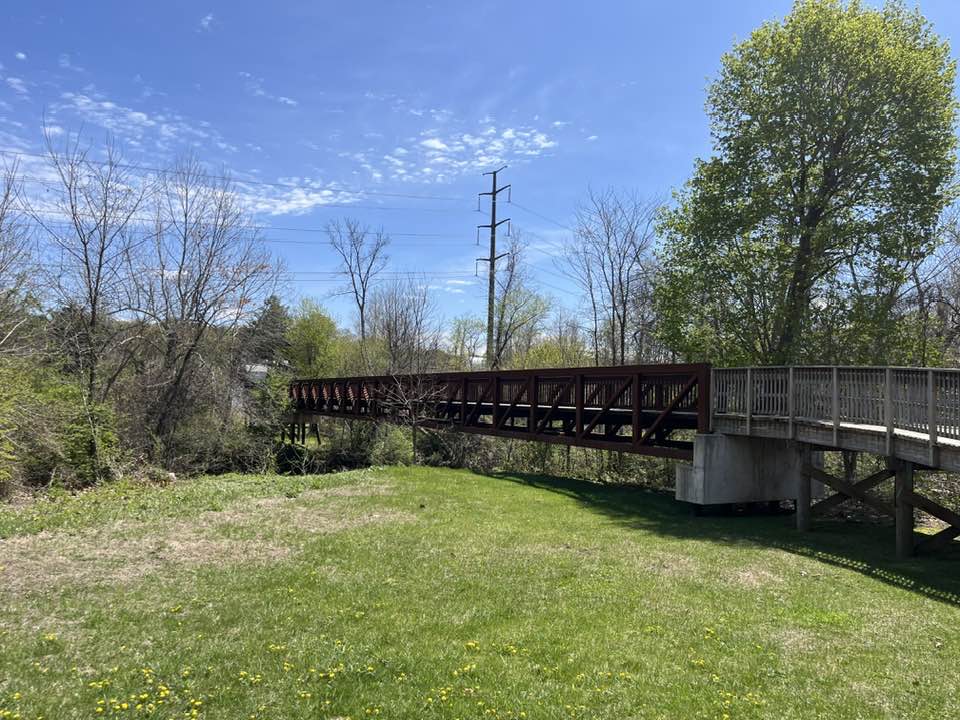
The Still River Greenway is more than a trail — it is the story of a town reclaiming its river and reconnecting with itself. Reborn from a polluted industrial past and the determined hands of local volunteers, this graceful path now winds peacefully through Brookfield, offering residents a daily place to walk, breathe, and remember why they love living here. What began as a grassroots dream has quietly become one of the town’s most treasured assets — a living corridor that links neighborhoods, supports local businesses, and reminds every resident that thoughtful community effort can turn a troubled river into a shared source of beauty, health, and pride.
“The Still River Greenway has been an integral part of the fabric of Brookfield and it has proven to be the second most popular greenway walk in CT. Our residents and the many visitors to our town use it on a daily basis to exercise, walk their dogs and enjoy the outdoors. It has also been a linchpin in attracting development in the Four Corners hamlet where town fathers had, in the 1970’s, laid out the first plans and zoning to build a vibrant, walkable new downtown area. Both the Greenway and our downtown have seen more people come, visit our shops and decide to choose Brookfield as where they want to live.
And it will continue to grow through the grants we have received that will plan a greenway from Long Island sound to our northern border and grants to build more of the Still River Greenway north towards New Milford.” –Steve Dunn Brookfield First Selectman
For millenia, the Still River shaped the life and character of Brookfield — first as a gentle corridor for Indigenous peoples, then as the beating heart of mills and railroads, later as a polluted industrial waterway known locally as the “Stinky Still River,” and finally as a symbol of renewal. This is the story of its remarkable journey: from ancient Indigenous uses and colonial industry, through decades of pollution and flooding, to the determined grassroots effort that reclaimed it, and onward to its bright future as a connecting force for homes, businesses, arts, and regional trails. At its center stands the Still River Greenway — a graceful paved path and iconic steel bridge that today ties the town together and quietly adds value to every home and business in Brookfield, while pointing toward an even more connected tomorrow.
Past: From Indigenous Uses to a River That Told Its Own Story
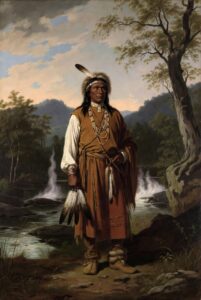 For thousands of years, the Still River moved like a silver thread through the quiet hills of Brookfield, carrying life in its gentle current. To the Pootatuck and Paugussett peoples, it was never just water — it was a vital companion. They fished its clear pools at dawn, gathered wild plants along its fertile floodplains, hunted in the surrounding woodlands, and followed its natural curves as seasonal pathways for travel and trade. Early colonial deeds still echo their presence, speaking of lands belonging to Sachem Pokono, son of the great Sachem Waramaug. These Indigenous uses of the river formed the first deep and enduring human connection to the valley — a relationship built on respect, rhythm, and reciprocity.
By the 1730s, European settlers heard the river’s powerful invitation. Its reliable drop in elevation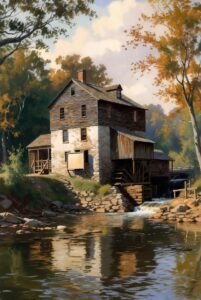 promised steady water power, and soon the stretch known as the Iron Works District came alive with industry. Grist mills turned grain into flour with the steady groan of stone wheels. Sawmills filled the air with the high, singing whine of blades slicing through fresh timber. Iron forges glowed orange in the twilight as molten metal was shaped into tools and hardware. Carding mills, cotton mills, a paper mill, comb shops, button factories, knife and shear works, and lime kilns all drew sustenance from the flowing water. One of those early grist mills, built around 1748–1780 by Abel Barnum on Whisconier Road, still stands today — its thick stone walls and heavy hand-hewn timbers now sheltering the studios and galleries of the Brookfield Craft Center, a graceful living bridge between past labor and present creativity.
The river found its perfect partner in steel and steam. In the early decades of the 20th century, the Housatonic Railroad breathed even greater life into the valley. As many as forty trains a day rumbled through Brookfield, stopping at two busy stations: one nestled in the Iron Works District, right across from the future Craft Center, and the other at Brookfield Junction on Stony Hill Road near the bottom of Sunset Hill. The air carried the sharp, metallic scent of coal smoke and hot steel. Freight cars clattered past loaded with raw materials and finished goods, while generations of local children rode the trains to high school in neighboring towns. The constant whistle and rhythmic clack of wheels on rails became the daily heartbeat of a thriving river valley economy.
By the mid-20th century, the corridor had taken on new, quieter rhythms. Farming and lighter industry wove themselves into the landscape. Many longtime Brookfield families, including the Schapperts, affectionately called it the “Stinky Still River.” The nickname had nothing to do with the water itself. It came from Hoffman’s Chicken Farm at the corner of Federal Road and Silvermine Road, right beside the one-way bridge. When the wind shifted just so, the sharp ammonia tang from the chicken coops and manure was so powerful it could bring tears to a driver’s eyes as they crossed the river. At 777 Federal Road, a busy lumber yard operating in the 1960s later transformed into one of Brookfield’s first indoor-outdoor shopping plazas — a clear marker of the town’s gradual shift from heavy industry to suburban commerce.
Nature, however, never surrendered its voice. In August 1955, Hurricanes Connie and Diane unleashed catastrophic floods across Connecticut. The Still River roared out of its banks with terrifying force, tearing at the shores and spreading contaminated sediments far downstream — a raw and unforgettable reminder of the river’s untamed power.
Yet the heaviest burden was slower, more insidious, and far longer-lasting.
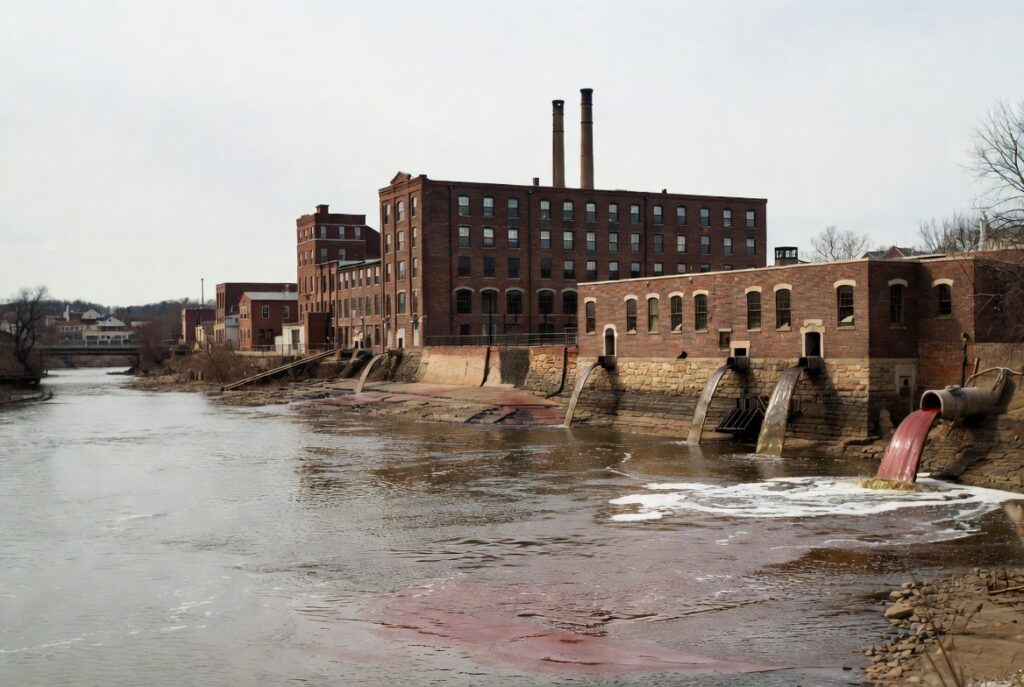
Upstream in Danbury, the self-proclaimed “Hat City of the World,” factories turned out millions of felt hats each year using mercury nitrate and vibrant chemical dyes. For generations, these pollutants flowed directly into the Still River. Local resident Richard Gehrig carried a vivid childhood memory: as a boy he would walk into his backyard simply to see what color the river ran that day — vivid red, shimmering gold, or deep black, depending on the batch being dyed upstream. The waterway had become an open industrial sewer, its once-clear waters stained by the very industries that had brought prosperity to the region.
This is the rich, complex tapestry of the Still River — Indigenous uses stretching back millennia, colonial mills and iron works, the thunder of forty daily trains, family farms with their distinctive smells, devastating floods, and decades of industrial pollution. It was a river of power and progress, but also of cost and consequence. By the late 20th century, many in Brookfield wondered whether the Still River could ever be reclaimed for beauty, recreation, and community pride.
The answer would come from determined local voices who believed the river still had a brighter story to tell.
Reclaiming the River’s Health and Building the Greenway
The healing of the Still River did not arrive with dramatic ceremony or sudden fanfare. It began quietly, almost secretly, in the early 1990s. Major upgrades to the Danbury wastewater treatment plant slowly worked their quiet miracle. Murky water began to clear. Oxygen levels rose. Fish returned in greater numbers, their quick silver flashes visible once again beneath the surface. Wetlands that had long been choked with invasive growth softened and greened. For the first time in living memory, the idea of walking beside the Still River without holding your breath no longer felt like a foolish dream.
A Linear Park Along The River
Arthur A. Harris was a visionary local leader in Brookfield, Connecticut, whose singular focus and persistence helped preserve and create the green space that became the Arthur A. Harris Linear Park — a key section of the Still River Greenway.
Who Was Arthur A. Harris?
- He served as Chairman of the Brookfield Conservation Commission in the 1960s and 1970s.
- In 1967, Harris proposed a bold, long-term idea: a narrow linear park running along the new Super Route 7 (the expanded highway corridor) from Norwalk all the way north to New Milford.
- His vision was to protect the natural beauty and ecological value of the land along the highway expansion, creating a continuous green corridor that would preserve open space, protect the Still River, and provide recreational opportunities for future generations.
His Major Achievement
When the state widened and improved Route 7, Harris worked tirelessly to convince the Connecticut Department of Transportation (CT DOT) to deed the leftover land along the highway right-of-way to the Town of Brookfield specifically for use as a linear park.
- This was no small feat. Highway projects often treat leftover land as surplus to be sold or developed. Harris’s dogged persistence and advocacy resulted in the state transferring significant acreage (including roughly 139 acres of wooded land) to the town.
- The land he helped secure forms the backbone of what is now called the Arthur A. Harris Linear Park, which sits directly behind Brookfield Town Hall / Municipal Center and serves as the northern anchor of the Still River Greenway.
The park was officially dedicated in the summer of 2010, and the Still River Greenway trail now winds through it.
Legacy
Arthur A. Harris is remembered as a quiet but highly effective conservationist — the kind of local citizen who saw the long-term value in preserving land amid rapid suburban growth and highway expansion. His singular vision in 1967 helped ensure that Brookfield would have a beautiful, accessible linear park and river greenway decades later.
The park named in his honor is a fitting tribute: a peaceful, wooded area with loops through wetlands and forests, right along the Still River — exactly the kind of protected natural corridor he fought to create.
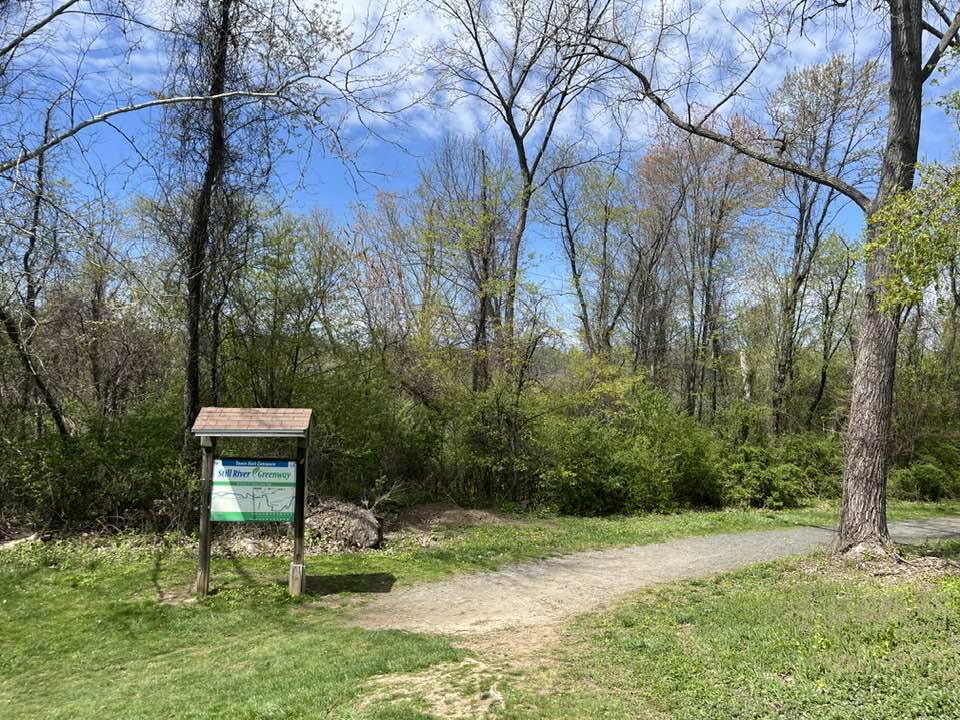
In 1996, Steve Schappert stood on the edge of that recovering corridor and saw something the maps could not show. So he called friend and Co-Brookfield Block Party founder Fred Ball. Together the 2 organized and lead a crew of 45 volunteers, he had watched them carve the first two rugged miles through dense woods and wetlands. Axes rang against stubborn branches. Shovels bit deep into heavy soil. Rakes pulled away years of tangled underbrush and fallen limbs. Sweat soaked shirts, blistered hands throbbed, and clothes tore, but with every swing of a tool the impossible began to feel possible. The cleared path proved the route could be walked. Yet Schappert realized a deeper truth: without a strong, graceful crossing over the river itself, the town-owned properties at the Municipal Center would remain forever separated from the shops and restaurants at Four Corners and the creative heartbeat of the Brookfield Craft Center. A bridge was not merely infrastructure — it was the unifying thread the entire vision needed.
As a painting contractor who had spent years battling the endless cycle of scraping, priming, and repainting metal and wood, Schappert knew exactly what he wanted. He wrote the first grant proposal for a long prefabricated steel pedestrian bridge spanning the Still River and its wide floodplain. He specifically advocated for self-weathering steel — COR-TEN steel — a material that would develop a stable, protective layer of light oxidation, a natural russet patina that seals the metal and eliminates the need for repeated painting. “Let the steel do the work,” he believed. The bridge would age gracefully, requiring almost no upkeep while standing as an elegant, enduring landmark. That original proposal was rewritten many times over the following years as costs fluctuated, environmental rules tightened, and designs were refined, but the core vision for a low-maintenance, beautiful steel crossing never wavered.
The journey from those first cleared miles to a finished trail tested everyone’s patience and resolve. Ninety percent of the proposed route lay within regulated wetlands and floodplains, triggering exhaustive reviews by the Connecticut Department of Transportation, DEEP, the EPA, and the U.S. Army Corps of Engineers. Wetland delineations, floodway analyses, easement negotiations, and detailed environmental impact studies stretched across years. Federal Transportation Enhancement grants provided critical funding, but rising costs — driven largely by the need to protect sensitive habitat while building the major bridge — required additional town appropriations, including a key $396,000 approval in 2015.
Construction finally broke ground in 2011. Phase One, the less complicated initial segment from Silvermine Road toward the Municipal Center, opened in 2012 and gave the community its first real taste of what was coming. Phase Two demanded far greater care and precision. Workers installed elevated boardwalks that seemed to float gently above delicate wetlands. They guided the graceful curves of the 10-foot-wide paved path through woodland and meadow. And at the heart of it all rose the centerpiece: the 170-foot prefabricated weathering steel bridge, its warm russet patina already beginning to form, recognized as Connecticut’s longest footbridge when completed. From its elevated deck, future walkers would one day enjoy sweeping views of the recovering river and the floodplain below.
After two decades of advocacy, volunteer labor, rewritten grants, and meticulous engineering, the full Still River Greenway officially opened to the public in November 2016. The total investment reached approximately $2.8 million — money that purchased far more than asphalt and steel. It purchased a transformation: a once-polluted industrial corridor reborn as a smooth, welcoming, ADA-accessible trail with interpretive signs sharing the river’s layered history, benches for quiet reflection, and a charming gazebo near the municipal campus.
Standing on that bridge today, it is easy to forget the decades of effort it required. The steel has taken on its warm, protective patina. The river below flows cleaner than it has in generations. What began with the ring of axes and the scratch of rakes in 1996 had become something lasting and beautiful — a public space that honors both the river’s difficult past and its hopeful future.
Present: How the Greenway Ties the Town Together and Adds Value to Every Home and Business
Step onto the Still River Greenway on a golden morning and you immediately feel its quiet power. Sunlight filters through the canopy, dappling the smooth 10-foot-wide paved path. A young family finishes soccer practice at the Municipal Center fields and, instead of heading straight to the car, chooses to stroll home together beneath the trees, laughter echoing softly beside the river. Nearby, an older couple walks arm in arm along a gentle loop near the senior center, their pace unhurried and steady, enjoying the kind of safe, level exercise that keeps them active and connected. Further along, an artist emerges from a woodturning workshop at the historic Brookfield Craft Center, crosses a short stretch of sidewalk, and wanders into Four Corners for a leisurely coffee or a scoop of ice cream at Sweet Scoops — all without ever starting a car.
This is the everyday magic the greenway has brought to Brookfield. It has become far more than a recreational trail. It is a graceful, living connector that weaves the town’s most important places into one seamless experience: from the Municipal Center with its Town Hall, ball fields, playground, and senior center, under Route 7, into the heart of Four Corners with its shops and restaurants, and onward to the historic Brookfield Craft Center on Whisconier Road.
For every homeowner in Brookfield, this connectivity translates into real, lasting value. Studies across New England show that well-designed greenways and multi-use trails typically add a 3–5% premium — and often more — to residential property values. Buyers today actively seek communities that offer safe, walkable access to nature, recreation, and local amenities. The Still River Greenway delivers exactly that. It makes every neighborhood more desirable, whether your home overlooks the river or sits several miles away. Families gain easier outdoor time after school or sports. Seniors enjoy safe, accessible daily walks that support healthy aging in place. The trail reduces short-trip car use, lowering costs while adding convenience and peace of mind. These improvements in daily livability help homes hold and increase their appeal and resale value over time.
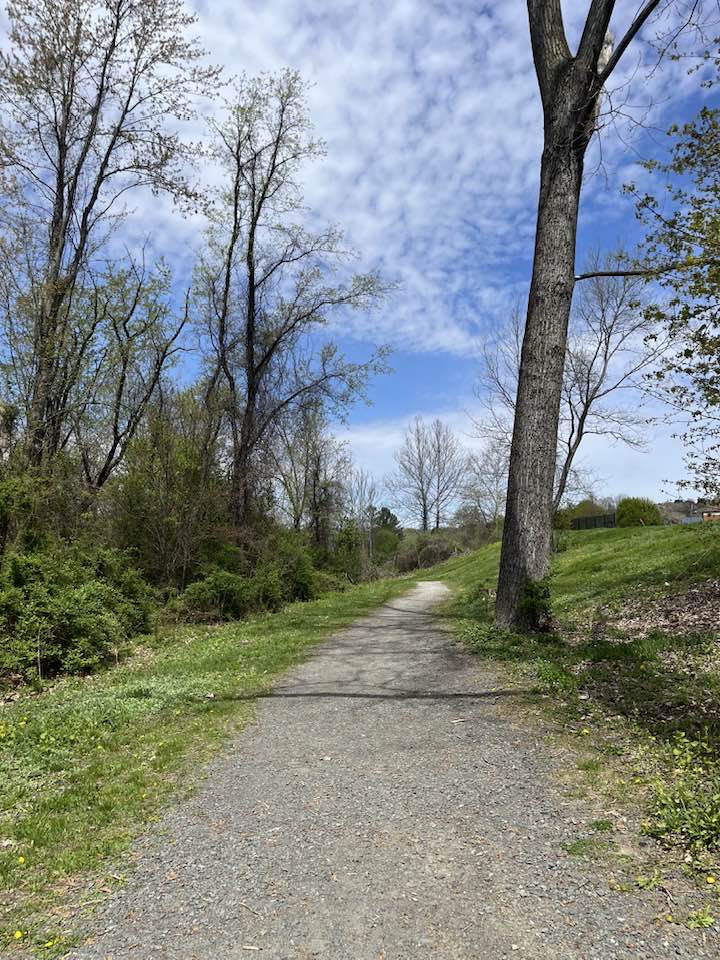
About 20 feet beyond that tree is where my Jeep ran over a 2″ tree stump that had been cut to a sharp edge and ripped a big hole in my tire. Fortunately I had Chuck Craemer of 4 Corner Towing on Speed dial! Local businesses feel the positive impact just as strongly. Increased foot traffic from trail users supports longtime favorites at Four Corners — restaurants, delis, the Food Emporium, and boutiques — while also breathing steady life into newer small-business incubators and pop-up retail concepts. A simple morning or evening walk often ends with lunch, shopping, or a visit to the Brookfield Craft Center’s gallery and studios. The Craft Center, housed in the town’s original grist mill, has become a natural extension of the trail experience. Visitors browse exhibitions, watch demonstrations, or join workshops in ceramics, woodturning, jewelry, and fiber arts. What used to feel like separate destinations are now seamlessly linked, bringing fresh energy and support to this cultural landmark without extra marketing.
Beyond measurable dollars and cents, the greenway creates something deeper and more enduring: a stronger sense of community and pride. Neighbors who once might never have crossed paths now greet one another on the path. Children pause at interpretive signs to learn about the river’s layered history. Artists find inspiration in the changing light dancing across the water. The trail has helped transform the Still River from a forgotten, once-polluted corridor into a shared community treasure that residents actively enjoy, protect, and celebrate.
In every season the greenway offers its own gifts. Spring brings the first tender green haze along the banks and the joyful return of birdsong. Summer provides cool, shaded relief and the constant soothing murmur of the river. Fall paints the floodplain in brilliant crimson and gold. Even winter, when the path lies quiet under snow, invites crisp walks and the rare, stark beauty of bare trees against a pale sky. Year after year, the trail quietly raises the quality of daily life for every Brookfield resident — making the town feel more connected, more livable, and more valuable in ways both tangible and deeply felt.
The Still River Greenway has proven that thoughtful public space pays rich dividends in private lives. It has turned a long-held vision into a practical, everyday advantage that benefits every home and every business in town — enriching both property value and the simple joy of living here.
Future: The River Reborn as a Regional Force
The Still River, once known for its vivid industrial colors and the memorable “Stinky Still River” nickname from nearby chicken farms, is quietly preparing to become a vibrant, unifying force in western Connecticut once again — this time not through factories and freight trains, but through recreation, tourism, shopping, and joyful human connection.
Momentum is building with remarkable speed. In late 2025, Brookfield received a $659,600 Community Connectivity Grant to construct the Still River Greenway Trail Connector — a graceful 1,900-foot link that will tie the existing trail more seamlessly into the downtown streetscape, extending north from Four Corners toward Newbury Village. This funding revives the long-stalled $12.4 million streetscape project and ensures that northward expansion will not be delayed by a single missing downtown piece.
Just months later, in March 2026, the town secured a $1.1 million state grant through the Local Transportation Capital Improvement Program. This will extend the greenway by about a half-mile from behind the Brookfield Police Department to a parking area on Pocono Road, including paving and lighting upgrades as part of the broader Town Hall campus improvements.
These local advances are part of something much larger. The Western Connecticut Regional Trail Project, supported by a federal RAISE grant and guided by Stantec Consulting, is developing shovel-ready plans for a continuous ~55-mile multi-use trail system. It will weave the Norwalk River Valley Trail in Danbury through Brookfield’s greenway and onward to the New Milford River Trail. Longer-term visions include further extensions toward Winsted and Torrington via the Sue Grossman Still River Greenway, ultimately feeding into the East Coast Greenway — a visionary 3,000-mile route from Maine to Florida.
When these connections are complete, the Still River will once again shape the region’s identity and economy — but in an entirely new and healthier way. Families will set out for full-day adventures, walking or biking car-free from Danbury’s riverfront parks, through Brookfield’s shaded greenway, and into New Milford’s historic village center. Artists will travel easily between creative hubs like the Brookfield Craft Center. Shoppers and diners will discover fresh reasons to linger in Four Corners and explore nearby businesses. Tourists will come not just for the scenery, but for the experience of moving through a landscape where history, nature, and community flow together.
The reborn river corridor promises to become a powerful economic engine through thoughtful recreation and tourism. Scenic trails with interpretive signs will tell the story of Indigenous uses, colonial mills, roaring railroads, and the river’s dramatic recovery. Elevated views from the weathering steel bridge will draw visitors who want to pause and breathe in the restored landscape. Increased foot traffic will support local shopping and dining, while the trail’s accessibility will encourage healthy outdoor activity for residents of all ages. Wildlife corridors will be protected, water quality will continue to improve, and Brookfield will strengthen its identity as a forward-thinking, trail-connected community in western Connecticut.
From the ancient footsteps of Indigenous peoples along its banks, through the thunder of forty daily trains and the vivid colors of industrial dyes, through the “Stinky Still River” days and the determined volunteer work of 1996, to the smooth paved path and steel bridge that opened in 2016 — the Still River has traveled a remarkable journey.
Today it flows cleaner than it has in generations. Tomorrow it will flow stronger — as a shared regional treasure that invites every resident and visitor to walk, explore, create, and connect. Thanks to the vision of early advocates who cleared the first miles and proposed the enduring bridge, and to the steady support of recent grants, the river has been reclaimed not only for beauty and health, but as a living force for good in the area.
The Still River Greenway is more than a trail. It is proof that a community can heal its past, honor its history, and build a brighter, more connected future — one graceful step at a time.