
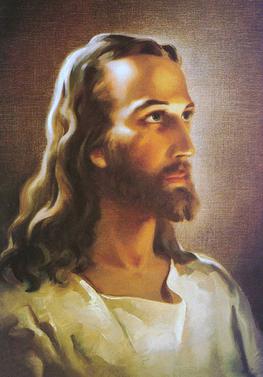
Sallman is widely regarded as the most reproduced artist of the 20th century, thanks largely to a single image: Head of Christ (1940). Seen in homes, churches, schools, hospitals, and even carried by soldiers into war, this painting became one of the most recognizable images in modern religious culture. Its reach is staggering—hundreds of millions of copies distributed worldwide—and its influence quietly profound.
This is the story of the artist who reshaped how millions visualize Jesus—and in doing so, blurred the line between fine art and everyday life.
Early Life and Formation
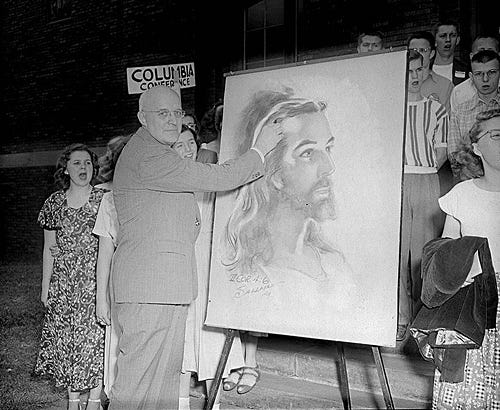
Warner Sallman was born on April 30, 1892, in Chicago, Illinois, to Swedish immigrant parents. His upbringing was rooted in Protestant Christianity, a cultural and spiritual framework that would later define his artistic direction.
He showed an early talent for drawing and went on to study at the Art Institute of Chicago. Unlike many artists who pursued gallery careers, Sallman entered the world of commercial illustration, working in advertising and visual design. This experience proved crucial: it trained him to communicate clearly, appeal to broad audiences, and produce imagery that could be reproduced at scale.
In the early 20th century, illustration was one of the most powerful visual mediums in America—appearing in magazines, advertisements, and religious publications. Sallman mastered this language of accessibility, long before he became known for religious art.
From Commercial Art to Devotional Image
Sallman’s transition into religious imagery was gradual rather than sudden. Influenced by his faith and by opportunities within Christian publishing, he began creating devotional illustrations alongside his commercial work.
This shift aligned with a broader cultural moment. In early 20th-century America, religious organizations increasingly used mass media—printed pamphlets, posters, and magazines—to reach growing audiences. There was a demand for imagery that was clear, emotionally resonant, and widely distributable.
Sallman was uniquely suited to meet that demand.
The Creation of Head of Christ
The painting depicts Jesus in a calm, reflective pose, gazing slightly upward. His expression is gentle and contemplative; his features are soft, symmetrical, and idealized. Light falls evenly across his face, creating a sense of serenity and spiritual presence.
Unlike earlier depictions of Christ—many of which emphasized suffering, divinity, or dramatic intensity—Sallman’s image presented a relatable, approachable figure. This was a Jesus meant to comfort, not intimidate.
Originally created for a publication by the Evangelical Covenant Church, the image quickly gained traction. Publishers recognized its appeal and began reproducing it on a massive scale: prints, calendars, bookmarks, framed images, and devotional cards.
What followed was unprecedented.
Mass Distribution and Cultural Saturation
By the mid-20th century, Head of Christ had become one of the most widely distributed images in history. Estimates suggest that over 500 million copies were produced, with some figures reaching even higher when including all formats and variations.
The image spread across:
- Private homes
- Churches of multiple denominations
- Public schools
- Hospitals and offices
- Military contexts
During World War II, pocket-sized versions were distributed to American soldiers, who carried them as sources of comfort and spiritual reassurance. After the war, the image became a fixture of domestic life, particularly in the United States.
In many mid-century households, Sallman’s Christ was not just decoration—it was part of the visual and emotional fabric of everyday existence.
Style, Accessibility, and Appeal
Sallman’s artistic style played a key role in this widespread adoption. His work is often described as realist but idealized, blending naturalistic detail with softened features and balanced composition.
Several elements contributed to its success:
- Clarity: The image is immediately recognizable and easy to interpret
- Emotional tone: Calm, compassionate, and reassuring
- Neutrality: Avoids overt denominational symbolism
- Reproducibility: Designed in a way that translates well across formats
This combination made the image accessible across cultural and theological boundaries. It appealed to Protestants, Catholics, and even non-Christians as a symbol of peace and humanity.
At a time when modern art was becoming more abstract and less accessible to general audiences, Sallman moved in the opposite direction—toward simplicity and emotional clarity.
Criticism and Debate
Despite its popularity, Head of Christ has not been without criticism.
Some art critics argue that the image is overly sentimental, lacking the complexity or originality associated with fine art traditions. Others point out that Sallman’s depiction reflects a distinctly Western, Eurocentric vision of Jesus, rather than a historically accurate one.
Theologians and cultural critics have also debated its influence, suggesting that its ubiquity may have shaped—and possibly limited—how people تصور Jesus across generations.
Yet even critics acknowledge its impact. Few images, regardless of artistic merit, have achieved such deep and lasting integration into global culture.
Beyond Head of Christ
Although Head of Christ dominates Sallman’s legacy, he produced many other religious works throughout his career, including illustrations of biblical scenes and devotional themes.
However, none reached the same level of recognition. In many ways, Sallman became a one-image artist—not because he lacked output, but because one image so completely eclipsed the rest.
This phenomenon raises an interesting question about artistic legacy: is it breadth that defines greatness, or the ability to create a single image that endures?
Legacy: The Most Reproduced Artist?
Warner Sallman died in 1968, but his work remains widely visible today. Prints of Head of Christ continue to be produced, sold, and displayed around the world.
He is frequently described as the most reproduced artist in history, a claim supported by the sheer volume of copies and the breadth of their distribution. While other artists may rival him in fame or influence, few can match the scale at which his work entered everyday life.
Sallman’s legacy challenges traditional definitions of artistic success. He was not a gallery artist, nor a central figure in avant-garde movements. Instead, he operated in a space between commerce, religion, and mass media.
And in that space, he achieved something extraordinary.
Conclusion
Warner Sallman’s story is not just about a painting—it is about how images move through the world. Through Head of Christ, he created a visual language that resonated across cultures, generations, and social contexts.
While the art world often celebrates innovation and exclusivity, Sallman’s achievement lies in accessibility and reach. He brought art out of museums and into homes, embedding it in daily routines and personal spaces.
In doing so, he may have accomplished something no other artist has: not just being seen, but being lived with.
📚 Sources
- “Warner Sallman” — https://en.wikipedia.org/wiki/Warner_Sallman
- “Head of Christ” — https://en.wikipedia.org/wiki/Head_of_Christ
- “Warner Sallman and the Head of Christ” — https://www.christianitytoday.com/history/people/evangelistsandapologists/warner-sallman.html
- “The Story Behind the World’s Most Famous Jesus Painting” — https://www.guideposts.org/inspiration/angels-and-miracles/the-story-behind-the-worlds-most-famous-jesus-painting
- “Head of Christ and Its Impact” — https://www.warnerpress.org/warner-sallman
- “Religious Art in 20th Century America” — https://www.neh.gov/article/religious-imagery-america
- “Mass Reproduction and Visual Culture” — https://www.tate.org.uk/art/art-terms/m/mass-production
- “Popular Religious Imagery in America” — https://www.loc.gov/item/ihas.200154200/
- “The Most Reproduced Image of Jesus” — https://www.artsy.net/article/artsy-editorial-this-is-the-most-reproduced-artwork-of-all-time
