
How Donn “Q” Quijada is Building a Cinematic Universe in the Streets of Connecticut
Digital Feature / Long-Form Arts & Culture Profile
The late-summer heat rises off the asphalt in New Haven like breath from living stone. In the American imagination, Connecticut has long been painted in watercolor restraint: white colonial facades, ivy-laced walls, and the hushed tensions of old money. Yet another Connecticut endures — raw, resilient, and humming with unseen life. It is the rattle of battered pickup trucks hauling lawnmowers through heavy August air, the low fluorescent glow of basement studios where beats are born after midnight, and the restless pulse of working-class neighborhoods in Hamden and New Haven, where survival and creation are bound together like marrow and bone.
For generations, artists from these places received the same quiet exile: leave if you want the world to see you. Donn “Q” Quijada refused that sentence.
Recent Success: Inpatient (Ren x Chris Webby) – “Caskets”
As a direct demonstration of the Crooked Smile production model in action, Donn “Q” Quijada recently produced the official music video for “Caskets” by Inpatient (Ren x Chris Webby). Directed by Rook & Frankie Fire Produced by Donn “Q” Quijada (Crooked Smile) & Maserati Rai. The emotionally powerful video — a cinematic tribute to loss, resilience, and the beauty in life’s mess — has already surpassed 1.26 million views on YouTube in its first 2 weeks, generating strong resonance across audiences.
Watch the video here:
As filmmaker, writer, and president of the Connecticut Film & TV Alliance, Quijada has chosen to stay and cultivate. He is turning the camera inward, toward the cracked sidewalks and corner-store neon of home, constructing a self-sustaining creative ecosystem capable of holding ambitious, authentic cinema. At its beating heart is his forthcoming feature, 2 Can Play.
The Anatomy of “2 Can Play”
2 Can Play moves like memory and fever combined — a psychological portrait dressed in the rhythms of New England street life. It follows Roberto Zamora, a 21-year-old Hispanic lyricist known underground as Anxiiiiety (four i’s, like a stuttered breath held too long). By day he cuts suburban lawns and navigates small hustles from his truck. By night he pours himself into composition notebooks, verses that read like both confession and map of the soul.
Logline: A young Hispanic rapper wrestling with anxiety refuses to sell his voice or his late brother’s notebooks to a label that wants the art without the artist. When the industry answers with violence, Roberto is drawn into a single night of desperate reckoning across the state’s shadowed edges.
The $250,000 offer first appears as deliverance. Then the fine print emerges: ghostwriting, erasure, the quiet surrender of identity. Roberto’s refusal ignites a robbery and home invasion that fractures his family’s fragile world and sends him spiraling through a city that suddenly feels both intimate and treacherous.
“I grew up around people like Roberto,” Quijada says softly. “Gifted souls whose light kept getting dimmed — not for lack of fire, but because the systems around them had no room for it.”
Vulnerability as Strength
What makes 2 Can Play singular is how deeply it inhabits mental struggle. Roberto’s severe anxiety attacks are not plot device or fleeting weakness — they become the film’s pulse, shaping its rhythm, its tightening frames, its labored silences. In a genre long defined by armored masculinity, Quijada offers something more honest and human: a young man waging two wars simultaneously — one against the streets, one against the storm in his own chest.
“Roberto isn’t broken,” Quijada reflects. “He carries something beautiful and heavy. The courage it takes for someone like him to keep creating — that is where the real poetry lives.”
Here, vulnerability does not diminish strength. It deepens it.
A New Visual and Sonic Language
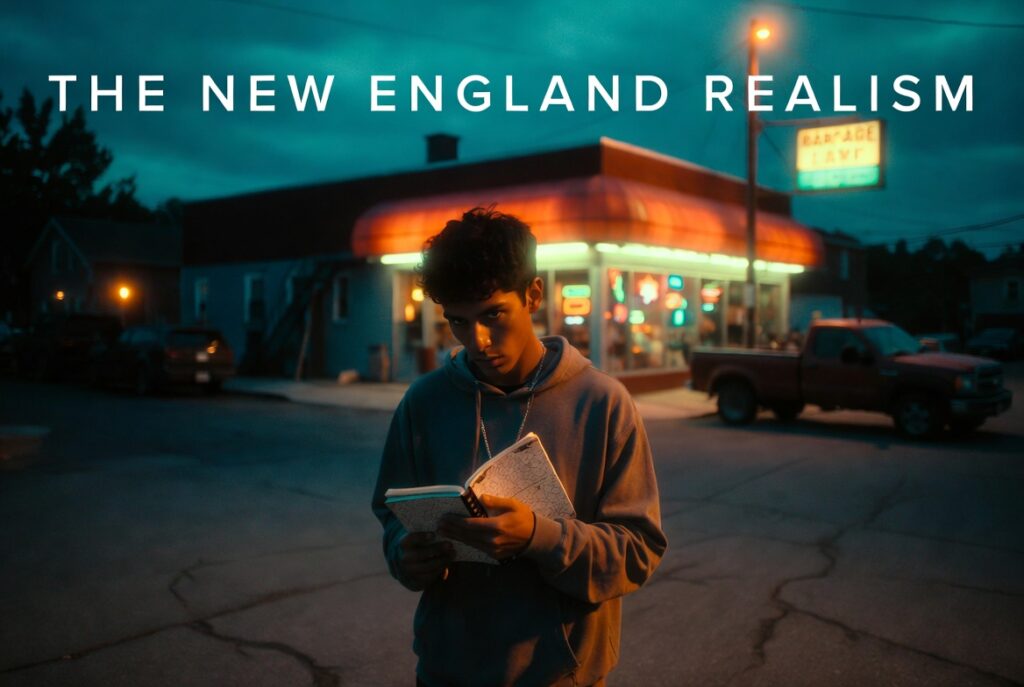
Visually, the film draws from the Safdie Brothers’ restless urgency, the grounded soul of 8 Mile, and the textured worlds of Snowfall and Atlanta. The camera stays close, handheld and alive. Practical light alone illuminates the scenes: the cold flicker of fluorescent kitchens, neon bleeding from pizza signs, pale dawn slipping through cracked blinds. Connecticut appears unadorned yet strangely luminous — beautiful in its bruises.
Sonically, the film refuses detachment. Roberto’s heartbeat emerges as a recurring percussion, rising and falling with his inner weather. Music seeps naturally from car stereos, old tape decks, and studio monitors, woven into the fabric of daily life. When Roberto steps to the microphone, the screen shifts. The bars arrive raw, urgent, unpolished — less performance than prayer, a momentary clearing in the fog of anxiety.
This is New England Realism: a cinematic dialect that finds grace in the particular — the weight of humid air, the cadence of regional speech, the quiet dignity of lives long rendered invisible.
Proof of Concept and a Larger Vision
Quijada’s ambition rests on more than vision. Through Crooked Smile Production Services and the Connecticut Film & TV Alliance, he has been methodically building local infrastructure — casting pipelines drawn from the community, pre-scouted locations that feel inhabited, and partnerships with the state’s film office. A short film now in post-production, Meathead, offers a vivid proof of voice: wild, musical, and unmistakably of this place.
The Living Canvas
In the end, 2 Can Play is more than one story. It is a declaration that profound, specific worlds exist beyond the traditional map of American cinema. That the streets of New Haven and its sister towns contain universes rich enough to sustain their own cinematic cosmos.
By pointing the lens homeward, Donn “Q” Quijada is doing something quietly radical: reclaiming the right to frame one’s own place with tenderness, clarity, and unflinching honesty. He invites us all to look again — and to see what has always been waiting there, luminous in the ordinary light.
Materials for Serious Inquiry The visual pitch deck (2-CAN-PLAY-OFFICIAL-PITCH-DECK-6426.pdf) and investment overview are available upon request. Full screenplay and detailed production materials available under NDA. Contact Donn “Q” Quijada through Crooked Smile Entertainment or the Connecticut Film & TV Alliance.
