
The Industrial Resurrection: How a Connecticut Mechanic Saved a Forgotten Visionary from the Landfill
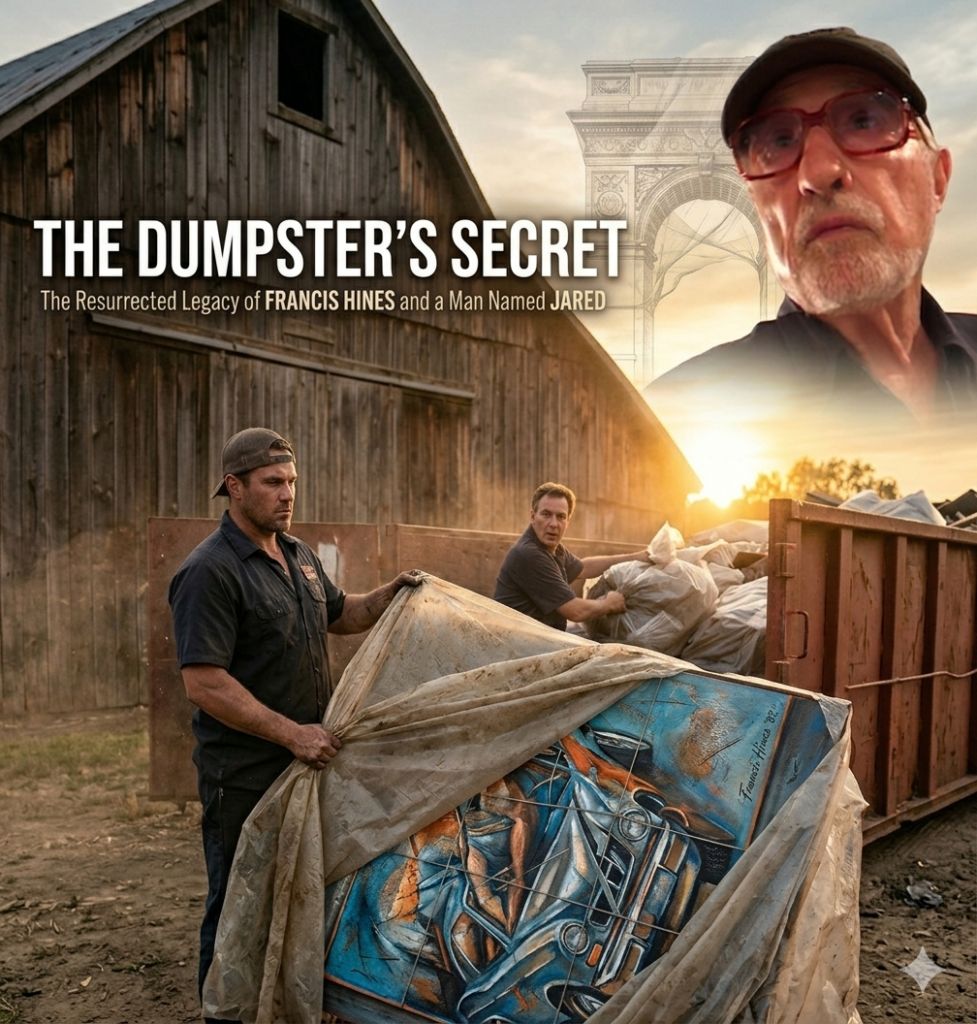
In the quiet, wooded outskirts of Watertown, Connecticut, there stood a barn that functioned as a silent sarcophagus for forty years. It was a space defined by the smell of aged timber, the stillness of stagnant air, and a mountain of mysterious, plastic-wrapped bundles that reached toward the rafters. This was the sanctuary of Francis Mattson Hines, an artist who had once literally “bandaged” New York City, only to retreat into a self-imposed exile that nearly resulted in his life’s work being ground into the dirt of a local landfill.
The story of how this multi-million dollar collection was salvaged is not a tale of art historians or museum curators. It is the story of Jared Whipple, a blue-collar mechanic and skateboarder who looked into a 40-yard dumpster and saw a ghost worth saving.
Part I: The Discovery in the Dust
The year was 2017. Jared Whipple’s world was one of grit, gears, and the rhythmic clatter of skateboard wheels against pavement. He was a man who understood the mechanics of how things held together—a skill that, unbeknownst to him, made him the perfect candidate to appreciate the work of Francis Hines.
When a contractor friend called Jared about a barn clean-out in Watertown, the premise was mundane. The property had been sold, and the new owners wanted the “junk” gone. Jared and his friend George Martin arrived to find a massive industrial dumpster already partially filled. As they peeled back the thick, grimy plastic from the bundles inside, they didn’t find old furniture or farm equipment. They found massive canvases, sculptures, and drawings, all defined by a strange, violent energy.
Every piece bore a cryptic signature: F. Hines.
“I’m just like, man, who is this guy?” Jared recalled. Initially, the digital world offered no answers. The name “F. Hines” was a dead end on early Google searches. It wasn’t until they found a small piece from 1961 with the full name—Francis Mattson Hines—that the mechanical heart of the mystery began to beat.
Part II: The Master of Tension
As Jared dove into the history of Francis Hines, he uncovered a legacy that was as massive as it was forgotten. Born in 1920, Hines was a man of the “Greatest Generation” who possessed a singular obsession: tension.
While other artists of the mid-20th century were focused on the stroke of a brush or the splash of paint, Hines was focused on the pull of a cord. He was a pioneer of “wrap art,” a style that utilized fabric and nylon to bind objects, creating a physical and visual strain that hinted at the hidden pressures of modern life.
The Washington Square Bandage The pinnacle of Hines’s career occurred in 1980. New York City was a different place then—gritty, vandalized, and teetering on the edge of fiscal collapse. In a daring feat of engineering and art, Hines received permission to wrap the Washington Square Arch.
Using a team of twenty-three people and 8,000 yards of white synthetic gauze, Hines crisscrossed the monument in a giant, translucent web. He called it a “bandage for a wounded monument,” a symbolic gesture to protect the city’s heritage from the decay surrounding it. At the time, it was an international sensation. He went on to wrap the JFK International Arrivals Building and the Port Authority Bus Terminal, cementing his status as the only artist to ever “wrap” Manhattan.
But by the mid-1980s, the spotlight began to fade. Hines, a man who cared deeply for the process of creation but held a profound indifference for the business of art, began trucking his massive works from his New York studio to the barn in Watertown. For forty years, he filled that barn, layer by layer, until the door finally closed on his career and his memory.
Part III: The Blue-Collar Battle for Legitimacy
For Jared Whipple, the discovery was only the beginning. He found himself in an extraordinary position: a mechanic in possession of a master’s estate, trying to convince an elitist art world that he hadn’t just found “cool trash.”
The rejection was immediate and frequent. “I got so many doors shut in my face,” Jared admitted. “I don’t know if it’s a snob thing, or maybe I just had the wrong etiquette. I’m a little old school, and I’m blue-collar.”
The art world often relies on provenance and prestige—two things a dumpster in Watertown lacks. However, Jared’s persistence was fueled by a mechanic’s sense of justice. He felt a kinship with Hines. He saw the “hardware” in the art—the bolts, the nylon straps, the heavy-duty frames—and recognized a fellow builder.
The breakthrough came when he met Peter Hastings Faulk, a renowned art historian and publisher. Faulk didn’t see a mechanic; he saw a curator of a lost era. “I was blown away by the originality,” Faulk noted. He recognized that Hines wasn’t just imitating the famous wrapping artists like Christo; he was doing something entirely different. Where Christo’s wraps were about the environment and the silhouette, Hines’s wraps were about the internal struggle of the object.
Part IV: The Anatomy of a Hines Masterpiece
To understand the value of what Jared saved, one must look at the “Deep Dive” of Hines’s technical evolution, often categorized into three distinct eras found within the Watertown cache:
-
The Hoboken Autobody Series: This was perhaps the most direct link between the artist and the mechanic. Hines used actual car parts and industrial materials, mounting them to wood and painting over them with a mix of grit and grace. He would then use nylon strips anchored to the back of the frame to pull fabric taut across the “machinery.” It was an exploration of the American car culture, rendered in a way that felt both beautiful and trapped.
-
The Urban Icons: These were the works that reflected his time in the city. Large-scale, architectural pieces that mimicked the skyscrapers and bridges of New York. They captured the feeling of being “bound” by the city’s grid—the tension of millions of people living on top of one another.
-
The Mutagenesis Series: In his later years, Hines became fascinated by the “biological-industrial morass.” These pieces often featured human figures—frequently female forms—that appeared to be evolving into or out of mechanical structures. They were wrapped in grids, suggesting a future where humanity and technology were inextricably tied together by cords of tension.
Part V: The Final Release
Francis Hines passed away in 2016 at the age of 96. He died knowing he had created a universe of art, but likely believing it would disappear with him. He had no interest in the digital age or the “Status Signaling” of the modern art market. He was a man of the studio, a man of the barn.
In May 2022, the tension was finally released. The Hollis Taggart Gallery in Southport, Connecticut, opened a major retrospective of the “Dumpster Treasures.” The event was a collision of two worlds: the high-society art collectors of the Gold Coast and the skateboarding mechanics from Waterbury who had pulled the canvases from the grime.
The works, once destined for a compactor, were now valued at over $20,000 per piece, with the total collection reaching into the millions. By legal agreement with the Hines family, who were grateful for the preservation of their patriarch’s legacy, a significant portion of the collection remained with Jared.
The Moral of the Watertown Barn
The story of Jared and Francis is a reminder that history is often fragile, held together by nothing more than a few layers of plastic and the luck of who finds it first.
Jared Whipple still considers himself a mechanic first. He still skateboards. But he now carries the weight of a man’s life in his hands. “The art world is taking me more seriously than I ever imagined,” he said, reflecting on the journey. “I can’t even wrap my head around it.”
In the end, Francis Hines spent his life exploring how things were bound together. It is only fitting that his legacy was saved by someone who knew how to pull the right strings. The “bandage” that Hines once applied to the Washington Square Arch has been replaced by a new kind of protection: the watchful eye of a mechanic who refused to let a masterpiece be treated like trash.
“Every piece of Hines artwork involved tension, and all of the energy occurs within that tension.” — Peter Hastings Faulk, Art Historian
The barn in Watertown is empty now, but the energy Francis Hines stored there for forty years is finally out in the light. It is a testament to the idea that some things are too powerful to stay buried—even if they have to spend a night in a dumpster to find their way home.
