
The Great Amnesia
We have been lied to about our past, and because of it, we are failing at our future.
The “official” story of human history—the one taught in ivy-league lecture halls and printed in glossy textbooks—tells us that our ancestors were primitive. We are led to believe that the rise of civilization was a slow, linear crawl from the mud to the skyscraper. We are told that the great megalithic wonders of the world were built by thousands of “slaves” using vine ropes, copper chisels, and sheer, bone-crushing muscle.
But if you stand among the ruins of Puma Punku in the Bolivian highlands, or trace the joints of the Valley Temple in Giza, that story doesn’t just feel incomplete—it falls apart entirely. You aren’t looking at “primitive” masonry; you are looking at a machine-shop floor frozen in time.
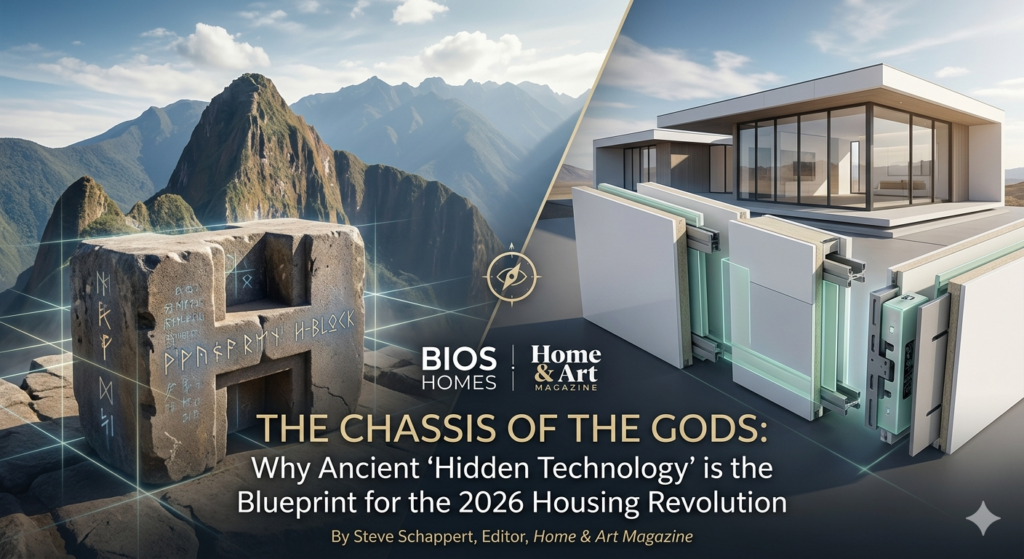
What we find at these ancient sites is not just “art,” but Standardized Industrial Design. At Puma Punku, the famous “H-Blocks” were crafted from diorite—a stone so hard it requires diamond-tipped tools to cut today. These blocks were shaped with such surgical precision that they look like they were pulled from a modern 3D printer. More importantly, they are modular. They were designed to interlock, to be swapped, and to scale.
They were a Universal Chassis. They had solved the “Logistics Protocol” 15,000 years ago—moving high-precision components from a central “factory” (the quarry) to the assembly site with zero margin for error. Today, in 2026, as we face a global housing crisis of unprecedented proportions, we must ask: why have we forgotten how to build like gods?
The Engineering Dark Age of the 21st Century
While we marvel at our smartphones and space-faring rockets, the way we build shelter—the most fundamental human need—has regressed into a chaotic, inefficient, and prohibitively expensive mess.
Today, the world is facing a housing deficit that feels insurmountable. In Connecticut alone, we are short thousands of units, trapped in a bottleneck of restrictive zoning and archaic construction methods. Nationally, the numbers are in the millions. We try to solve this with “stick-built” methods that haven’t fundamentally changed since the 1800s. We are still hauling raw lumber into the mud, fighting the weather, wasting 30% of our materials, and wondering why a basic home costs a fortune.
We are living in an Engineering Dark Age.
In 1990, when I began managing renovations and building homes from the ground up, the inefficiencies were already glaring. Over 1,300 projects later, the conclusion is unavoidable: construction is the only major industry that has actually lost productivity over the last fifty years.
The ancients didn’t have a labor shortage because they didn’t rely on “hand-crafting” every single joint on-site. They utilized a Logistics Protocol. They manufactured standardized components at a distance and assembled them with a precision that eliminated the need for mortar. They understood that the secret to scale isn’t more labor; it’s a better Chassis.
The “Big Idea”: David Ogilvy Meets the Bronze Age
As a student of David Ogilvy’s advertising principles, I’ve always believed that “The consumer is not a moron; she is your wife.” The modern homebuyer is not a moron, either. They know that the current way of building is broken. They see the “Big Idea” behind the BIOS Universal Housing Chassis: a system that brings the same “Ancient Precision” to modern modularity.
Ogilvy taught us that “Big Ideas” are the only way to break through the noise. In real estate, the “Big Idea” isn’t a granite countertop or a finished basement. It is the fundamental restructuring of how a house is manufactured.
The BIOS approach is Affordable by Design. We aren’t cutting corners or using cheaper materials; we are using a Global Logistics Protocol to automate the construction process. We are moving the “factory” to the site, rather than moving the “chaos” of the site to the consumer.
[VIDEO: The Modular Mystery of Puma Punku]
The Logic of the White Wall and the Jewelry Rule
In my work as owner and editor of Home & Art Magazine, I’ve developed what I call the “Gallery Strategy” for interior design. It is a philosophy rooted in the logic of the ancient world.
If you look at the greatest architectural achievements in history, the “shell”—the structure itself—was a masterpiece of geometry and permanence. The “lifestyle”—the textiles, the gold, the wood—was layered on top. This is the “Jewelry Rule.”
We keep the walls white, architectural, and gallery-grade. This creates a “Universal Chassis” for the interior. It maintains real estate liquidity because it doesn’t force a specific “taste” on a future buyer. Instead, it creates a canvas for Portable Wealth: art, designer furniture, and high-end hardware.
By applying this to the BIOS Village concept, we create homes that are indestructible at their core but infinitely customizable on their surface. We are building the frame to last 500 years, while allowing the “jewelry” to change with the fashion of the decade.
The Mathematics of the Chassis
Standard modular building is often just “stick-building under a roof.” It’s better than site-building, but it doesn’t solve the fundamental problem of Precision Logistics.
The BIOS Universal Housing Chassis is different. It is based on a rigid, panelized system that utilizes high-density materials and standardized “plug-and-play” mechanical cores.
-
Precision: Like the H-blocks of Bolivia, our panels are engineered to tolerances measured in millimeters, not “inches-and-a-half.”
-
Interchangeability: A BIOS Chassis can be configured as a 600-square-foot ADU or a 3,000-square-foot family home using the same core components.
-
Speed: We reduce construction time from nine months to nine days of on-site assembly.
This isn’t just “pre-fab.” This is Architectural Intelligence.
The Burden of Proof: § 8-30g and the BIOS Village
The biggest obstacle to solving the housing crisis isn’t technology—it’s Permission.
In Connecticut, we have a powerful tool called CGS § 8-30g. This statute shifts the “burden of proof” from the developer to the town. If a town hasn’t met its 10% affordable housing threshold, they cannot simply say “no” to a high-density project unless they can prove a substantial threat to public health or safety.
We are currently filing formal notices of intent for BIOS Village set-aside developments in towns like Barkhamsted and New Hartford. We aren’t just fighting for “affordable housing” in the sense of “cheap” units. We are fighting for Industrial Excellence.
By presenting a project that is “Affordable by Design,” we remove the aesthetic and financial arguments that NIMBYism (Not In My Backyard) usually relies on. We are showing that a high-density village can be a gallery-grade asset to the community.
The Origins of Architecture: A 20,000-Year Cycle
My upcoming book project, The Origins of Architecture, explores 20,000 years of these “unsolved mysteries.” From the “Hidden Technology” of the Ice Age to the automated factories of the future, there is a clear through-line.
We are currently in a transition period. The old world of “manual labor” and “bespoke waste” is dying. The new world of “Automated Logistics” is being born.
The BIOS Village isn’t just a business venture; it is a Housing Manifesto. It is a global protocol for how we will live in the mid-21st century. We are returning to the modular wisdom of the ancients, but we are doing it with the data and speed of the modern age.
A Note to the Skeptics
When people see our traffic numbers—hitting 16.95k unique visitors in a single day—they often ask why a real estate broker is talking about ancient aliens or hidden technology.
The answer is simple: Everything is connected.
If you want to understand how to build a house that people can actually afford in 2026, you have to understand why the houses we build now are so inefficient. You have to look at the civilizations that solved these problems with a fraction of our modern tools. You have to be willing to look at the “H-Blocks” of Puma Punku and realize that we aren’t the first ones to think of modularity.
We are just the ones tasked with bringing it back.
Conclusion: The Shift is Here
The technology isn’t “hidden” anymore. It’s right here, in the chassis.
We are moving away from the “disposable” construction of the last fifty years and returning to the “Permanent Logistics” of our ancestors. We are building the Origins of Architecture in real-time, right here in Connecticut, and eventually, across the globe.
The housing crisis will not be solved by more government subsidies or more “stick-building.” It will be solved by a Big Idea. It will be solved by the Universal Housing Chassis.
Are you ready to see the site plans for the first BIOS Village? [Click here to view our Barkhamsted and New Hartford Project Intelligence.]
Join the Revolution
Steve Schappert is a licensed Real Estate Broker, builder, developer, and teacher. As the founder of BIOS Homes and owner/editor of Home & Art Magazine, he is leading the charge for “Affordable by Design” housing in the 21st century.
For media inquiries or development partnerships, contact Steve at [email protected].
