
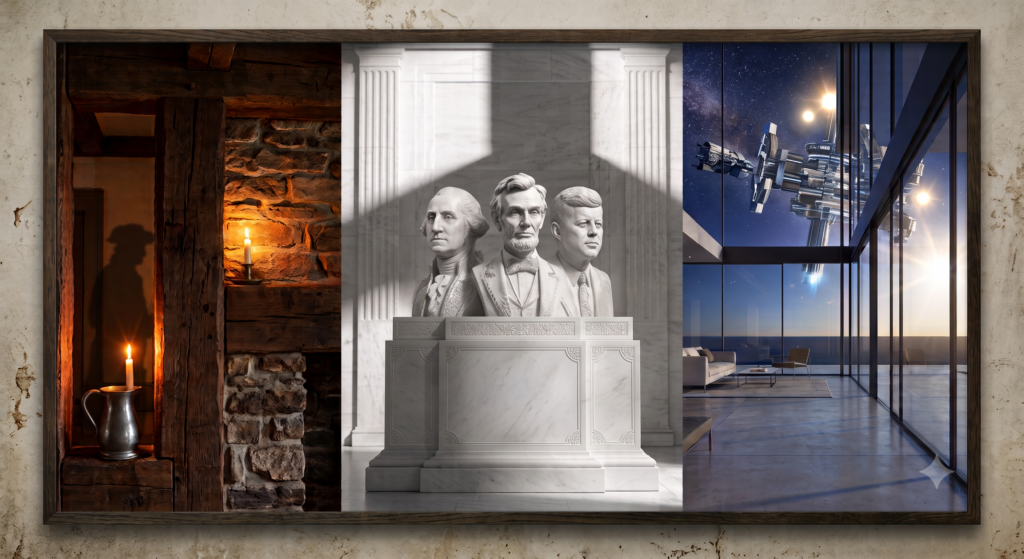
Every republic begins as a spatial challenge: how do you design a physical environment for a society that has just discarded its historical blueprint?
On the Fourth of July, cultural consensus often treats American independence as a static archive—a document signed, a monument erected. But design is never static. From the perspective of material culture, liberty is a continuous project of spatial definition, structural renovation, and generational inheritance. It is a narrative lived out not in textbooks, but within the shifting architecture of the domestic home.
To trace this evolution is to observe how the spaces we inhabit inevitably dictate the societies we build. Three distinct eras define this trajectory.
The Foundation: Vernacular Self-Reliance
Before a culture can cultivate an industrial or artistic identity, it must claim its terrain. The Revolutionary era, helmed pragmatically by George Washington, enacted a deliberate architectural rebellion. It was a rejection of European monarchical baroque in favor of a disciplined, agrarian classicism.
This was the freedom of physical place, manifested in the symmetry of early Federal-style homes, hand-hewn local oak, and unpolished native fieldstone. Stripping away the imported velvet and gold leaf of the Old World was not merely an aesthetic choice; it was a declaration of domestic self-reliance. The early American home was designed for utility and resilience—an architectural framework constructed to ensure a family could remain sovereign under its own roof.
The Renovation: Structural Integrity and the Domestic Hearth
A structure can boast a grand facade, but it cannot survive if its internal framework is fracturing. The Civil War era forced a violent pause in America’s westward expansion, turning the nation’s gaze inward toward the profound structural flaws in its own foundation.
During Abraham Lincoln’s presidency, the visual landscape lost its romantic innocence. The pastoral landscapes of the Hudson River School yielded to the stark, unflinching chemistry of early battlefield photography. At the domestic level, this fracture redefined the home. The hearth became a space of forced resilience, where families managed the immediate, material consequences of a divided nation. Lincoln’s legacy was an agonizing structural overhaul. He reinforced the internal pillars of the republic, asserting that the national home could not endure unless its foundations sheltered everyone inside equally.
The Horizon: The Mid-Century Open Plan
By the 1960s, American design had completely shed its historical nostalgia. Post-war technological innovation introduced a radically altered domestic landscape defined by clean lines, cantilevered concrete, and expansive sheets of plate glass.
This era, punctuated by the forward-looking optimism of John F. Kennedy, fundamentally re-engineered the family home. The traditional, insular layout opened up into the mid-century “open plan.” Load-bearing walls came down, and sliding glass doors blurred the boundary between the living room and the natural world outside. This spatial liberation mirrored a grander ambition. Kennedy looked at a society mastering avant-garde engineering and pointed it toward the ultimate frontier: the cosmos. The material vernacular shifted from heavy stone and timber to polished aluminum and synthetic polymers, turning the sky from a ceiling into an open horizon.
The Contemporary Canvas
Washington cleared the terrain. Lincoln fortified the structural core. Kennedy dissolved the boundaries.
Today, the architecture of the future faces an entirely new set of design prompts. The contemporary home is being redrawn by the demands of ecological sustainability, smart technology, and a post-pandemic reclaiming of multi-generational living spaces. The story of liberty remains an active studio space, and its next chapter depends entirely on the spaces we choose to build next.
