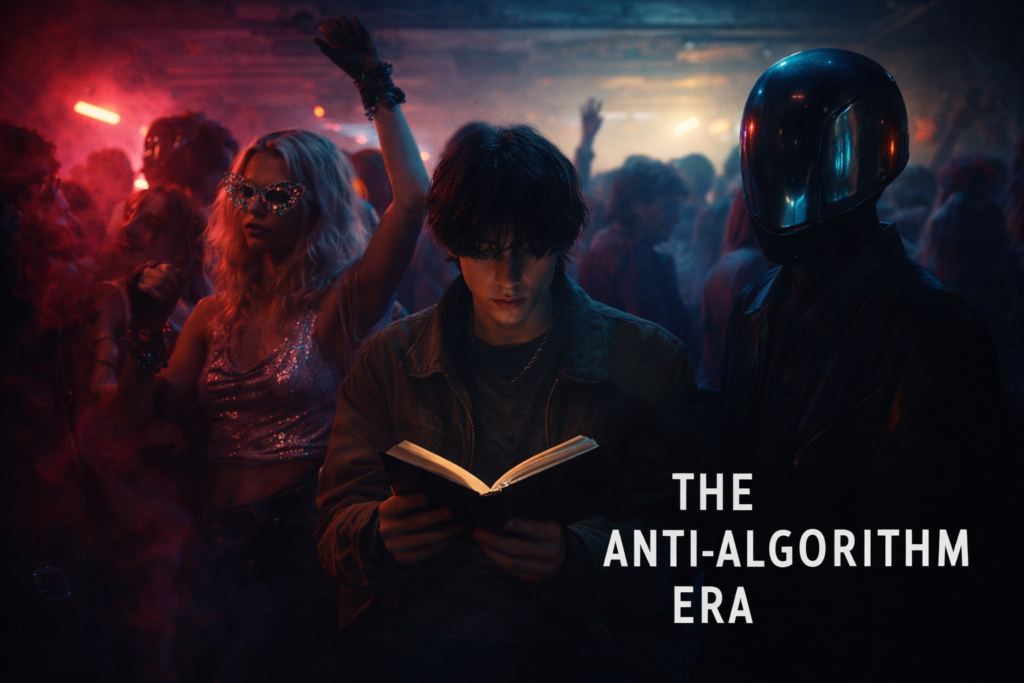
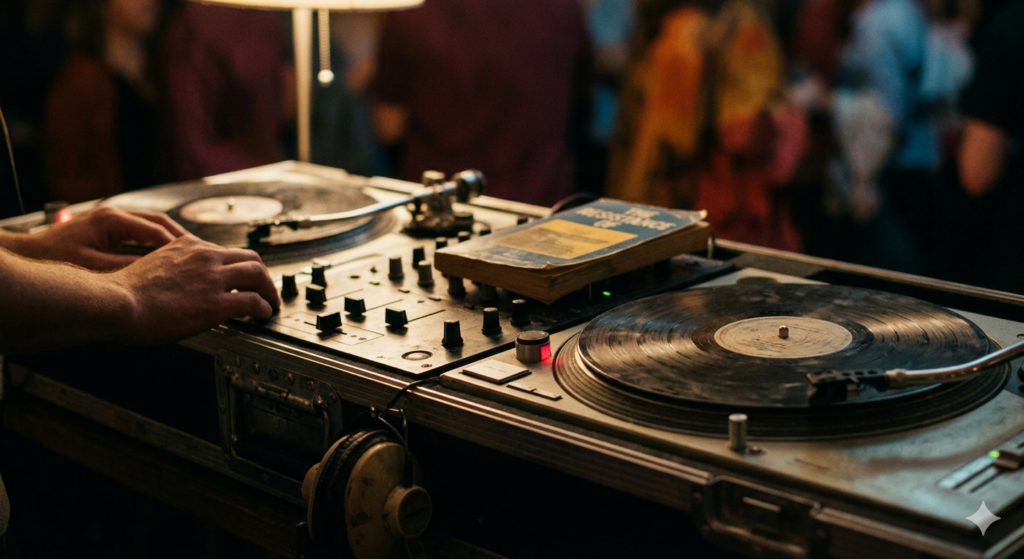
On a damp Friday night in Brooklyn, somewhere between a warehouse party and something that would have once been called a salon, a DJ eased the music down not with a dramatic drop but with a kind of quiet surrender, as if the room itself had decided it needed a different frequency. No one complained. A few people laughed. Someone sat cross-legged on the floor and opened a book, and instead of feeling like a joke, it felt like a shift in gravity.
For a few minutes—ten, maybe twenty—the room stopped performing the usual rituals of nightlife and tried on something else, something slower and harder to categorize. Phones were still out, of course; no one is pretending we’ve escaped that. But the energy had changed. People weren’t documenting a moment so much as negotiating what a moment even is anymore.
If culture in the last decade felt frictionless—optimized, polished, endlessly scrollable—then 2026 feels like the beginning of resistance, not in the form of some grand, unified movement, but in a thousand small refusals to behave exactly as expected.
The Past Is No Longer Remembered — It’s Reassembled
For years, we’ve been told that culture is stuck in a loop, that nothing feels new because everything is being recycled faster than it can be forgotten. That part is still true, but it misses what’s actually changed. What’s happening now is less like nostalgia and more like collage.
The past isn’t returning intact; it’s being broken apart and reassembled with a kind of casual disregard for historical accuracy. A washed-out Instagram filter from 2013 might sit on top of a hyper-detailed AI-generated image. Early-2000s clubwear appears again, but stripped of its original context and fused with the emotional residue of the pandemic years. Entire aesthetics are being lifted, flattened, and then rebuilt into something that feels both familiar and slightly off, like a memory that’s been edited too many times. This is not about honoring the past. It’s about using it.
Intelligence Has Become Visible Again—But Not in the Way You Remember
There was a stretch of time when overt intellectualism felt socially risky, when the safest posture was ironic detachment and the highest compliment was being effortlessly unbothered. That posture is eroding. In its place, something more complicated is emerging, something that treats knowledge not just as something to possess, but as something to display, arrange, and even stylize.
You see it in the way people carry books into spaces where books used to feel out of place, or in how fragments of philosophy circulate online not as dense arguments but as sharp, aestheticized signals of thought. You see it in artists who no longer separate their work from the ideas that shape it, who treat references and reading lists as part of the performance rather than something that happens quietly in the background.
It would be easy to dismiss this as shallow, as another form of branding, but that would ignore the deeper impulse underneath it: a desire, however imperfectly expressed, to move beyond surface in a culture that has spent years rewarding nothing but.
The Algorithm Has Not Disappeared—It Has Simply Lost Its Authority
No one is under the illusion that the algorithm has loosened its grip. If anything, it has become more sophisticated, more predictive, more quietly embedded in how culture circulates. What has changed is the level of trust people place in it.
Artists talk, sometimes openly and sometimes in coded language, about the pressure to produce work that behaves correctly within a system designed to reward immediacy and punish ambiguity. Increasingly, they are choosing—deliberately—to resist that pressure, even if the cost is visibility.
Songs stretch where they are supposed to tighten. Visual work embraces textures that compress poorly and colors that refuse to resolve cleanly on a screen. There is a growing interest in making things that do not travel well, that cannot be easily clipped into a fifteen-second excerpt and understood without context. The algorithm still distributes culture, but it no longer defines what feels valuable within it.
Identity Is Narrowing in Order to Deepen
The idea of a shared mainstream has been dissolving for years, but what has replaced it is not chaos so much as precision. People are organizing themselves into smaller, more specific constellations of taste and identity, often invisible to anyone outside them. These are not subcultures in the traditional sense, with clear boundaries and recognizable markers, but something more fluid and harder to map—networks of reference, mood, and mutual recognition.
Belonging no longer comes from appealing to as many people as possible. It comes from resonating, very specifically, with the right ones. And in that specificity, something interesting happens: connection feels less performative, less diluted by scale, even as it remains mediated by the same platforms that once promised universality.
Global Culture Is Expanding Faster Than Our Ability to Hold It
The speed at which culture now moves across borders has created a strange tension, one that is impossible to ignore and difficult to resolve.
A visual style, a sound, or a phrase can travel from one part of the world to another almost instantly, but meaning does not always survive the trip. Context thins out. Nuance disappears. What arrives is often a version that is easier to consume but harder to trace back to its origins. At the same time, there is a genuine hunger for cross-cultural exchange, for influence that feels expansive rather than extractive.
What we are left with is not a clean narrative of globalization, but a messy, ongoing negotiation—one that plays out in real time, often in public, and rarely with clear answers.
Being There Matters Again, Even If “There” Is Harder to Define
After years in which digital space felt like the primary stage for culture, physical presence is regaining a certain kind of value—not as a rejection of the online world, but as a supplement to it.
Events are less about spectacle and more about atmosphere, less about who is seen and more about who is actually present. There is an increasing emphasis on moments that resist perfect documentation, that feel slightly diminished when translated into content.
This does not mean people have abandoned the instinct to record and share; it means they are becoming more aware of what is lost in the process. And sometimes, they are choosing to protect that loss.
What This Moment Actually Means
It would be tempting to declare this a clean break, to frame 2026 as the year culture finally escaped the systems that shaped it. That would be too simple, and probably untrue. The platforms remain. The incentives remain. The underlying structures have not disappeared. What has shifted is something more subtle but no less important: a growing unwillingness to let those structures fully dictate the terms of expression.
People are allowing themselves to be less legible, less optimized, less immediately understood. They are experimenting with forms of presence that do not translate cleanly into data, with aesthetics that resist compression, with identities that are not designed for mass recognition. It is not a revolution. It is something quieter, more diffuse, and in some ways more durable. A gradual turning away from the idea that everything must be made to fit.
