
Why the most valuable homes are the ones that haven’t been “improved” yet—and how to unlock what’s already there
There is a kind of house most buyers walk past too quickly. It doesn’t photograph well. The colors are dated. The carpet might still be there. The kitchen won’t impress anyone scrolling on a phone. And yet, if you stand still for a moment—longer than the average showing allows—you begin to notice something else.
The floors are solid. The structure is straight. The doors still fit their frames. Nothing feels loose, rushed, or temporary. It is not a flashy house. It is a sound house. And that distinction is where the money is.
Why This Is the Best Value in the Market
The modern buyer has been trained—by listings, by social media, by speed itself—to want a finished product. A house that has already been transformed, updated, optimized, and staged into something immediately legible.
But the moment a house looks finished, the opportunity is largely gone. Because you are no longer buying potential—you are buying someone else’s work, marked up accordingly. The house Grandma lived in—and Grandpa maintained—sits in a different category entirely.
- It has been lived in, not flipped
- It has been maintained, not neglected
- It shows age, but not failure
That combination is rare, and it is where value hides. Older owners did not treat their homes like short-term assets. They fixed things when they broke. They kept water out. They maintained systems. They did the quiet, unglamorous work that prevents expensive problems from forming. What they often did not do was update for appearance.
So what you are buying is this:
👉 A structurally sound house with cosmetic inefficiencies
And cosmetic inefficiencies are where money is made.
The Mistake Most Buyers Make
They confuse dated with damaged.
They see:
- Old paint
- Worn floors
- Outdated fixtures
And assume the house is a problem. In reality, these are signals. Signals that the house has not yet been monetized by someone else. Signals that the next layer of value has not been extracted.
The truth is uncomfortable but simple:
The less a house has been “improved” for resale, the more room you have to create value yourself.
How to Unlock the Value (Without Losing It)
You do not need to gut the house. In fact, that is often where people destroy their margins.
You need to correct, not reinvent.
1. Smooth the Walls and Ceilings
Walls carry more visual weight than people realize. Imperfections—waves, seams, rough patches—create a constant, low-level distraction. Even if buyers can’t articulate it, they feel it. A skim coat with drywall mud, properly sanded, restores the surface to a uniform plane. Modern sanding systems with built-in vacuums have made this far more manageable than it used to be.
What you get is not just smoother walls—you get clarity of space. Light moves better. Corners feel sharper. The entire house looks more expensive without actually being expensive.
2. Eliminate Every Gap Your Eye Can Catch
Your eye is drawn to breaks—gaps in trim, uneven joints, sloppy transitions. That is where attention goes, whether you want it to or not. Caulk is one of the highest-return tools in a house.
- Baseboards to walls
- Window trim to casing
- Corners that were rushed the first time
Seal them. Then cut clean lines. Once those lines exist, paint has something to follow. If you can paint a straight edge, do it. If not, tape it. Precision is not optional here.
Clean lines communicate something buyers don’t consciously name but immediately trust:
This house was finished properly.
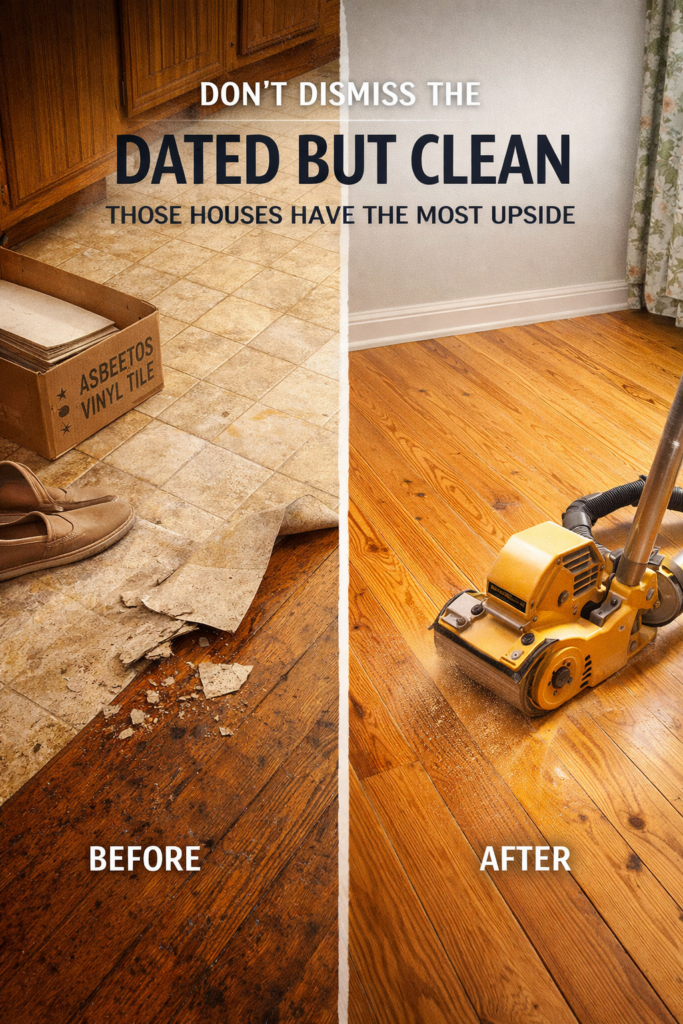
3. Restore the Floors Instead of Replacing Them
Old hardwood floors are one of the most misjudged assets in real estate. They are often covered, ignored, or dismissed when they are, in fact, one of the strongest value drivers in the house. Sand them down. Refinish them. What comes back is not just a surface, but depth—grain, variation, durability that modern materials struggle to replicate. New floors cost money. Restored floors create value. And they align perfectly with the original integrity of the house.
What to Avoid
This is where discipline matters. Not everything you do adds value.
Some things are:
- Personal taste
- Lifestyle upgrades
- Design decisions that may not translate to the next buyer
There is nothing wrong with those—but they are not investments. A high-end kitchen renovation, for example, may look impressive, but much of its cost is rarely recovered. Even smaller upgrades—like replacing a front door—often return only a portion of what you spend. You are not trying to impress the next buyer. You are trying to hand them a house that feels right—and let them pay for their own preferences.
The Real Advantage
- When you buy a house that was lived in and maintained, you are stepping into a structure that has already proven itself.
- The systems have lasted. The materials have endured. The problems—at least the serious ones—have often already been addressed.
- What remains is surface.
- And surface is where disciplined buyers quietly build equity.
The Takeaway
The best house is rarely the one that looks finished.
It is the one that has been:
- Lived in long enough to be honest
- Maintained well enough to be sound
- Left untouched enough to still have upside
Grandma made it a home.
Grandpa kept it standing.
Your job is not to reinvent it.
It’s to recognize what’s already there—and finish it properly.