
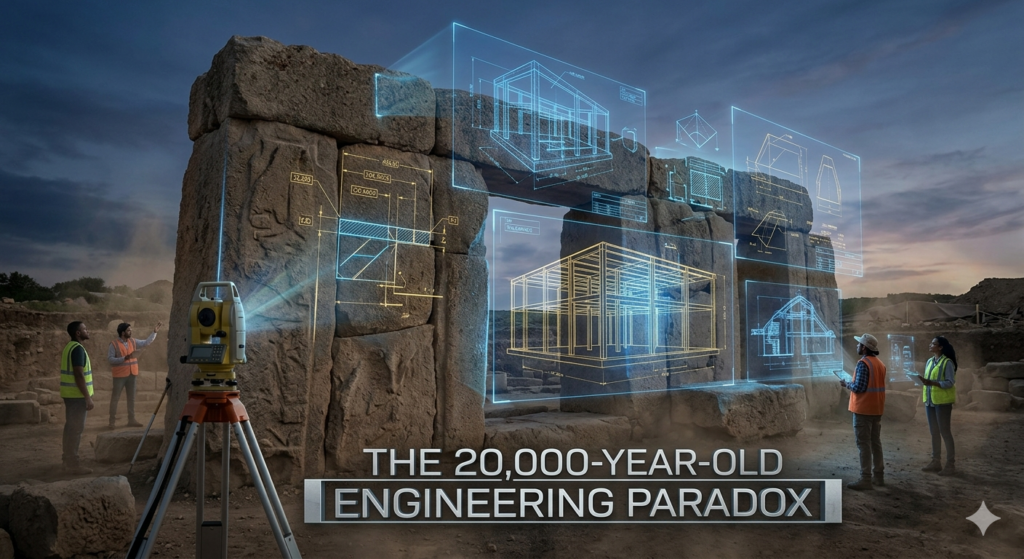
We live in an era of “Black Box” engineering. Today, a structural engineer inputs variables into a Building Information Modeling (BIM) suite, and the software calculates the wind load, seismic resistance, and thermal expansion of a skyscraper in milliseconds. We trust the algorithm. But when we look at the megalithic structures of the distant past—from the precision-cut basalt of Egypt to the polygonal masonry of Peru—we encounter a paradox: monumental precision achieved without a digital interface.
If we strip away our modern reliance on electricity and silicon, we are forced to confront a “Computational Baseline”—a sophisticated, analog method of engineering that may have been superior to our own in terms of longevity and environmental integration.
The Myth of the “Primitive” Builder
The prevailing narrative of human progress is linear: we started with sticks and stones and worked our way up to steel and glass. However, the archaeological record suggests a “technological pulse” rather than a straight line.
Take, for example, the site of Tiwanaku in Bolivia. Builders there utilized interlocking H-blocks, carved with such precision that they seem to have been mass-produced using a template. These weren’t just decorative; they were functional, modular components designed to withstand the tectonic shifts of the Andes. To achieve this today, we would use CNC (Computer Numerical Control) milling. The ancients achieved it with an understanding of geometry and material science that we are only beginning to reverse-engineer.
The Computational Baseline: Geometry as Software
How do you calculate a 20,000-ton load-bearing capacity without a calculator? You use the most stable language in the universe: Geometry.
Ancient architects didn’t see math as an abstract concept in a textbook; they saw it as a physical law. The “Computational Baseline” refers to the use of:
-
Harmonic Proportions: Using the Golden Ratio ($\phi$) and Pi ($\pi$) not just for beauty, but for structural distribution.
-
Solar Alignment: Using the earth’s rotation as a literal “clock” to calibrate measurements.
-
Optical Refinement: Subtle curves in “straight” lines (like the entasis in Greek columns) to compensate for human visual distortion.
The 20,000-Year-Old Paradox
The paradox lies in the “lost gap.” We see high-level engineering appearing suddenly in the fossil record—at sites like Göbekli Tepe, dating back nearly 12,000 years—with no clear “v1.0” or “v2.0” preceding them. It suggests that a fundamental understanding of architectural technology existed much earlier than we credit.
These builders weren’t just moving heavy rocks; they were solving complex logistical problems. They understood the Coefficient of Friction, the Specific Gravity of different stone types, and the Acoustic Resonance of interior chambers. In many ways, they were building “hardened” infrastructure designed to last for millennia, while our modern “stick-built” structures have a planned obsolescence of barely 80 years.
What Modern Builders Can Learn
As we move toward modular and sustainable construction, we are actually circling back to ancient principles. The “Global Logistics Protocol” of the past involved sourcing local materials and using interlocking designs that required no mortar—a precursor to modern dry-stack modularity.
-
Passive Resilience: Ancient structures utilized thermal mass to regulate temperature naturally. Modern “Passivhaus” standards are essentially a high-tech version of an Egyptian granary.
-
Interlocking Joinery: By moving away from adhesives and nails and toward precision joinery, we can create buildings that are easier to disassemble, recycle, and repair.
-
Site-Specific Alignment: Harnessing archeoastronomy allows us to optimize solar gain and natural lighting without relying entirely on mechanical HVAC systems.
Conclusion: The Future is Behind Us
The 20,000-year-old engineering paradox invites us to stop viewing the past as a collection of “mysteries” and start viewing it as a technical manual. By reconciling our digital tools with the ancients’ analog wisdom, we can move toward an architecture that isn’t just “smart,” but wise—built not just for the next fiscal quarter, but for the next few thousand years.
References & Further Reading:
