
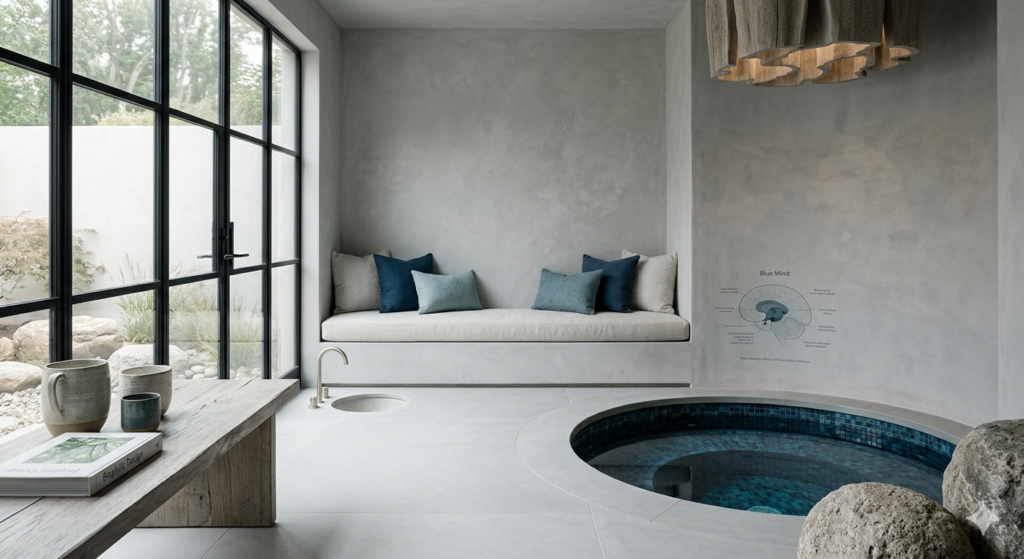
As we move into the heart of the 2026 spring season, the luxury real estate and design markets are witnessing a profound transformation. We are moving away from the “look-at-me” architecture of the early 2020s toward a more introspective, emotionally resonant aesthetic. Emerging from the high-pressure environments of our increasingly digitized lives, a trend titled “Seaside Cool” has taken hold of the industry, moving from elite coastal estates into the mainstream of high-end inland design.
This is not the nautical kitsch of decades past. There are no literal anchors, no navy stripes, and no seashell-shaped soap dishes. Instead, “Seaside Cool” is a sophisticated, minimalist philosophy centered on the intersection of human wellness and environmental psychology. It is a design language intended to lower the heart rate, regulate breathing, and turn the modern home into a high-performance restorative sanctuary.
The Science of the “Blue Mind”
The foundation of “Seaside Cool” is built upon a growing body of research into what marine biologists and environmental psychologists call the “Blue Mind.” This term refers to the mildly meditative state we enter when near, in, or under water. Science has shown that being in the presence of water—or even its visual and textural proxies—triggers the release of dopamine, serotonin, and oxytocin, while simultaneously reducing levels of cortisol.
In 2026, designers are leveraging this “Blue Mind” effect to combat the chronic overstimulation of urban life. By utilizing a specific spectrum of colors and light-refractive surfaces, we can trigger the brain’s “rest and digest” system even in a landlocked environment.
The core of this restorative palette is a sophisticated layering of three primary tones:
-
Mineral Grays: These are “living” grays that mimic the natural variations of wet river stones, weathered driftwood, and morning mist. Unlike the flat, industrial grays that dominated the mid-2010s, these tones have depth and movement.
-
Deep Atlantic Blues: Used as visual anchors, these moody, desaturated blues provide a sense of stability. They represent the “weight” of the ocean, giving a room a grounded, permanent feel.
-
Misted Teal: A soft, desaturated green-blue that acts as a bridge. This color mimics the “liminal space” where the water meets the sky, providing a sense of openness and possibility.
When combined, these colors create a form of visual “white noise.” By reducing the high-contrast “visual clutter” that characterizes most modern interiors, “Seaside Cool” allow the brain to transition into a state of deep focus and relaxation.
Sensory Design: The Tactile Revolution
A key differentiator of “Seaside Cool” is its focus on the tactile. In 2026, the luxury market has experienced a significant “shine fatigue.” We are moving away from the highly polished, reflective surfaces that require constant maintenance and instead embracing matte, porous textures that feel “honest” and “grounded” to the touch.
Honed Natural Stones
The flooring and countertop materials in a “Seaside Cool” home are almost exclusively matte. Honed marble, brushed limestone, and soapstone are the materials of choice. These stones feel cool to the touch and provide a soft, velvet-like finish that diffuses light rather than reflecting it. This reduces glare, which is a major contributor to eye strain and mental fatigue.
Raw and Weighted Linens
Upholstery has moved toward heavyweight, unbleached linens and textured bouclés. These materials provide a sense of “enclosure.” In a “Seaside Cool” master suite, window treatments are often floor-to-ceiling linen drapes that move gently with the air, mimicking the soft movement of a coastal breeze and diffusing sunlight into a soft, ethereal glow.
Weathered and Sun-Bleached Timbers
While our recent features have highlighted the richness of dark walnut, “Seaside Cool” utilizes the opposite end of the wood spectrum. We are seeing a surge in silvered oaks and sun-bleached timbers. These woods look as though they have been shaped by the elements—wind, salt, and sun—providing a sense of time and resilience.
The Architecture of Wellness: The Integrated Spa
This aesthetic shift is inextricably linked to the evolution of the Home Wellness Suite. In the real estate market of May 2026, a “luxury” home is no longer defined by its theater room or its five-car garage; it is defined by its integrated wellness infrastructure.
Developers are now designing homes with dedicated “Transition Zones.” These are spaces located between the high-energy areas of the house (the kitchen and living room) and the private quarters. A typical “Seaside Cool” wellness zone might include:
-
Circadian Lighting Systems: Indirect LED systems that shift from the cool, blue-white light of a coastal morning to the warm, amber glow of a sunset, keeping the inhabitant’s internal clock in sync.
-
Integrated Hydrotherapy: Cold plunges and steam showers that are built into the architecture rather than added as afterthoughts. These are often finished in the mineral gray stones of the palette, making them feel like natural grottoes.
-
Sensory Gardens: Small, internal courtyards or “Zen Gardens” featuring water features and native grasses that rustle in the wind, providing a layered auditory experience.
Market Analysis: The Value of “Sanctuary”
For the professional developer and real estate broker, the “Seaside Cool” trend represents a shift in what the market considers “Highest and Best Use” (HBU) for a residential parcel. Current data suggests that homes marketed with “restorative” or “wellness-centric” language are selling 18% faster than traditional luxury listings.
High-net-worth buyers in 2026 are looking for homes that act as a buffer against the world. They are willing to pay a premium for “Quiet Luxury”—homes that don’t shout about their price tag but instead offer an unparalleled quality of life. The “Seaside Cool” aesthetic provides a universal appeal; it feels expensive because of its material quality, but it feels approachable because of its connection to nature.
Bringing the Ocean Home: Practical Implementation
The beauty of this movement is that it is not dependent on geography. You do not need a view of the Long Island Sound or the Atlantic Ocean to embrace these principles. By focusing on the “tension” between cool mineral tones and warm, weathered textures, any space can be transformed.
Start with the “Foundation of Three”
To achieve this look, we recommend starting with a foundation of three textures: one hard (honed stone), one soft (raw linen), and one organic (weathered wood). Keep the color palette within the mineral gray and deep blue spectrum, and use “Antique Cream” (our previous feature’s star) as the light-reflecting mediator.
Lighting as Architecture
In a “Seaside Cool” home, lighting is not just a fixture; it is an architectural element. Move away from harsh overhead canisters and toward indirect wall washes and floor lamps that provide “pools” of light. This creates a sense of mystery and depth, mimicking the way light filters through water or fog.
Conclusion: The Soul of the 2026 Home
As we continue to navigate the complexities of this decade, the home remains our most important asset. It is the one place where we can truly curate our environment to support our mental and emotional well-being.
“Seaside Cool” is a reminder that design is never just about what we see; it is about how we feel. By embracing the restorative power of the “Blue Mind” and the tactile honesty of natural materials, we are creating homes that are more than just shelters—they are sanctuaries for the soul.
