
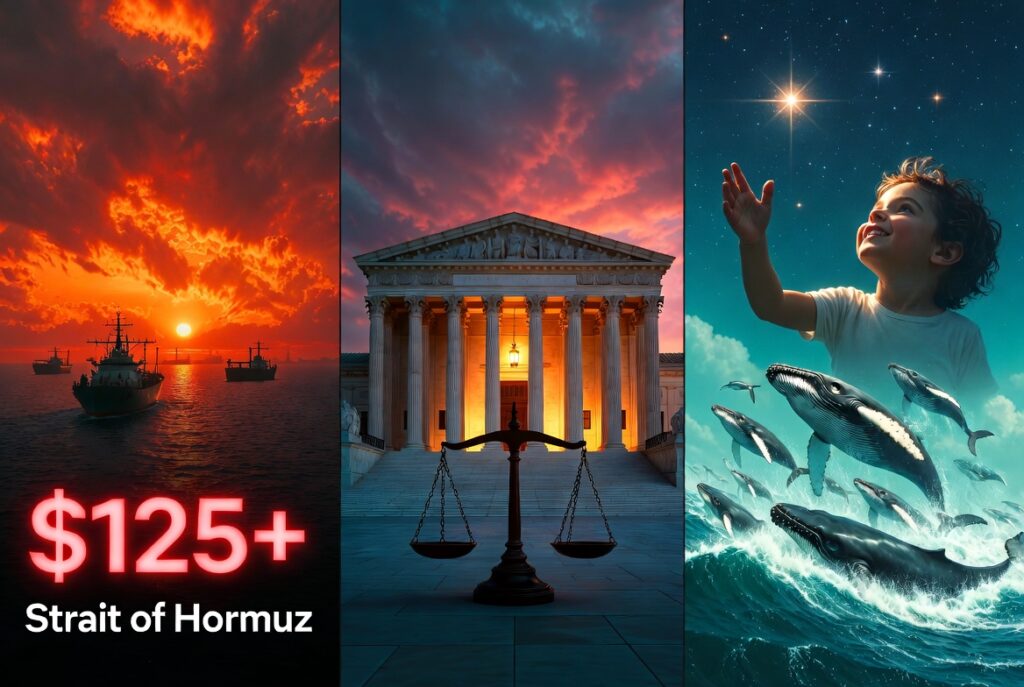
A dispatch from the crossroads of crisis and possibility.
The world awoke today to familiar tremors and unexpected grace. In the narrow Strait of Hormuz, a geopolitical standoff has throttled one of the planet’s vital arteries, sending oil prices surging toward levels not seen in years. Half a world away, the United States Supreme Court delivered a ruling that narrows the Voting Rights Act, redrawing the contours of political power for generations. Conflicts in Lebanon simmer with fresh violence, while faint diplomatic signals flicker over Ukraine. Yet amid these shadows, humanity’s capacity for ingenuity and resilience shone through: a child’s sight restored by gene therapy, and the majestic resurgence of humpback whales gathering in record-breaking “supergroups” off South Africa — living proof that healing is possible even after decades of damage.
This is not merely a catalog of headlines. It is a portrait of a species at once imperiled by its own divisions and propelled by its enduring creativity. For the nearly eight billion souls sharing this fragile planet, today’s events carry profound implications: higher energy costs that ripple through every economy, questions of democratic equity that test social cohesion, and scientific breakthroughs that remind us our greatest tools against despair are knowledge, cooperation, and wonder.
The Strait of Hormuz: Humanity’s Energy Lifeline Under Siege
Few geographic features shape global destiny as profoundly as the Strait of Hormuz — a 21-mile-wide chokepoint through which roughly one-fifth of the world’s oil supply has historically flowed. Today, U.S.-enforced restrictions and stalled nuclear negotiations with Iran have effectively constricted this artery. President Trump has signaled the blockade could persist for months absent a comprehensive deal, prompting Brent crude to spike dramatically, with prices climbing toward four-year highs above $120–$125 per barrel in recent sessions.
The human cost is already manifesting. Developing nations dependent on imported fuel face soaring transportation and food prices, threatening inflation and food security for hundreds of millions. In wealthier economies, the shock reverberates through manufacturing, logistics, and household budgets. Airlines, shipping firms, and farmers confront higher costs that will inevitably pass to consumers. Energy-intensive industries — steel, chemicals, cement — may slow, delaying infrastructure projects essential for climate adaptation and development.
Yet the crisis also accelerates long-term shifts. It underscores the peril of over-reliance on any single region for energy and hastens investment in renewables, nuclear, and diversified supply chains. Nations are scrambling for alternatives: ramped-up domestic production, pipeline deals, and renewed urgency around green transitions. In this sense, today’s pain may plant seeds for a more resilient energy future — one less vulnerable to the whims of geopolitics.
For mankind as a whole, the lesson is stark: our interconnected economies remain hostage to fragile maritime routes and unresolved conflicts. Stability in the Gulf is not a regional luxury; it is a global necessity.
Democracy’s Foundations Tested: The Supreme Court and Voting Rights
In Washington, the U.S. Supreme Court issued a 6-3 decision limiting key applications of the Voting Rights Act of 1965. The ruling struck down a Louisiana congressional map designed to create an additional majority-Black district, deeming it an unconstitutional racial gerrymander. Civil rights advocates decry it as a severe weakening of protections against minority vote dilution.
The implications extend far beyond one nation. The United States remains a bellwether for democratic norms worldwide. When a landmark civil rights law — once passed with overwhelming bipartisan support — sees its enforcement narrowed, it signals to other democracies grappling with polarization, minority rights, and electoral integrity. Authoritarian-leaning leaders elsewhere may draw encouragement; reformers may feel the ground shift beneath them.
At stake is the fundamental promise of representative government: that every citizen’s voice carries equal weight. In an era of demographic change and technological disruption of information, fair redistricting and voting access are bulwarks against fragmentation. The ruling will likely spur further legal battles, legislative adaptations, and public mobilization — testing whether societies can renew their democratic covenants or allow them to erode.
For humanity, this moment highlights a deeper tension: the perpetual struggle to balance majority rule with minority protections in diverse societies. History shows that inclusive institutions foster stability and innovation; exclusion breeds resentment and decline.
Persistent Conflicts and Glimmers of Diplomacy
In southern Lebanon, fragile ceasefires have frayed as Israeli forces and Hezbollah exchange strikes, with both sides accusing the other of violations. An Iran-linked attack in London further illustrates how regional tensions export violence globally. These cycles of retaliation exact a terrible human toll — lives lost, communities displaced, generations scarred.
In Ukraine, President Trump’s recent conversations with Vladimir Putin have produced talk of a limited ceasefire around Russia’s May 9 Victory Day observances. While modest, any pause in Europe’s bloodiest conflict since World War II offers a momentary reprieve for exhausted populations and a potential opening for broader negotiations. The world watches anxiously: true peace remains elusive, but even small diplomatic windows matter when nuclear risks linger.
Collectively, these conflicts drain resources that could address climate change, poverty, and health crises. They remind us that war’s true cost — measured in human potential squandered — far exceeds battlefield tallies.
Beacons of Hope: Two Stories That Illuminate Our Better Angels
Amid the turbulence, two narratives stand as testaments to humanity’s capacity for healing and stewardship.
The Gift of Sight Restored. In Britain, young Saffie Sandford, born with a rare genetic form of blindness (Leber congenital amaurosis), has regained vision through groundbreaking gene therapy. Doctors at Great Ormond Street Hospital delivered a corrected gene via a one-time injection, transforming her world from darkness to light. She can now see her family’s faces, colors, and the play of sunlight. This success — part of a broader wave of gene therapies honored recently with Breakthrough Prizes — heralds an era where inherited conditions once considered incurable become treatable. Thousands more patients worldwide stand to benefit as these techniques scale. It is a victory not just for one child, but for the promise of precision medicine to alleviate suffering across borders.
The Return of the Giants: Humpback Whale Supergroups. Off South Africa’s west coast, marine biologists and photographers have documented extraordinary “supergroups” — gatherings of hundreds of humpback whales feeding together in chaotic, awe-inspiring density. Once hunted nearly to extinction, these populations have rebounded dramatically thanks to international protections. Sightings of such massive aggregations have surged, with one recent day recording over 300 individuals. These whales, communicating across vast oceans and cooperating in ways scientists are only beginning to understand, symbolize nature’s resilience when given space to recover. Their resurgence boosts ecotourism, inspires conservation efforts, and reminds us that ecosystems can heal faster than we sometimes dare hope.
These stories are more than feel-good interludes. They demonstrate that targeted human intervention — whether through science or policy — can reverse decline. They counter cynicism with evidence: progress is real, incremental, and replicable.
Stories the World Should Prioritize
To navigate this moment wisely, humanity must focus on:
- Energy Security and the Green Pivot — Accelerate diversification away from volatile fossil fuel chokepoints. Every nation should treat today’s oil shock as a call to invest in renewables, storage, and efficiency at unprecedented scale.
- Democratic Resilience — Strengthen institutions that protect minority rights and electoral fairness. Civic education, independent judiciaries, and transparent redistricting matter everywhere democracy exists.
- Diplomatic Persistence — Support every credible ceasefire and negotiation channel. Even limited truces can build momentum toward lasting peace.
- Scientific and Conservation Momentum — Scale gene therapies, protect marine habitats, and celebrate successes that unite people across divides.
A Closing Horizon
On April 30, 2026, the world feels both smaller and more fragile than ever — bound by shared economic arteries, shared democratic aspirations, and shared ecological fates. Oil blockades test our adaptability. Court rulings probe our commitment to equity. Conflicts expose our worst impulses.
Yet the same day reveals our finest qualities: a child seeing stars for the first time, whales dancing in restored oceans, researchers decoding life’s instructions to mend what was broken.
Mankind stands at a perennial crossroads. We can allow crises to define us, or we can harness them as catalysts for wiser, more compassionate systems. The choice, as always, belongs to us — one policy, one innovation, one act of stewardship at a time.
The sun will rise tomorrow over the same troubled yet beautiful planet. May we meet it with clearer eyes, bolder hearts, and the unyielding belief that renewal is within our grasp.
