
The Manifesto of the Scarred Floorboard
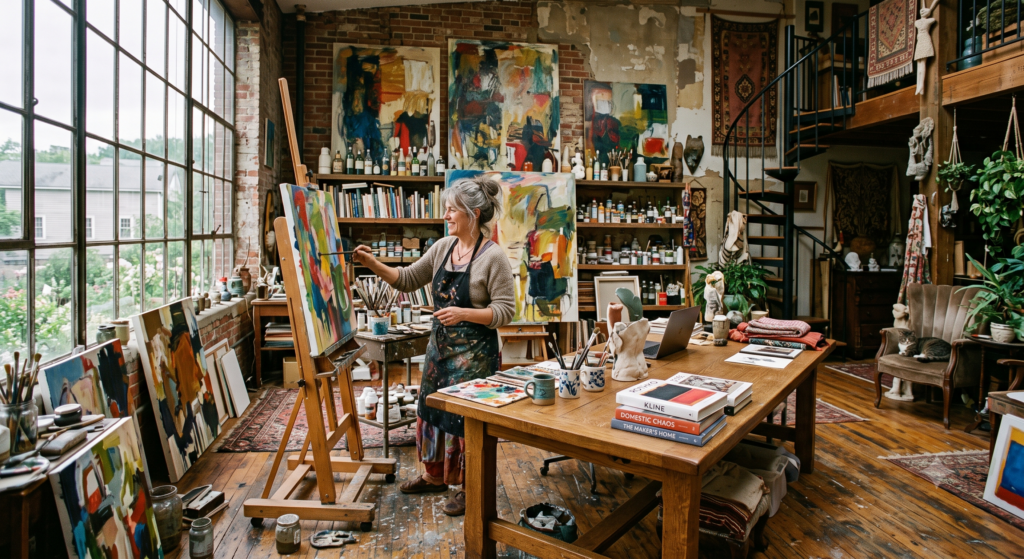
An artist’s home is never just a repository for furniture; it is a living, breathing manifestation of the creative impulse. It is the crucible where the barrier between the studio and the sanctuary completely dissolves, leaving a trail of charcoal dust, wet oil paint, and raw soul across the hardwood. When creators curate their own spaces, they reject the sterile symmetry of modern minimalism and the polite, staging-ready curation found in commercial lookbooks. Instead, they embrace a chaotic, beautiful dialogue between texture, light, and human connection. This is design stripped of corporate polish and injected with pure cultural swagger—an architectural remix where the heritage of craftsmanship meets the baseline of a lived-in life.
To walk into an environment shaped by a maker is to step directly inside their psychology. The traditional zoning of a house—the rigid separation of utility, rest, and labor—is utterly smashed. The kitchen counter doubles as a staging area for ceramic glazes; the living room hearth becomes an impromptu gallery mantle; the sunroom is surrendered entirely to the tyrannical, beautiful demands of north-facing daylight. It is a sensory collision that challenges the very definition of domesticity. Here, the architecture doesn’t merely house the art—it is the primary canvas, a structural collaborator that participates in the daily act of creation.
The Architecture of Collision
Step inside the domestic sanctuary of the modern visionary, and the visual rhythm immediately quickens. Think of it as a masterclass in high-low friction: architectural authority clashing magnificently with raw, found-object poetry.
In the main living volume, the structural bones are treated with a mix of reverence and irreverence. Exposed brick, sandblasted to reveal decades of soot and sediment, acts as a rough-hewn backdrop for oversized, unfinished canvases that lean casually against the baseboards rather than hanging by precise museum wires. This refusal to permanently fix things to the wall isn’t laziness; it’s a commitment to fluidity. The room is an evolving installation, subject to change at the whim of a fresh perspective or a midnight burst of inspiration.
+-----------------------------------------------------------------+
|                       THE ARTIST'S PALETTE                      |
+-------------------------------+----------------------------+
| Structural Elements                | Textural Counterpoints     |
+-------------------------------+----------------------------+
| Sandblasted Exposed Brick          | Raw, Unfinished Canvas     |
| Industrial Steel I-Beams           | Distressed Cognac Leather  |
| Poured Concrete Floors             | Hand-Knotted Wool Textiles |
| Unlacquered Brass Hardware         | Charred Yakisugi Wood      |
+-------------------------------+----------------------------+
Look closer at the materials, and you see a deliberate rejection of synthetic perfection. The flooring is often wide-plank oak, left unsealed or treated with a simple oil finish so that every dropped palette knife, every scuff of a work boot, and every spill of turpentine leaves an indelible mark. This is the beauty of the patina—the understanding that a house becomes more beautiful as it surrenders to the friction of reality.
Against this raw architectural framework, the furniture choices are fiercely eclectic. A pristine, structurally radical Pierre Paulin ribbon chair might sit directly adjacent to a heavy, brutalist worktable salvaged from an abandoned textile mill. Mid-century geometric lines clash with deeply textured, hand-knotted textiles sourced from global travels, each thread carrying its own history and introducing a rhythm that breaks the starkness of the industrial envelope.
The Communal Altar and the Poetry of Light
In the heart of the home, the kitchen and dining spaces abandon the clinical, stainless-steel coldness of the trend-driven culinary world. Instead, they are reimagined as tactile workshops for sensory nourishment.
The centerpiece is invariably a scarred wooden dining table—an imposing slab of timber that has witnessed decades of spilled wine, late-night arguments over color theory, and the messy, joyous chaos of family breakfasts. It functions as a communal altar. Here, the boundary between the artistic elite and the familial everyday is completely obliterated. The same surface that holds a stack of reference monographs on Baroque chiaroscuro is currently hosting a bowl of fresh heirloom tomatoes and a child’s crayon drawing.
“We don’t protect our furniture from our lives. If a glass of red wine stains the wood, that stain becomes part of the room’s iconography. It’s a timestamp of a night spent laughing with people we love.”
The lighting design in these spaces owes more to the stage than the showroom. Creators don’t rely on the uniform, soul-crushing glow of recessed LED cans. Instead, they chase the drama of natural illumination. Sunlight is treated as a physical material—it cuts through the air like a spotlight in a darkened theater, slicing across the room at sharp angles, catching the orbit of dust motes, and shifting the mood of the space from morning clarity to late-afternoon melancholy.
When the sun sets, the illumination drops to a subterranean hum. Low-wattage incandescent bulbs, sculptural floor lamps, and a multitude of flickering candles cast long, distorted shadows across the artwork, turning the home into a moody, cinematic sanctuary that feels more like a smoke-filled Greenwich Village jazz club than a suburban residence.
Craftsmanship as an Act of Rebellion
To understand the artist’s home is to understand that craftsmanship is an act of defiance against a disposable culture. Every object within these walls is chosen because it possesses an authorship, an visible fingerprint of the creator.
In the bathroom, you won’t find mass-produced porcelain fixtures. Instead, a basin hand-carved from a single block of volcanic stone sits atop a vanity crafted from charred yakisugi wood. The hardware is unlacquered brass, oxidizing unevenly over time as it reacts to the moisture of the air and the touch of human hands.
This obsession with the handmade extends to the smallest details:
-
Ceramic mugs that are intentionally asymmetrical, bearing the thumbprints of the potter who threw them on the wheel.
-
Door handles forged by hand in a local blacksmith’s fire, heavy and cold to the touch.
-
Curtains made from heavy, unrefined linen that pools unceremoniously on the floor, celebrating the natural slub and imperfection of the fiber.
This reverence for the maker’s mark creates an environment that feels profoundly grounded. It reminds us that our spaces have the power to connect us to ancestral traditions while pushing the boundaries of contemporary aesthetics. It is a rejection of the algorithmic uniformity that dominates our digital screens, offering instead a tactile sanctuary where the senses are provoked rather than pacified.
The Living Installation
Ultimately, an artist’s home is an ongoing conversation with time. It is a space that refuses to settle, resisting the finality of a “finished” interior design project. Ancestral artifacts—perhaps an antique oil portrait with a cracked varnish or a weathered piece of folk art—sit proudly next to radical, neon-hued contemporary sculptures.
This fearless juxtaposition creates a narrative tension that keeps the home alive. It is a space where family history, historical reverence, and fearless creative execution collide in a glorious, unedited symphony. It proves that the most profound masterpieces are not the ones locked away behind stanchions in a climate-controlled museum, but the ones we choose to live inside, step over, and build our lives around every single day.
