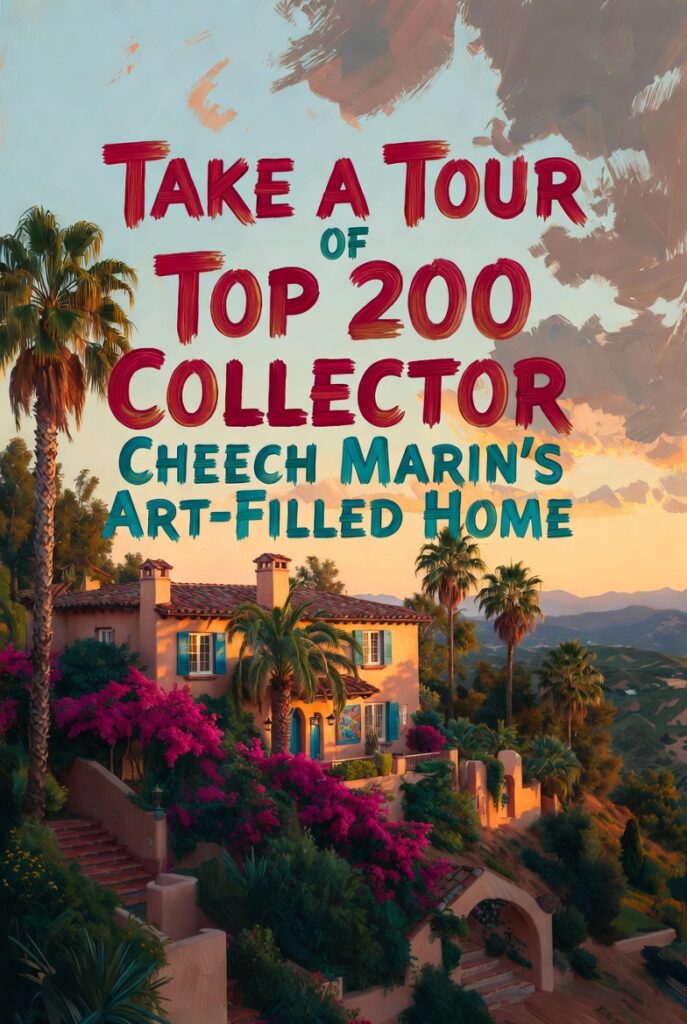
Cheech Marin’s Art-Filled Home: A Vibrant Sanctuary of Chicano Art and Cultural Legacy
Cheech Marin’s residence in the upscale Pacific Palisades neighborhood of Los Angeles is far more than a luxurious Hollywood home — it is a living, breathing museum dedicated to one of the most dynamic and important American art movements of the late 20th and 21st centuries: Chicano art. Every wall, corner, and surface pulses with bold colors, powerful narratives, cultural pride, social commentary, spirituality, and raw emotional depth. This private collection, painstakingly assembled over more than 40 years, reflects Marin’s deep personal connection to his Mexican-American heritage and his commitment to elevating artists who were long overlooked by mainstream institutions.
Watch the full, delightful ARTnews home tour (highly recommended):
The Man Behind the Collection
Richard “Cheech” Marin, best known worldwide as one half of the legendary comedy duo Cheech & Chong, has built a parallel legacy as a passionate art collector, advocate, and cultural philanthropist. A third-generation Mexican-American, Marin grew up in a Catholic household where church murals — dramatic scenes of saints, angels, and dramatic biblical narratives — first sparked his lifelong fascination with visual storytelling. As a child, he was a natural collector of everything from marbles and baseball cards to bottle caps. This instinct evolved into serious art collecting in the 1980s.
In interviews, Marin explains that he instantly recognized the quality and authenticity of Chicano art. “I knew what it was. I knew what it was based on. I knew the techniques,” he told ARTnews. He saw technically masterful painters and artists who were creating work rooted in their lived experiences — barrio life, immigration, identity, resistance, humor, and spirituality — yet receiving little mainstream recognition. “These guys and women are really good. How come they’re not getting shelf space?” This question became his mission.
Inside the Pacific Palisades Home: An Immersive Experience
Visitors to Marin’s home are immediately enveloped by art. Works cover walls from floor to ceiling, turning ordinary rooms into vibrant galleries. The collection is personal and lived-with — not stored away or displayed clinically.
Key Highlights from the Collection (as featured in the iconic 2020 ARTnews home tour):
- Carlos Almaraz — One of the cornerstones of the collection. Marin compares Almaraz to “the John Coltrane of American contemporary painters” for his spontaneous, exotic, spiritually charged, and often sensual style. A standout piece is The Boating Party, an homage to classic art history (Renoir and others) reimagined in Echo Park Lake settings — blending Impressionist composition with Chicano urban life, vibrant colors, and personal narrative. Another favorite is Two Chairs, positioned near the front door so guests see it on the way in and out.
- Glugio “Gronk” Nicandro — A founding member of the influential ASCO collective (known for its punk-influenced, performative street art). Gronk represents a pivotal shift in Chicano art toward abstraction while maintaining figurative roots. His large-scale works feature layered, chaotic backgrounds influenced by everyday urban life, with figures emerging powerfully from the visual noise. Marin owns over 50 works by Gronk, showcasing his evolution.
- Jamex and Einar de la Torre — The brothers’ innovative lenticular (3D) pieces are showstoppers. Their breakthrough work Rapture changes dramatically depending on the viewer’s angle, revealing multiple layered paintings. Marin notes that other artists are particularly stunned by these technically groundbreaking, rococo-inspired mixed-media sculptures and installations that blend glass-blowing traditions with contemporary experimentation.
Additional major artists represented include Patssi Valdez, George Yepes, Chaz Bojórquez, Michael Álvarez, Frank Romero, Gilbert “Magu” Luján, Margaret García, and many more — over 700 pieces at its peak.
The home itself becomes a narrative space: art spills into living areas, dining rooms, and hallways, creating an environment where creativity feels integrated into daily life rather than cordoned off.
Cultural Significance and Marin’s Vision
Chicano art, for Marin, is not a narrow style but “the flavor” (sabor) of an entire community — nonlinear, multifaceted, and deeply American. It draws from Mexican traditions, street life, civil rights struggles of the 1960s–70s, and contemporary global influences. Themes include identity, migration, family, politics, sexuality, humor, and resilience.
Marin has long argued that Chicano art ranks among the most vital American art movements. Through major touring exhibitions like Chicano Visions: American Painters on the Verge (2001–2007) and Chicanitas: Small Paintings from the Cheech Marin Collection, he brought these works to millions, breaking attendance records and challenging museums to expand their collections.
The Ultimate Legacy: The Cheech Marin Center
The private collection eventually outgrew even Marin’s spacious home. In a landmark act of generosity, he donated hundreds of works to the Riverside Art Museum. On June 18, 2022, The Cheech Marin Center for Chicano Art & Culture (“The Cheech”) opened in a beautifully renovated 1960s former public library building in Riverside, California. It is the first museum in the United States dedicated exclusively to Chicano art and culture.
The Cheech now houses a significant portion of Marin’s collection (nearly 500 works initially, with ongoing growth) and serves as a hub for exhibitions, scholarship, education, and community dialogue. It celebrates both historical Chicano Movement roots and contemporary voices.
Why This Matters
Cheech Marin’s home tour — and the larger story it represents — is about more than beautiful objects. It is a testament to cultural reclamation, artistic advocacy, and the power of one passionate individual to shift narratives. What began as a personal passion became a national movement, ensuring that Chicano art is recognized not as “folk art” or marginal, but as essential American art.
