
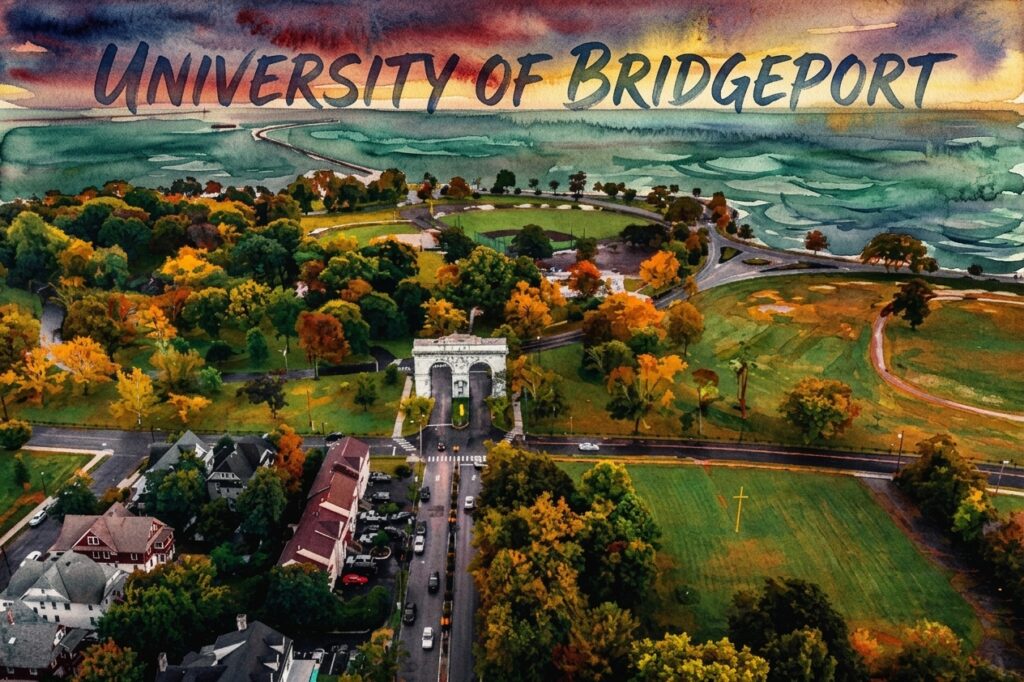
How the University of Bridgeport Turned Historic Mansions and Street Culture Into the Future of Enterprise
Far from the cold, sterile towers of corporate academia, the University of Bridgeport is turning Victorian mansions, coastal grit, and high-velocity culture into a radical blueprint for the modern mind.
The light coming off Long Island Sound in late September has a distinct, bruised-purple weight to it. It rolls across the salt-pruned oaks of Seaside Park—325 acres of coastal meadow designed by Frederick Law Olmsted back when the Gilded Age had money to burn—and hits the wrap-around porches along Park Avenue. It lights up the intricate shingles, the towering turrets, and the hand-carved balustrades of Victorian mansions that have stood against the Connecticut weather since P.T. Barnum was running the town.
To anyone driving down Route 1, this strip of Bridgeport looks like a preserved architectural sanctuary, a quiet relic of seaside domesticity. But watch the street at four in the afternoon. Watch the kids coming up the granite steps—scuffed boots, worn leather backpacks, coffee cups in hand—and you realize something much stranger and far more electric is happening behind those antique stained-glass windows.
This isn’t a historic museum district. It’s the campus of the University of Bridgeport. And while the rest of American higher education spent the last thirty years tearing down its soul to build cold, glass-and-steel degree factories, UB did something radically counter-cultural: it moved into the house.
Watch: Inside the Engine Room of Coastal Connecticut Enterprise
Forget the anonymous lecture halls and sterile corporate factory lines. This brief visual profile from the Ernest C. Trefz School of Business lays bare what happens when higher education is returned to its human scale. From students building ventures ground-up in Portugal to finance teams taking on global commodity trading, this is the real story of craftsmanship, mentorship, and legacy happening right along the Sound.
I. The House That Barnum Built
There is a quiet violence in how modern universities design space. They build brutalist concrete monoliths with fluorescent-lit basements and multi-tiered lecture halls engineered specifically to make the student feel small and the institution feel invincible. You sit in seat 184F, take notes on a screen, and leave without making eye contact with a single human being.
UB took the exact opposite gamble. By inheriting and restoring the late-nineteenth-century residential footprint of Park Avenue, the university anchored its academic life directly inside the proportions of a home.
When your seminar room sits inside a grand former parlor—where the acoustics were designed for fireside conversation rather than megaphones—the posture of learning completely shifts. The artificial hierarchy between teacher and student evaporates. A lecture turns into an argument across a heavy oak dining table. The wide front porch becomes an impromptu strategy session. The grand staircase becomes a gallery.
It turns out that human beings don’t actually learn best in sterile boxes; they learn in places that feel like home. By embedding its identity into the living, breathing domestic architecture of the Sound, the university grounds its ambition in a sense of spatial permanence. It tells a student that their ideas deserve a room with character, history, and light.
II. The Anatomy of the Machine
Walk through the front doors of the Ernest C. Trefz School of Business and you won’t find a room full of suits memorizing static formulas from a 1998 textbook. You’ll find kids taking apart the actual engine of modern culture.
In a landmark move, the Trefz School struck an alliance with NBALAB—the official research, development, and design incubator for the National Basketball Association. It is an incubator where high-design art, street-level fashion, and athletic enterprise collide. Instead of running hypothetical case studies on dead corporations, UB students are thrown directly into the pipeline of real IP creation. They study how brand capital is built from scratch, how physical product design creates human obsession, and how a league’s cultural swagger translates into global commerce.
Just down the road at the Hartford Healthcare Amphitheater, other students are running live operations on the ground—managing logistics, financial models, and spatial flow for major live entertainment events. They are learning that enterprise isn’t an abstract spreadsheet; it’s a living ecosystem that requires grit, instincts, and visual storytelling.
This is the bridge where Home meets Art: business education stripped of its dry, corporate academic speak and returned to its original form—as a creative craft.
III. The Kitchen Table Legacy
At its core, true enterprise was never meant to live in a windowless skyscraper in Manhattan. It belongs on a porch by the water, nurtured by people who actually know your first name.
With small class sizes and a faculty made up of working industry practitioners rather than distant academic dons, UB functions less like a sprawling bureaucracy and more like a tight-knit family cohort. That human scale matters deeply in a city like Bridgeport. The university acts as a powerful economic matriarch for coastal Connecticut, taking first-generation college students, local artists, and neighborhood dreamers and handing them the tools to build real, lasting wealth.
The degrees earned in these old Victorian rooms don’t wind up as forgotten wall decorations in an anonymous corporate cubicle. They get carried back to local kitchen tables. They turn into neighborhood storefronts, independent design studios, and family-owned enterprises that keep the regional culture, spirit, and economy unmistakably alive.
As the sun finally drops below the horizon at Seaside Park, casting long shadows across the lawns, the lights inside the houses on Park Avenue flick on one by one. Through the glass, you can see small groups of students gathered around tables, plotting out designs, debating strategies, and building their futures. They aren’t just getting an education. They are learning how to build a life—right here at home.
The Blueprint for the Modern Mind: Where Grit Meets the Harbor

This unique learning identity established along Park Avenue is designed for direct application across the water at Steelpointe Harbor. While the university’s restored Victorian “porches” offer an intimate sanctuary for deep thought and collaboration, this massive, multi-billion dollar mixed-use development provides the high-energy urban canvas where those ideas are put to the test.
It is the perfect synergistic loop: UB’s Ernest C. Trefz School of Business equips students with “real-world grit” and creative craft through powerful industry partnerships, and Steelpointe Harbor—with its deep-water marina, dynamic retail anchors like Bass Pro Shops, and premier waterfront living—serves as a 2.8 million square foot living lab. Students analyzing brand capital or logistical flow can walk from their seminar room into the heart of New England’s premier maritime and entertainment destination, seeing firsthand how a historic maritime legacy is re-envisioned as the future of Connecticut commerce.
