
I. THE MACHINE
Late August 2026 arrived with an unmistakable tremor from the high atmosphere of global policy.
Bill Gates published an urgent manifesto warning that civilization has crossed an irreversible threshold. The transition to artificial intelligence, he argued, will be among the most turbulent periods in modern history—a compressed shockwave that will not dissipate with the next economic cycle. From the stratosphere of compute token taxation, international monitoring regimes, and structural labor displacement, Gates sounded an alarm that cannot be ignored: society must urgently determine how to protect human labor and presence before pure market incentives strip them from the landscape entirely.
Gates is right about the velocity of the rupture. But to understand the true depth of the crisis, you have to look past the policy white papers and look at what is happening to the ground floor of the middle class.
The traditional rungs of economic ascension are snapping in real time. We have entered a three-year window of unprecedented white-collar contraction. The entry-level bastions that built modern domestic security—junior software engineering, tax accounting, market analysis, mortgage underwriting—are being swallowed whole. Code is no longer hand-typed by young programmers learning their craft; it is orchestrated and compiled by neural models in seconds. The junior accountant reconciling spreadsheets is competing against a system that audits millions of ledger lines continuously, without fatigue or payroll taxes.
When cognitive labor becomes virtually free, the social contract governing modern family life collapses. For three generations, the blueprint was clear: develop a quantitative skill, climb the corporate ladder, secure a mortgage, and build a sanctuary for your household. When algorithms strip away those bottom rungs, the crisis is not merely financial. It is existential. It strikes directly at our sense of purpose, our daily routines, and the dignity of human effort.
Gates views this battlefield from thirty thousand feet, prescribing macroeconomic levies and government frameworks. But a compute tax cannot heal a fractured sense of self-worth, and international treaties cannot protect what happens inside the four walls of a private home.
The defining question of our generation is not what machine intelligence can produce.
The real question is: what must we refuse to outsource?
At Home Art & Family, we call this non-negotiable territory The Human Hearth: those sacred spaces, tactile crafts, and biological relationships whose very value diminishes the moment a human being is removed from the equation.
Let the algorithms have the logistics pipelines. Let them optimize supply chains, balance regional electrical grids, sequence viral proteins, and clear title paperwork at light-speed. That is welcome efficiency.
But efficiency is a tool for machines, not a philosophy for living. When efficiency becomes an all-consuming religion, it optimizes away the friction, the physical touch, and the unscripted vulnerability that make us human in the first place.
To see what that resistance looks like when carved into stone, wood, and light, you have to leave the digital ether, step away from the panic of the policy tables, and head down Chapel Street in New Haven.
II. THE TEMPLE
Leave the digital ether, turn off the glowing screens, and walk down Chapel Street. Across from the Gothic revival arches of Yale’s campus stands Louis I. Kahn’s final, posthumous monument: the Yale Center for British Art (YCBA).
In an era when generative artificial intelligence promises infinite, weightless variations in fractions of a second, Kahn’s building delivers a quiet, physical counterweight. It is heavy. It is disciplined.
Where synthetic software dissolves structural constraints, Kahn celebrated them. The exterior meets the street with matte pewter-finish stainless steel panels set within an uncompromising, exposed concrete frame. Cross the threshold, and the building reveals its interior palette: smooth travertine stone floors, textured unbleached Belgian linen display walls, and monumental partitions clad in raw, unvarnished white oak.
Kahn structured the entire museum on a rigorous twenty-foot concrete grid. The interior walls are not load-bearing drywall; they are independent oak-paneled volumes that sit loosely within the concrete skeleton, allowing the building to show its honest bones. Nothing here pretends to be something else. The concrete bears the imprint of the plywood forms that shaped it; the oak bears its biological grain; the travertine carries the mineral strata of the Italian quarry from which it was cleaved.
Most importantly, Kahn designed a structure that refuses to simulate light.
Instead of relying on fluorescent tubes or algorithmic lumen mapping, Kahn built a machine that waits for actual sunlight. The roofline is equipped with an intricate grid of V-shaped skylight diffusers and automated louvers that capture living New England daylight, bounce it internally, and bathe five centuries of oil paintings in a soft, ambient glow.
The gallery experience is inextricably bound to the physical earth. When an autumn cloud bank drifts over New Haven, the concrete dims and Constable’s brooding skies darken. When the late afternoon sun breaks through, Turner’s golden maritime canvases catch fire. No text prompt can summon that exact instant. It cannot be downloaded or duplicated because it requires the convergence of three real-world elements: physical matter, natural weather, and a conscious human being standing in the room.
Kahn famously posed an elemental question to his students: “What does a brick want to be?” A brick, he answered, wants to be an arch. It wants to honor its own density, its limits, and its earthy origin.
If a brick wants to be an arch, what does a building want to be? It wants to be a sanctuary for life.
And in 2026, as machine intelligence threatens to automate away the texture of our existence, Kahn’s architecture forces us to take the final, unavoidable step:
What does a human being want to be?
And what do we want our homes to be?
Do we want to be disembodied nodes in a frictionless data stream, consuming synthetic images and delegating our creative instincts to probabilistic models? Or do we want to remain creatures of mass and mortality—people who belong in spaces that hold weight, who build things with their hands, and who find meaning in the unscripted truth of the physical world?
III. THE HAND
To understand the intellectual spine of the Yale Center for British Art, you have to leave the grand skylit courtyards and descend into the Department of Rare Books and Manuscripts. There, preserved across thirty-five thousand volumes, sits the historical blueprint for our present crisis.
History does not repeat itself, but it rhymes with astonishing fidelity.
Long before neural networks flooded our visual landscape with synthetic imagery, Victorian England was engulfed by the first great machine age. In the late nineteenth century, steam-powered mechanical looms, high-speed rotary presses, and industrial foundries began churning out textiles, books, and household goods at a volume and speed humanity had never witnessed. Suddenly, ornament was cheap. Symmetry was automated. The market was flooded with mass-produced commodities that made the work of traditional weavers, joiners, and engravers appear commercially obsolete overnight.
It was against this suffocating tide of industrial mechanization that John Ruskin and William Morris launched the British Arts & Crafts movement.
Morris did not organize the movement out of blind, reactionary Luddism. He was not terrified of the steam engine; he was terrified of what unchecked mechanization did to the human spirit. When he established the Kelmscott Press—obsessively casting his own typefaces, hand-binding volumes in limp vellum, and printing on handmade linen paper—he was making an urgent philosophical statement: the value of an object is inseparable from the human joy, labor, and creative freedom of the person who made it.
Morris identified a paradox that has roared back to life in 2026: When machine production makes flawless replication infinitely abundant, machine perfection ceases to have any scarcity premium.
Generative artificial intelligence has accomplished the ultimate commodification of form. An algorithm can ingest trillions of parameters and generate a hyper-detailed Renaissance canvas, a seamless mid-century credenza render, or a thousand lines of immaculate prose in four seconds flat.
The machine can manufacture the artifact. It cannot manufacture the hours of a human life that were invested in making it.
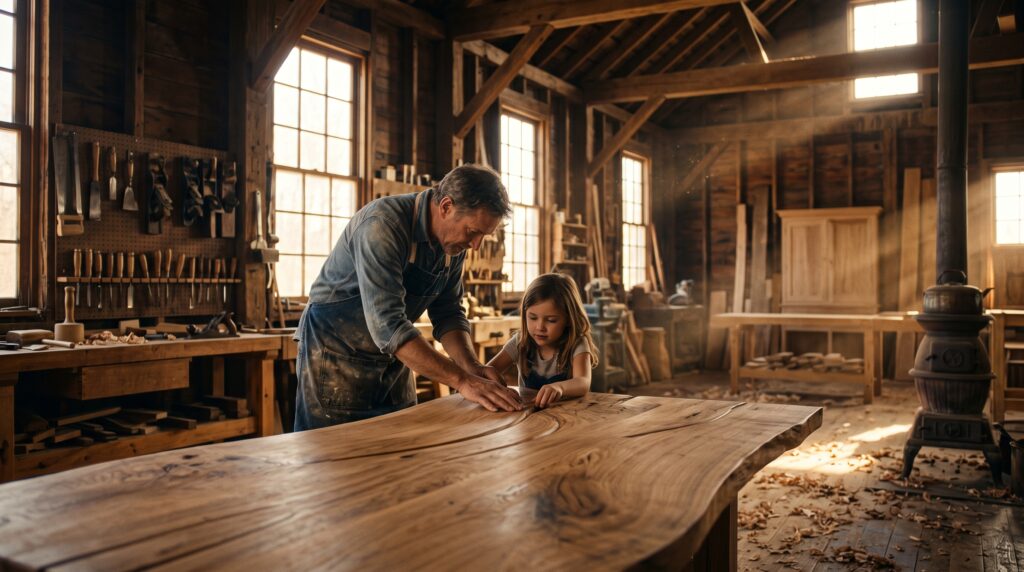
The true value of human art and bespoke craft has never been about technical symmetry. A machine eliminates error by definition; an artisan standing at a workbench, shaping a slab of black walnut with an adze, risks destroying days of work with a single misjudged strike of the blade. The brushstroke on linen, the thrown terracotta vessel with its subtle structural wobble, the mortise-and-tenon joint cut with a hand saw—these are not aesthetic flaws to be smoothed away by an optimizing algorithm. They are the undeniable, physical proof of a human consciousness working within the constraints of real time and mortal limits.
We do not treasure a hand-planed dining table or an original oil study because the maker possessed superior processing power. We treasure it because a fellow human being spent an irreplaceable Tuesday afternoon of their finite life pouring their physical strength, attention, and creative spirit into its creation.
Scarcity used to be a technical problem solved by factories and processors. In an automated world saturated with effortless, ambient abundance, human time has become the rarest luxury on Earth.
IV. THE HEARTH
The argument for the Human Hearth ceases to be an academic debate over aesthetics or economics the moment it crosses the threshold of the home.
In his writing on the future of care, Gates struck a rare, disarming note of vulnerability when reflecting on his late father’s battle with Alzheimer’s disease. As the illness progressed and his father’s ability to communicate deteriorated, it was not technological wizardry that sustained his dignity. It was the caregivers—human beings who possessed the patient, somatic ability to read subtle facial shifts, decipher broken silences, and offer comfort through physical presence. Gates conceded a profound truth: no robotic arm, no matter how delicately motorized, and no synthetic voice interface, no matter how soothingly synthesized, could or should ever replace that bond.
A machine can simulate attentiveness; it cannot participate in a human life.
Yet, Silicon Valley’s latest frontier is an aggressive push into that exact territory: the introduction of generative AI companions into the nursery, the study, and the bedroom. We are being offered a vision of frictionless companionship—digital agents that never get tired, never argue, remember every detail of your life, and validate every emotional impulse with algorithmic flattery.
This is where the psychological danger shifts from displacement to emotional atrophy.
In The Anxious Generation, social psychologist Jonathan Haidt warns of the profound hazards of raising “greenhouse children.” When a sapling is raised inside a climate-controlled greenhouse—shielded entirely from the stress of wind, drought, and changing seasons—it never develops the deep root systems and thick cellular walls required to withstand the open air. The moment the glass is removed, the first gust of wind snaps it at the base.
Synthetic companions are emotional greenhouses. An algorithm that is programmed to never lose its temper, never misunderstand you, never get bored, and never assert its own autonomous needs is not a companion. It is a psychological mirror that feeds an illusion of connection while silently eroding our capacity for reciprocity.
True human relationship is fundamentally inconvenient.
A real friend misunderstands your motives, requires an apology, and expects you to show up when it rains. A spouse has bad days, holds contradictory opinions, and demands that you compromise. An aging parent requires patience that tests your limits. A child throws a tantrum on the kitchen floor, forcing you to navigate the messy, un-optimizable art of unconditional love.
Those friction points are not software bugs waiting to be patched out of the human experience.
The friction is the relationship.
It is precisely within the resistance of another sovereign, unpredictable human consciousness that empathy is forged. When we replace the messy friction of family life with the frictionless compliance of synthetic agents, we do not eliminate loneliness—we engineer an emotional vacuum where our children forget how to love anyone who does not immediately bend to their will.
The home was never meant to be an optimized transit hub or an automated consumption chamber. It is the primary emotional forge of civilization. It is the messy, loud, sacred territory where we learn to bear the weight of each other’s humanity.
V. THE RESERVATION
We cannot—and should not—attempt to wall ourselves off from computational reality.
Let the algorithms sequence life-saving proteins, predict erratic climate shifts, map global supply chains, and automate municipal bureaucracies. Let machine intelligence handle the vast, mechanical architecture of logistics. That is what tools are for.
But we must possess the cultural spine to draw a permanent line in the sand.
The Human Hearth is our reservation. It is the conscious decision to declare that our homes, our creative expressions, and our families are not optimization problems waiting to be solved by Silicon Valley.
This line is not drawn through grand legislative mandates or corporate committee meetings; it is defended in the quiet, daily choices of everyday life. It means choosing the dining table with the hand-planed joinery that will outlive our grandchildren over the disposable, composite flat-pack. It means hiring the local architect and the stonemason whose hands know the weight of granite. It means choosing the painter whose studio carries the sharp scent of linseed oil and turpentine over a thousand instantaneous digital renders. And it means looking our children in the eye and teaching them that the hardest, most inconvenient parts of being human are precisely where our dignity resides.
Picture the family dinner table on an ordinary Thursday night.
It is completely un-optimized.
No machine learning model designed the seating arrangement. No algorithm vetted the menu. The meal is late because the workday ran long. The soup is too salty. Someone is complaining about their third-period teacher. Someone else spills a glass of water across the scarred oak tabletop, and paper napkins are frantically passed around in the chaos. A sibling rolls their eyes at a joke their father has told a hundred times before. An argument flares over whose turn it is to clear the plates, dissolves into exasperation, and then softens into sudden, unscripted laughter that rattles the silverware and fills the room.
The machine age will claim vast territories in the decades ahead. It will build our infrastructure, balance our ledgers, and manage the speed of the world.
The only question that remains is whether we will have the courage to reserve the hearth for ourselves.
