
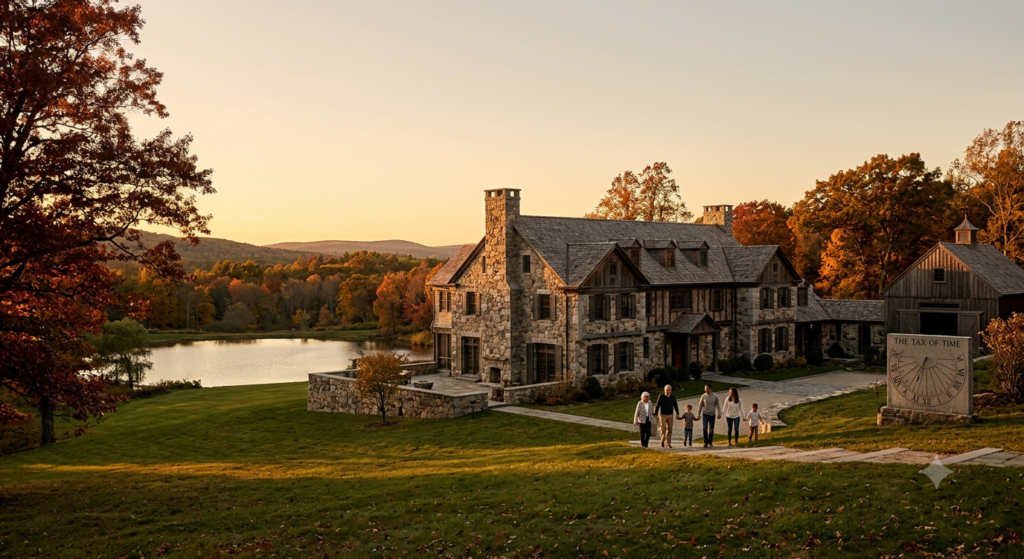
When an architect lays stone on a high-net-worth estate, the blueprint accounts for wind, load, and light. But the most relentless erosion a sanctuary faces over a hundred-year horizon isn’t weather—it is municipal tax drag.
Real estate media routinely reduces residential decision-making to list price or square footage. Yet, for families anchoring multi-generational wealth, the initial purchase price is a secondary variable. The true equation of spatial longevity lies in the annual holding cost—a figure governed by municipal tax policy.
As detailed in the comprehensive overview of Connecticut Mil Rates 2026 By County & Town on the Connecticut Real Estate Center, property tax rates across the state vary wildly—ranging from 10.85 mills in Washington to 68.95 mills in Hartford.
Over a 30-year stewardship, that spread isn’t an line item. It is an asset allocation decision that dictates whether capital compounds inside a family’s legacy portfolio or dissolves into local operating budgets.
The Mathematics of Permanent Sanctuaries
To understand how municipal economics shape fine homes, consider two identical $3,000,000 estates in separate Connecticut enclaves:
┌─────────────────────────────────────────────────────────────────────────────┐
│                       THE 30-YEAR TAX DRAG EQUATION                         │
│                                                                             │
│   Assessed Value (70% Market Value): $2,100,000                             │
│                                                                             │
│   ENCLAVE A: Low-Tax Haven (e.g., Washington / Greenwich ~11.0 Mills)      │
│   • Annual Tax: ~$23,100                                                    │
│   • 30-Year Cumulative Tax: $693,000                                        │
│                                                                             │
│   ENCLAVE B: Standard Suburban Rate (e.g., Central CT ~35.0 Mills)          │
│   • Annual Tax: ~$73,500                                                    │
│   • 30-Year Cumulative Tax: $2,205,000                                      │
│                                                                             │
│   THE ARBITRAGE DIFFERENCE: $1,512,000                                      │
└─────────────────────────────────────────────────────────────────────────────┘
The $1.5M+ tax differential between low-mill historic enclaves and high-tax municipalities represents pure preserved capital. In the context of Home, Art & Family™, that delta equals:
-
A museum-grade private collection acquired over three decades.
-
Complete structural timber & stone restoration to outlast centuries.
-
The seed capital for an ancestral trust securing the property for the next generation.
Low-Mill Enclaves: The Geography of Longevity
The state’s tax landscape reveals why historic art enclaves and architectural sanctuaries cluster in specific pockets.
1. The Litchfield Hills Sanctuary
-
Key Enclaves: Washington (10.85 mills), Sharon (24.25 mills), Roxbury (22.75 mills).
-
The Legacy Profile: Long favored by artists, authors, and industrial stewards seeking uncompromised privacy. Low municipal tax drag preserves expansive acreage, allowing estates to maintain agrarian, timber, and architectural integrity without development pressure.
2. The Gold Coast Anchors
-
Key Enclaves: Greenwich (11.393–12.04 mills), Darien (14.69 mills), New Canaan (16.144–16.69 mills).
-
The Legacy Profile: Combining proximity to global financial hubs with low mill rates, these towns allow high-net-worth families to build high-valuation architectural statements while retaining capital for private art advisory and enterprise investments.
Designing for the 10,000-Year Horizon
When building or acquiring an ancestral home, true luxury means looking beyond today’s transaction. It requires evaluating the local grand list, understanding municipal reassessment cycles, and selecting a municipality where local governance respects the preservation of private property.
Home, Art & Family™ exists to document the cornerstones of civilization—our shelters, our art, and our bloodlines. By mastering the underlying economics of spatial longevity, stewards ensure their physical sanctuaries remain secure, sovereign, and lasting for generations to come.
Data Source Reference: For complete town-by-town municipal tax tables, visit the Connecticut Mil Rates 2026 Directory.
