
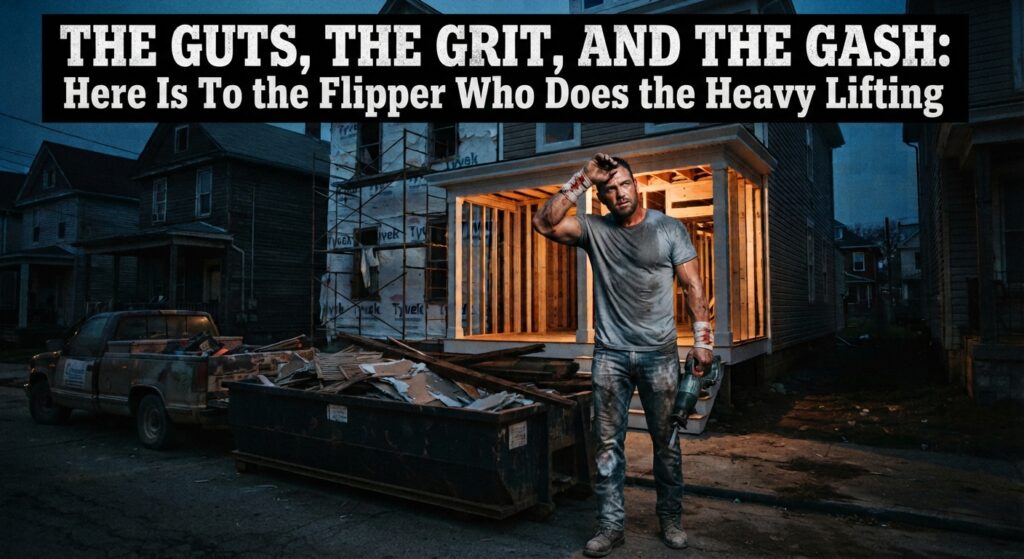
There is a specific, suffocating kind of nerve required to unlock a derelict front door—a place smelling of damp plaster, forgotten decades, and structural failure—and still see a cathedral waiting under the rot.
Wholesalers pass paper like ticket scalpers. They trade equity from behind laptop screens, eyeing a PDF of someone else’s misfortune without ever lifting a hammer or tasting drywall dust in the air. They are the vultures of the curb.
The true flipper is different. They are the reckless romantics of the urban landscape: part structural surgeon, part financial acrobat, part high-stakes gambler willing to bet everything on a vision everyone else called a hallucination.
To the flippers with the guts to step into the rot and drag a forgotten building back into the light: this one is for you.
The Shock Absorbers of the Stock
You are the shock absorbers of our housing stock.
While bureaucrats draft another committee and speculators hoard empty lots like dragons on ash, you roll up your sleeves and absorb the volatility. You stare down sinking fieldstone foundations, knob-and-tube wiring installed during the Roosevelt administration, and layers of oil-based lead paint thick enough to carve. You put your hand on a rotted joist, look straight into the abyss of a sagging roofline, and say, “We can make this sing.”
The Brutal Physics of the Craft
Strip away the pastel-filtered gloss of an HGTV montage. This is not a thirty-minute miracle.
It is six months of grinding anxiety. Unexpected municipal code violations that swallow a month of profit. Budget blowouts. The daily, low-humming prayer that the main plumbing stack has not completely rusted into cast-iron powder. It takes a rare, unhinged brand of audacity to sign hard-money loans at double-digit interest rates and trust that the market will not shift out from under you while you are elbow-deep in subflooring, fighting old-growth heart pine that treats a modern reciprocating saw blade like a toothpick.
Urban Alchemy on the Block
Yet when it works, it is nothing short of alchemy.
You take a block that was slowly bleeding out—windows choked with plywood, porches sagging toward the dirt, streetlights that barely bothered to turn on—and you inject an immediate, violent pulse back into the pavement. You save the historic plaster moldings instead of drywalling over soul. You restore the double-hung weights in windows that have not slid smoothly since Eisenhower was in office. You replace the tarp roofs with architectural shingles that finally catch the autumn sun with some dignity.
In doing so, you change the psychological gravity of an entire street. A fixed-up facade is wildly contagious. It tells the homeowner across the alley that their investment still matters. It gives the corner store a reason to sweep the sidewalk. It turns a blighted neighborhood liability into a proud anchor of domestic life.
The Beacon in the Dusk
Yes, you took the hits when the purists shrieked “gentrification” and the armchair cynics called it greedy. The houses you resurrected do not care about the internet noise. They just stand taller against the dusk.
The scaffolding comes down. The dumpster rolls away. And deep in a neighborhood the world wrote off as a lost cause, a single warm porch light flickers on—a bright, defiant beacon cutting through the dark, welcoming home a family who finally has a floor beneath them that does not shake.
Here is to the grease-stained knees, the midnight spreadsheets, the structural engineers who saved a load-bearing wall by a millimeter, and the sheer, unadulterated grit it takes to bet on a block that everyone else gave up for dead.
You did not just flip houses.
You gave neighborhoods their heartbeat back.
