
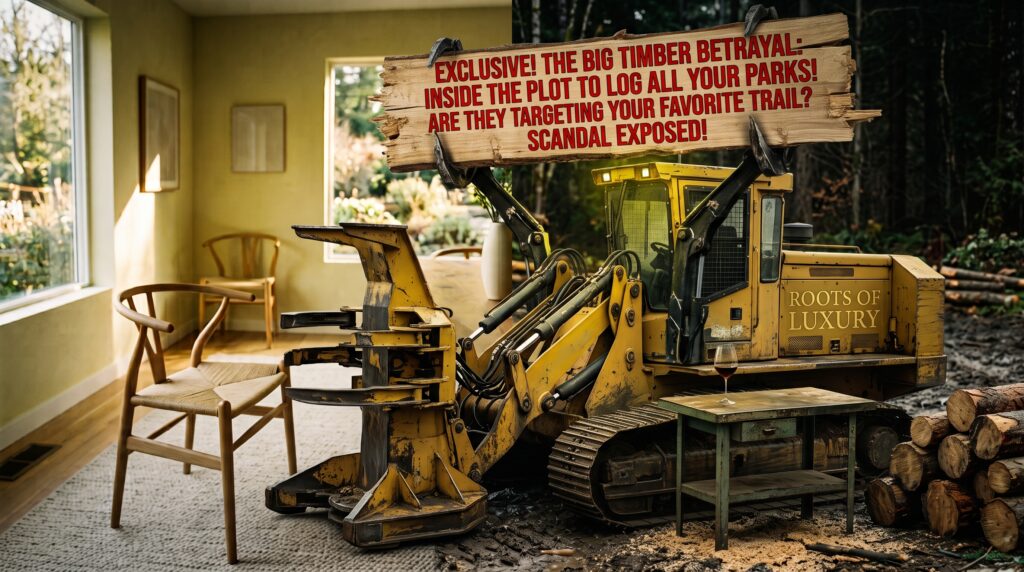
BLOOD TIMBER: The Hidden Crime in America’s Most Beautiful Living Rooms
Washington just handed the keys to 193 million acres of America’s public wildlands to a commercial timber lobbyist named Tom Schultz—and the ancient trees he’s targeting are heading straight for your living room floor. While the administration packages the rollback of backcountry roadless protections as “wildfire prevention,” the real prize isn’t fire safety. It’s the high-margin, dense-grain old growth that feeds luxury architectural design.
Take a look at your dining table. Run your bare hand across that stone-cold, tight grain. Count the exposed end-rings—two hundred of them stacked tight, an irreplaceable archive of alpine blizzards, high-country droughts, and centuries of slow growth. You paid a premium for that structural honesty. You call it an heirloom.
You interrogate everything else that crosses your threshold. You ask which hillside vineyard produced the Pinot Noir. You demand to know if the eggs were pasture-raised, which Italian mill spun the linen, and whether the lime wash is zero-VOC. Every surface in your home carries a meticulous paper trail. Except the wood. The wood gets a pass.
We treat fine timber as if it falls from the sky—pre-aged, naturally ethical, washed in clean intention. It doesn’t. It comes from the earth. And under Schultz’s newly deregulated Forest Service, it comes from roadless public backcountry liquidated to furnish high-end residential spaces.
The Fox at the Helm
In Washington, corporate extraction doesn’t arrive in an armored car with masked bandits. It wears a bespoke Carhartt vest, holds a master’s degree, and calls itself “active management.”
In February 2025, Agriculture Secretary Brooke Rollins named Tom Schultz the 21st Chief of the U.S. Forest Service—handing him regulatory command over 193 million acres of national forests and grasslands held in public trust.
Schultz wasn’t an agency scientist tracking mycorrhizal networks or a veteran ranger with thirty years of fireline grit. He came straight from the executive suite of Idaho Forest Group, where he served as vice president of resources and government affairs: running timber procurement and lobbying the very agency he now leads. Simultaneously, he chaired the Federal Forest Resource Coalition, the primary trade group pushing to expand commercial logging on public lands. He is the first Chief in Forest Service history hired with zero prior experience inside the agency.
This isn’t an administrative shuffle. In Wall Street terms, it is a private-equity partner taking over the SEC to deregulate his former fund’s core assets. Washington handed the lumber executive the master key to the warehouse he used to buy from, put him on the federal payroll, and billed the American public for perimeter security.
The Road Is the Whole Scheme
Nobody defends clear-cutting ancient trees outright anymore. So the industry doesn’t ask for that. It asks for “wildfire resilience” and “hazardous fuels reduction”—phrases that poll well and obscure the balance sheet underneath.
Here’s the tell: the fuels that actually ignite and incinerate communities are the small, dry, three-inch brush growing right against mountain towns. That’s the Wildland-Urban Interface. Thinning it is slow, unglamorous, and commercially worthless. Nobody gets rich chipping scrub oak.
The trees with high retail margins are miles away—the thick-barked, fire-resilient Western redcedar and Douglas fir giants deep in high-elevation backcountry that have shrugged off blazes for three centuries.
Reaching them requires gouging an unpaved industrial haul road through steep alpine topography that hasn’t seen an engine block since the retreat of the glaciers. The road destabilizes ridgelines, bleeds silt into municipal drinking watersheds, and invites invasive weeds.
The road is the whole scheme. It isn’t a byproduct of fire safety; it is the economic catalyst. The moment the bulldozer punches through, inaccessible public heritage becomes billable private inventory.
The Blood Timber Test
For twenty-five years, the 2001 Roadless Area Conservation Rule has kept roughly 45 million acres of public interior free from industrial machinery. It survived decades of lawsuits and administrative attacks because the science was ironclad: once you punch a road into pristine wilderness, you kill the watershed forever. You don’t just lose trees—you lose the thermal canopy cooling riverbeds for spawning trout, the deep roots preventing landslides, and the snowpack that steadies the continent.
Nobody is saying stop building with wood. That is economically illiterate. Certified domestic hardwoods from managed private woodlots, second-growth forests, and urban timber salvage programs that mill fallen city trees are supply chains that can look you in the eye.
This is about the wood that can’t.
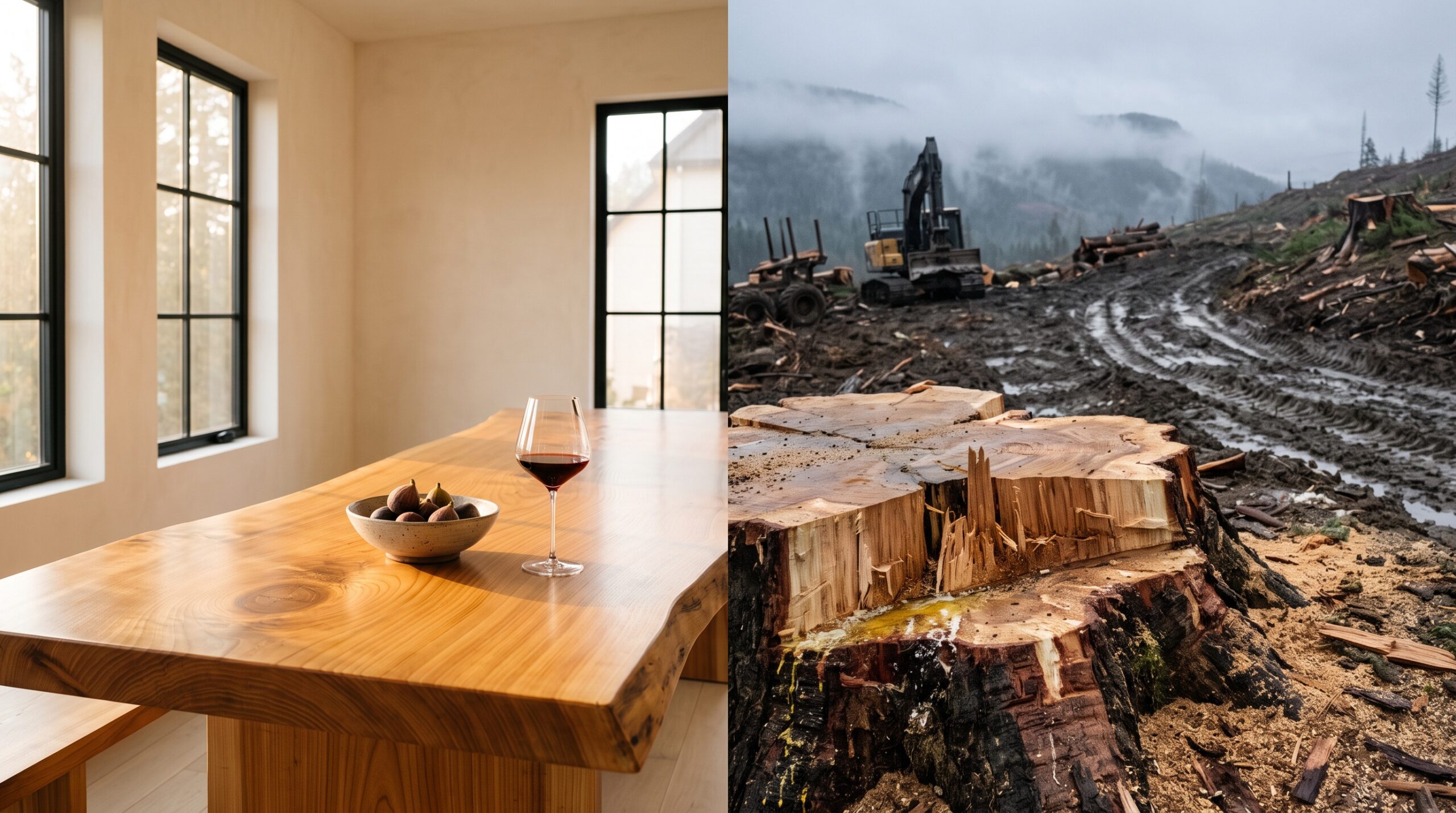
Before you specify a timber package, commission a dining table, or approve an architectural beam, put it through the Blood Timber Test:
- Did it require cutting a haul road into an unroaded public watershed? If yes: Blood Timber.
- Was it fast-tracked through emergency exemptions that bypassed environmental review and public comment? If yes: Blood Timber.
- Can the supplier verify the exact geographic parcel and management plan it came from? If they can’t: Blood Timber. The silence is the answer.
If a board cannot survive those three questions, it doesn’t get to wear the word “natural.” The burden of proof belongs on the supply chain, not on your family.
The 120-Day Alternative
The timber lobby has spent half a century selling architects and homeowners a calculated lie: Either we cut public backcountry forests, or you can’t build homes.
It is an extortion racket disguised as supply-chain reality. We do not need to plunder ancient ecosystems to build magnificent, structurally bulletproof spaces.
A heritage white oak or Western redcedar takes 80 to 300 years of unrepeatable botanical time to yield architectural-grade timber. Industrial hemp takes 120 days.
Compressed under hydraulic pressure with bio-based resins, engineered hempwood tests harder than red oak on the Janka scale, sands to a museum-grade polish, and takes a fastener without splitting. Pair that with hemp-lime wall systems (hempcrete) that breathe, regulate indoor humidity, and deliver exceptional fire-resistance without synthetic drywall toxins, and you have a material future that grows on an annual farm rotation instead of liquidating an ancient watershed.
The industry doesn’t ignore agricultural fiber because it doesn’t work. It ignores it because you cannot monopolize a crop that American family farmers can rotate in a standard field every spring and harvest every August.
What Are You Actually Handing Down?
At Home, Art & Family, we believe the four walls of a house are never neutral.
A dining table is not a countertop. It is the sacred physical anchor of a household—where children learn to read, where old friends drink late into the night, and where an entire family history gets etched into the wood by decades of ordinary life. That domestic permanence demands ethical honesty.
So ask yourself what story sits inside the grain. “Milled from ancient cedar” sounds romantic until you finish the sentence: milled from ancient cedar poached out of a public roadless watershed that will not exist again in your grandchildren’s lifetimes.
There is something profoundly broken about building a family sanctuary by destroying the sanctuaries outside our doors.
A home should not merely look natural; its materials must have a natural history a family can live with. The finest heirloom isn’t merely an object built to last a hundred years—it is something whose existence didn’t require us to liquidate what took a thousand years to create.
Stop looking at that unverified timber table as a rustic antique. If it came out of an ancient, roadless public grove, look at it for what it really is:
A receipt from a robbery.
SOURCES & FACT-CHECK DOSSIER
The Regulatory Capture & Revolving Door
- The Guardian: Forest Service Chief Faces Scrutiny Over Logging Ties as Trump Plans to Scrap Protections – Confirms Tom Schultz as the first Chief hired without internal agency experience, his executive history at Idaho Forest Group, and recent lobbying records.
- Public Citizen: Research on Extractive Industry Revolving Door Appointments – Forensic breakdown of Schultz’s policy lobbying, corporate ties, and the administrative move to double federal timber sales in Idaho.
- U.S. Forest Service: Official Leadership Biographies – Official agency record of current executive leadership and administrative direction.
- Federal Forest Resource Coalition (FFRC) – Congressional testimony archives and lobbying positions of the commercial federal timber procurement coalition.
The Roadless Rule & Backcountry Protections
- U.S. Forest Service: 2001 Roadless Area Conservation Rule – Foundational regulatory history, legal text, and inventory of the 45 million acres of protected backcountry.
- Center for Biological Diversity: Roadless Rule Legal Defense Archive – Tracking ecological assessments, threatened species impacts, and ongoing litigation surrounding public forest road-building.
- Earthjustice: The Fight for Ancient Watersheds – Case filings on categorical exclusions, NEPA exemptions, and public land extraction mandates.
Wildfire Ecology & Road Ignition Data
- John Muir Project: Scientific Research on Logging and Fire Severity – Peer-reviewed ecological research demonstrating how canopy thinning and commercial logging increase ground temperatures, wind speeds, and fire severity.
- Wildland-Urban Interface (WUI) Defensible Space Studies – Forest Service research confirming home survival during wildfires depends on immediate perimeter defensible space, not backcountry logging.
Regenerative Material Engineering & Provenance
- HempWood Technical Testing & Specifications – Lab-certified Janka hardness ratings (~2,400 lbf), carbon footprint data, and density comparisons against traditional red and white oak.
- U.S. Hemp Building Association (USHBA) – Building codes, thermal and vapor performance certifications, and ASTM fire testing standards for lime-hemp composites.
- Urban Wood Network – Verified supply-chain infrastructure and standards for reclaiming fallen municipal timber and urban tree salvage.
