
Intro — What You See When You Look Up.
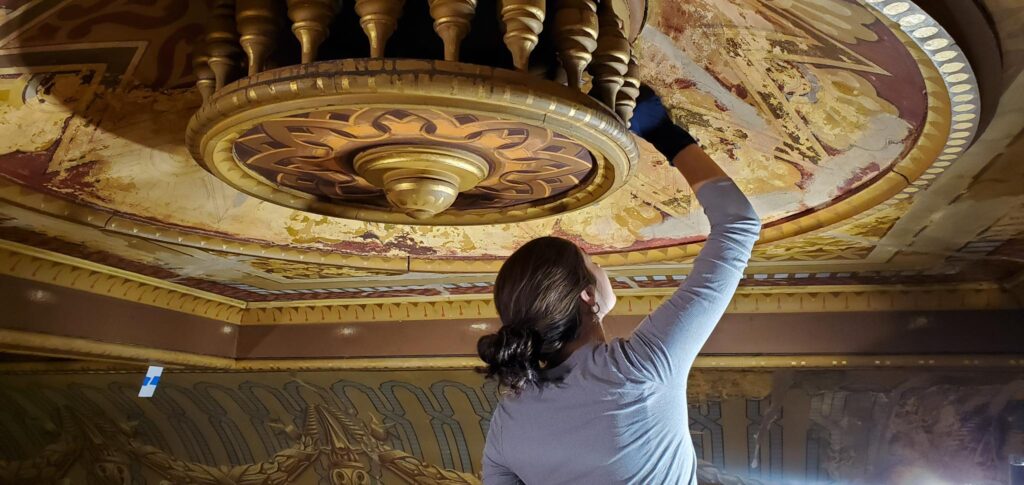
You don’t walk into the Thomaston Opera House and look straight ahead. You try, maybe. Out of habit. Toward the stage, the seats, the shape of the room. But something pulls your attention upward—gradually, almost against your own intention—until you’re standing still, looking at the ceiling, as if that was always the point.
It isn’t just decoration.
It’s presence.
Color and geometry move across the surface with a confidence that feels deliberate but not rigid, intricate without being fragile. There is a certainty to it, a sense that whoever designed it expected it to last—not just physically, but culturally. Not just to be seen, but to be returned to. And for more than a century, it has been.
The building itself was never meant to be separate from the life of the town. When it was completed in 1885, it stood as part of a larger idea—one that placed civic function and cultural expression under the same roof, as if governance and imagination were not competing forces, but parallel ones. Offices below. Performance above. A structure that suggested a community could be defined as much by what it creates together as by what it produces. “All images courtesy of Friends of The Thomaston Opera House unless otherwise noted.”
That idea no longer announces itself.
It doesn’t need to.
It’s embedded in the space—in the proportions of the room, in the way the ceiling still draws the eye before anything else has a chance to. You don’t need to know the history to feel that something here was built with intention.
What’s harder to see—at least at first—is how close that intention came to being lost. Like many buildings of its kind, the Opera House has been altered, adapted, closed, reopened, and, at times, neglected. Layers were added. Details were softened. Function replaced form, and then replaced it again. Over time, the original clarity of the space didn’t disappear.
It receded. Becoming something people sensed more than they saw. Until recently.
The current restoration hasn’t created something new so much as it has removed what stood in the way. What’s emerging now isn’t a reinvention, but a recognition—of what was always there, waiting to be seen clearly again. Much of what allows a place like this to function is rarely seen at all—noticed only when something fails. And that changes the question.
This is no longer a story about whether the Thomaston Opera House can be saved. It already has been. The question now is what, exactly, has been preserved—and what it means to carry that forward in a world very different from the one that built it.
Because buildings like this don’t survive on history alone. They survive because, at certain moments, people decide they still matter. And act accordingly.
Support The Thomaston Opera House
The Timeline — A Building Shaped by Its Moments
1883–1885 | A Building with Purpose
The Thomaston Opera House was built at a moment when the town believed in itself.
Industry had taken hold, shaped in large part by the precision of Seth Thomas’s clocks, and with that came a broader confidence—one that extended beyond manufacturing into the idea of what a town could be. The decision to construct a building that combined municipal offices with a performance hall was not incidental. It reflected a way of thinking that placed civic life and cultural life in direct conversation.
Designed by architect Robert W. Hill and completed in 1885, the structure rose with that intention embedded in it. Below, the business of the town would be conducted. Above, something less measurable but no less essential would take place—performance, gathering, shared experience.
The ceiling made that clear.
Even then.
1890s–1910s | A Center of Public Life
For decades, it did.
The Opera House became part of the rhythm of Thomaston, not as a novelty, but as a constant. Touring productions passed through. Lectures filled the hall. Music, theater, and public gatherings gave the building a steady pulse. People did not come because it was historic.
They came because it was where things happened.
It was understood, without needing to be stated, that a place like this belonged at the center of the town.
1920s–1930s | Adaptation and Layering
Change arrived gradually, as it tends to.
New forms of entertainment began to replace old ones. Motion pictures, with their own demands and expectations, altered how the space was used. Adjustments followed—some practical, some aesthetic. Surfaces were repainted. Details were covered. Elements that once defined the room were softened, not out of neglect, but out of necessity.
The building adapted in order to remain active. In doing so, it began to carry layers—each one reflecting a different moment, a different priority. None of them erased what came before. They simply made it harder to see.
1940s–1960s | Decline and Closure
By the middle of the twentieth century, the balance had shifted.
Maintenance became more difficult. Standards changed. The expectations placed on public buildings no longer aligned easily with what the Opera House could provide without significant investment. The same forces that had required it to adapt now began to pull it toward obsolescence. The closure, when it came, was not dramatic.
It was quiet.
The lights went off. The doors closed. And for a time, the building stood without purpose, its future uncertain in a way that, in retrospect, feels far more fragile than it likely did at the time. For a time, it was not clear the building would return at all. This is the part of the story that is easiest to overlook.
And the most important.
Late 1960s–1972 | Restoration and Return
What brought it back was not inevitability.
It was decision.
Local effort—persistent, often unrecognized—moved the building from disuse back into relevance. The reopening in 1968 did not restore it to what it had been, but it returned it to what it could still be: a place used by the community, shaped by participation rather than memory alone.
Its inclusion on the National Register of Historic Places in 1972 formalized its significance, but the designation itself was not what sustained it. Use did that.
People returning. Performances resuming. The building filling again with the kind of activity it had been designed to hold.
1980s–1990s | A Community Takes Ownership
In the years that followed, the Opera House found a different kind of stability.
Community theater began to define its identity, bringing with it a shift in ownership—not legal, but personal. The building belonged to the town, but it was sustained by the people who chose to give their time to it, onstage and off.
It was during this period that Jeff Dunn first walked through its doors, not as a director or a steward, but as a young participant learning the work from the inside. Lights, sound, production—the practical realities that make performance possible became his entry point into a space that would later define his professional life.
Like many others, he came in through the side door of involvement.
And stayed.
2000s–2010s | Continuity and Care
As Dunn’s role evolved into leadership through Landmark Community Theatre, the Opera House entered a period that could best be described not by change, but by continuity. Productions were staged regularly. Audiences returned with familiarity. The building functioned as it was meant to—active, accessible, and present in the cultural life of the region.
But continuity has its own demands.
The deeper needs of the building did not disappear. They accumulated quietly, the way all long-term responsibilities do, until it became clear that maintaining the Opera House would require more than consistency.
It would require intervention.
2020s | Restoration and Revelation
That moment has arrived.
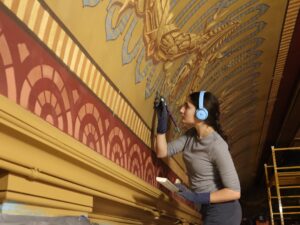
The current restoration has addressed the structural and practical needs of the building, but it has also done something less expected. In removing layers of paint and repair, it has revealed the ceiling in a condition that few anticipated—its original artwork not lost, but preserved beneath what had been added over time.
What has emerged is not simply a restored surface, but a clearer understanding of what the building has always been.
Not lost… Just waiting.
That clarity does not return the Opera House to the past. It places the past in direct conversation with the present. And it leads, inevitably, to the question that defines the building now—not how it was built, or even how it was saved, but how it will continue.
Support The Thomaston Opera House
Restoration — What It Means to See Clearly Again
The work began for the same reason most restoration does.
Because it had to.
Time does not announce itself in a building like this. It settles in gradually—through systems that age, materials that weaken, expectations that shift. For years, the Thomaston Opera House continued to function, carrying its history forward without interruption, even as the demands placed on it changed. But there comes a point when continuity alone is no longer enough.
The building had reached that point.
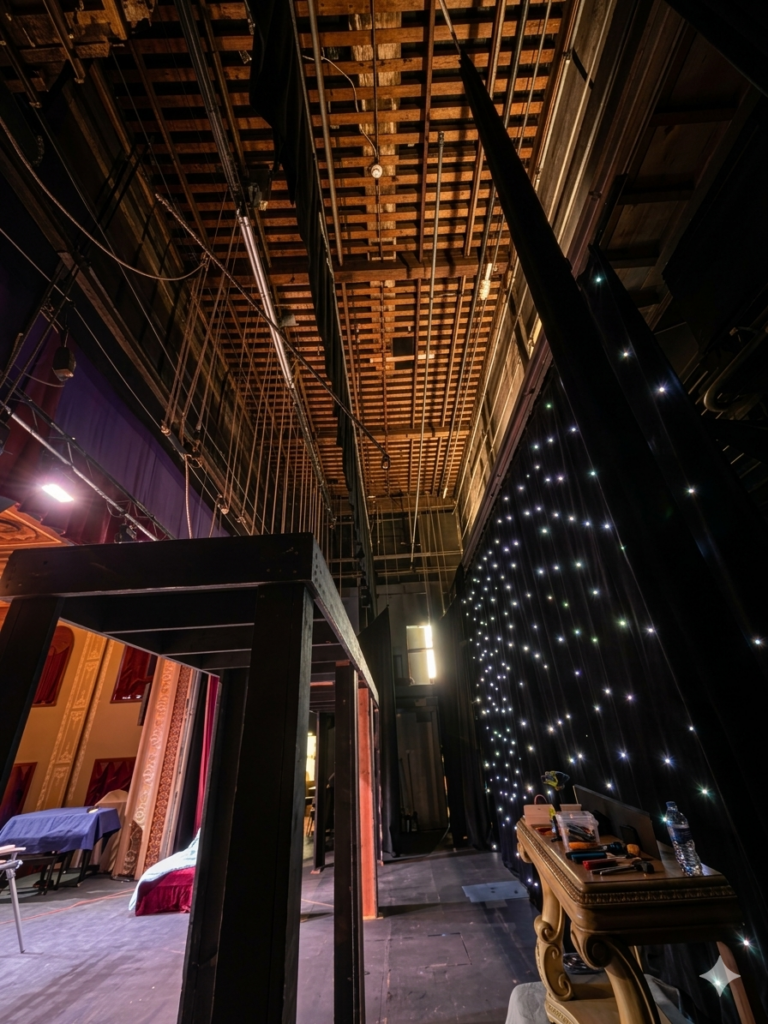
The initial focus was practical. Structural systems required attention. Accessibility needed to be addressed. Electrical, mechanical, and backstage facilities—many of them long outdated—had to be brought into alignment with what a working theater now requires. None of this was visible to an audience.
All of it was essential.It was the kind of work that determines whether a building can continue to be used at all. And then, as the work moved inward, the nature of the project began to shift.
Attention turned to the interior surfaces that defined the space—most notably the ceiling that had hovered above generations of performances, always present, but no longer fully seen. Over time, layers of paint and repair had dulled its surface. Details had softened. Colors had receded into a uniformity that suggested age more than intention.
It remained impressive. But it was no longer clear.
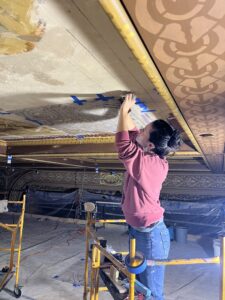
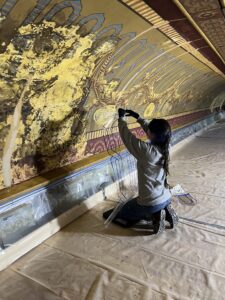
Restoring it required a different kind of discipline—one that moved slowly, deliberately, and without assumption. Each layer added over decades had to be examined and, where possible, removed by hand. The process was less about transformation than revelation. And what it revealed was unexpected.
Beneath the accumulation of time, the original work had endured. The colors returned first—subtle at first, then unmistakable. Patterns followed, re-emerging with a precision that had been hidden for decades. What had long been understood as a faded surface revealed itself instead as something remarkably intact.
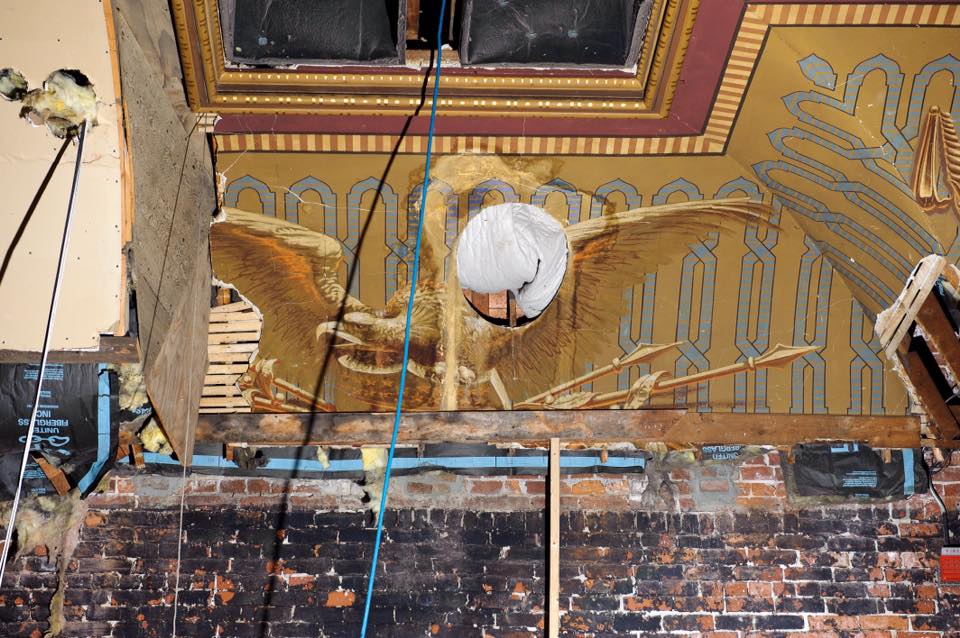
Not recreated. Recovered. It changed how the room felt.
Not dramatically. Not all at once. But in a way that made the space more legible, as if something that had been speaking quietly for years was suddenly easier to hear. That moment—the recognition that the building still contained so much of itself—altered the meaning of the project. This was no longer restoration as repair. It became restoration as understanding.
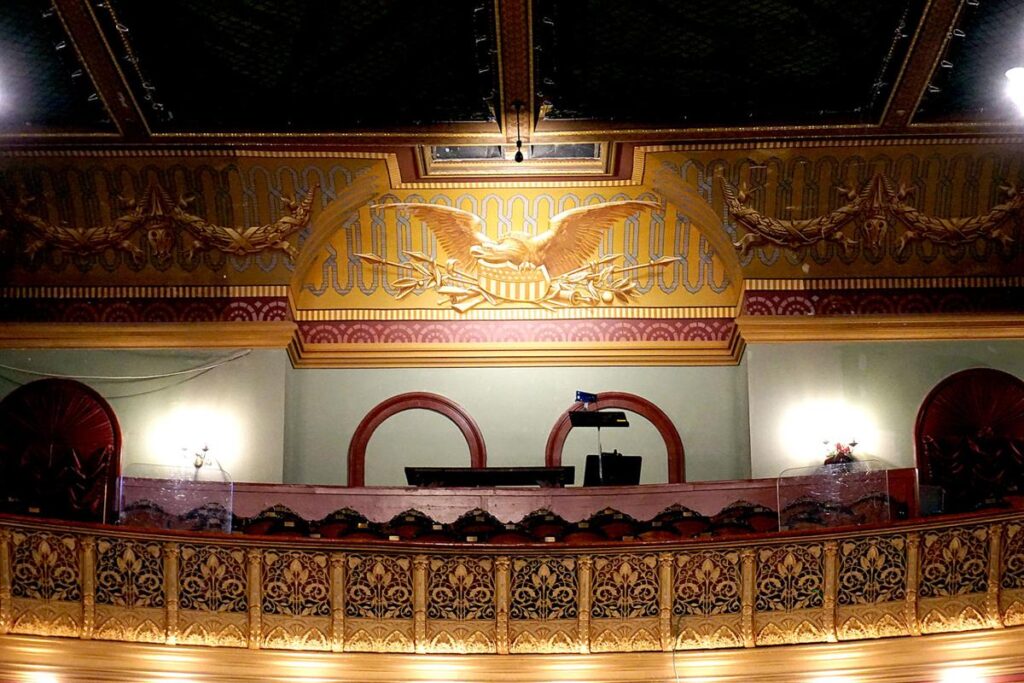
Because to uncover something is not the same as knowing what to do with it. The Opera House now presents itself with a level of clarity that invites attention, and with that attention comes responsibility. The building must be maintained, certainly, but it must also be interpreted—used in a way that acknowledges both its history and the expectations of a present that did not shape it.
Not everything uncovered is simple. Some elements carry meanings that have shifted over time, requiring not just preservation, but understanding. That balance is not fixed.
It is negotiated—continuously—through decisions that are often invisible to the audience but essential to the experience. What to preserve. What to adapt. What to leave untouched. The work does not end when the scaffolding comes down. In many ways, that is where it begins. Because the Opera House is no longer at risk of being lost in the way it once was. It has moved beyond that.
What stands now is something more demanding—a building that has been clarified, and in that clarity, asks to be sustained with the same level of care that brought it back into view. The question is no longer whether it can be saved. It is whether it will continue to be understood.
Support The Thomaston Opera House
The Interview — In Which the Building Asks
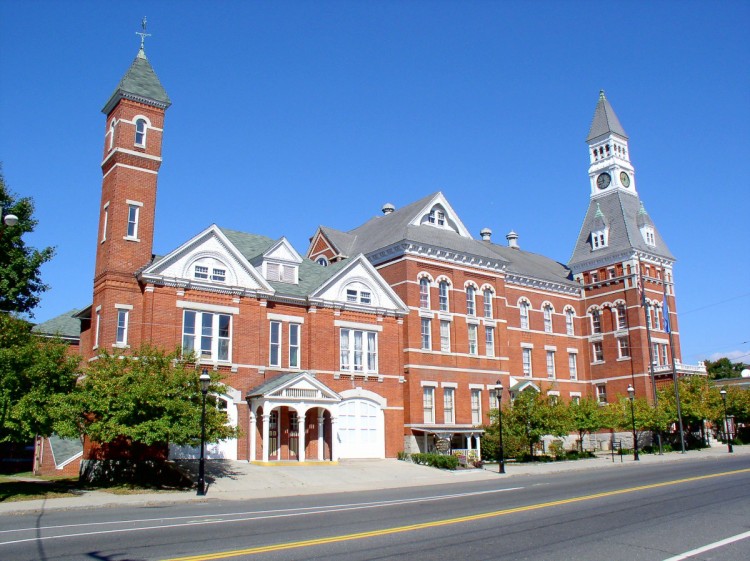
At the center of the Opera House’s present moment is Jeff Dunn, executive director of Landmark Community Theatre and the individual responsible for managing and stewarding the Thomaston Opera House on behalf of the town. His connection to the building extends back decades, long before his leadership role, and that continuity shapes how he understands the work now before him.
If the building could ask questions of its caretaker, they would not concern programming or schedules, but something more enduring—what it means to carry something forward that was never entirely yours to begin with.
On Beginnings
 Jeff Dunn first entered the Opera House as a young participant, drawn not by the idea of leadership, but by the opportunity to be involved. He learned the building from the inside—through production work, through repetition, through the quiet accumulation of experience that only comes from being present over time.
Looking back, he does not describe that early involvement as a path so much as a progression. The building, gradually, became part of his life in a way that made the transition to leadership feel less like a shift and more like a continuation.
Stewardship, as he understands it now, is defined less by control than by responsibility—the obligation to leave the building stronger than it was found, and prepared for those who will follow. That responsibility has been tested in recent years in ways that extend beyond routine management.
Talking About A Pivotal Year
Dunn points to a moment during Fiddler on the Roof when newly completed dressing rooms were used for the first time, even as construction continued around them. The work was unfinished, the conditions temporary, and the process far from simple—sets, costumes, and props moved in and out each weekend so that renovation could continue during the week—but the shift was unmistakable.
It felt, for the first time, like a return. Not to what had been. But to something that could continue.
On Challenge and Continuity
That sense of progress has been accompanied by less visible strain. For nearly two years, productions have been maintained under conditions that required constant adaptation—temporary spaces, limited access to facilities, and the dispersal of essential materials across multiple locations. While longtime patrons have remained supportive, Dunn acknowledges that the disruption has affected the broader audience, particularly those who attend less regularly.
Rebuilding that connection will take time. It always does.
What the Audience Sees—and Doesn’t
There is, however, a distinction between what is experienced and what is required to produce it. Theater, as Dunn describes it, is designed to feel complete, regardless of the complexity behind it. The audience is not meant to see the mechanics—the cost, the coordination, the adjustments made along the way. What matters is the experience as it is received. That principle extends beyond leadership.
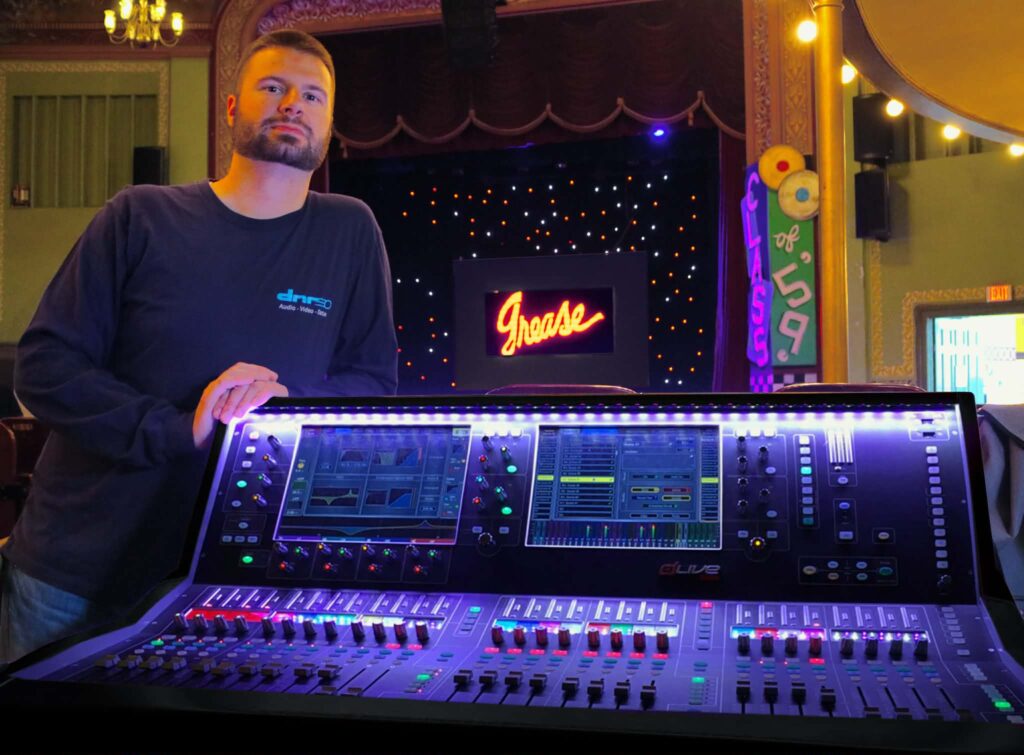
From the technical booth, Ian Jones, Technical Director, describes a parallel responsibility—one defined by what goes unnoticed.
“You wouldn’t notice the lights,” he says, “but you’d notice if they weren’t on. You wouldn’t notice the audio if it was good, but you’d notice if a microphone wasn’t working.”
It is a kind of precision that disappears when it is done well, shaping the performance without calling attention to itself.
And yet, even that level of control has its limits.
For Jones, the difference between a production that functions and one that remains with an audience begins earlier, in the structure of the work itself. “It comes down to the writing,” he explains. “If the story isn’t strong, no amount of acting or production can make up for it.”
Then, with a pause that suggests both humor and something less easily defined, he adds:
“When the ghosts are messing with me.”
The “Graveyard” Connection
The most consistent story is that the building is haunted because it was constructed over a former burial site. Historical records and local lore suggest that the 1884 structure sits on land where Thomaston residents were buried over 140 years ago. In the basement, there are even areas that highlight where these graves were reportedly located.
Notable Sightings and Reports
-
The Usher’s Account: A long-time usher (with over 23 years of service) has reported that the building is definitively haunted. Staff and performers have mentioned a general “presence” that lingers in the theater, especially when it is empty.
-
Investigative Findings: Groups like Obsidian Paranormal and the Northeast Paranormal Investigations Society have conducted formal investigations in the building. Their findings include:
-
Unexplained Noises: Disembodied voices and the sound of heavy movement when no one is in the room.
-
Shadow Figures: Brief glimpses of figures moving in the wings or the balcony area.
-
Electronic Phenomena: Anomalies captured on recording equipment that investigators attribute to the spirits of those originally buried on the site.
-
Seasonal “Graveyard Stories”
The Landmark Community Theatre frequently leans into this history during the Halloween season with their “Graveyard Stories” tours. These tours specifically take visitors into the subterranean spaces of the basement to discuss the residents who once called that plot of land their final resting place.
On Stewardship and Structure
For Dunn, that balance between what can be controlled and what cannot is built into the structure of the organization itself.
Landmark Community Theatre operates not simply as a producing entity, but under a management agreement with the town. The Opera House is a municipal building, and its care is shared. Revenue from performances contributes directly to its maintenance and restoration, aligning artistic activity with long-term preservation. The goal is not only to sustain the building as it exists.
But to prepare it for what comes next.
The Personal Connection
For Dunn, that meaning remains personal.
As a lifelong resident of Thomaston who has been connected to the Opera House since adolescence, he does not speak of it as an institution separate from the community, but as part of it. It is, in his view, one of the town’s defining spaces—a place where creativity and participation intersect in a way that is difficult to replicate.
For those working within the building, that connection is shaped not by history alone, but by repetition—by the act of returning, of participating, of seeing the space continue to function in real time.
The Pressure and Support
The demands of sustaining that function are constant. Unexpected challenges—weather, equipment failures, logistical complications—can affect performances in ways that require immediate response. In those moments, Dunn relies not only on his own experience, but on the support of staff, board members, and a wider network of individuals who contribute to the operation of the building.
The work, while led, is shared.
Looking Forward to the Future
Looking ahead, the next phase of renovations will require the same balance that has defined the current effort—planning, funding, and the ability to continue operating while improvements are made. Work on the stage and fly system, along with further restoration of the auditorium, will extend the project forward, ensuring that the Opera House remains both functional and relevant.
The challenge is not only completing that work.
But sustaining what makes it possible.
What Sustains the Work
Through it all, Dunn returns to a simpler measure of commitment.
The work remains meaningful.
The challenges, while significant, have not outweighed the value of what is being sustained. That balance—between difficulty and purpose—continues to define his involvement.
Building A Legacy
When asked how his time at the Opera House might ultimately be understood, he does not attempt to define it.
That will come later.
What matters now is ensuring that the building continues—active, relevant, and capable of carrying forward everything that has brought it to this point.
Support The Thomaston Opera House
Final Act — What Is Carried Forward
When the performance ends and the audience begins to file out, the Opera House does not empty all at once. It releases slowly. Voices linger in the aisles. Footsteps soften against the floor. There is a moment—brief, but consistent—when the building seems to hold what has just taken place before allowing it to pass.
Then, gradually, it settles. The lights dim. The stage returns to stillness. What remains is not silence exactly, but something quieter than that—a kind of suspension, as if the space is waiting, not for what comes next, but for the continuation of something already in motion.
This is where the work becomes less visible. Not the restoration. Not the performances. Not the decisions that shaped them. But the accumulation of all three—held in place by use, by repetition, by the simple fact that the building continues to be entered, occupied, and experienced.
The ceiling, now restored, no longer asks to be rediscovered. It exists again as it was intended to—present, certain, part of the room rather than apart from it. It does not demand attention. It receives it anyway. Below it, everything else continues.
The systems that keep the building functioning. The work that happens out of view. The adjustments made quietly, without recognition, so that what appears effortless can remain so. It is the kind of effort that, when successful, disappears. And yet it is what allows everything else to endure. The Opera House has reached a point where its survival is no longer uncertain in the way it once was. It has been restored, clarified, and returned to use with a level of care that ensures its presence in the present.
But survival is not the same as continuation. Continuation requires something more deliberate. It depends on the same choice, made repeatedly, across time—the decision to keep the building active, to keep it relevant, to allow it to function not as a memory, but as a place where something is still happening. That responsibility does not belong to any one individual. It extends outward—to those who manage it, to those who perform within it, to those who support it, and to those who enter it, even briefly, and recognize that it is not simply there, but there because it has been kept.
The Opera House does not conclude.
It pauses.
It waits.
And, as it has for more than a century, it relies on the next person to walk through its doors, look up, and decide—whether consciously or not—that it is worth continuing.
Because that is how buildings like this endure.
Not by standing still.
But by being carried forward.
The Thomaston Opera House continues its story through live performances and community support. Click below for tickets to the 2026 season, including upcoming concerts and productions.
Upcoming Shows 2026 Concert Series
Support The Thomaston Opera House
Recent Improvements to the Thomaston Opera House


Gallery Photo Credit Steve Schappert
Enoy the story? Leave a comment or share below
Article Written and sponsored by Steve Schappert