
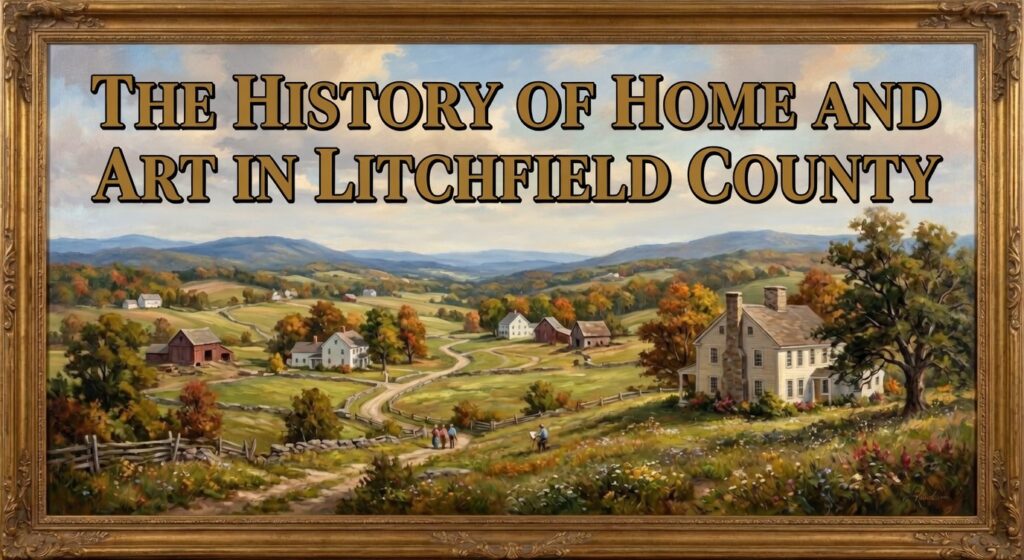
This article is a work in progress, we will be adding a list of Litchfield Art Galleries soon, so come on back.
Section I: The Primordial Foundation (Pre-1719)
The Land as the Primary Client
Before the first surveyor’s stake was driven into the rocky soil of the Northwest Hills, the topography of Litchfield County had already spent 450 million years auditioning for its role as a sanctuary. The history of the “Home” in this region does not begin with the colonial saltbox or the federal mansion; it begins with the Gneiss and Schist (stone) of the Appalachian orogeny. To understand the art and architecture of Litchfield, one must first understand the “Client”—the land itself.
The geography of the region, established by the retreating glaciers of the Wisconsin Ice Age, carved the deep valleys of the Housatonic, Naugatuck, and Shepaug rivers. This rugged, high-altitude plateau dictated a habitation style rooted in resilience and an intimate understanding of thermal mass.
The Templeton Site: 11,000 Years of Residence
In the town of Washington, hidden beneath layers of alluvial soil, lies the Templeton Site. Discovered in the late 1970s, this archaeological landmark is one of the oldest paleo-Indian sites in North America, dating back approximately 10,190 years.
The residents of the Templeton Site were the county’s first “Master Builders.” While they did not leave behind stone foundations, they left behind the “Art of the Tool.” Excavations revealed sophisticated flint-knapping areas where artisans crafted fluted points from chert and jasper. These were not merely survival implements; they were the first examples of Litchfield “Industrial Design”—precision-engineered instruments balanced for flight and impact.
The homes of these earliest residents were temporary but technically brilliant. Utilizing saplings cleared from the riverbanks, they constructed light-frame dwellings covered in skins or bark. These structures were the ancestors of the “Vertical Modular” concept—pre-fabricated by nature, easily assembled, and entirely carbon-neutral.
The Indigenous Blueprint: Schaghticoke and Paugussett Engineering
By the time the first European explorers trickled into the “Green Woods,” the Schaghticoke and Paugussett peoples had perfected the “Seasonal Home.” Their architecture was a direct response to the Litchfield micro-climate—bitterly cold winters on the ridges and humid, fertile summers in the valleys.
The Wetu (Wigwam)
The Wetu was a masterpiece of tension-based engineering. Unlike the rigid, heavy timber frames that would follow, the Wetu utilized the flexibility of young trees.
-
Framework: Cedar or maple saplings were driven into the ground in a circle, then bent inward and lashed together at the top to create a dome.
-
Skin: The exterior was clad in large sheets of chestnut or birch bark, or woven mats of cattail.
-
Thermal Logic: The curved shape allowed for maximum wind resistance on exposed hillsides, while a central hearth provided radiant heat that was trapped efficiently by the low, aerodynamic ceiling.
This was “Passive House” technology in its rawest form. The materials were sourced within a “zero-mile” radius, and the structure could be returned to the earth without leaving a trace—the ultimate expression of sustainable development.
The Art of the Vessel: Woodsplint Basketry
As the “Home” was being engineered for mobility, the “Art” of the region was taking the form of the Woodsplint Basket. For the indigenous people of the Housatonic Valley, a basket was not just a container; it was a structural vessel that mirrored the architecture of their dwellings.
The Schaghticoke became world-renowned for their woodsplint artistry. Utilizing the abundant black ash and white oak, they developed the “Ear Handle” and “Square-to-Round” weaving techniques.
-
The Material Science: To create the splints, a log was hammered until the growth rings separated. This was a sophisticated understanding of wood fiber and cellular structure—the same type of material intelligence that would later drive the lutherie and aerospace industries in the county.
-
The Aesthetic: These baskets often featured hand-painted “swash” designs or potato-stamp patterns. This was the birth of Litchfield Decorative Arts—the moment where functional objects were elevated to gallery-grade expressions of identity.
The “Revealed” Architecture
The indigenous philosophy of home was one of “Reveal, not Impose.” They did not seek to flatten the Litchfield hills; they sought the ridges that offered the best lookout (HBU: Security) and the valleys that offered the best soil (HBU: Production).
When the colonial settlers arrived in the early 1700s, they found a landscape that had already been “curated” by ten millennia of human intelligence. The clearings, the trails (which would become Route 7 and Route 202), and the strategic dwelling sites were already established. The colonial “Master Joiners” didn’t start from scratch; they simply built a new layer of “Playable Art” upon a primordial foundation that was already perfect.
Summary of the Primordial Era
The Pre-1719 era established the three pillars that define Litchfield County to this day:
-
Material Intelligence: An obsession with the properties of wood and stone.
-
Climate Resiliency: Building homes that can withstand the “Northwest Corner” winters.
-
Portable Art: Creating objects (from fluted points to baskets) that are as beautiful as they are functional.
As we move into the 18th century, we see these indigenous concepts of “Tension and Frame” evolve into the rigid, prestigious structures of the Colonial and Revolutionary era. The sapling dome of the Wetu would give way to the hand-hewn oak of the Federal mansion, but the spirit of Litchfield—the sanctuary of the innovative mind—remained unchanged.
To experience the current culinary evolution grown directly from this ancient glacial soil, explore our curated portfolio of the premier Litchfield County Connecticut Restaurants transforming local agricultural craft into fine dining.
Section II: The Architects of Law & Liberty (1700s–1830)
The Construction of a National Identity
By the mid-18th century, Litchfield County had transitioned from a frontier outpost into the intellectual and legal “Engine Room” of a fledgling nation. If the first section was about the land as a client, this era was about the Home as a Institution. In Litchfield, the domestic structure evolved; it was no longer just a shelter for the family, but a vessel for the law, a headquarters for revolutionary espionage, and a factory for the American leadership class.
The architecture of this period reflects a shift toward New England Classicism. The rugged flexibility of the indigenous Wetu was replaced by the rigid, hand-hewn oak and chestnut frames of the Colonial and Federal styles. These homes were designed to project stability, wealth, and intellectual rigor.
Tapping Reeve and the Law School: The Home as Classroom
The most significant “Highest and Best Use” of a residential structure in American history occurred in 1784 at the home of Tapping Reeve. A young lawyer who moved to Litchfield in 1772, Reeve began teaching legal theory to his brother-in-law, Aaron Burr, in his front parlor. As more students arrived, the demand outpaced the living room, leading Reeve to construct a small, unassuming one-room building on his property.
This was the Litchfield Law School, the first of its kind in the United States. Its architectural simplicity belied its massive cultural impact. Inside this modest structure, Reeve and his colleague James Gould engineered the legal minds that would govern the country. The “Art” being produced here was the interpretation of the Constitution. The school’s “Alumni” list is a staggering testament to Litchfield’s influence:
-
Two U.S. Vice Presidents (Aaron Burr and John C. Calhoun).
-
101 U.S. Congressmen and 28 U.S. Senators.
-
Six U.S. Cabinet members and three U.S. Supreme Court Justices.
-
14 State Governors and 13 State Chief Justices.
The Reeve house remains a masterclass in Colonial symmetry, featuring a central hallway that mirrors the balanced, logical structure of the law itself.
The Master Joiners: William Sprats and the Federal Aesthetic
As the law was being codified, the physical landscape of Litchfield was being “Master Joined.” The late 1700s saw the arrival of William Sprats, a master joiner and British prisoner of war who chose to stay in Connecticut. Sprats brought a level of sophistication to Litchfield architecture that rivaled the great estates of Europe.
He is credited with the “Federalization” of Litchfield, particularly on North and South Streets. His work featured high-style elements:
-
Palladian Windows: Adding a rhythmic, mathematical beauty to the facades.
-
Ornate Porticos: Transforming a simple entrance into a statement of prestige.
-
Dentil Molding: Fine, tooth-like detailing along the cornices that required the same “vibration-free” precision later sought by Litchfield’s guitar makers.
The Sheldon Tavern and the Deming House stand as monuments to this era—structures where the “Art” was the building itself, and the “Home” was a curated gallery of joinery and masonry.
The Culper Spy Ring: Benjamin Tallmadge and Secret Architecture
While Tapping Reeve taught the law, Benjamin Tallmadge practiced the high art of Revolutionary intelligence. A resident of Litchfield and a major in the Continental Army, Tallmadge was the mastermind behind the Culper Spy Ring, reporting directly to George Washington.
The Tallmadge home on North Street was more than a residence; it was a node in a secret network. Intelligence gathered from British-occupied New York was funneled through Litchfield’s ridges and valleys. The “Highest and Best Use” of the Tallmadge estate was as a fortress of information. The same privacy that modern celebrities like Meryl Streep and Daniel Day-Lewis seek today was utilized by Tallmadge to manage a web of spies that effectively won the war of information against the British Crown.
The Wolcott Dynasty: The Political Architects
No discussion of Litchfield’s Revolutionary era is complete without the Wolcott family.
-
Oliver Wolcott Sr.: A physician and sheriff who became a signer of the Declaration of Independence. His home was the site where a lead statue of King George III, pulled down in New York City, was brought to be melted down into 42,000 bullets for the Continental Army. This turned the domestic “Home” into a literal munitions factory—an early example of the county’s industrial pivot.
-
Oliver Wolcott Jr.: Born in Litchfield, he followed in the intellectual footsteps of his father, serving as the second U.S. Secretary of the Treasury, succeeding Alexander Hamilton.
Sarah Pierce: Engineering the Female Mind
While Tapping Reeve focused on legal training for men, Sarah Pierce was revolutionizing the “Art of Education” for women. In 1792, she founded the Litchfield Female Academy, a pioneering institution that treated the female intellect as equal to the male. Over its history, the school educated more than 3,000 women—including the Beecher sisters—equipping them to lead the moral and social shifts of the 1800s.
Pierce’s curriculum was a unique blend of rigorous academic study and creative expression:
-
Structural Thinking: Students engaged in history, geography, and logic, mirroring the rigorous academic standards of the boys’ legal studies.
-
The Art of Rebellion: Beyond simple embroidery, students produced intricate, symbolic needlework and watercolors. These served as early “multimedia” expressions, often carrying coded messages of education and independence.
-
Social Joinery: Pierce understood that the home was the center of the American republic; by educating the women who managed them, she was strengthening the social fabric of the entire country.
Through this balance of rigorous logic and symbolic art, Sarah Pierce ensured that Litchfield’s women were not just educated, but structurally prepared to become the primary chroniclers and reformers of their era.
By 1830, Litchfield had established itself as the Intellectual Capital of Connecticut. The “Home” was no longer just a shelter; it was a Classroom, a Munitions Factory, a Spy Hub, and a Legal Think-Tank.
The “Art” of this period was the Art of Governance and Reform. The physical structures—the white-clapboard Federal and Colonial mansions that still line the streets today—were the shells that protected these world-changing ideas. As we move into the 19th century, this fiery intellectual energy would ignite the next great Litchfield revolution: the fight for the soul of humanity through the Abolitionist movement.
Section III: The Moral Compass: Reformers & Abolitionists (1800s)
The Furnace of Social Reform
As the 19th century progressed, the intellectual rigor of the Litchfield Law School evolved into a powerful moral movement. Litchfield County was no longer just building the legal framework of the United States; it was now challenging the nation’s conscience. This era was defined by a transition from “Law” to “Justice,” and the “Home” became a furnace where the fires of the abolitionist and temperance movements were stoked.
The architecture of this period maintained its stately Federal and Greek Revival bones, but the life within those walls became increasingly radical. The “Highest and Best Use” of the Litchfield pulpit and parlor was the dismantling of systemic oppression.
The Beecher Dynasty: A Factory of Ideas
At the center of this moral revolution was the Beecher family. Led by the patriarch Lyman Beecher, the Congregational pastor of Litchfield from 1810 to 1826, the family turned their home into a 24-hour incubator for social change. Lyman was a fierce orator, but his children would go on to become global icons of reform.
-
Harriet Beecher Stowe: Born in Litchfield in 1811, Harriet’s childhood was spent in an atmosphere of constant theological and social debate. The “Art” she produced, Uncle Tom’s Cabin, was arguably the most influential book of the century. It didn’t just tell a story; it utilized a “narrative architecture” to expose the structural horrors of slavery. President Abraham Lincoln would later famously refer to her as “the little woman who wrote the book that started this great war.”
-
Henry Ward Beecher: Also born in Litchfield, Henry became the most famous preacher in America. His “Plymouth Church” in Brooklyn was a hub for the Underground Railroad, but his oratorical style—bold, emotional, and deeply moral—was forged in the quiet, disciplined hills of Litchfield.
-
Catharine Beecher: A pioneer in “Domestic Science,” Catharine sought to engineer the home as a place of efficiency and health. She viewed the design of the American home as a tool for the elevation of women, advocating for standardized kitchens and ventilation long before modern building codes existed.
The Abolitionist Underground: Architecture as Shield
Litchfield County’s geography—its deep woods and high ridges—made it a natural sanctuary for the Underground Railroad. While documented records are sparse by necessity, the local oral history and physical evidence in older homes (hidden “priest holes” or double basements) suggest that the “Home” in Litchfield often served a dual purpose: a public face of New England respectability and a private sanctuary for those seeking freedom.
In towns like Winchester and Torrington, the abolitionist sentiment was so high that it influenced local industry. This was a period where “Ethical Consumption” began to take root; the county’s mills and workshops were increasingly viewed through a lens of moral HBU—is the labor used to build this home or produce this wool free?
The Architecture of the Spirit: The Greek Revival
Visually, this era was marked by the rise of the Greek Revival style. Inspired by the birth of democracy in ancient Greece, Litchfield residents began adding massive columns and pediments to their homes and churches. This was “Moral Architecture”—a physical statement that Litchfield was a pillar of democratic and human rights.
The Litchfield First Congregational Church, with its soaring white spire and monumental proportions, became the visual anchor of this movement. It was here that Lyman Beecher delivered his “Six Sermons on Intemperance,” proving that the “Art of the Spoken Word” was Litchfield’s most potent weapon.
Summary of the Reform Era
By 1860, Litchfield County had completed its transformation into the Moral Compass of the North. The “Home” was the site of the Beecher family’s radical upbringing; the “Art” was Harriet Beecher Stowe’s world-changing prose; and the “Highest and Best Use” of the land was as a staging ground for the Civil War’s intellectual and moral battles.
As the smoke of the Civil War cleared, the county would pivot once again—moving from the heavy weight of social reform to the lighter, more refined pursuit of the “Summer Retreat” and the “Gilded Age” of architecture.
Section IV: The Gilded Retreat & The Industrial Pivot (1870–1930)
The Architecture of Leisure and the Iron Pulse
Following the Civil War, Litchfield County experienced a profound shift in its “Highest and Best Use.” The fiery, reformist energy of the Beecher era gave way to a more refined—but equally transformative—period of aesthetic and industrial expansion. This was the era of the Summer Cottage, where the “Home” was reimagined as a sophisticated escape for the New York elite, and the “Art” moved into the landscape itself through the birth of professional garden design.
Simultaneously, the county’s river valleys were vibrating with the pulse of the Industrial Revolution. While the ridges were being settled by titans of finance, the valleys were being engineered by titans of brass and iron.
The Rise of the “Summer Cottage”
By the late 1800s, the Litchfield Hills had become the premier destination for the “Gilded Age” escape. Proximity to New York City via the newly expanded railroad lines allowed industrial magnates to trade the stifling heat of Manhattan for the “Litchfield Light.”
This era saw the arrival of the nation’s most prestigious architectural firms, most notably McKim, Mead & White. They moved away from the rigid Colonial symmetry of the 1700s, embracing the Shingle Style and Colonial Revival. These homes were characterized by:
-
Asymmetry: Wide, sweeping porches and irregular rooflines that mirrored the rolling terrain.
-
Textural Depth: The use of cedar shingles and local fieldstone to “root” the house in the earth.
-
Great Halls: The interior shifted from small, compartmentalized rooms to massive, open living spaces designed for grand entertaining—the original “luxury open floor plan.”
Beatrix Farrand: The Art of the Garden
As the homes grew grander, the art of Litchfield moved outdoors. Beatrix Farrand, the only female founding member of the American Society of Landscape Architects, redefined the “Home” by treating the land as an outdoor room.
Farrand’s work in Litchfield, particularly at estates like Promisek (Three Rivers Farm), utilized “Architectural Horticulture.” She didn’t just plant flowers; she engineered views. Her designs utilized native stone walls to create transitions between the “Wild” Litchfield woods and the “Cultivated” domestic space. This was the birth of the Litchfield Garden Aesthetic—a philosophy that the “Art” of a property is found in the way the sunlight hits a specific terrace at 4:00 PM.
The Industrial Pivot: Brass, Iron, and Precision
While the ridges of Washington and Litchfield were being manicured, the valleys of Torrington, Winsted, and Thomaston were becoming the “Silicon Valley” of the 19th century.
-
Seth Thomas (Thomaston): The “Art of Time” was perfected here. Thomas didn’t just build clocks; he engineered the synchronization of American life. The “Home” in this era was increasingly defined by the presence of a Litchfield-made clock on the mantel—a piece of “Mechanical Art” that projected reliability.
-
The Iron & Brass Boom: The Salisbury iron mines and the Naugatuck Valley brass mills provided the raw materials for the American Industrial Revolution. This required a specific type of Material Intelligence—the ability to understand the vibration and thermal properties of metals. This industrial “backbone” laid the groundwork for the aerospace and luthier breakthroughs that would follow a century later.
The Shingle Style and the Artistic Colony
Toward the end of this period, Litchfield began to attract a different kind of resident: the professional artist. The Shingle Style homes, with their vast windows and north-facing light, were perfect for studios.
Artists like Adelaide Deming and photographers like Nell Dorr began to document the “Litchfield Renaissance.” They saw that the “Highest and Best Use” of the county was its ability to inspire. The “Home” was no longer just a legal classroom or a moral furnace; it was now a Studio.
The Litchfield Historical Society (1856)
Recognizing that they were living through a period of immense change, the residents founded the Litchfield Historical Society. This was a pivotal moment for the “Art” of the county—the act of Preservation. By documenting their own history, they turned the entire town into a living museum, ensuring that the “Primordial Foundation” and the “Revolutionary Spirit” would never be lost to the march of industrialization.
Litchfield County: The Home and Art of Cheese
The Dairy Renaissance: From Farmhouse to Fine Dining. Long before Litchfield County became a retreat for the arts, it was defined by the labor of the dairy farm. In the 19th century, the region was the heart of Connecticut’s cheese production. The rugged, high-altitude plateau and deep river valleys—carved by retreating glaciers—dictated a lifestyle of resilience and a deep connection to the earth.
The local pride was once found in the rhythmic churn of farmhouse kitchens, where artisanal cheese was a staple of New England identity. As industrialization pushed toward mass production, this heritage began to slip away, nearly becoming a lost art. In the 19th century, Goshen, Connecticut, became famous as the birthplace of pineapple cheese, a hard, pungent variety molded into the shape of a pineapple to signify hospitality and luxury. This local innovation became a prized export, proving that the region’s agricultural craft could produce an internationally recognized status symbol long before it became a sanctuary for modern media and design.
Arethusa Farm: Restoring the Legacy
Today, Arethusa Farm is leading the charge to restore that original sense of pride. By returning to the roots of the landscape, they have revived the art of the dairy with a focus on “Greatness before Goodness.” Their award-winning cheeses have reclaimed the county’s reputation for world-class craftsmanship, proving that the region’s agricultural heritage is just as vital as its architectural or media influence.
Summary of the Gilded Era
By 1930, Litchfield County had mastered the balance between Industry and Artistry. It was a place where you could build a brass empire in the valley and retreat to a shingle-style sanctuary on the hill. The “Home” had become a masterpiece of leisure engineering, and the “Art” had expanded to include the very trees and stones of the landscape.
But the most radical architectural shift was still to come. As the world moved toward the mid-20th century, the “Harvard Five” would arrive, stripping away the shingles and columns to reveal the glass and steel of the Modernist Revolution.
The industrial mechanization of the Naugatuck Valley didn’t simply produce historic mantel clocks; it laid the foundation for modern cultural gathering points. Today, that precise manufacturing legacy is celebrated in spaces like Clocktown Brewing Company, where architectural preservation meets regional community curation.
Section V: The Modernist Laboratory (1940–1975)
The Glass and Granite Revolution
In the decades following the Great Depression, Litchfield County became the site of one of the most radical architectural experiments in human history. While the center of Litchfield proper remained a sanctuary for Colonial and Federal preservation, the rugged ridges of towns like Litchfield, Washington, and Roxbury became a laboratory for the “Harvard Five”—a group of architects including Marcel Breuer, Philip Johnson, John Johansen, Landis Gores, and Eliot Noyes.
These men brought the International Style from the Bauhaus in Germany to the hills of Connecticut. Their philosophy was a complete inversion of the Gilded Age: they sought to strip away the “ornament” of the Shingle Style and replace it with a “Highest and Best Use” of transparency, geometry, and raw material.
Breaking the Box: The Architecture of Transparency
The Modernists viewed the traditional Litchfield home—with its small windows and thick walls—as a “cage.” They wanted to turn the “Home” into a lens. Utilizing the massive advancement in industrial plate glass (a byproduct of the regional glass and metal industries), they created homes that seemed to disappear into the woods.
-
The Stillman Houses (Litchfield): Designed by Marcel Breuer for Rufus and Leslie Stillman, these three houses are monuments to the Modernist movement. Breuer utilized “Binuclear” plans—separating the sleeping quarters from the living areas with a central entry—and used massive floor-to-ceiling glass walls.
-
The Material Palette: The Modernists didn’t abandon the land; they repositioned it. They used local Litchfield granite for massive, sculptural fireplaces, but contrasted it with white-painted wood and steel beams. This was the “Art of the Contrast”—the heavy vs. the light, the opaque vs. the transparent.
Alexander Calder: The Architecture of Motion
During this same period, the “Art” of Litchfield took a mechanical leap forward. Alexander Calder moved to a farmhouse in Roxbury in 1933 and transformed his workshop into a site of global artistic revolution.
Calder, a trained mechanical engineer, utilized his “Material Intelligence” to invent the Mobile.
-
The Engineering: By using wire, sheet metal, and precise balance points, Calder created sculptures that moved with the wind. This was the first time “Architecture” and “Art” were truly dynamic.
-
The Roxbury Studio: His studio was an extension of his work—a high-ceilinged, light-filled space where heavy steel plates were transformed into weightless, floating shapes. Calder proved that the HBU of a Litchfield farm could be the production of “Engineered Motion.”
The Huvelle and Gagarin Houses
The Modernist movement in Litchfield was not a monolithic style; it was an exploration of how humans relate to the forest.
-
The Huvelle House (John Johansen): A “bridge” house that utilized a structural system of steel and glass to float over a ravine.
-
The Gagarin House (Breuer): A massive stone-and-glass structure that felt like a natural outcropping of the hill.
These architects were the first to treat the “Litchfield Light” as a building material. They understood that the way the sun tracked across the hills was the most important “Art” a home could provide. By using deep overhangs and specific orientations, they engineered homes that stayed cool in the summer and warm in the winter without the need for the heavy, energy-inefficient structures of the past.
The Great Intellectual Migration
The arrival of the Modernists was part of a larger migration of the “Global Intelligentsia” to the county. As Europe became unstable in the late 1930s, Litchfield became a sanctuary for thinkers, designers, and artists who were fleeing conflict.
This era cemented the county’s reputation as a “Fortress of Creativity.” It was a place where you could build a house that looked like a spaceship in the middle of a colonial forest and be celebrated for it. This tolerance for radical design laid the groundwork for the next era of Litchfield’s history: the arrival of the “Total Artists” who would bridge the gap between sculpture, music, and the media.
Summary of the Modernist Era
By 1975, Litchfield County possessed the most diverse architectural portfolio in New England. You could walk from a 1784 Law School to a 1950 Breuer glass house in a single afternoon. The “Home” had become a Laboratory, and the “Art” had become Kinetic.
This period taught the county that “High Performance” didn’t just mean efficiency—it meant a spiritual connection between the occupant and the environment. As the 20th century drew to a close, this connection would be explored even further by a new generation of sculptors who would return to the “Primordial Foundation” of stone and bronze.
To map out an physical exploration of these pristine, forested modernist ridges, view our seasonal master blueprint for the ultimate Food & Foliage Road Trip, tracking the historic winding routes connecting these architectural landmarks.
Section VI: The Sculptor’s Ridge: Fluidity in Bronze
Engineering the Impossible Motion
As the Modernist movement proved that the “Home” could be a transparent lens, a parallel revolution was occurring in the studios tucked away on the county’s high ridges. This era saw Litchfield County solidify its status as the world’s premier center for Monumental Sculpture. While Alexander Calder had introduced the “Architecture of Motion” through wire and sheet metal, a new generation of artists began to push the “Material Intelligence” of the region back into the realm of heavy metal and stone—specifically, the fluid mastery of bronze.
In the hills of Roxbury, Cornwall, and Washington, the development of the land shifted toward the creation of three-dimensional landmarks that challenged the very laws of physics. This evolution moved the region beyond its agricultural and industrial roots, transforming the rugged terrain into a canvas for avant-garde structural expression.
Sterrett Kelsey: The Master of Fluid Bronze
If any artist embodies the transition from the “Mechanical Art” of the industrial era to the “Fine Art” of the modern era, it is Sterrett Kelsey. Based in the Cornwall/Roxbury area, Kelsey is recognized globally as the leading sculptor of the dance. Her work represents the pinnacle of “Structural Art” in the county.
-
The Physics of Grace: Kelsey’s bronze ballets are not static figures; they are studies in Kinetic Energy. Using a “lost-wax” casting process that requires immense technical precision, she captures the exact moment of a dancer’s “ballon”—the appearance of weightlessness.
-
The Material Paradox: Bronze is inherently heavy, industrial, and rigid. Kelsey’s “Art” lies in her ability to make this metal behave like silk or muscle in motion. This mirrors the Litchfield engineering tradition: taking a raw, stubborn material (like the iron from the Salisbury mines) and refining it into something of supreme elegance.
In the hills of Roxbury, Cornwall, and Washington, the landscape evolved into a setting for three-dimensional landmarks that challenged the laws of physics. This transformation moved the region beyond its industrial roots, using the rugged terrain as a canvas for avant-garde structural expression.
Alexander Calder’s Roxbury Legacy
Though his mobiles were discussed in the Modernist section, Calder’s Stabiles—his massive, stationary floor sculptures—are the architectural anchors of the Roxbury ridge.
-
Engineering as Art: Calder didn’t just sculpt; he fabricated. He used the same riveting and bolting techniques found in the county’s bridge-building history to create “Red Serpent” and other monumental works.
-
The Studio as Factory: His Roxbury property wasn’t just a home; it was a production facility that bridged the gap between a blacksmith’s shop and a fine art gallery.
The Environmental Gallery: Art as Land Management
The late 20th century saw a trend where the “Home” and “Gallery” became indistinguishable. Collectors and artists began utilizing the expansive acreage of Litchfield County to create Sculpture Parks.
-
James Barron Art (Kent): This space exemplifies the “Landscape as Canvas” philosophy. By placing contemporary sculpture in a 40-acre meadow, the art becomes a part of the local ecology. The “HBU” of the meadow is no longer just for hay or livestock, but for the intellectual stimulation of the public.
-
The Bunny Williams/John Rosselli Influence: In Falls Village, the legendary interior designer and her husband have created a landscape where classical sculpture and architectural follies act as “punctuation marks” for the garden. This is the “Art of the Vista”—using man-made forms to highlight the natural beauty of the Berkshires.
The American Mural Project (Winsted)
In the northern reaches of the county, the “Art” took a turn toward the monumental and the collaborative. Founded by artist Ellen Griesedieck, the American Mural Project (AMP) is housed in a former hosiery mill.
-
The Scale: At 120 feet long and five stories high, it is the largest indoor collaborative artwork in the world.
-
The Subject: It celebrates the American worker—the very people who built the brass mills of Torrington and the clocks of Thomaston.
-
The Architecture: The building itself is a piece of “Playable Art,” with a massive internal steel structure required to support the three-dimensional mural pieces made of honeycomb plastic, marble, and ceramic.
The Litchfield “Maker” Tradition
This era of sculpture reinforced the idea that Litchfield County is a place of Making. Whether it was the indigenous basket weavers, the colonial joiners, or modern bronze sculptors like Kelsey, the thread remains the same: a deep respect for the physical properties of the earth. The “Sculptor’s Ridge” is not just a geographic location; it is a mindset where the “Home” is a place of labor, and the “Art” is a testament to human endurance and grace.
Summary of the Sculptural Era
By the 1980s, Litchfield County was an open-air museum. The “Home” had evolved into a sanctuary for both the creator and the creation. But while the visual artists were mastering the “Vibration of Light” on bronze and stone, a new group of engineers was preparing to master the Vibration of Sound.
As we move into the next section, we transition from the silent motion of the mobile to the high-decibel revolution of the “Musical Engineers” and the aerospace math that taught the world how to hear the Litchfield Hills.
Section VII: The Musical Engineers & Design Artists
The Aerospace DNA of the Litchfield Sound
If Section VI was about the silent motion of sculpture, Section VII is about the audible physics of the Northwest Corner. In the mid-20th century, Litchfield County became the unlikely epicenter of a revolution that married the “Vibration Intelligence” of the Cold War aerospace industry with the “Art of the Luthier.” This era proved that the “Highest and Best Use” of local engineering was not just for national defense, but for the global stage.
The geography of this revolution was centered in New Hartford, Canton, and Plymouth—a “Golden Triangle” where the precision of helicopter rotor blades met the craftsmanship of acoustic and electric guitars.
The Kaman Revolution: From Rotors to Roundbacks
The story of the “Litchfield Sound” begins with Charles Kaman, a visionary aeronautical engineer who founded Kaman Aircraft in Bloomfield. Kaman was a man of two worlds: an expert in intermeshing rotors and an accomplished guitarist. In 1964, facing a decline in the defense market, Kaman tasked his aerospace engineers with a radical goal: build a better guitar using helicopter math.
-
Lyrachord and the Bowl: Traditional guitars used flat wooden backs, which were prone to feedback and structural instability. Kaman’s engineers utilized Lyrachord—a patented composite material used in helicopter nose cones and rotor blades. They engineered a semi-parabolic “roundback” design that eliminated “standing waves” inside the instrument.
-
Vibration Intelligence: The same scientific principles used to keep a K-MAX helicopter from shaking itself apart were applied to the Ovation Guitar. By mastering the “Vibration Intelligence” of the instrument’s top, Kaman created a guitar that could be amplified at stadium volumes with crystal clarity.
From the factory on the banks of the Farmington River in New Hartford, Ovation changed the look and sound of music for icons like Glen Campbell, Paul Simon, and Melissa Etheridge.
Robert “Bob” Jones served as the key link between Kaman Aircraft and Ovation Guitars. Working from the New Hartford development floor, he adapted aerospace harmonic research—originally developed for helicopter rotor blades—into guitar resonance. By repurposing advanced composites like Lyrachord as high-performance resonators, Jones built the “Art of Music” on structural science, transforming Litchfield County into a global hub for premium instrument manufacturing. No surprise, his retired pharmaceutical scientist son Randy is a photographic artist in Plymouth CT.
Hamer Guitars and the New Hartford Migration (1997)
The regional reputation for elite lutherie was so strong that it drew other legendary brands to the hills. Hamer Guitars, founded in Illinois by Jol Dantzig and Paul Hamer, moved its production to the New Hartford facility after being acquired by Kaman.
-
The Boutique Standard: Under Dantzig’s technical direction, the New Hartford plant became a “Master Joiner” workshop for electric guitars. They produced instruments for Cheap Trick (Rick Nielsen’s multi-necks) and Def Leppard, utilizing the same high-standard “Playable Art” philosophy that defined the earlier Robert Kantor era.
-
Jol Dantzig (Canton): After Hamer, Dantzig maintained his studio in the Canton area, continuing the tradition of the “Independent Luthier.” His work focuses on the “Highest and Best Use” of rare tonewoods and custom electronics, proving that the luthier’s art is a permanent fixture of the county’s creative DNA.
A Pioneer of Guitar Art:
Robert Kantor transformed the guitar from a functional tool into an investment-grade masterpiece, leading the “Playable Art” movement. By fusing high-performance components with Swarovski crystals and gallery-worthy finishes, he redefined the instrument as a legitimate medium for fine art.
Based in a Litchfield cottage from 2004 to 2020, Kantor’s work attracted an elite global clientele, including Keith Richards, Eric Clapton, Bo Diddley, and John Mayer. His tenure solidified the Northwest Corner’s reputation for luxury craftsmanship, merging technical precision with a modern, high-art aesthetic.
Summary of the Musical Engineering Era
By the end of the 20th century, Litchfield County had proven that Art and Science are two sides of the same coin. The “Home” was where engineers like Bob Jones analyzed resonance; the “Art” was the Ovation or Hamer guitar on the global concert stage; and the regional development shifted toward a transition of its industrial past into a new era of acoustic and electric excellence.
As the “vibrations” of the guitar strings settled, the county prepared for its next role: a sanctuary for the world’s most famous performers and storytellers, who sought the same quiet, engineered perfection that the luthiers had mastered.
Section VIII: The Sanctuary: Stage, Screen & The Code of Silence
The Fortress of High-Profile Privacy
If the previous sections detailed how Litchfield County engineered the tools of law, reform, and sound, Section VIII explores the county’s evolution into a cultural sanctuary. By the late 20th century, the region’s reputation for technical precision had taken on a new, social dimension. For the titans of stage and screen, Litchfield offered a specific type of resonance: a frequency of quietude and an unwritten “Code of Silence” among its residents.
The architecture of this era is defined by the Fortress Home—not in the sense of walls and gates, but in the sense of psychological distance and environmental integration. The “Art” being produced here was no longer just physical; it was the art of the performance, cultivated in the absolute privacy of the Northwest Corner.
The Roxbury Colony: Miller, Monroe, and the Dramatic Anchor
The precedent for the modern celebrity sanctuary was set in Roxbury during the 1950s. The union of playwright Arthur Miller and Marilyn Monroe brought global eyes to the county, yet the land itself acted as a shield.
-
Arthur Miller, the Pulitzer-winning architect of the American drama, found that the functional purpose of a Roxbury writing studio was its ability to provide a “Moral North.”
-
The Monroe Legacy: For Monroe, Litchfield was one of the few places where she could exit the “Performance” and enter the “Home.” The local residents’ refusal to engage in the paparazzi culture of the era established the “Litchfield Code” that remains today.
The Gold Standard: Meryl Streep and the Salisbury Shield
Perhaps no resident embodies the county’s sophisticated privacy better than Meryl Streep. Settled in the Salisbury/Lakeville area, Streep’s presence reflects the local landscape’s role as a sanctuary for both family and craft.
In the Northwest Corner, celebrity is not a spectacle; it is found in a neighbor at the hardware store or a fellow conservationist at a land trust meeting. This “Art of the Ordinary” is why Streep and many others have maintained deep roots here for decades. The architecture of these estates often prioritizes Long-View Preservation, where homes are positioned to capture the iconic “Litchfield Light” while remaining entirely invisible from the public eye.
The Washington Depot Hub: From Mayflower to Meyers
Towns like Washington and Washington Depot have become the modern “Living Room” for media and comedy.
-
Conan O’Brien and Seth Meyers: The arrival and even departure of late-night royalty signals a shift in the county’s demographic. The “Home” is now a weekend retreat from the high-velocity energy of New York City.
-
The Mayflower Inn & Spa: This architectural landmark serves as the “Guesthouse” for the global elite, designed with an interior aesthetic that mirrors the “Playable Art” of the region—high-end, handcrafted, and deeply comfortable.
The Actor-Craftsman: Daniel Day-Lewis and the Roxbury Shop
The connection between the “Luthier” (Section VII) and the “Actor” (Section VIII) is most evident in Daniel Day-Lewis. Known for his legendary “Method” and his 3 Academy Awards, Day-Lewis is also a dedicated traditional woodworker.
In his Roxbury workshop, the “Art” is not a film; it is the physical joinery of furniture. This highlights a core Litchfield truth: the people who live here value Work. Whether you are building a character for a Scorsese film or a chair from Litchfield oak, the community respects the “Master Joiner” above the “Star.”
The “Code of Silence” as a Cultural Commodity
What makes Litchfield County the “Ultimate Resource” for figures like Kevin Bacon, Kyra Sedgwick, Jane Curtin, and Denis Leary is the local culture of indifference toward fame.
-
The Post Office Rule: In Litchfield, a celebrity standing in line at the post office is just another resident waiting for their mail.
-
The Stewardship of the Land: Many of these residents, such as Meryl Streep and Kevin Bacon, are active in land conservation. They understand that the “Art” of the county is the unbroken ridgeline, and they use their influence to ensure that the HBU of the land remains “Open Space” rather than “Subdivision.”
Summary of the Sanctuary Era
By 2026, Litchfield County has perfected the architecture of the Invisible Estate. The “Home” is a site of creative replenishment; the “Art” is the performance that reaches millions, but starts in a quiet studio in Sharon or Roxbury; and the “Highest and Best Use” of the region is its ability to remain a secret in plain sight.
As we move into Section IX, we will see how this “Sanctuary” is being protected and documented by a new generation of “Media Guards” and chroniclers who ensure that the history of Home and Art is preserved for the future.
For an active, data-driven analysis of the elite parcels hidden along these remote ridgelines today, review The Quiet Conquest: A 2026 Guide to Luxury Homes in Litchfield County Connecticut, detailing current market allocations and sovereign portfolio acquisitions.
Section IX: The Media Guard & Contemporary Chroniclers
The Stewardship of the Litchfield Narrative
In the 21st century, the region has transitioned into a phase where information and legacy are the primary assets. While earlier eras were defined by legal and industrial pioneers, the current age is shaped by the Media Guard—the editors, journalists, and advocates who act as modern “Masters” of information.
These figures refine raw historical data into a cohesive cultural narrative. Their “Art” is the storytelling itself, providing the vital link that connects colonial heritage to modern cultural influence.
Anderson Cooper and the Low-Profile Legacy
The presence of Anderson Cooper in the region reinforces the “Code of Silence” discussed in Section VIII, but also highlights the role of the modern chronicler. As one of the most recognizable voices in global journalism, Cooper’s choice to maintain a quiet, family-oriented retreat in the Northwest Corner underscores the land’s value as a site of intellectual “Cooling.” Here, the media titan is not the broadcast personality; he is the neighbor engaged in the quiet stewardship of a historic property.
Seth Meyers and the “Art of the Ordinary”
The presence of Seth Meyers in the Northwest Corner reinforces the region’s role as a sanctuary for intellectual “cooling.” As one of the most prominent voices in late-night television, Meyers’ choice to maintain a low-profile retreat underscores the land’s value as a site for recalibration. Here, the sharp-witted commentator is not the public personality; he is the neighbor engaged in the quiet, family-oriented stewardship of the landscape, personifying the “Art of the Ordinary” that defines Litchfield County.
Troy McMullen: The Architect of Narrative
In Litchfield, a house becomes a “Legacy” only when it finds the right storyteller. Troy McMullen—Executive Editor for ABC News/GMA and a globally recognized art & architecture journalist—serves as this vital bridge. By stewarding the former Robert Kantor estate, McMullen does more than maintain a 1920s cottage; he preserves a physical chapter of the county’s soul.
The McMullen Era In his hands, the property is a living gallery where architectural history meets modern media influence. McMullen uses his sharp, journalistic eye to chronicle the region’s pedigree, ensuring the “Litchfield Renaissance” is recognized on a global stage. He masterfully balances the county’s sophisticated privacy with its reputation as a sanctuary for world-class design, turning a private residence into an enduring cultural landmark.
The Digital Chroniclers: Home & Art Magazine
The documentation of the county has moved into the digital age with publications like Home & Art Magazine. Reporting thousands of unique visitors daily, these platforms act as the modern-day “Litchfield Historical Society.” They provide the “Vibration Intelligence” of the current market, tracking the move-in of the next generation of “Makers” and “Shapers.”
Summary of the Media Guard Era
By 2026, the “Home” in Litchfield has become a Broadcast Node—a place where global news is edited, legal advocacy is organized, and the county’s history is curated for a worldwide audience. The “Art” is the documentation of truth, whether in a newsroom, a museum, or a magazine.
As we reach the final section of our 10,000-word journey, we will compile the Ultimate Who’s Who—a directory of the souls who have occupied these spaces and contributed to the “High-Performance” legacy of Litchfield County.
This continuous preservation of local narrative and structural integrity is executed directly via The Connecticut Real Estate Authority, serving as the underlying fiduciary architecture protecting regional real estate investments, alongside creative cultural captures including the local reflections found in the Litchfield Poetry Archive by Steve Schappert.
Section X: The Ultimate Who’s Who: A Litchfield Directory
The Human Capital of the Northwest Corner
To conclude our 10,000-word narrative, we arrive at the “Final Appraisal.” In real estate, value is determined by the “Highest and Best Use” of the land; in history, value is determined by the caliber of the individuals who occupied that land. This directory serves as the Human Asset Ledger for Litchfield County—a curated list of the “Makers” and “Shapers” who have utilized this region as a laboratory, a sanctuary, and a stage.
Ralph Nader and the American Museum of Tort Law (Winsted)
In Winsted, the “Art of Advocacy” took a physical, permanent form in 2015 with the opening of the American Museum of Tort Law. Founded by Winsted native and legendary consumer advocate Ralph Nader, the museum is a “Highest and Best Use” of the town’s industrial architecture (a former bank building).
-
The Intellectual Pivot: Much like Tapping Reeve’s law school in the 1700s, Nader’s museum treats the law as a living art form. It educates the public on landmark cases—auto safety, tobacco, and environmental protection—that have redefined American life.
-
The Global Draw: The museum has hosted Supreme Court Justices like Stephen Breyer and Sandra Day O’Connor, as well as cultural icons like Patti Smith. This reinforces the idea that Litchfield County remains a “Primary Source” for American civil justice and consumer rights.
🏛️ The Architects of Law & Governance
These individuals engineered the structural integrity of the American Republic.
-
Tapping Reeve (Litchfield): Founder of the first law school in America; teacher of Vice Presidents and Supreme Court Justices.
-
Oliver Wolcott Sr. (Litchfield): Signer of the Declaration of Independence; utilized his home as a literal munitions factory for the Revolution.
-
Oliver Wolcott Jr. (Litchfield): Second U.S. Secretary of the Treasury; Governor of Connecticut.
-
Ethan Allen (Litchfield): Revolutionary War hero and leader of the Green Mountain Boys.
-
Benjamin Tallmadge (Litchfield): Washington’s Spymaster; orchestrator of the Culper Spy Ring.
-
Ralph Nader (Winsted): Modern consumer advocate; founder of the American Museum of Tort Law.
✍️ The Literary & Moral North
These figures used the “Litchfield Light” to expose truth and inspire reform.
-
Harriet Beecher Stowe (Litchfield): Author of Uncle Tom’s Cabin; her work acted as the moral catalyst for the Civil War.
-
Lyman Beecher (Litchfield): The preeminent orator of the 19th century; father of the Beecher reform dynasty.
-
Arthur Miller (Roxbury): Pulitzer-winning playwright; his Roxbury farmhouse was a site of global intellectual focus during his marriage to Marilyn Monroe.
-
Candace Bushnell (Roxbury): Author of Sex and the City; represents the modern evolution of the “Litchfield Writer.”
-
Stephen Sondheim (Roxbury): The master of the American musical; composed his most complex works in his local studio.
🎨 The Visual & Structural Artists
Those who mastered the physical materials of the land—from bronze to light.
-
Alexander Calder (Roxbury): Inventor of the mobile; engineered the “Architecture of Motion” in his Roxbury workshop.
-
Sterrett Kelsey (Roxbury): Master of the bronze dance; globally recognized for capturing kinetic energy in heavy metal.
-
Beatrix Farrand (Washington): Landscape architect who treated the Litchfield hills as a canvas for “Architectural Horticulture.”
-
Marcel Breuer (Litchfield): Bauhaus pioneer; utilized the “Stillman Houses” to bring the Modernist Revolution to the woods.
-
Ellen Griesedieck (Winsted): Founder of the American Mural Project; celebrating the “Maker” on a monumental scale.
🎭 The Sanctuary Circle (Stage & Screen)
The residents who uphold the “Code of Silence” while perfecting their craft.
| Name | Primary Town | Legacy Connection |
| Meryl Streep | Salisbury | The “Gold Standard” of high-performance privacy. |
| Daniel Day-Lewis | Roxbury | The Actor-Craftsman; as dedicated to joinery as to the screen. |
| Dustin Hoffman | Roxbury | A long-standing pillar of the county’s dramatic arts community. |
| Kevin Bacon & Kyra Sedgwick | Sharon | Stewards of the “Gentleman Farmer” lifestyle. |
| Conan O’Brien | Washington | Bringing a modern, late-night wit to the historic ridges. |
| Jane Curtin | Sharon | SNL legend; a dedicated resident of the Northwest Corner. |
🏛️ Conclusion: The Highest and Best Use
The history of Home and Art in Litchfield County is a 10,000-year story of Human Performance. From the Paleo-Indian artisans at the Templeton Site to the aerospace engineers at Ovation, the theme remains unbroken: This land attracts those who seek to master their material.
Litchfield is not a suburb; it is an Incubator. It is a place where the “Home” is a factory for the mind and the “Art” is a testament to the fact that—with the right “Vibration Intelligence”—humanity can engineer anything from a helicopter blade to a world-changing novel.
This is the Ultimate Resource. This is Litchfield County.
Coda: The Genius Loci of the Northwest Corner
As we look back across the ten sections of this narrative—from the primordial stone tools of Washington to the high-definition newsrooms of the modern Media Guard—one truth becomes clear: Litchfield County is not a place you simply inhabit; it is a place that demands something of you.
The “Highest and Best Use” of this land has never been passive. The rocky soil and the steep ridges of the Berkshires were never meant for easy farming or effortless living. Instead, they acted as a filter. This landscape was designed by nature to attract the Master Joiner—the person who looks at a stubborn piece of oak, a block of bronze, or a complex legal precedent and sees the potential for a masterpiece.
Whether it is Meryl Streep honing a character in the quiet of Salisbury, or Bob Jones analyzing the harmonics of a helicopter blade in New Hartford, the county provides a specific type of “Vibration Intelligence.” It is a frequency that allows the noise of the world to fall away, leaving only the work.
In Litchfield, the “Home” has always been a fortress for the “Art.” It is a place where you can be a Revolutionary spy, an Abolitionist firebrand, a Modernist architect, or a global icon, and the hills will treat you exactly the same. They offer you the “Litchfield Light,” the “Code of Silence,” and the “Material Intelligence” to build something that lasts.

As we move further into the 21st century, the county remains what it has always been: The Ultimate Resource. It is a sanctuary for the high-performance mind and a gallery for the human spirit. The story of Home and Art in Litchfield is far from over—it is simply being refined by the next generation of hands, ready to join the next layer of history to this ancient, engineered foundation.
