
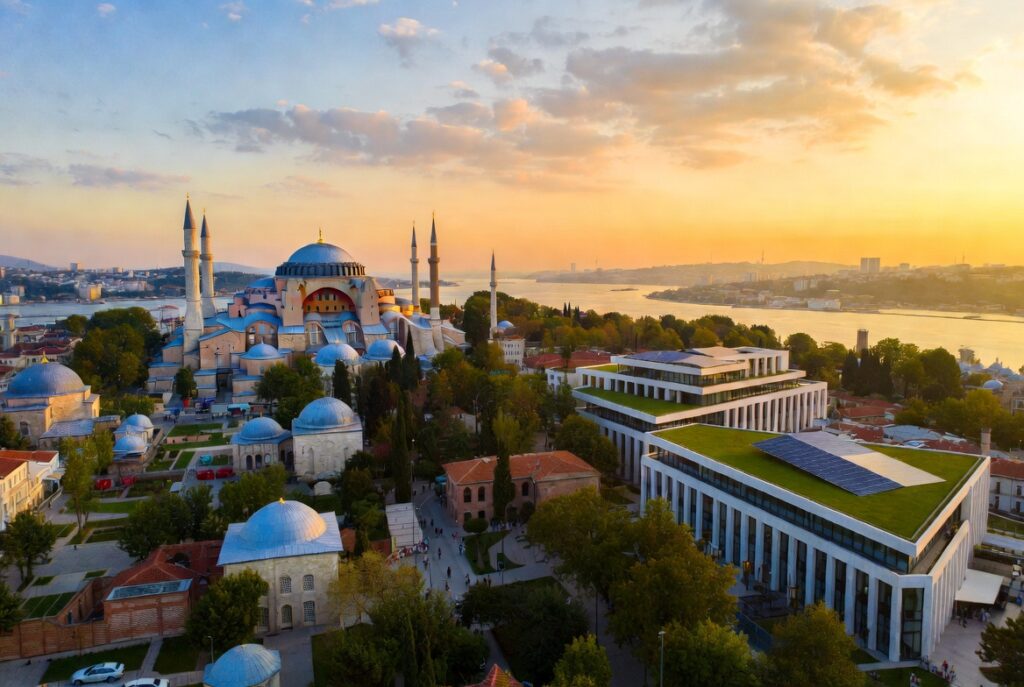
Istanbul stands as one of humanity’s greatest living laboratories for sustainable heritage. Straddling Europe and Asia, this 8,500-year-old metropolis carries the layered legacies of Byzantine, Ottoman, and modern Turkish civilizations while confronting 21st-century realities: seismic risks, climate change, rapid urbanization, rising sea levels, and the pressures of mass tourism. In January 2026, 34 students and faculty from the Hong Kong University of Science and Technology (HKUST) Division of Environment and Sustainability embarked on a week-long study trip to Istanbul. The program, hosted in collaboration with Koç University, explored how this historic city is redefining heritage not as a static museum piece, but as a dynamic resource for environmental resilience, social inclusion, and sustainable urban futures.
The Day 3 video from the trip offers a calm, observational glimpse into this journey. Shot with minimal narration and gentle pacing, it captures students moving through Istanbul’s layered urban fabric — ancient monuments, bustling neighborhoods, and sites where preservation meets innovation. The footage embodies the trip’s core message: heritage can actively support climate adaptation, lower carbon footprints, and strengthen community bonds when approached with creativity and respect.
 The HKUST ENVR Study Trip 2026: Context and Purpose
From 5 to 12 January 2026, 14 EVMT and 20 EVSM students, accompanied by faculty, immersed themselves in Istanbul’s rich tapestry. The program blended academic seminars and workshops at Koç University with direct field exploration of iconic landmarks: Hagia Sophia, Topkapı Palace, the Blue Mosque, the Basilica Cistern, and the Grand Bazaar. These sites were not treated merely as tourist attractions but as case studies in sustainable heritage management.
Day 3, captured in the linked video, formed part of this intensive schedule. Students examined how Istanbul’s historic structures — built with thick stone walls, natural ventilation systems, courtyards, and locally sourced materials — offer proven passive cooling and energy-efficiency strategies that modern architects can adapt. The trip also highlighted digital heritage tools, such as Digital Twins, which allow precise documentation and monitoring of vulnerable monuments without increasing physical visitor impact. By making sites more accessible through virtual experiences, these technologies promote inclusivity while reducing wear on fragile structures.
Throughout the week, discussions centered on four intersecting themes: cultural heritage preservation, environmental sustainability, urban transformation, and the role of digital innovation. Students witnessed how traditional Ottoman water management systems — cisterns, aqueducts, and fountains — still inform contemporary resilience planning in a city facing water stress and extreme weather. They explored community-led regeneration in historic neighborhoods, where restoring old buildings reduces embodied carbon compared to new construction and strengthens social cohesion.
Istanbul’s Unique Challenges and Opportunities
Istanbul faces a perfect storm of pressures. With over 16 million residents, it ranks among the world’s most populous cities. It sits on active fault lines, making earthquake resilience a constant priority. Climate change brings rising sea levels that threaten coastal heritage zones, intensified heat islands in dense districts, and more frequent extreme weather events. Rapid urbanization and tourism add further strain: how do you protect 1,500-year-old mosaics in Hagia Sophia while accommodating millions of annual visitors?
Yet these challenges also create opportunities. Istanbul’s heritage is not monolithic. Byzantine engineering marvels like the Basilica Cistern demonstrate sophisticated underground water storage that could inspire modern stormwater management. Ottoman architecture, with its emphasis on natural light, airflow, and multifunctional spaces, offers lessons in biophilic and low-energy design. Mimar Sinan’s 16th-century contributions — including structural reinforcements to Hagia Sophia — show how adaptive reuse has sustained buildings across centuries.
Recent restoration efforts illustrate this balance. Ongoing work on Hagia Sophia’s dome incorporates both advanced seismic engineering and materials consistent with Ottoman techniques, ensuring the structure remains stable while preserving its historic character. Digital documentation projects create high-fidelity records that support conservation even as physical access is carefully managed.
The HKUST students also learned about broader urban strategies. Green infrastructure integrated into historic districts helps combat urban heat, improves air quality, and enhances biodiversity. Community involvement in heritage projects turns preservation into a tool for social resilience, ensuring that local voices shape how sites evolve rather than being displaced by top-down development.
Day 3 in Focus: A Visual and Experiential Journey
The Day 3 video stands out for its quiet, contemplative style. Instead of rapid cuts or heavy voice-over, it allows viewers to absorb the city’s rhythm: the play of light on ancient stone, the contrast between grand monuments and everyday street life, and moments where modern interventions (green spaces, pedestrian zones, or subtle technological integrations) enhance rather than erase the past.
Viewers see students engaging directly with sites, reflecting on how heritage can lower energy consumption through passive design, support inclusive tourism via digital tools, and foster community pride. The footage reinforces a key insight: sustainable heritage is not about freezing buildings in amber. It is about keeping them alive — functionally, culturally, and environmentally — so they continue serving people today and tomorrow.
Global Lessons from Istanbul’s Approach
Istanbul’s experience offers valuable takeaways for cities worldwide. First, traditional building knowledge provides cost-effective, low-tech resilience solutions that complement high-tech innovations. Thick masonry walls and shaded courtyards reduce cooling needs far more sustainably than air conditioning in many climates.
Second, digital technologies like Digital Twins democratize access. Virtual tours can reach global audiences, including those with mobility challenges, while minimizing physical pressure on fragile sites.
Third, heritage-led regeneration can drive inclusive urban development. When local communities participate in restoring neighborhoods, the process builds social capital and economic opportunities alongside environmental gains.
Finally, viewing heritage through a sustainability lens shifts the narrative from “protect the past” to “learn from the past to build a better future.” Istanbul demonstrates that cultural continuity and environmental responsibility are not competing goals — they reinforce each other.
Practical Reflections for Students and Professionals
For the HKUST participants, the trip bridged theory and practice. Seminars at Koç University provided frameworks for analyzing heritage-sustainability intersections, while site visits grounded those ideas in real-world complexities. Students left with fresh perspectives on how interdisciplinary collaboration — between architects, engineers, historians, environmental scientists, and policymakers — is essential for meaningful progress.
Anyone interested in urban sustainability can draw similar inspiration. Start by examining local heritage for passive design lessons. Advocate for digital documentation to support conservation. Push for community-inclusive planning that treats historic areas as living assets rather than relics. And recognize that true resilience requires both technical solutions and cultural respect.
Final Reflection
Istanbul’s sustainable heritage journey is both ancient and urgently modern. In a world grappling with climate disruption and rapid change, this city reminds us that the deepest wisdom often lies in layered histories. By honoring its Byzantine and Ottoman roots while embracing innovation, Istanbul is forging a model where cultural identity strengthens environmental resilience — and vice versa.
The Day 3 video captures just one slice of this vibrant learning experience, but its calm, respectful gaze encourages viewers to slow down and truly see. Watch it, and you may find yourself rethinking how we value the past in service of the future.
What aspect of Istanbul’s sustainable heritage resonates most with you — the ancient engineering ingenuity, the power of digital tools, or the potential for community-driven regeneration? Share your thoughts in the comments.
Linked Sources & Further Reading
- Main Video (Day 3): ENVR Study Trip 2026 – Sustainable Heritage: Exploring Istanbul’s Cultural & Environmental Resilience – Day 3 by HKUST – Division of Environment and Sustainability
- Full Playlist – ENVR Study Trip 2026 Istanbul: https://www.youtube.com/playlist?list=PL0nvHwcn9mhM27bp-No8fW9spQTgGppGD
- HKUST Official News: ENVR Study Trip to Turkey 2026
- HKUST Division of Environment and Sustainability YouTube Channel: https://www.youtube.com/channel/UCxpUYUxzfFK53NomEjruCwQ
- Koç University Collaboration Highlights (Facebook/Instagram posts from the trip): Search for posts dated early 2026 on @hkust.envr or related accounts
- Additional context on Istanbul heritage and resilience: UNESCO World Heritage listings for Historic Areas of Istanbul and related academic resources on Ottoman/Byzantine sustainable practices
