
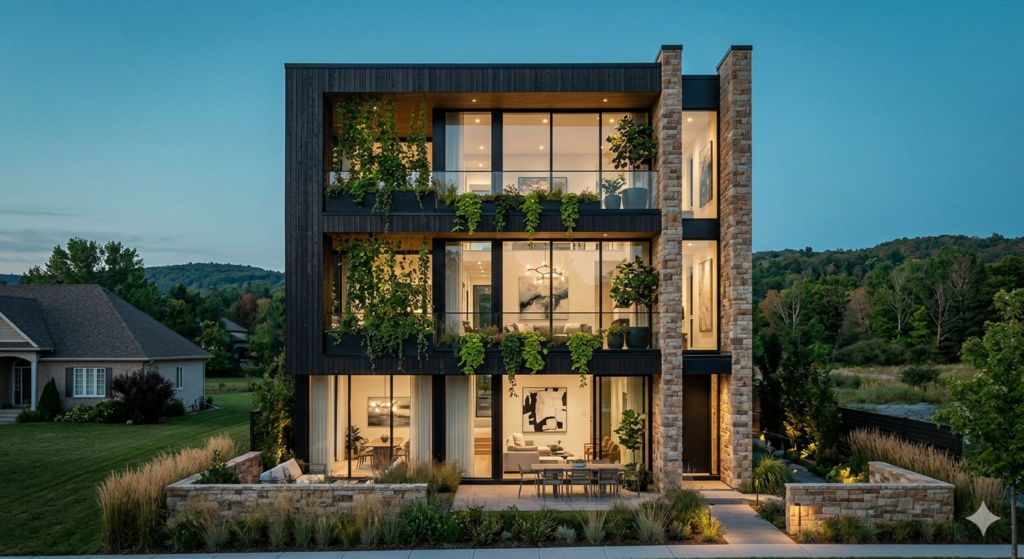
In the traditional luxury real estate playbook, “more” was the only metric that mattered. Success was measured in sprawling square footage, echoing hallways, and rooms that often went unused for months at a time. But as we navigate the economic landscape of May 2026, a new definition of “premium” is emerging. High-net-worth buyers and savvy developers are pivoting toward “Right-Sizing”—a movement that prioritizes meaningful volume, architectural precision, and the Highest and Best Use (HBU) of urban and suburban parcels.
This shift is particularly evident in the surge of interest in luxury triplexes and high-density apartment sites. Efficiency is no longer just a buzzword for the budget-conscious; it has become the new status symbol.
The Macro-Economic Engine: Why the “Big House” is Shrinking
The 2,000-square-foot luxury unit is the new 5,000-square-foot estate. To understand why, we must look at the convergence of three major economic forces in 2026:
-
The Capital Efficiency Mandate: With the cost of capital remaining significantly higher than the “free money” era of the 2010s, developers can no longer afford “dead space.” Every square foot must generate a return, whether through higher rent or increased resale value.
-
The Maintenance Fatigue: Modern high-net-worth individuals are increasingly “time-poor.” The psychological burden of maintaining a massive estate—landscaping, roof repairs, and cleaning—is being traded for the “lock-and-leave” convenience of a high-end, professionally managed triplex.
-
The Energy Envelope: In 2026, the cost of heating and cooling a poorly designed “McMansion” is not just a financial drain but a social liability. Right-sized units allow for superior insulation and geothermal integration that would be prohibitively expensive on a larger scale.
The HBU Strategy: Maximizing the Development Pad
From a development perspective, the math has fundamentally changed. With land costs in the Northeast—particularly in Connecticut—remaining at historic highs, the focus has shifted to maximizing the value of the “development pad”. For many developers, the HBU of a traditional single-family lot is increasingly being identified as a higher-density residential configuration.
We are seeing a trend where a 0.5-acre parcel, which might have previously held a single large estate, is now being reimagined as a boutique multi-family site. By increasing the density—often up to 10 or 11 units—developers can offer a superior amenity package and higher-quality materials, such as walnut cabinetry and natural stone, that would be cost-prohibitive in a single-family build.
“Meaningful Volume” Over Square Footage: The Architecture of the New Triplex
The 2026 buyer is looking for “quality of space” over “quantity of space”. This has led to the rise of the Luxury Triplex, where the design focus is on verticality and light.
Vertical Grandeur
Instead of 8-foot standard ceilings, “right-sized” units are utilizing 10- or 12-foot heights. This verticality creates a sense of grandeur that rivals much larger homes while maintaining a smaller, more efficient footprint. When you walk into a 1,500-square-foot unit with 12-foot ceilings and floor-to-ceiling glass, the brain perceives the space as significantly larger and more luxurious than a 3,000-square-foot basement or attic space.
The Glass Factor
Oversized, high-performance glass walls are being used to flood these smaller footprints with natural light. This isn’t just about the view; it’s about the “Biophilic Connection.” By blurring the line between the interior sanctuary and the natural world, designers are expanding the visual space into the horizon.
Flex-Zones and Multi-Functional Geometry
The rigid room-by-room layout is being replaced with “Flex Zones”. In a right-sized triplex, a study can seamlessly transform into a guest suite or a wellness area using integrated modular furniture and concealed wall systems. This ensures that every square foot is functional 24 hours a day, rather than sitting idle.
The Market Driver: The Rental/Ownership Gap
A key force supporting the demand for these higher-density luxury units is the persistent gap between the cost of owning and renting. With mortgage rates remaining elevated in 2026, even high-income professionals—doctors, attorneys, and tech entrepreneurs—are choosing to stay in the rental market longer.
However, these “renters by choice” do not want to sacrifice the luxury experience. They are looking for properties that offer:
-
Professional Management: A seamless lifestyle where maintenance is a non-issue.
-
Material Honesty: Top-tier finishes like the walnut and “Antique Cream” palettes we’ve tracked this month.
-
Curated Community: A sense of belonging within a smaller, more exclusive building footprint.
For the developer, this creates a stable, high-quality tenant base that prioritizes lease renewals, creating a “sticky” asset that outperforms generic apartment complexes.
Investment Resilience in the Northeast: A 2026 Snapshot
While other regions are seeing a cooling in multi-family starts, the Northeast remains a bright spot. In the first quarter of 2026, the region posted a significant year-over-year surge in completed multi-family units, signaling a robust market that is actively absorbing new supply.
In Connecticut specifically, investors are finding “sweet spots” in secondary markets—areas like Litchfield and Middlesex counties—where cap rates remain attractive and the demand for modernized, affordable, and luxury multi-family housing continues to outpace inventory. The shift toward higher density is not just a trend; it is a necessity to meet the housing shortage while maintaining the high aesthetic standards of the region.
The Wellness Edge: High-Density Doesn’t Mean Low-Health
Critics of high-density development often cite a lack of privacy or green space. However, the 2026 Luxury Triplex solves this through “Integrated Nature.” We are seeing the rise of:
-
Private Sky-Gardens: Each unit in a luxury triplex often features a significant outdoor terrace or rooftop garden.
-
Acoustic Engineering: Advanced sound-dampening materials—often disguised as art installations—ensure that high-density living doesn’t mean hearing your neighbor.
-
Air Filtration: Commercial-grade HEPA and UV-C filtration systems are becoming standard in right-sized luxury builds, providing a level of air quality that is difficult to achieve in older, sprawling estates.
Conclusion: The Strategic Path Forward
“Right-sizing” is more than a reaction to economic pressure; it is a more intelligent, more sustainable, and ultimately more profitable way to build. By focusing on density, efficiency, and high-performance design, developers are creating assets that are more resilient to market shifts and more appealing to the modern, wellness-conscious inhabitant.
As we look toward the future of the Connecticut real estate market, the winners will be those who recognize that the highest and best use of a property is found at the intersection of architectural soul and financial precision.
Key Takeaways for Developers:
-
Volume is Value: Prioritize ceiling height and window scale over total square footage.
-
Density is Security: More units on a single pad diversify the income stream and lower per-unit maintenance costs.
-
Materiality is the Hook: Use high-end materials in high-touch areas (kitchens and baths) to justify luxury pricing in smaller footprints.
