
Publication: Home & Art Magazine
Issue: Summer 2026
Category: Sustainable Design & Eco-Architecture
## The Blueprint for a Quiet Revolution: Shaking Off the Grid
### BOOK DETAILS
-
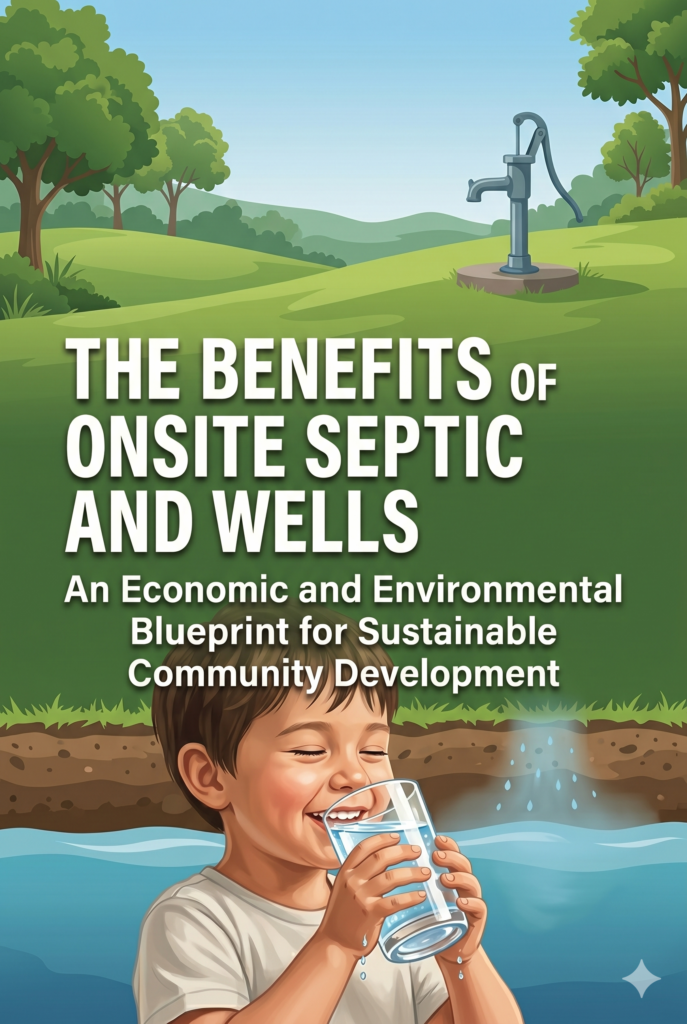
Title: The Benefits of Onsite Septic and Wells: An Economic and Environmental Blueprint for Sustainable Community Development
-
Author: Stephen Schappert (Founder of BIOS Homes & BIOS Farm)
-
Volumes: 2-Volume Manual (Vol. 1: Advanced Onsite Water Production; Vol. 2: Advanced Onsite Septic & Wastewater Engineering)
-
Core Focus: Decentralized utility engineering, self-contained residential cluster development, and micro-utility monetization.
Based on an exclusive look at the book’s first draft, this manual delivers a technical blueprint for complete utility sovereignty. Currently in art and editing, it launches on Amazon on July 4, 2026, celebrating a new era of freedom from centralized wastewater systems that pollute our rivers and streams.
### THE REVIEW
For over a century, modern real estate has been shackled to a 19th-century assumption: that high-density progress requires a physical umbilical cord to a centralized municipal grid. In his provocative and meticulously engineered new book, Stephen Schappert fundamentally shatters this paradigm. He calls out the “traditional municipal grid” for what it has truly become—a compounding financial and environmental liability characterized by multi-million-dollar taxpayer debt, systemic wet-weather sewage overflows, and a catastrophic “hydrological siphon” that drains local water tables only to dump water into the ocean.
Schappert doesn’t just critique the status quo; he delivers an un-romanticized, highly technical, and deeply empowering blueprint for complete utility sovereignty.
Written with the dual precision of an environmental engineer and a savvy land developer, The Benefits of Onsite Septic and Wells explains exactly how a developer can take a “rejected” piece of land—parcels orphaned by the multi-million-dollar cost of municipal sewer and water line extensions—and transform it into a thriving, high-density, 25-unit net-neutral pocket community.
What makes this book a must-read for architects, green builders, and forward-thinking planners is its brilliance in turning structural challenges into biophilic design triumphs. Schappert outlines “The Artery Framework,” showing how advanced Moving Bed Biofilm Reactors (MBBR) can purify wastewater to pristine standards in compact subgrade concrete vaults, shrinking the required land absorption footprint by 75% compared to conventional septic layouts. The resulting clear, odorless fluid is fed directly into a high-pressure subsurface drip matrix to nourish biophilic landscaping and local co-op farms naturally, keeping the water where it belongs—local.
Volume 1 acts as a masterclass in sovereign water production, sweeping away the guesswork of well-drilling with advanced fracture-trace analysis and LiDAR topography to pinpoint high-yield subterranean targets. Schappert walks the reader step-by-step through building a state-compliant Community Pump House—outlining the exact fluid dynamics, hydro-pneumatic arrays, and multi-barrier pathology disinfection loops needed to safely neutralize heavy metals, radon, and surface pathogens.
Yet, the book’s ultimate masterstroke is its brilliant financial pro forma disruption. Schappert reveals how keeping the utility loops entirely inside the property line converts infrastructure from a maintenance liability into an institutional asset class. By treating the autonomous node as a private micro-utility and deploying smart sub-meters, developers can recapture operating expenses and drive Net Operating Income (NOI) straight up—adding massive equity value out of thin air.
### THE VERDICT
“True stewardship is designing an architecture that listens to the soil, keeping the water local, and letting nature do the engineering for free.”
— Stephen Schappert
Schappert’s words ring out as a manifesto for the modern era. The Benefits of Onsite Septic and Wells is an indispensable tool that bridges the gap between environmental ethics and commercial real estate viability. It is a stunning, data-backed proof that we do not need to expand the grid to build density; we simply need to master the earth beneath our feet.
Our Rating: ⭐⭐⭐⭐⭐ (5/5) – An absolute triumph for sustainable housing development.
### Key Takeaways for Home & Art Readers:
-
The 7,500 GPD Sweet Spot: Discover how keeping design flows under 7,500 Gallons Per Day allows developments to fast-track through local health regulations, completely bypassing lengthy and highly politicized state environmental reviews.
-
Thermal Energy Capture: A brilliant look at how warm graywater exiting residential structures can be routed through an inline subgrade heat-exchanger to pre-heat the domestic water supply, cutting central boiler energy costs by 25%.
-
Water as Localized Capital: Learn how to view the local watershed like a community bank, replacing extractive infrastructure with on-site systems that recharge unconfined aquifers to protect local streams and surrounding wetlands from artificial drought.
