
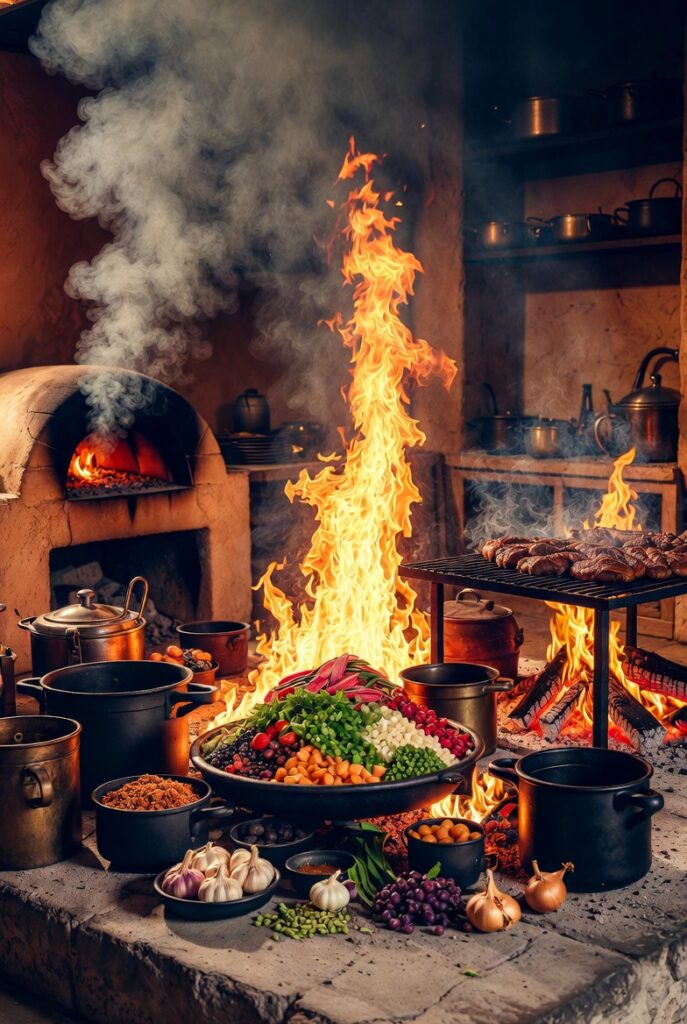
Where Food Becomes Culture — Heat, Transformation, Craft
Fire is the first kitchen.
Before stoves, before ovens, before copper pans and induction burners, there was flame. Fire transformed food from survival to sustenance, from raw necessity to shared ritual. It altered flavor, texture, digestibility, and community itself. If land is origin, fire is transformation.
The story of food is, in many ways, the story of controlled heat.
When early humans learned to harness fire, they changed biology and society simultaneously. Cooking made food safer, softer, and more nutrient-accessible. It reduced disease risk and expanded dietary possibilities. But it did something even more profound: it created gathering.
Fire drew people inward.
Around flame, communities formed. Around heat, stories were told. Around coals, meat roasted and grains softened. The hearth became both architectural and social center. In ancient homes, it was not decorative—it was essential. Every culture, regardless of geography, developed its own relationship with flame.
Cooking is applied physics. Heat rearranges molecules. It caramelizes sugars, denatures proteins, releases aroma compounds, and alters texture. Maillard reactions turn bland into complex. Smoke infuses flavor. Slow heat tenderizes muscle fibers. Fast heat crisps and seals.
Transformation is the language of fire.
Grain becomes bread. Dough becomes crust. Milk becomes cheese through warmth and time. Coffee beans crackle and darken under roast. Even fermentation relies on controlled temperature. Fire is not only visible flame—it is every calibrated degree that reshapes ingredients.
But fire is also restraint.
Too much heat destroys. Too little fails to transform. Mastery lies in calibration. The grill master watching flare-ups. The baker reading oven spring. The chef adjusting flame by instinct. Cooking is not brute force; it is balance.
Different cultures have refined different relationships with heat. Open-flame grilling in Argentina. Clay tandoors in India. Wood-fired pizza ovens in Italy. Woks over high heat in China. Smoked fish in Nordic regions. Each technique reflects both environment and ingenuity.
Fuel shapes flavor.
Hardwood smoke carries distinct notes—oak, hickory, applewood. Charcoal burns differently than gas. Clay ovens retain heat in ways steel cannot. Even altitude influences boiling point and cooking time. Geography still informs fire.
Modern kitchens may conceal flame behind sleek surfaces, but the principle remains unchanged. Whether through induction precision or wood-fired intensity, food depends on energy transfer. Cooking is chemistry performed in real time.
Yet fire’s importance extends beyond technique.
The hearth historically defined domestic space. Early architecture centered around fire pits. Chimneys restructured homes. Industrialization moved heat into factories and centralized bakeries, altering not just meals but urban design. Even today, restaurant layouts often place open kitchens at the visual core—a modern echo of the ancient hearth.
Fire creates spectacle.
It commands attention. Flames rising under cast iron. Sparks drifting from grills. Embers glowing in darkness. In fine dining, presentation often ends with torching or tableside flambé. The visual drama connects diners to process. We trust what we see transform.
But fire also demands respect.
Wildfires remind us of its volatility. Kitchen accidents teach caution. Throughout history, entire cities have burned due to uncontrolled flame. Cooking requires both intimacy and vigilance. Fire gives life and can take it.
In contemporary food systems, heat is scaled beyond imagination. Industrial ovens, pasteurization systems, flash freezing, and sterilization technologies extend shelf life and enable global distribution. But the more heat becomes mechanized, the more people crave its authenticity.
This is why wood-fired bread, slow-smoked brisket, and hearth-baked pizza resonate so deeply. They reconnect us to elemental transformation.
Even in sustainability conversations, fire remains central. Energy consumption in food production—gas stoves, commercial kitchens, processing plants—contributes to environmental impact. As the world moves toward electrification and renewable energy, the future of cooking heat is evolving.
Induction replaces gas. Solar ovens re-emerge in off-grid communities. Energy efficiency becomes culinary strategy. The question is no longer only how we cook, but how responsibly.
Fire also structures time.
Slow braises demand patience. High-heat stir-fries reward speed. Roasting cycles shape dinner rhythms. Baking aligns with morning routines. Flame disciplines tempo.
Cooking by fire is choreography.
The cook watches color shift, listens to sizzle, smells smoke rise. These sensory cues cannot be fully automated. Even with digital thermometers and smart ovens, intuition remains irreplaceable.
In a fast world, tending flame slows the body. Watching coals glow invites stillness. Outdoor grilling transforms backyards into temporary gathering grounds. Campfires collapse hierarchy; everyone faces the same light.
Fire unifies.
It is both tool and teacher. It instructs humility, attentiveness, and care. It punishes distraction. It rewards presence.
And in that presence, food becomes more than nutrition.
It becomes ritual.
Across religions and cultures, fire holds symbolic weight—purification, transformation, sacrifice, illumination. Shared meals cooked over flame carry ceremonial undertones, even when informal. Lighting a candle at dinner echoes ancient hearths. Blowing out birthday candles acknowledges time and renewal.
Fire marks milestones.
From harvest festivals to family cookouts, from sacred offerings to wedding feasts, heat anchors memory. Taste is inseparable from moment.
As food innovation accelerates—lab-grown proteins, cold-pressed technologies, raw culinary movements—fire remains constant. Even raw food philosophies define themselves against it. Flame is reference point.
To cook is to participate in a lineage thousands of years old.
The tools change. The surfaces modernize. But heat remains mediator between land and table.
If land is potential, fire is realization.
It turns harvest into meal. Ingredient into experience. Geography into flavor. Community into memory.
Everything that begins in soil must pass through transformation.
Fire is where food becomes culture.
And culture, like flame, must be tended.
