
Section 1: The Aligned Vanguard
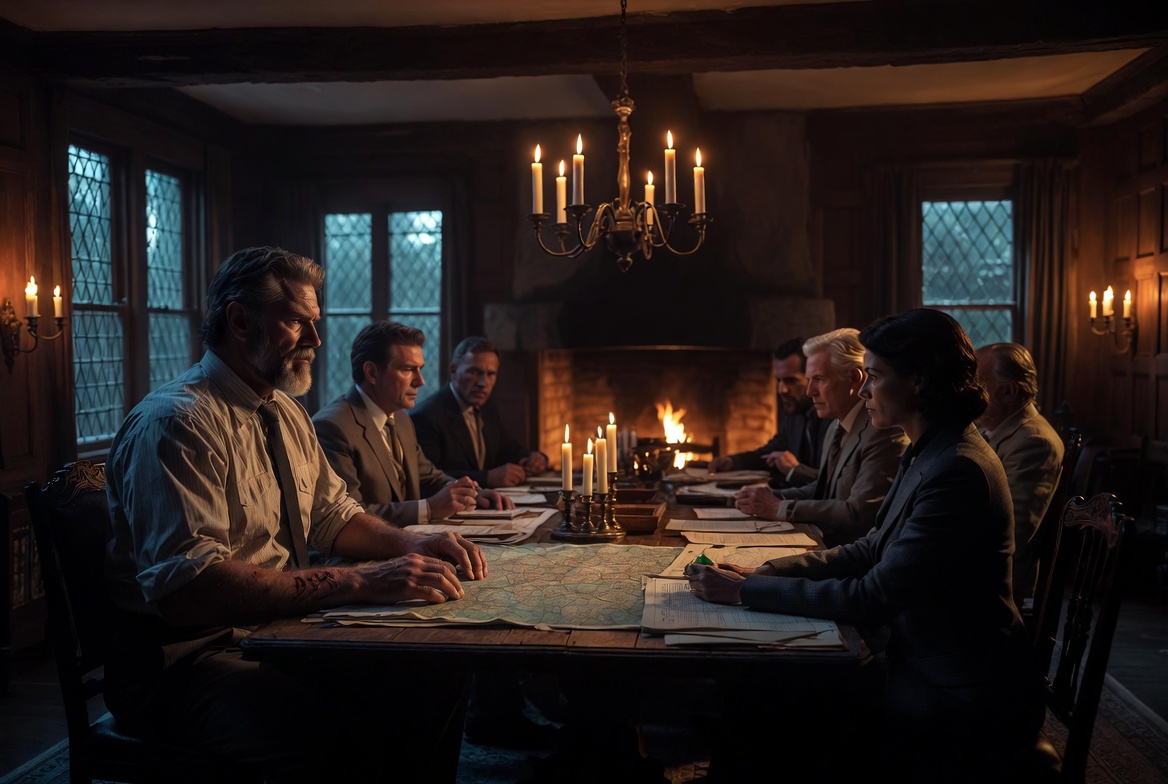
The dining room at the historic Litchfield estate did not possess the aggressive, reflective sheen of a Manhattan boardroom or the calculated, hyper-modern minimalist posturing of a Greenwich family office. Here, forty miles north of the coastal hedge fund corridors, power didn’t need to flash its credentials or announce its scale. It sat quietly in a room wrapped in hand-planed, midnight-grained chestnut paneling that had deepened in color over two and a half centuries, absorbing the low, golden resonance of wood fires and the hushed, definitive conversations of families who had held the dirt beneath the state since before the formulation of the charter.
A single, massive trestle table—hewn from a single white oak log that Dave had salvaged from an un-compromised structural frame in the Naugatuck Valley years ago—stretched down the center of the room. There were no fluorescent lights, no glowing flat-screen presentation monitors, and no polished leather portfolios embossed with corporate emblems. The illumination was entirely cast by thick, hand-dipped beeswax candles set into heavy, un-lacquered iron sconces, their steady flames casting long, soft shadows against the oil-rubbed wood planks and the pristine white plaster walls. The air carried the rich, deep scent of woodsmoke, aged wool, and the crisp, iron-sharp trace of the cold Connecticut rain that was still misting through the ancient hemlocks outside the leaded glass windows.
Six people sat around the table, their postures relaxed but entirely alert, watching Dave and Maeve with the quiet, clinical scrutiny of multi-generational stewards. These were not venture capitalists chasing a liquid exit or speculative day-traders scanning an algorithmic dashboard for a micro-percentage shift in arbitrage. These were the heads of the region’s most private, asset-backed family trusts—men and women who measured wealth not in volatile fiat numbers on a digital server, but in thousands of acres of contiguous forest, un-shortable water rights, and the preservation of structural human culture.
To Dave’s left sat Evelyn Sterling-Vance, the matriarch of the Litchfield land trusts, her silver hair pulled back into a sharp, uncompromising knot that mirrored the clean geometry of her ancestors’ architecture. Across from her was Julian Ward, a man whose family had managed the primary timber and iron-ore reserves of the upper valley since the early nineteenth century, his hands calloused and rough despite the multi-million dollar liquidity reserves he directed with a single, unrecorded phone call. They sat in absolute silence, the only sound the faint, elegant clink of heavy pewter forks against porcelain and the steady, low-frequency hum of the estate’s thick stone foundation absorbing the damp New England night.
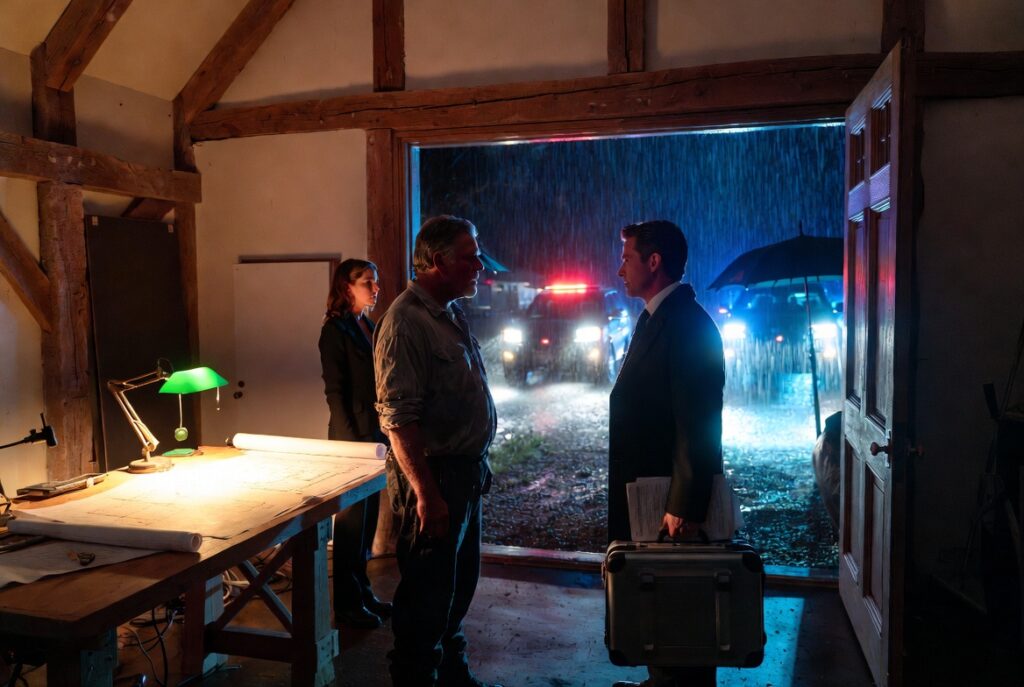
They all knew about the late-night raid at the Litchfield studio. They knew that Vance Sterling’s black SUVs had breached the gravel driveway at 2:45 AM, and they knew that the Goliath Media Group had unleashed the full, automated velocity of a federal asset-freeze injunction. On Wall Street, a notification like that was a terminal diagnosis; it was a digital execution notice that caused institutional partners to instantly sever lines of credit, freeze clearing accounts, and distance themselves from the corporate carcass before the morning opening bell.
But around this oak table, the news hadn’t caused a single eyelid to twitch. They were assessing something far more critical than a piece of paper from a Southern District judge. They were assessing the structural integrity of the human beings sitting at the head of the table.
Maeve sat perfectly erect, her hands resting calmly on the table beside her father’s polished green jade token. The natural green of the stone caught the flickering candlelight, its deep, translucent core looking completely unyielding against the dark, oiled grain of the oak. She wore a simple, charcoal-grey wool blazer—no jewelry, no corporate signifiers—but her eyes carried the fierce, razor-sharp focus of an elite forensic auditor who had seen the interior mechanics of the giant’s machine and discovered that its core was entirely hollow.
Dave sat right beside her, his massive framing stature dominating the end of the table. His sleeves were rolled up just enough to reveal the thick, pale track of surgical scars along his right forearm—the physical record of a lifetime spent working under maximum structural compression. He hadn’t touched his wine glass. He simply watched the faces of the vanguard, his gray eyes carrying the quiet, dangerous warmth of a master builder who knew exactly how much weight his foundations could bear before the schist ledge beneath them even began to feel the load.
“Sterling thinks he executed an administrative execution tonight,” Evelyn Sterling-Vance said softly, her voice carrying the dry, authoritative crackle of an old-world registry book. She paused, setting her glass down with a slow, deliberate motion that commanded the room. “He spent three hours on the phone with the Hartford clearing houses before dawn, ensuring that every digital domain tied to Home & Art Magazine was flagged for administrative non-compliance. They are moving to isolate you from the marketplace, David. They believe that if they take away your megaphone, the BIOS Village platform will starve in the dirt before you can lay your first foundation line.”
Julian Ward leaned forward, his broad chest pressing against the edge of the oak table, his dark eyes locking onto Dave’s. “The commercial banks are already pulling back their appraisal bids on the regional land parcels we locked down last month. They’re calling it a ‘reputational risk assessment.’ Goliath is applying pressure to the secondary mortgage market, signaling that any contractor or builder who interfaces with our network will find themselves blacklisted from the primary supply chains. They aren’t just suing you, Dave. They’re attempting a systemic strangulation.”
The room went entirely still. The candlelight flickered slightly as a low draft of wind brushed against the thick glass panes, reminding everyone in the room of the hostile world that lay just beyond the stone borders of the estate. It was the exact moment where a standard corporate leadership team would have broken—where an executive board would have begun calculating the cost of a settlement, looking for an elegant way to surrender their intellectual property in exchange for a preserved minority stake.
But Maeve didn’t look at the legalpad, and Dave didn’t shift his weight. A slow, powerful warmth broke across Dave’s weathered face—a brilliant, terrifying look of pure amusement that made Julian Ward’s brow furrow in sudden, intrigued realization.
“Let them strangle the digital pipes, Julian,” Dave said, his gravelly voice dropping into a low, resonant cadence that seemed to ground the entire room. “A machine only understands how to cut off what it owns. Goliath thinks our value is an internet profile because that’s what their algorithms are programmed to track. They think that if they shut down the registry, the audience disappears. But they forgot how a real network operates. They forgot that long before there was an international fiber-optic grid, there was an unyielding alignment of human culture, craftsmanship, and trust that didn’t require a commercial bank’s permission to build.”
He reached out, his broad, calloused hand resting flat against the oak tabletop, his fingers spreading out as if he were testing the grain of a massive timber beam.
“We didn’t invite you here tonight to pitch you a traditional real estate syndication or ask you to fund a defensive legal defense fund to fight their injunction,” Dave continued, his gray eyes locking onto each face around the table with an unbreakable, absolute certainty. “We brought you here because the giant has finally marched into the exact terrain we designed for him. They brought their paperwork, their debt obligations, and their corporate arrogance right to our property line. And tonight, we aren’t going to defend our borders. Tonight, we are going to use the un-leveraged architecture of this vanguard to execute a structural counter-strike that will change the ownership of this valley forever.”
Maeve picked up the jade token, its smooth, cool weight settling into her palm as she stood up to command the floor. The vanguard shifted their attention to her, their faces reflecting the deep, analytical silence of an audience that knew they were no longer looking at an independent publisher and a local broker—they were looking at the architects of an entirely parallel financial fortress.
Section 2: The Failure of the Casino
Dave set his water glass down onto the raw oak table. The sound was a heavy, singular crack that silenced the residual whispers in the room and cut through the low, ambient crackle of the hearth. He didn’t stand up immediately. Instead, he leaned his massive frame forward, resting his calloused forearms on the edge of the layout plans. His grey eyes locked onto Julian Ward with an unblinking, heavy intensity before shifting to scan the rest of the vanguard.
“Julian mentioned that the commercial banks are pulling back their appraisal bids because of what their risk-compliance officers call ‘reputational contagion,’” Dave began, his voice a low, gravelly rumble that seemed to vibrate directly out of the two-hundred-year-old chestnut-paneled walls. “Let’s pull the sheetrock off that phrase and call it what it actually is: institutional cowardice hiding behind an automated algorithm. The traditional real estate market in this country isn’t a market anymore, gentlemen. It’s a rigged casino, and every single person sitting around this table knows it because you’ve spent the last thirty years watching it systematically strip-mine the equity of this valley.”
He stood up then, his framing stature casting a long, imposing shadow across the master blueprint of the BIOS Village layout. He didn’t use a laser pointer or a digital stylist; he used his hand, sweeping his broad palm across the topographical map of the Litchfield hills like a master mason assessing a failing fieldstone retaining wall under maximum hydrostatic pressure.
“Let’s trace exactly how Goliath’s real estate apparatus actually functions when it interfaces with our communities,” Dave said, his cadence slowing into the deliberate, rhythmically authoritative tone of a teacher exposing a fatal design flaw. “They don’t buy land to build physical shelter for human families. They buy land to construct debt instruments. They take a pristine, two-hundred-acre parcel of Connecticut woodland, place it into a off-balance-sheet special purpose vehicle, and use it as an asset-anchor to issue millions of dollars in short-term commercial paper. Then, they hire a high-volume regional contractor who uses the cheapest, most toxic stick-built framing available, packs the walls with low-grade fiberglass, slaps some luxury vinyl siding on the exterior, and calls it an exclusive, high-end subdivision.”
He paused, his eyes narrowing into slits under the candlelight as he drove the point straight home to the billionaires who held the true title to the county.
“They financialize the literal shelter of our citizens,” Dave continued, his voice tightening with a fierce, quiet authority that seemed to drop the temperature in the dining room by ten degrees. “They pack these developments with tiered tranches of mezzanine debt, slice them into mortgage-backed securities, and sell them to institutional pension funds before the first New England winter storm even has a chance to warp the un-seasoned roof rafters. And when the macroeconomic machine needs to purge its excess liquidity—when the interest rates spike and the credit markets lock up—the banks squeeze the primary consumer. The homeowners default, the community maintenance funds collapse, the houses fall into rapid structural decay, and the corporate cartels use their bankruptcy clearing houses to buy back the underlying land for pennies on the dollar. It’s a predatory, closed-loop extraction mechanism designed to pump the value out of our soil, ship it down the line to a Manhattan trading desk, and leave the local municipality holding the bag for the infrastructure failure.”
Evelyn Sterling-Vance watched him without moving a muscle, her hands clasped tightly over the silver-headed cane resting between her knees, her sharp eyes tracking every micro-expression on his weathered face. She knew the math better than any analyst on Wall Street. Her family’s trust had rejected three separate institutional acquisition offers from Goliath’s development subsidiaries over the last decade, all of them disguised as premium conservation partnerships but structured with hidden subordination clauses.
“The machine is hollowing out human culture because its business model cannot monetize permanence,” Dave said softly, his voice dropping into a deep, resonant cadence that commanded the room’s absolute focus. “A house that is engineered to last two hundred years without requiring a secondary mortgage or a continuous cycle of synthetic material replacements is an existential threat to Wall Street’s debt pipeline. A decentralized, clean-energy micro-grid built from precision modular components that doesn’t rely on a utility cartel’s transmission lines is a line-item liability on their balance sheets. That is the real reason Vance Sterling was standing on our porch at midnight with a federal injunction. They aren’t afraid that the Home & Art Group is going to fail, Julian. They are absolutely terrified because they know our un-leveraged model is about to prove that their entire casino is a house of cards.”
He reached down, his thumb pressing firmly onto the vellum sheet where the legal architecture of the Hearth & Holding Co. was mapped out.
“The casino is failing because its leverage has turned toxic,” Dave concluded, looking directly into the eyes of the vanguard. “Goliath has forty-two billion dollars in paper assets, but thirty-eight billion of that is backed by nothing but speculative debt and variable-rate credit lines that are resetting by the hour. We have zero debt, absolute title sovereignty, and the unshakeable trust of the people who actually live in this dirt. They brought their paper knives to a structural war. Now, it’s time for this vanguard to pull the plug on the casino and buy the floor out from under them.”
Section 3: The Architecture of Legacy
Maeve watched the ripples settle in Julian Ward’s wine glass. The silence in the room was no longer the polite, defensive quiet of investors listening to a pitch; it was the heavy, pressurized stillness that occurs just before a massive structural load shifts from a failing timber to a solid block of granite. Dave had exposed the rot in the machine. He had stripped the drywall off Goliath’s balance sheet and shown them the termites.
Now, it was her turn to show them the ironwork.
She stood up from the oak trestle table, her movement smooth, fluid, and entirely devoid of the nervous theatricality that typified Manhattan fundraising rounds. She didn’t reach for a projector remote or flip open a sleek leather pitch deck. Instead, she picked up her father’s green jade token, letting her thumb trace the cool, unyielding groove carved into its edge by a master craftsman half a century ago. She held it for a brief second before setting it back down at the exact intersection of Dave’s regional land maps and the vellum schematics of the Hearth & Holding Co.
“Dave has shown you how the casino extracts value from our dirt,” Maeve began, her voice carrying a crisp, bell-like clarity that cut through the low rumble of the wood fire. “My job is to show you how we break the casino’s bank. To do that, we have to stop thinking like real estate syndicators, and we have to start thinking like sovereign architects.”
She walked toward the high leaded-glass windows, her eyes reflecting the faint, steady amber glow of the candles against the dark New England mist outside. “When Goliath Media and its banking consortium look at Litchfield County, they see an efficiency problem. They see land that isn’t producing enough debt-yield per acre. Their response is corporate sprawl—modular junk designed to degrade within twenty years so the consumer is forced to refinance, re-insulate, and rebuild using materials manufactured by their own industrial subsidiaries. They have financialized time itself by making decay a line item on their revenue sheets.”
She turned back to face the vanguard, her gaze locking directly onto Evelyn Sterling-Vance. “But legacy cannot be financialized, Evelyn. And legacy is the one asset Goliath cannot short.”
Maeve stepped back to the table, her hands resting flat against the wide-plank oak. “We aren’t here tonight to ask you to purchase equity shares in a standard private equity raid on Goliath’s stock. If we buy their equity, we enter their jurisdiction. We become subject to their margin calls, their regulatory boards, and their Delaware corporate courts. Instead, we are establishing our own parallel financial architecture. Tonight, the Hearth & Holding Co. is officially launching a private, closed-loop sovereign bond market.”
The room went entirely motionless. Julian Ward leaned his broad chest further over the table, his dark eyes sharpening into slits of intense analytical focus.
“A private bond market,” Julian murmured, the implications of her words slowing his speech. “You’re bypassing the institutional clearing houses entirely.”
“Completely,” Maeve said, her voice tightening with an absolute, unshakeable confidence. “We are issuing private legacy bonds backed one-to-one not by paper promises or variable-rate derivatives, but by the physical title of the land banks we have secured through Connecticut Real Estate Brokerage LLC. We call it the Sovereign Love Tranche. It is a non-dilutive, asset-secured debt instrument with a fixed three-percent yield, structured specifically for multi-generational family trusts that require preservation over speculation.”
She reached down, her slender fingers tracing the clean legal geometries stamped with gold seals on the vellum document. “Here is the structural defense: because these bonds are registered under historic Connecticut land-banking statutes and held within private, non-discretionary estate trusts, they do not interface with the Depository Trust & Clearing Corporation. They cannot be electronic-shorted by a hedge fund algorithm. They cannot be attached to secondary corporate liabilities. And they cannot be frozen by an ex-parte order from a Southern District judge who thinks he regulates the global digital grid.”
She looked around the table, her eyes wide, fierce, and brilliant under the golden candle flame. “We are asking this vanguard to completely fund the Love Tranche tonight. We aren’t asking for speculative capital to build a subdivision; we are asking for private impact liquidity to rescue human culture from corporate sprawl. We are going to use this capital to buy out the underbelly of Goliath’s empire—the thousands of acres of suppressed-value land reserves they have packed with toxic variable debt. The moment our Section 8-30g affordable housing notices hit the public records tomorrow morning, those land reserves will transform on their balance sheets from passive collateral into active, un-hedged structural liabilities.”
Maeve leaned forward, her voice dropping into a low, dangerous whisper that commanded the room’s absolute soul. “Goliath built their empire on the assumption that you would always keep your capital parked in their casino because you were too afraid of the volatility outside. They thought that by sending Vance Sterling to our porch with a midnight injunction, they could scare us into playing by their rules. But we have changed the physics of the game. We have built an un-leveraged fortress out of real timber, real concrete, and the absolute trust of the people in this room. The slingshot is loaded, gentlemen. The math is verified. Now, we need the stones to break the giant’s jaw.”
Section 4: The Oversubscribed Fortress
The echo of Maeve’s voice hung in the high, timbered ceiling long after she finished speaking, vibrating silently against the dark chestnut paneling. The beeswax candles had burned down significantly, their steady amber flames casting a deeper, more atmospheric glow over the scattered regional maps and the gold-sealed vellum schematics. Nobody moved. Nobody reached for a glass of wine. The six individuals around the table sat in the profound, pressurized silence of an elite high-stakes boardroom—a silence where millions of dollars of real-world liquidity are calculated not through frantic typing or verbal bartering, but through the cold, absolute geometry of mental math.
Julian Ward was the first to break the stillness. He didn’t look at Maeve, nor did he look at the blueprints. His gaze remained fixed on the small, polished green jade token resting at the geometric center of the table. Slowly, he reached out with a thick, calloused hand and tapped his knuckle against the three-inch oak planks.
“It’s an elegant trap, Maeve,” Julian said, his deep voice carrying a quiet, gravelly respect that seemed to ground the tension in the room. “You aren’t just out-negotiating Goliath. You’re exploiting the structural blind spot of their entire mathematical worldview. Their risk-assessment algorithms are programmed to simulate every conceivable scenario involving debt acceleration, hostile stock accumulation, and media blackouts. But their software literally doesn’t have a metric for an opponent who refuses to use their currency, declines their credit, and operates entirely on the unyielding physical ledge of sovereign title.”
He turned his head slowly, his dark eyes locking directly onto Dave’s weathered face. “Goliath has over five thousand acres of restricted-density timberland reserves locked up on their balance sheets between Barkhamsted and the upper Naugatuck Valley. If those Section 8-30g notices land on the municipal registries at 9:00 AM tomorrow, the statutory mandatory rezoning triggers instantly. Their senior secured lenders in New York won’t just flag the asset—they’ll panic. They will see high-density, precision-engineered modular developments encroaching on their pristine collateral, and they will trigger an immediate asset revaluation. The margin calls will be automated by noon.”
Julian reached into the breast pocket of his charcoal wool jacket and pulled out a classic, silver-plated fountain pen. He didn’t ask for a contract. He didn’t ask for a multi-page investor disclosure form. He pulled the leather-bound surveyor’s logbook toward him, flipped to the first clean page beneath the sepia entries of his ancestors, and wrote a single, definitive number next to his bold, sweeping signature.
“The Ward Trust is in for twenty-five million,” Julian said softly, setting the pen down with a solid, definitive click. “We aren’t purchasing a yield, Dave. We are buying back the sovereignty of this valley.”
Evelyn Sterling-Vance watched the pen change hands, her face an unreadable mask of old-world authority. She looked at the number Julian had written, then looked up at Maeve, a brilliant, razor-sharp warmth finally breaking through her clinical demeanor.
“For forty years, the corporate cartels have told us that our desire for architectural permanence, for real craftsmanship, and for sustainable, high-density communities was an economically unviable nostalgia,” Evelyn said, her voice dry, clear, and cutting as a diamond edge. “They told us we had to surrender our land to their sprawl or watch our towns die. They didn’t realize we were simply waiting for a master builder who knew how to frame a proper counter-strike.”
She took the silver fountain pen from Julian’s hand. Without a single moment of hesitation, she signed her name beneath his, her script elegant and unyielding. Next to her signature, she wrote a figure that caused even Julian’s eyes to sharpen into slits.
“The Sterling-Vance Land Trusts will take forty million,” she declared, looking up to lock her grey eyes with Dave’s. “The Love Tranche is no longer an experiment, David. It is a financial fortress. Let the giant march his lawyers up our hill tomorrow morning. They will find that the floor beneath their feet has already been bought and paid for.”
Within ten minutes, the silver pen had passed around the entire oak trestle table. No slides had been shown, no investment bank intermediaries had taken a percentage fee, and no digital clearing houses had validated the transactions. By the time the logbook slid back to the head of the table where Maeve stood, the Sovereign Love Tranche wasn’t just funded—it was completely oversubscribed by an astronomical margin of fifteen million dollars.
The financial fuel for the slingshot was locked down. The defensive armor was completely impenetrable. They had successfully insulated their capital from the global digital grid, and they now possessed the raw, liquid weight necessary to execute the most sophisticated asset-inversion strategy the region had ever seen.
Dave reached out and closed the heavy leather logbook with a solid, muffled thud that seemed to echo through the quiet estate like the closing of a bank vault door. The candle flames flickered violently for a split second as he stood up, his massive framing stature fully dominating the room once more, his grey eyes carrying a fierce, triumphant cadence.
“The alignment is complete,” Dave said, his gravelly voice dropping into a low whisper that commanded the absolute soul of the vanguard. He picked up the green jade token from the table and handed it back to Maeve, his hand closing over hers with a powerful, unbreakable warmth. “The armor is on, the math is verified, and the funding is secured. The defensive phase of this war ended the moment Vance Sterling stepped off our porch tonight.”
He turned toward the window, looking out into the damp, grey stillness of the early morning Connecticut mist where the first faint light of dawn was finally beginning to break over the Litchfield hills.
“Tomorrow morning, the giant expects a surrender,” Dave whispered, a dangerous, knowing grin cutting through the wrinkles of his weathered face. “Instead, we go entirely on the offensive.”
