
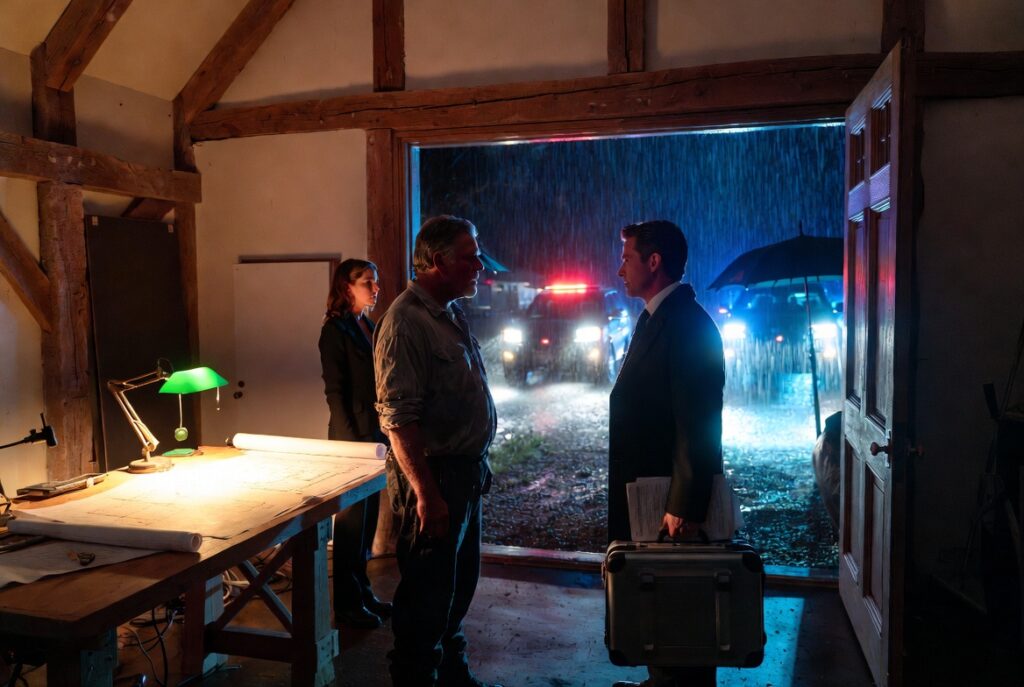
Section 1: The Tactical Breach
The high-pitched, aggressive wail of the sirens didn’t just echo against the Litchfield hills; it vibrated straight through the ancient schist foundation of the studio, humming in the soles of Dave’s boots. The blinding sweep of halogen headlights cut through the dark New England rain, casting long, fractured shadows of the window panes across the oak layout table.
Maeve didn’t flinch, but her fingers tightened instinctively around Dave’s calloused hand, her father’s green jade token caught like an anchor between their palms.
“They’re early,” she murmured, her voice a cool, deceptive calm that masked the sudden spike of adrenaline in her chest.
“Panic makes people sloppy,” Dave said. His gravelly voice was entirely devoid of fear, carrying the steady, unhurried weight of a master builder who had spent forty-six years watching structural loads shift under maximum compression. “They realized what the Love Tranche just uncoupled. When a forty-two billion dollar machine realizes its main bearing is about to seize, it doesn’t send a polite letter. It sends the enforcers.”
Outside, the tires of three blacked-out SUVs crunched violently against the wet gravel of the driveway, their blue and red strobe lights painting the interior of the white-walled studio in a rapid, nauseating pulse. The engines idled with a heavy, mechanical growl.
Dave gently released her hand, walked over to the cast-iron radiator, and turned the valve. It gave a final, sharp hiss before falling silent. He wasn’t rushing. He reached down to his rolled-up sleeve, pulling it down to cover the long track of surgical scars on his right forearm, then adjusted the collar of his shirt. He looked less like a man about to face a corporate firing squad and more like a professor preparing to deliver a lecture on a fatal design flaw.
A heavy, synchronized slam of car doors echoed through the downpour. Three figures stepped into the glare of the headlights, shielded by large, golf-size black umbrellas. The man in the center wore a tailored charcoal overcoat that looked entirely out of place against the raw, muddy Connecticut landscape. In his right hand, he carried a heavy, waterproof synthetic briefcase.
Thud. Thud. Thud.
The brass knocker on the thick timber door rattled with a clinical, authoritative force. Not the frantic pounding of local police, but the measured, weaponized knock of institutional power.
Dave walked to the entry, Maeve stepping up right beside his shoulder. When he threw the door open, the wet, iron-scented night air rushed into the room, cutting through the warmth of the studio.
The man in the charcoal coat didn’t wait for an invitation. He stepped across the threshold, his leather oxfords leaving wet, dark prints on the wide-plank oak floor. He didn’t look at Dave; his eyes locked instantly onto Maeve’s open laptop on the layout table, where the blood-red notification still glowed: LIQUIDITY SEIZURE INITIATED.
“Maeve Miller? David Vance?” the man asked, his tone dripping with the sterile, practiced neutrality of a high-priced Manhattan litigator. He didn’t wait for a confirmation. He snapped the latches of the synthetic briefcase open and pulled out a thick stack of legal documents bound in blue backing paper. “My name is Vance Sterling, representing the global restructuring consortium for the Goliath Media Group. I am here to formally serve you with an emergency, ex-parte temporary restraining order and asset-freeze injunction issued two hours ago by the Southern District of New York.”
He extended the papers, the stark white sheets gleaming under the studio’s halogen lights.
“As of 2:45 AM, all digital domains, bank accounts, intellectual property, and physical assets tied to the Home & Art Group, Connecticut Real Estate Brokerage LLC, and your subsidiary building networks are officially under the receivership of the consortium. You are ordered to cease and desist all digital transmissions immediately and surrender your cryptographic keys.”
Sterling offered a cold, predatory smile—the look of a man who had executed a hundred corporate executions before breakfast and never watched the bodies hit the floor. “The game is over, Mr. Vance. You pulled a very sophisticated lever tonight, but the machine owns the grid. Turn off the terminal, or the federal marshals waiting at the bottom of your hill won’t just be directing traffic.”
Maeve felt the air leave her lungs for a fraction of a second. The sheer velocity of the corporate counter-strike was staggering. They hadn’t just sued; they had moved to erase them from the board entirely before the sun even rose.
But Dave didn’t look at the papers. He didn’t look at the SUVs idling in the driveway. He looked directly into Sterling’s eyes, a powerful, brilliant warmth breaking across his weathered face that looked terrifyingly like amusement.
“You’ve got the wrong jurisdiction, Sterling,” Dave said softly.
The litigator’s smile faltered, his brow furrowing slightly. “I assure you, Mr. Vance, the federal oversight on your interstate digital banking protocols falls squarely within—”
“I’m not talking about the banking protocols,” Dave interrupted, stepping forward until his massive framing stature completely dominated the doorway, forcing the corporate attorney back half a step onto the wet porch. “I’m talking about the dirt you’re standing on. You brought a New York paper knife to a Connecticut structural war.”
Dave reached into his back pocket and pulled out a crisp, single-page document bearing a raised, embossed gold seal—the formal corporate registry and statutory title declaration he had spent the last three weeks hidden away filing.
“You think you’re seizing a leveraged digital media company because that’s what your algorithms told you we were,” Dave whispered, his gray eyes locking onto the attorney’s with a fierce, unbreakable cadence. “But you didn’t check the foundations. The Home & Art Group isn’t an internet company, Sterling. It’s a debt-free, asset-backed sovereign holding company registered under Connecticut land banking statutes. And that emergency injunction you’re holding? It’s completely toothless against an unleveraged estate.”
Dave slapped his document directly on top of the blue-backed legal stack in Sterling’s hands.
“Take your papers, get back in your black trucks, and tell your masters that the slingshot didn’t just fire. The stone has already landed.”
Section 2: The Schist Ledge
The heavy timber door clicked shut, the thick brass latch dropping into place with the solid, definitive sound of a bank vault sealing shut. Outside, the muffled roar of the SUV engines revved high, their tires spraying wet, muddy gravel against the fieldstone wall as Vance Sterling and his corporate enforcers retreated back down the dark Litchfield hill. The red and blue strobe lights swept across the stark white walls one last time—a frantic, artificial pulse—then vanished into the New England downpour, leaving the studio cloaked in the quiet, steady shadows of the Connecticut night. The only remaining sound was the steady, rhythmic drumming of rain against the standing-seam metal roof and the faint, low hum of the desktop computer tower cooling down.
Maeve stood by the entry, her back pressed slightly against the cool wood of the door frame. Her breathing was shallow, her eyes fixed on the threshold as if expecting the wood to splinter under a second, heavier wave. The adrenaline was still humming through her veins like a live wire, making the tips of her fingers tingle. She looked at Dave. He was already walking back to the oak layout table, entirely unbothered, his gait steady and unhurried. He paused to adjust the positioning of a cast-iron drafting weight on a set of site plans, treating the corporate raid with the same casual dismissal he’d show a stray raccoon crossing the porch.
“They’ll be back, Dave,” Maeve said, her voice tight, echoing slightly in the high-ceilinged room as she crossed the wide-plank floor to join him. “Sterling isn’t a local code enforcer you can stall with a grandfather clause. He’s a senior restructuring partner. Goliath doesn’t just walk away because you handed them a piece of paper with a gold seal. They have a forty-two billion dollar balance sheet, an army of forensic accountants, and a hundred appellate lawyers who eat sovereign title statutes for breakfast. They will find a loophole in our corporate registry by sunrise.”
“To find a loophole, you need a knot to pull on, Maeve. You need leverage,” Dave said smoothly. He reached out and pulled the heavy brass green-shade desk lamp closer to the center of the table. The incandescent bulb hummed softly, casting a sharp, brilliant pool of golden light across the scattered layout sheets, the matte-finish architectural renderings, and the glowing screen of the laptop. “And leverage is the one thing Goliath’s algorithms can’t find on our books, because I never allowed them to grow the weeds to hide it.”
He tapped the laptop trackpad with a calloused finger. The blood-red LIQUIDITY SEIZURE INITIATED warning—the digital death warrant Goliath’s servers had automated to freeze their operations—was still blinking stubbornly in the corner. But Dave minimized it with a single, deliberate stroke, pulling up a massive, encrypted spreadsheet document.
Maeve leaned over his shoulder, the scent of the rain-washed cedar air from the doorway still clinging to her coat. Her eyes, trained by years of institutional accounting and corporate balance-sheet analysis, scanned the rows of data. This wasn’t the standard QuickBooks dashboard she managed for the day-to-day operations of Home & Art Magazine. This was a deep, underlying architectural map of their entire corporate anatomy. It detailed asset tiers, holding entities, and land-trust allocations mapped out with the obsessive precision of a structural engineer calculations for a multi-story load-bearing wall.
“Look at the modern media landscape,” Dave said, his rough finger tracing a column of figures tracking the rapid collapse of their competitors over the last decade. “What is it built on? It’s a house of cards built on digital clicks, arbitrary traffic metrics, and programmatic ad-tech impressions. Goliath Media grew into a giant by buying up every independent regional publication from Boston to New York. They didn’t do it with superior content; they did it by convincing independent publishers that data was the new gold, and that the only way to mine it was to scale up through debt. They forced those local papers to take on massive mezzanine financing to build bloated server farms and pay for algorithmic distribution systems.”
He looked up at her, his gray eyes fierce, clear, and steady under the golden glare of the lamp. “And what happened? The moment the digital ad-market softened, the interest rates on that variable mezzanine debt spiked. The financial cartels squeezed. Those independent publishers chased the clicks into bankruptcy, selling their souls and their editorial independence to Goliath just to keep the servers from going dark. That’s how the Giant became a giant. They aren’t builders, Maeve. They didn’t lay a single brick of cultural value. They just collected the debt on dying assets and monopolized the distribution pipes.”
Maeve’s eyes raced across the columns of their own ledger. Her mind automatically looked for the standard liabilities lines that dictated the life and death of any modern business: the debt schedules, the short-term amortization tables, the revolving lines of credit used to smooth out cash-flow gaps.
She blinked, squinting at the screen, then rubbed her eyes and looked again. “Dave… where is the debt schedule? Where are the institutional liabilities?”
“There isn’t one,” Dave said, a quiet, dangerous pride warming his gravelly voice.
“That’s mathematically impossible,” she whispered, her fingers flying to the keyboard, scrolling frantically through the asset-allocation tabs. “To run a print-and-digital media group with this kind of regional footprint—to maintain premium paper stock, high-end color separation, and a full editorial staff while simultaneously acquiring strategic land parcels through Connecticut Real Estate Brokerage LLC—the printing and overhead costs alone require a multi-million dollar revolving line of credit. Where is the clearing bank? Where is the primary lienholder?”
“Look at line forty-eight,” Dave instructed softly, his hand resting on the edge of the wooden table, steady as a timber post.
Maeve’s eyes dropped to the bottom of the ledger. There, typed in clean, uncompromised formatting, sat the capital structure of the Home & Art Group.
Long-Term Institutional Debt: $0.00 Short-Term Operational Liabilities: $0.00 Lines of Credit Utilized: 0.0% Pristine Cash Flow Retention: 94.2% Asset Backing: 100% Tangible (Real Estate/Sovereign Title)
“Every single issue of Home & Art Magazine, every digital domain we own, every piece of photography in our archives, and every square foot of the historic timber and schist studio we are standing in right now is paid for in full,” Dave explained. His voice took on the rhythmic, authoritative cadence of a master carpenter describing a flawless, interlocking mortise-and-tenon joint. “While the rest of the media world was chasing venture capital evaluations and taking on toxic bank leverage to look bigger than they were, I kept our footprints tight and our concrete deep. We don’t owe a dime to Wall Street, we don’t owe a dime to the commercial banks, and we don’t use their credit clearing houses to validate our existence. We are entirely unleveraged.”
Maeve felt a profound shock wave ripple through her mind, the cold reality of the data settling into her brain. She looked from the screen to Dave’s weathered face, realizing for the first time the true scale of what he had spent years secretly engineering. Home & Art Group wasn’t just a successful, elegant regional magazine; it was a financial paradox, a sovereign island sitting right in the middle of a hyper-leveraged corporate ocean. In an economic system where every corporate entity was hollowed out by debt and forced to comply with institutional gatekeepers, Dave had built an un-shortable financial fortress.
Goliath’s automated asset-freeze had failed because there was no bank intermediary to coerce. There was no master mortgage to accelerate, no lines of credit to abruptly cancel, and no senior secured lender for Vance Sterling to intimidate. They were trying to cut off the water supply to a house that had its own deep, artesian mountain well.
“But the capital, Dave,” Maeve said, leaning back, her hands gripping the edge of the layout table as her mind raced to find the missing puzzle piece. “To stay debt-free while maintaining this level of production, and while quietly banking premium land assets for our high-density housing models… raw magazine cash flow alone doesn’t cover that kind of physical scaling. To buy out the land parcels we’ve locked down in the Litchfield hills, you need massive liquidity injections. If it didn’t come from the banks, where did it come from?”
Dave smiled, a powerful, knowing expression that made the fine wrinkles around his eyes deepen into lines of absolute certainty. He reached across the table, picked up her father’s polished green jade token from the blueprint stack, and set it gently on top of the laptop keyboard, right over the line showing their pristine cash-flow retention.
“It didn’t come from institutions, Maeve. It came from relationships,” Dave said softly, his voice dropping to a whisper that seemed to command the room. “The kind of old-world, sovereign wealth that doesn’t show up on Wall Street’s radar because it refuses to travel through their digital pipelines. The slingshot is fully carved, Maeve. We have the pristine balance sheet. And the people who provided that capital? They are the ones who just gave us the stones.”
Section 3: The Sovereign Alignment
The leather-bound surveyor’s logbook did not belong in a room dominated by high-resolution monitors and digital drafting software, yet it sat at the exact geometric center of Dave’s layout table like an ancient anchor holding down a modern ship. Its spine was cracked away in ragged, fibrous strips of dark calfskin, exposing the coarse grey linen threading beneath. The corners were permanently rounded and stained with the faint, overlapping circular rings of long-forgotten black coffee and the pale, powdery dust of dry Connecticut limestone. It was a physical ledger from an era before cloud computing and automated compliance metrics, and as Dave pulled it into the sharp, golden pool of illumination beneath the green-shade desk lamp, it seemed to absorb the light rather than reflect it.
Maeve leaned over the edge of the oak table, her breath catching slightly as the scent of aged paper and dried ink cut through the clean, ozone-heavy air left behind by the storm. Her fingers, still carrying the faint, residual tremor of the adrenaline that had spiked during Vance Sterling’s legal ambush, hovered just above the cream-colored pages. She was a woman trained in the sterile, hyper-logical architectures of institutional finance; she was used to tracking wealth through multi-tiered digital dashboards, Bloomberg terminals, and encrypted PDF audits that stretched on for six hundred pages of deliberately dense legalese.
What lay before her was the absolute antithesis of Wall Street’s digital landscape.
The pages were thick, heavy-weight cotton rag, ruling lines drawn by hand with a soft graphite pencil that had faded over decades to a silver-grey haze. But it was the writing that stopped her breath. It wasn’t typed. It was recorded in meticulous, hand-drawn font styling—elegant, uniform fountain-pen strokes using a deep iron-gall ink that had oxidized over time into a rich, dark sepia. There were no corporate logos, no SEC registration codes, and no standard international identification numbers. There were only names, dates, geographic coordinates, and individual signatures that cut across the paper with a fierce, uncompromising permanence.
“This is our capital stack,” Dave said softly. His voice was lower now, falling into a deep, gravelly resonance that seemed to mimic the steady, low-frequency hum of the timber barn’s structural frame. He placed his hand flat against the open ledger, his broad, calloused thumb resting near a heavy, stylized signature at the bottom of a page dated fourteen years prior. “When I started the Home & Art Group, and later when we quietly laid down the legal foundations for the BIOS Homes builder network, I didn’t take the train down to Greenwich to pitch to the merchant banks or the private equity funds on Steamboat Road. If you take their money, Maeve, you take their timeline. And a bank’s timeline is a degenerative disease that eats craftsmanship from the inside out.”
He looked up at her, the incandescent light catching the silver-grey stubble along his jawline and highlighting the deep, permanent creases around his eyes. There was no trace of the lingering tension from the confrontation on the porch. He looked like a man who had spent forty-six years calculating the exact moment a timber beam would settle into its pocket, and who knew, with absolute mathematical certainty, that his calculations were flawless.
“Think about how a traditional real estate fund operates,” Dave continued, his rough finger tracing a hand-drawn column tracking land-trust allocations. “They pool institutional capital from pension boards, sovereign wealth funds, and high-yield aggregators. The managers promise a twelve to fifteen percent internal rate of return, and they promise it on a strict twenty-four to thirty-six month liquidity horizon. What does that mean for the dirt? It means the builder is forced to become a butcher. You’re forced to cut corners before the foundation even has time to cure. You use cheap, standardized, stick-built framing that warps within five seasons. You skimp on the insulation package, you dump toxic, mass-produced drywall into the interiors, and you pack the houses as tightly as the local zoning board will allow without a single thought for the long-term carrying capacity of the water table or the social fabric of the neighborhood. You build it fast, you paint it white, you dress it up with cheap luxury veneers, and you flip the asset to a secondary buyer before the structural settling cracks start to show through the sheetrock. That isn’t building, Maeve. That’s financial extraction disguised as housing.”
Maeve nodded slowly, her eyes tracking the sepia names in the logbook. She knew the reality of that extraction all too well. Before she had left Manhattan to join Dave in the quiet, unyielding hills of Litchfield, she had watched the corporate machinery of the Goliath Media Group financialize the very idea of domestic space. They didn’t see homes; they saw cash-flow yielding units that could be collateralized, securitized into complex mortgage-backed tranches, shorted on the derivatives market, and managed via algorithmic property-management systems that raised rents automatically based on regional supply scarcity.
“I didn’t want their capital, because I refused to accept their terms,” Dave said, his hand sliding down the page to point to a name written in a sharp, authoritative script—Caleb Sterling, Trust for Land Preservation, 2012. “I didn’t go to the gatekeepers. I went directly to the people who actually own the dirt beneath our feet. I went to the multi-generational estates, the private family trusts, and the quiet, old-world wealth tucked away in the deep pockets of the Litchfield hills, Fairfield County, and the Hudson Valley. These are families who have watched the modern corporate machine spend the last forty years systematically hollowing out their towns. They watched the factories close, they watched the historic main streets get replaced by strip malls and corporate fast-food franchises, and they watched their children get priced out of the very valleys their ancestors farmed.”
He tapped the page with his knuckle, a sharp thud that echoed against the studio’s white walls. “These people don’t want a short-term, twelve-percent speculative dividend that evaporates during the next Wall Street liquidity crisis. They don’t think in fiscal quarters, Maeve. They think in generations. They want permanence. They want sovereign impact yield. They want to see sustainable, high-density, precision-engineered housing models built out of real concrete, indigenous timber, and advanced thermal mass systems that will still be standing, uncompromised, two hundred years from now. They provided the primary capital injections because they wanted an economic shield against the very machine Vance Sterling represents.”
Maeve felt a profound shift in her understanding of their financial position. She leaned down further, her long hair falling forward over her shoulders as she carefully turned the heavy cotton page. The spreadsheet on her laptop screen was still open, its clean columns mirroring the hand-inked entries of the logbook. She began to correlate the digital data with the historical records before her.
“The private investor network,” she whispered, her finger tracing a name that belonged to one of the most private, historically significant family trusts in Washington Depot—a family that hadn’t granted a public media interview or disclosed a financial position since the mid-1970s. “They aren’t just passive shareholders listed on an LLC operating agreement, Dave. They are the primary depositors in our private land banks. They didn’t lend us money; they integrated their equity directly into our physical foundations.”
“Exactly,” Dave said, a quiet, dangerous warmth returning to his grey eyes. “Goliath’s entire system is built on relationship physics, but their physics are sterile, transactional, and entirely dictated by automated risk-assessment software. They assume every human being has a specific liquidation price, and that every independent asset can be shorted into submission if you apply enough legal pressure and supply-chain leverage. They understand the leverage of debt, but they have absolutely no understanding of the mechanics of a sovereign alignment.”
He stood up, walking over to a large, wooden flat-file drawer against the far wall. He slid it open with a low, metallic rattle and pulled out a thick sheet of vellum paper covered in intricate, dark blue ink lines—the master legal schematic for the BIOS Village housing platform and its underlying holding company, Hearth & Holding Co. He brought it over to the layout table, unrolling it directly over the spreadsheet, using his ancient iron drafting weights to hold down the curled edges.
“Look at the legal geometry of this structure, Maeve,” Dave said, his voice dropping into the authoritative cadence of a master bricklayer explaining a complex bond pattern. “When we structured the corporate charter for the Home & Art Group and Connecticut Real Estate Brokerage LLC, we didn’t use the standard Delaware C-Corp template that corporate raiders use to execute hostile takeovers. We utilized the historic, un-amended Connecticut statutory land-banking provisions and private estate trust frameworks that pre-date the Federal Reserve system. The capital provided by the families in this logbook isn’t held in standard commercial checking accounts or liquid corporate brokerages that can be frozen by an automated interbank wire-stop or an ex-parte injunction from a Southern District judge.”
He traced his finger along a complex, interlocking web of legal entities stamped with private seals. “Their capital is legally locked into what we structured as the Sovereign Love Tranche. It is a closed-loop, asset-backed equity vault. Under the explicit terms of our operating covenant, that capital cannot be called in by a court order, it cannot be attached to a secondary corporate liability, and it cannot be liquidated by a third-party receiver. The physical land parcels we have spent the last three years quietly acquiring across Barkhamsted, New Hartford, and Thomaston aren’t owned by a shell company that can be dissolved by a corporate lawsuit. They are held in independent, sovereign land trusts where the sole beneficiary is the development of the sustainable infrastructure itself.”
Maeve’s eyes widened as she followed the legal flowcharts on the vellum sheet. As an accountant, she had analyzed some of the most sophisticated corporate shells in the world, but this was different. This wasn’t a shell designed to hide money from tax authorities; this was a fortress designed to isolate real-world assets from the institutional debt market. It was an economic circuit breaker. By eliminating institutional leverage entirely, Dave had removed the very wires that the corporate cartels used to deliver their shocks.
“Vance Sterling stood on our porch tonight and thought he was holding our execution order,” Maeve said, a slow, brilliant realization breaking through the fatigue on her face. Her voice was growing stronger now, losing its defensive edge and adopting the sharp, analytical precision that made her Dave’s perfect counterweight. “He thought that by freezing our digital domain registry and sending a notice to our commercial clearing banks, our operations would collapse by morning because he assumed we relied on the same short-term liquidity lines that every other media and real estate company uses to survive.”
“He checked our digital profile, and he let his software fill in the blanks,” Dave said, a low chuckle vibrating in his chest. “The algorithm told him that a print magazine and a regional brokerage with our level of expansion must be carrying at least eight to ten million dollars in revolving credit lines. It assumed that if they shut off our digital access points, we wouldn’t be able to meet payroll for our building crews or pay our paper suppliers by Friday, forcing us into a technical default. But you can’t default on a debt that doesn’t exist, Maeve. And you can’t freeze an asset that isn’t connected to your ledger.”
He reached across the table, picked up the small, polished green jade token that had belonged to her father, and held it up between his thumb and forefinger. The smooth stone caught the golden light of the lamp, its deep, natural green looking rich and unyielding against the white-walled background of the studio.
“Your father understood the true nature of wealth before the corporate world went entirely digital,” Dave said softly, his eyes softening as he looked at the stone. “He knew that real power isn’t a collection of digits sitting on a server in Virginia or New Jersey. Real power is relationship physics. It’s the absolute, unshakeable trust between two people who refuse to sell out their core values, backed by the raw, tangible dirt of the earth. When we aligned with our investor network, we didn’t sign a contract for capital; we signed an alliance to protect the hearth. That’s why our balance sheet is an unassailable schist ledge. The corporate storm can howl all it wants, the legal sirens can scream at the bottom of our hill until the batteries run dry, but they cannot crack a foundation that doesn’t belong to their system.”
Maeve looked down at the hand-inked logbook, then back up to the master blueprint of the BIOS Village layout. The initial terror of the late-night raid had completely evaporated, replaced by a cold, calculating, and exhilarating focus. She realized that they weren’t just defending a small business from a predatory conglomerate. They had spent years quietly engineering a counter-system—a structural slingshot that was fully loaded, perfectly balanced, and locked onto the primary structural vulnerability of the forty-two billion dollar giant.
“They think they’ve cornered us in this room, Dave,” she said, her lips curving into a sharp, confident smile that perfectly mirrored his own dangerous calm. “They think that because the lights are flashing outside, we’re trapped inside our own borders.”
Dave set the jade token gently back down onto the exact center of the master ledger page, its weight anchoring the historical records to the modern layout.
“They didn’t trap us, Maeve,” Dave said, his voice carrying the deep, unyielding weight of an absolute truth. He turned his head toward the wide window panes, where the blinding glare of the retreating headlights had finally dissolved into the soft, grey stillness of the early morning mist. “They just marched their entire administrative army right into our canyon. They brought all their paperwork, all their debt liabilities, and all their corporate arrogance right to our property line. Now, we close the pass. We pull the pin on the Love Tranche, we activate our builder network, and we show them what happens when the giant tries to stand on ground it doesn’t own.”
Section 4: The Cartography of War
The rain had stopped, leaving the night completely silent save for the steady, heavy drop of water from the eaves of the barn onto the gravel drainage beds below. Inside the studio, the atmosphere had completely shifted from defensive survival to the cold, clinical precision of an offensive launch. The golden light of the desk lamp now illuminated a battlefield mapped out in blueprint blue, sepia ink, and the sharp white glare of a freshly opened satellite cartography program on Dave’s secondary monitor.
Maeve pulled a fresh legal pad toward her, her pen hovering over the top sheet. The shock of the late-night raid was gone, replaced by the sharp, analytical mindset that had once made her the most feared forensic auditor in the New York corporate restructuring circuit.
“If their asset-freeze can’t touch our capital,” Maeve said, her eyes locked on the digital map, “then Vance Sterling’s only move left is a public-relations execution. They will try to starve us out by shutting down our distribution pipes. They’ll drop our digital domains by sunrise, cut off our paper suppliers for the print edition of Home & Art Magazine, and threaten our regional advertisers with legal non-compliance if they don’t pull their contracts.”
“Let them shut down the digital pipes,” Dave said, his voice flat and dangerous. He leaned over the table, placing his large palms flat on the edges of a sprawling regional map of Connecticut. “A pipe is just a hollow tube, Maeve. Goliath spent forty billion dollars buying up the tubes, but they forgot to check what was flowing through them. They think our audience belongs to them because they control the servers. They don’t understand that our readers don’t buy Home & Art for the platform. They buy it for the truth. We don’t need their digital grid to talk to our people. We’ve got the local networks, we’ve got the physical mail routes, and we’ve got the dirt.”
He tapped a specific geographic coordinate on the map—a heavily forested interior parcel located right on the border of Barkhamsted and New Hartford.
“This is where we strike back,” Dave whispered. “Goliath Media isn’t just a publishing company; they are a massive, hyper-leveraged real estate holding trust disguised as a media conglomerate. Over the last seven years, they’ve used their corporate subsidiaries to quietly buy up thousands of acres of suppressed-value land across Litchfield County. They’re holding those parcels on their balance sheets as ‘undeveloped corporate reserves,’ using them as debt-collateral to back their Wall Street lines of credit. They think nobody can touch that land because the local municipal zoning laws restrict anything other than low-density, single-family luxury estates.”
Maeve’s eyes narrowed as she studied the parcel boundary lines. “But we aren’t playing by traditional zoning laws anymore.”
“No, we aren’t,” Dave said, a slow, predatory grin breaking across his weathered face. “Yesterday afternoon, at exactly 4:00 PM, attorney Murdo Smith filed our formal Notice of Intent letters under Connecticut General Statutes Section 8-30g for three separate development sites in Barkhamsted, New Hartford, and right here in Thomaston.”
Maeve felt a thrill of cold clarity run down her spine. Section 8-30g. It was the ultimate legal equalizer in Connecticut land use law—the affordable housing appeals procedure. Under 8-30g, if a town does not meet the state’s minimum threshold for affordable housing stock, an independent developer can completely bypass traditional municipal zoning restrictions, density caps, and local planning commissions to build high-density, community-focused projects. The burden of proof shifts entirely to the town to prove a substantial threat to public health or safety—a legal standard that is nearly impossible to meet.
“Goliath’s entire corporate valuation is based on the assumption that those land reserves are worth fifty thousand dollars an acre as restricted, undeveloped woodland,” Dave explained, his rough finger tracing the perimeter of the New Hartford parcel. “By filing those 8-30g notices, we didn’t just propose a project, Maeve. We executed an immediate asset inversion. We are forcing a mandatory rezoning of their collateral. The moment our notices hit the public record, those parcels shift from low-density land to high-density, precision-engineered modular development sites. We are forcing them to recognize a massive, un-hedged liability on their own balance sheets.”
He reached for his phone and tapped a short command into an encrypted messaging app. “The moment Sterling stepped onto our porch tonight, he activated our legal tripwire. Murdo is already serving Goliath’s primary clearing bank with a formal notice of the statutory filings. By the time Wall Street opens at 9:30 AM, Goliath’s risk-assessment algorithms are going to flag their Litchfield land reserves as active legal war zones. Their collateral value will plummet, their debt-to-equity ratios will instantly breach their compliance covenants, and their senior lenders will be forced to issue an automatic margin call.”
Maeve looked at the legal pad, her pen flying across the page as she calculated the financial velocity of the strike. “It’s a systemic cardiac arrest,” she whispered, looking up at him with absolute awe. “You aren’t trying to win a lawsuit, Dave. You’re weaponizing their own massive size against them. You’re turning their debt into the weight that pulls them under.”
“David didn’t kill Goliath by matching his armor, Maeve,” Dave said, his gray eyes catching the sharp, fierce reflection of the computer screen. “He used a smooth stone and the giant’s own forward momentum. They came to our studio tonight to take our assets, but by tomorrow afternoon, we are going to use the Sovereign Love Tranche to execute a hostile, asset-backed leveraged buyout of their entire regional infrastructure.”
He reached across the layout table, picked up the green jade token, and placed it firmly into her palm, closing his massive, calloused hand over hers.
“The management team is already moving into position in the dark,” Dave said softly, his voice carrying the final, unyielding authority of a master builder locking the final key-stone into place. “The ammunition is loaded. The blueprint is carved. Now, we watch the giant fall.”
