
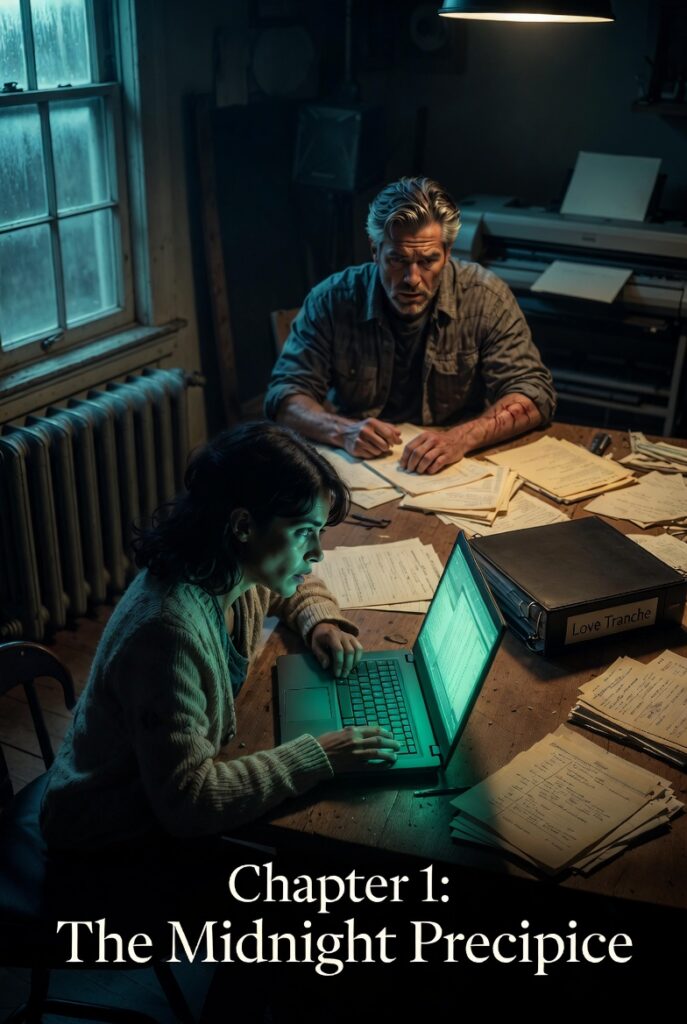
Section 1: The Midnight Precipice
The cast-iron radiator in the northeast corner of the Litchfield studio gave a sharp, metallic hiss—a desperate, sputtering gasp like a dying animal trying to clear its throat—before falling entirely dead.
Maeve Sterling didn’t look up to check the valves. She kept her eyes locked on the glowing spreadsheet on her laptop screen, though the columns of data had long since blurred into a cold, green digital fog. The clock in the upper-right corner of her monitor read 2:14 AM. In exactly six hours and forty-six minutes, the automated clearinghouse wire transfer for the quarterly printing deposit was scheduled to pull from her commercial checking account.
The balance was short exactly eleven thousand four hundred and two dollars.
If that wire bounced, the Home & Art Group—the pristine, debt-free sanctuary of independent journalism and architectural curation she had spent five agonizing years building from the ashes of her old life—would face immediate contractual default. The specialty printing house in Hartford would halt the presses. The regional distribution networks would snap shut, enforcing a cascading non-performance penalty. The independent media empire she had sacrificed her entire life savings to protect would be liquidated for pennies on the dollar by the very same predatory collection agencies she used to fight off during her twenty years on the administrative frontlines of institutional healthcare.
She pulled her faded wool cardigan tighter around her shoulders, shivering as the damp New England chill began to claim the room. Her hands were cold. Not just from the midnight draft leaking through the historic, single-pane window frames, but from the quiet, eating terror that had lived in her stomach like an unexploded ordnance for the last six months.
Across the massive oak layout table, Dave Pendelton sat in absolute, unyielding silence.
The overhead halogen cast a harsh, unforgiving light over his face, deep-lining the profound fatigue carved around his eyes. He looked thinner than he had three months ago, his jaw shadowed with a sharp, silver-and-black stubble. His flannel sleeves were rolled up, revealing heavy forearms mapped with old scars from framing saws, concrete burns, and the calluses of a lifetime spent on active job sites. In front of him lay a stack of yellow legal pads covered in dense, handwritten algebraic formulas, interspersed with three separate Notice of Intent letters from his primary materials suppliers. His construction company, a business that had built the literal foundations of this county, was suffocating under the weight of floating interest rates, supply chain strangulation, and unpaid commercial invoices.
They were two of the most capable minds in the state, and they were both entirely, brutally broke.
On the desk between them sat a thick, black vinyl binder. It contained the blueprints for a financial vehicle Dave had spent months engineering in secret—a structure he called the “Love Tranche.” In traditional corporate finance, a tranche is simply a sliced-up portion of investment debt or security designed to manage risk for cold institutional profit. But Dave had re-engineered the math completely. This wasn’t a slice of corporate debt meant to enrich shareholders; it was a legally binding, asset-backed equity shield designed to protect human value over speculative yield.
Dave had structured the tranche so that the underlying capital could never be traded, shorted, or leveraged by outside Wall Street entities. It was a financial vault where the value of independent land, sustainable solar micro-grids, and local clean water purification plants were legally locked together, prioritizing community survival over corporate dividends. To the global financial cartels, it looked like an anomaly—an un-shortable financial fortress. But to Dave and Maeve, it was the ultimate human safeguard. It was an investment tier backed entirely by their uncompromised mutual trust, designed to provide financial sanctuary for ordinary people drowning under the weight of the modern economy.
But to launch it, they had to pull the trigger tonight.
“If we execute this,” Maeve said, her voice cutting through the silence like a dull blade, “there is no safety net, Dave. We don’t have a parent company. We don’t have an endowment. If the clearinghouse blocks the activation code at nine o’clock, I lose the magazine by noon. And your trucks get hooked by the bank before sunset.”
Dave didn’t move for a long, agonizing moment. He kept his gaze fixed on the black binder resting between them. When he finally looked up, his grey eyes were entirely bloodshot, stripped of the calm, detached certainty he usually wore like armor.
“We are already losing, Maeve,” he said, his voice a low, gravelly rasp that sounded like crushed stone. “The market is rigged to starve out anyone who tries to build something honest. Being a brilliant builder hasn’t been enough for nearly twenty years.”
He stood up, his joints popping from hours of rigid stillness, and began to pace the narrow lane between the layout table and the blueprints rolled up in cardboard tubes along the historic brick wall.
“I spent forty years learning how to read timber, how to calculate structural loads down to the millimeter, and how to turn raw Connecticut dirt into an unyielding sanctuary for families,” he said, gesturing with a calloused hand toward the dark window. “But since 2007, the game hasn’t been played on the dirt. It’s played in the clouds by algorithm cartels. We waited out the subprime crash. We survived the tsunami of foreclosures that stripped the equity out of every working-class neighborhood in this state. And just when the market stabilized, just when we got our hands back on the tools, the supply chains paralyzed. A sheet of basic exterior plywood went from nineteen bucks to eighty-five. Copper became a precious metal.”
He stopped pacing, turning to look at her, his rugged silhouette framed against the dark glass.
“We adjusted,” Dave continued, his jaw tightening so hard a muscle twitched in his cheek. “We re-engineered the logistics, we trimmed the margins down to the absolute bone, and we were nearly ready to break ground and start building honest, single-family homes again. Then what happens? All-out macro-warfare breaks out across the globe. Energy grids fracture. Shipping lanes get choked off by geopolitical posturing. The global financial cartels use the chaos to inflate the cost of living, drive interest rates through the roof, and weaponize the very price of shelter against the population.”
He walked back to the table, leaning his heavy palms flat against the oak, staring directly into Maeve’s eyes. The distance between them, usually managed by professional protocols, evaporated in the heat of his intensity.
“A young couple can’t buy a starter home because a Wall Street private equity syndicate buys the whole block with printed money before the foundation is even poured,” Dave whispered, the raw passion of a teacher and a master builder bleeding into his tone. “They financialized the hearth, Maeve. They turned the human need for light, water, and insulation into an over-leveraged gambling chip. My business isn’t drowning because people don’t need houses. It’s drowning because the monster controls the price of the air we breathe to build them. If we don’t execute this asset inversion, we aren’t just going bankrupt—we are letting them permanently lock the door on the human standard.”
Maeve watched him, her administrative brain translating his anger into the hard, cold data she had tracked for two decades. She knew he was right. The medical cartels she had fled used the exact same playbook—starve out the independent practitioners, commoditize human vulnerability, and consolidate power behind an unfeeling corporate shield.
They had spent the last month screaming at each other in this very room—horrific, visceral fights born from the sheer panic of poverty. He had accused her of being too stubborn to survive; she had accused him of turning into the very monsters he used to investigate back when he worked as a federal asset dismantling international bank fraud. They had torn at each other’s wounds until there was nothing left but an empty, echoing space between them.
But sitting here on the edge of the cliff, with the dark Connecticut night pressing against the glass, the noise of their anger finally died away. There was no room left for pride. They were down to their last turn at bat.
Maeve’s hand drifted toward the center of the table, her fingers resting near the small piece of green jade her father had given her decades ago. “When you’re down to your last strike, Maevecita,” his steady voice echoed from the old stadium bleachers of her memory, “you don’t look at the scoreboard. You lock your eyes on the ball.”
She looked across the table at Dave. The hyper-analytical financial engineer had vanished. In his place was just a man, entirely exposed, who had held her hand in the dark when the first foreclosure warnings arrived.
“Show me the alignment again,” she whispered, her fierce Puerto Rican pride softening into a raw, absolute vulnerability. “Not the corporate debt structures. Show me how this heals us.”
“We use their own weapons to take the land back,” Dave said softly, his hand moving to rest just an inch from hers on the table. “We use their archaic 1994 book values against them. We trigger the cross-collateralization covenants on their legacy bonds, seize their suppressed urban holdings, and we build our own decentralized infrastructure. Independent solar micro-grids. Modular, high-density sanctuaries that bypass their supply chains entirely. Clean water purification systems that don’t rely on their corrupt utilities. We heal our own balance sheets by healing the literal foundation of how humanity lives. But I can’t release the slingshot alone, Maeve. I need the gatekeeper.”
Maeve looked down at the signature line on the activation order. The eleven-thousand-dollar deficit in her printing account felt small compared to the multi-billion-dollar abyss staring back at her from the page. But looking at Dave—seeing the unbroken competence of a man who refused to let the machine crush his craft—the terror in her stomach transformed into pure, unadulterated focus.
“They think because we are bleeding financially, we are weak,” Maeve murmured, a sharp, dangerous smile finally touching her lips.
“They don’t understand relationship physics, Maeve,” Dave said, his grey eyes locking onto hers with a sudden, soaring warmth that she hadn’t felt since the war began. “They don’t know that when a structure is under maximum compression, that’s exactly when the stone hardens.”
Maeve picked up the heavy, silver-plated fountain pen—the one her father had used to sign her birth certificate in San Juan. The clock on the wall gave a heavy, rhythmic tick, mirroring the opening, isolated piano notes of a melody that was already playing in the theater of her soul.
“Let’s break the giant, Dave,” she whispered.
She pressed the nib to the paper, but as the ink hit the sheet, the sharp scratch of the metal triggered a sudden, overwhelming rush of memory—a vivid smash-cut to a sun-blasted afternoon three years ago, when the world was completely different, and the war hadn’t yet left a single scar on their hearts.
Section 2: The First Inversion
The sharp, rhythmic scratch of the fountain pen vanished, swallowed instantly by the heavy, humid hum of a New England midsummer afternoon three years ago.
The Litchfield studio didn’t smell like cold, stale coffee and panic back then. It smelled of raw cedar shavings, linseed oil, and the crisp, clean scent of expensive heavyweight paper stock. The air was thick, but it was the kind of vibrant heat that made a person feel completely alive and unburdened. Sunlight, pure and golden, poured through the floor-to-ceiling multi-paned windows, illuminating the very first mock-ups of Home & Art Magazine pinned to the historic brick walls like architectural declarations of independence.
Maeve stood at the center layout table, wearing a sleeveless white linen blouse that contrasted sharply with the deep, rich tone of her skin. Her dark hair was pulled back loosely with a tortoise-shell clip, a few stray curls framing a face defined by high, sharp cheekbones and an intense, unwavering focus.
She was entirely in her element. She had spent twenty years in the corporate administrative trenches of Manhattan medicine—orchestrating massive clinical schedules, staring down insurance executives who tried to turn patient care into automated billing cycles, and surviving on pure, unadulterated grit. When she finally walked away, taking her hard-earned retirement savings and her proud Puerto Rican heritage up the coastline to Connecticut, she didn’t do it to slow down. She did it to build a fortress. A media platform dedicated to the absolute preservation of human craft, culture, and shelter. Debt-free. Uncompromised.
She was leaning over a proof of the magazine’s premiere feature—The 20,000-Year-Old Engineering Paradox—when the heavy timber front door swung open.
The bell above the frame gave a clean, brass chime.
Maeve didn’t look up immediately. In her line of work, you learned to judge people by the weight of their entrance. Most of the local contractors and high-end architects who came to pitch features walked with a rushed, self-important stride, their leather loafers clicking sharply on the floorboards.
This step was different. It was heavy, deliberate, and entirely unhurried. It was the stride of a man who spent his life walking across naked ceiling joists thirty feet in the air, a man who understood gravity at a molecular level.
“Maeve Sterling?”
The voice was a low, resonant baritone that carried the gravelly texture of the Connecticut shoreline.
Maeve adjusted her reading glasses and finally looked up.
Dave Pendelton stood in the doorway, a rolled-up set of structural blueprints tucked under his left arm. He didn’t wear a suit. He wore a faded navy work shirt with the sleeves rolled precisely to his forearms, revealing thick, muscular wrists and hands that looked like they could snap a 2×4 in half or delicately carve a dovetail joint with equal ease. His hair was a rugged mix of silver and dark charcoal, his grey eyes piercingly clear beneath a heavy brow. He looked less like a corporate executive and more like a permanent fixture of the landscape itself—solid, unyielding, and completely grounded.
“I’m Maeve,” she said, her voice carrying the sharp, confident clip of her Manhattan years, seasoned with the natural warmth of her roots. She didn’t offer a polite, deferential smile. She assessed him openly, her administrative eye tracking the weather-beaten leather of his briefcase and the quiet, intense authority in his posture. “You must be the builder Artie mentioned from the historic preservation committee.”
“Dave Pendelton,” he said. He walked toward the layout table, his presence instantly altering the geometry of the room. The studio suddenly felt smaller, the air tighter. He set his briefcase down on the edge of the dark oak table. He didn’t drop it; he placed it with the exact, calculated care of a master carpenter setting a level on a foundational sill.
“Artie said you were building a feature on ancient New England masonry foundations,” Dave said, his eyes scanning the proofs pinned to the table. He didn’t look at her layout with the polite curiosity of a casual reader. He scrutinized the cross-sections of stone walls with the clinical intensity of an engineer checking for structural rot. “But your layout has a three-degree pitch variance on the dry-stack stone diagram on page fourteen. If a mason builds that wall with that specific batter in this climate, the frost-heave will split the footing within four winters.”
Maeve’s brow went up. Her fingers tightened imperceptibly around the small piece of green jade resting in her palm. Nobody came into her studio and challenged her curation—especially not on day one.
“The diagram is modeled after a historic 1790 barn foundation in Cornwall, Mr. Pendelton,” Maeve countered, her independent pride rising instantly to meet his gravity, her eyes narrowing behind her lenses. “It has survived over two hundred New England winters without a single microchip or a modern engineer telling it how to stand.”
Dave looked up from the page, his grey eyes locking onto hers. The silence that followed wasn’t uncomfortable; it was a sudden, high-voltage current that snapped between them like a physical wire.
For a fraction of a second, the studio seemed to lose its sound.
Dave didn’t blink. He looked at her—not just at her face, but into the fierce, unyielding intelligence behind her eyes. He recognized her. He didn’t see a lifestyle editor; he saw a gatekeeper. A woman who possessed the exact same uncompromising standard of structural integrity that he carried into the dirt every single morning.
And Maeve felt the floor shift beneath her linen flats. In her twenty years managing chaotic medical systems, she had met thousands of highly educated men—surgeons, executives, politicians—but they all carried a veneer of manufactured power. This man was different. He carried the raw, terrifying competence of absolute truth. He looked like a man who could negotiate with international bank fraudsters and then go home and frame a cathedral ceiling by hand.
It was a lightning strike. An instantaneous, mathematical alignment of two psychological mirrors.
“The Cornwall barn survived because it was built on an underlying schist ledge that absorbs the hydraulic pressure,” Dave said softly, his voice losing its professional distance, dropping into an intimate, concentrated rumble that made her pulse give a sudden, erratic kick. He leaned in slightly, his shoulder inches from hers as he pointed to the blueprint. “The drawing doesn’t account for the ledge. Without the stone underneath to anchor the frequency, the math fails. You need the foundation to match the environment, Maeve. Otherwise, the beauty is just a temporary illusion.”
Maeve looked from the diagram to his face, her breath catching in her throat. She could smell the faint scent of cedar and sawdust on him, a primal, comforting aroma of shelter itself. Her sharp, defensive administrative armor didn’t break; it simply recognized an equal force.
“Then we change the math,” Maeve whispered, her dark eyes flashing with a sudden, dangerous brilliance. She slid a fresh sheet of drafting paper over the proof and pushed a mechanical pencil toward his hand. “Show me the correct geometry, Dave. Show me how to make it last forever.”
Dave reached out, his rough, calloused fingers brushing against hers as he took the pencil. The contact was brief, but it hit like an electric shock, an undeniable baseline frequency that locked their souls into a single, permanent orbit.
They spent the next four hours leaning over that oak table, their minds clicking together with the effortless precision of a tongue-and-groove joint, completely unaware that this perfect, beautiful summer afternoon was the exact structural anchor they would have to fight to remember when the storm finally came to tear them apart.
Section 3: The Scar Tissue
The memory of that golden, light-filled afternoon didn’t just fade; it fractured. It shattered like un-tempered glass under a sledgehammer, snapping Maeve back into the cold, suffocating chokehold of 2:22 AM.
The scratch of the silver fountain pen on the activation order felt heavy now, less like an invitation to collaborate and more like a warrant for execution.
Maeve let go of the pen. It rolled across the black vinyl cover of the Goliath Media prospectus, leaving a tiny, dark trail of ink that looked like an open vein on the page. She rubbed her temples, the glare of the laptop screen casting an oily, green pallor over her skin. The warmth of that first summer three years ago was long gone, buried under layers of corporate litigation, crushing economic inflation, and the agonizing, slow-motion wreck of their own financial survival.
She looked across the table at Dave. The man who had once held a pencil with effortless, poetic competence now looked like a soldier trapped in a mud-slicked trench line that was about to be overrun by heavy armor.
The corporate giant hadn’t fought them with creative brilliance, better design, or superior architecture. It had fought them with pure, unyielding systemic gravity. The moment the Home & Art Group had gained real market traction—expanding its footprint across New England and actively threatening the consolidated real estate syndicates by advocating for localized, debt-free modular density—the machine had turned its razor-sharp jaws toward them.
First came the artificial supply chain chokeholds. Suddenly, local timber and concrete prices mysteriously doubled, but only for independent contractors who refused to sign exclusive procurement waivers with Goliath’s shell distributors. Dave had to look his crew—local Connecticut guys with families and mortgages—in the eye and tell them he couldn’t cover payroll on Friday because a corporate developer had intentionally delayed a major milestone payment on a technicality. The cost of running his flatbed trucks skyrocketed; a single delivery of framing lumber became a high-stakes gamble against insolvency.
Then came the predatory lawsuits. Frivolous, endless environmental and zoning challenges were filed against Dave’s job sites, funded by shell companies tied directly to Goliath’s board members. They weren’t designed to win; they were designed for no other reason than to bleed them dry of legal fees, month after agonizing month. Maeve watched her hard-earned retirement savings, the capital meant to keep the magazine uncompromised, vanish into the pockets of Hartford defense attorneys.
The pressure hadn’t just drained their bank accounts; it had poisoned their sanctuary. It had crawled into their bed, sat at their dinner table, and torn at the fabric of their love until they were screaming at each other in the dark.
Maeve closed her eyes, but she couldn’t shut out the ghosts of the domestic warfare that had taken place in this very room over the last six months.
“You’re turning into them, Dave!” her own voice echoed in the chambers of her mind, raw, trembling, and ugly with rage from a freezing rainy Tuesday in November. They had been standing by this exact oak table, which was littered with past-due notices and legal summons. “You don’t look at the craft anymore. You don’t look at the families we’re supposed to be helping. You’re just staring at spreadsheets, trying to find a back-door legal loophole in their bond covenants! You’re playing their dirty high-finance game, and it’s killing the soul of everything we built!”
And Dave’s response had hit her like a physical blow—his voice dropping its usual calm, grounding gravity, breaking into a harsh, desperate roar she had never heard from him before: “Because soul doesn’t pay the timber yard, Maeve! Soul doesn’t stop the bank from putting a primary lien on my grandfather’s cranes! I am out there in the dirt every single day trying to keep a roof over our heads while you’re treating this company like an uncompromised art exhibition! We are in a knife fight with a forty-billion-dollar beast, and you’re mad at me because my blade is covered in mud!”
They had cut each other to the absolute bone. Every horrific fight was driven by the terrifying, suffocating panic of poverty—the kind of systemic, relentless financial drowning that makes even the deepest love feel like a luxury you can no longer afford. He had retreated into a cold, hyper-analytical shell, treating every conversation like a tactical military brief to protect his raw vulnerability. She had weaponized her fierce, independent pride, shutting him out completely, refusing to let him see the absolute terror she felt every time the mailbox rattled with another certified legal letter.
They hadn’t slept in the same bed in three months. They had become ghosts inhabiting the same coordinates, speaking only in short, clipped operational phrases, waiting for the final economic blow to drop and permanently erase them.
Maeve opened her eyes and looked at her hands. They were trembling slightly. She reached out and picked up her father’s green jade token, pressing the smooth, hard stone into her palm until the edges hurt, desperate for an anchor.
The corporate machine hadn’t just beaten them in the markets. It had done something far worse: it had made them forget who they were to each other. It had turned their perfect psychological mirror into a jagged weapon.
“We haven’t looked at each other in months, Dave,” Maeve whispered, her voice cracking in the heavy quiet of the midnight studio. The sharp, defensive administrative armor she wore was completely gone, leaving only the raw exhaustion of a woman who had fought until she had nothing left to lose. “We don’t even talk about the homes anymore. We don’t talk about the art. We just talk about the defaults. If we sign this… if we trigger this leveraged buyout and step into their boardroom… is there going to be anything left of us when the dust settles?”
Dave stopped his pacing. He stood at the edge of the table, his heavy shoulders sagging under the weight of her words. The cold, mechanical mask he had worn throughout the entire crisis began to crack, revealing the profound, unvarnished pain underneath. He looked at the legal pads, then at his own scarred hands, and finally, he looked up at her.
The silence between them was no longer filled with the static of old arguments. It was heavy, intense, and terrifyingly real.
Section 4: The Slingshot Release
The clock on the wall struck 2:45 AM, its heavy, mechanical chime sounding like a gavel falling in an empty courtroom.
Dave didn’t answer right away. He walked back to the oak table, his steps slow and unhurried, carrying the sudden, crushing weight of a man who had reached the absolute end of his rope. He didn’t look at the financial prospectus. He looked at Maeve. Truly looked at her, piercing through the fog of their three-month winter, past the exhaustion, the anger, and the bitter scar tissue of their midnight shouting matches.
He saw the woman who had stood on the frontlines of institutional corruption for twenty years and refused to let it break her spirit. He saw the proud Puerto Rican heritage that burned like an unquenchable fire in her eyes, even when the room was freezing and the bank account was empty.
Slowly, Dave reached across the layout table. His large, rough hand traveled across the space that had felt like an impassable canyon for months. As he moved, the harsh halogen light caught the long, pale track of surgical scars running from his wrist all the way up his right forearm, disappearing beneath his rolled-up sleeve.
Four surgeries over forty-six years of hard, physical labor. Three separate times he had lived in a sling, forced to watch other men handle the tools while his own bones and tendons rebuilt themselves. One hundred and forty-nine stitches and surgical staples had held his flesh together across a lifetime of framing accidents, structural failures, and the brutal physical toll of the trade. To anyone else, it was just the standard operating tax of being a builder. But tonight, those marks on his skin aligned perfectly with the invisible scar tissue defacing their relationship. His body was a map of survival. He had been cut open, repaired, and stitched back together before—he knew exactly what it took to heal after a catastrophic fracture.
He didn’t stop until his palm rested flat on the wood, just inches from hers, completely exposed.
“If we don’t sign this, Maeve, there won’t be anything left of us anyway,” he said, his voice dropping into a quiet, gravelly register that shook with an emotion he had spent half a year trying to suppress. “The machine doesn’t just want our assets. It wants our compliance. It wants us broken, isolated, and bitter, proving to the world that honest people can’t build honest things without selling their souls to a consortium.”
He leaned closer, the heat of his presence hitting her across the small distance.
“I shut you out because I was terrified,” Dave whispered, his gray eyes locking onto hers with a raw, absolute honesty that made her breath catch. “I looked at the supply chains collapsing, I looked at the foreclosures, I looked at the notices of intent piling up on my desk, and I felt the foundation sliding out from under me. I thought if I didn’t turn into a machine, I couldn’t protect you. But I was wrong. The only asset we have that they can’t buy, copy, or manipulate… is the fact that we know each other. Truly know each other. They are a multi-billion-dollar colossus, but they are hollow. They have no heart. We do.”
Maeve looked at his hand, her eyes tracing the jagged white lines of his surgical scars before moving up into his face. The cold, mechanical financial engineer was gone, replaced by the master builder who had promised to help her build a fortress for human culture. The lines of Phil Collins’ ballad echoed through the quiet architecture of her mind—You’re the only one who really knew me at all.
Despite the blood on the floor from their fights, despite the terrifying specter of impending bankruptcy, she realized the absolute truth of their relationship physics: they were two halves of a single, unyielding structure. Under maximum compression, they hadn’t broken. They had crystallized.
Her fingers slid across the table, passing her father’s green jade token, and locked firmly into his. His calloused palm was warm, solid, and entirely grounding. The moment their skin met, the suffocating terror in her stomach vanished, replaced by a soaring, defiant focus. They were broke, they were bleeding, but together, they were dangerous.
“We heal the balance sheets by healing the foundation,” Maeve murmured, her voice steadying into a fierce, unbreakable cadence. “We take their land, we bypass their supply chains, and we build a sanctuary for the people who are drowning just like we are.”
“We scale the hearth,” Dave agreed, a powerful, brilliant warmth finally breaking across his weathered face. He reached out with his other hand, picked up the silver-plated fountain pen, and turned it so the grip faced her. “Let’s release the stone.”
Maeve took the pen. She didn’t hesitate. With a swift, elegant stroke of her father’s pen, she inked her signature onto the primary gatekeeper authorization line.
Dave took the pen from her fingers and immediately signed his name directly beneath hers, his heavy script anchoring the document.
The moment the second signature was dry, Maeve reached out and struck the execution key on her laptop.
On the screen, an encrypted digital terminal flickered to life. The Hearth & Holding Co. sovereign routing protocol began to broadcast. It was the “Love Tranche”—a highly sophisticated, patent-pending private equity default trigger Dave had engineered using federal anti-fraud codes. It bypassed the Wall Street prime brokers entirely, hitting the automated global banking clearinghouses in London and Frankfurt at the speed of light.
It was a legal, hostile leveraged buyout disguised as a systemic cardiac arrest. The signal went live, targeting the hidden, suppressed 1994 book-value real estate assets of the global financial giant.
For three seconds, the laptop screen whirred in absolute silence.
Then, a single, blood-red notification flashed across the monitor:
TRANSMISSION SUCCESSFUL. CROSS-COLLATERALIZATION COVENANTS TRIGGERED. LIQUIDITY SEIZURE INITIATED.
The corporate slingshot had just been released.
Before either of them could draw a breath, the silence of the Litchfield studio was shattered by a deafening, synchronized roar. Outside the window, the sudden, blinding sweep of headlights cut through the dark New England rain. Down the gravel driveway, the high-pitched, aggressive wail of multiple sirens began to echo against the hills, moving fast, moving directly toward their door.
The giant already knew. And the war was coming to their porch.
