
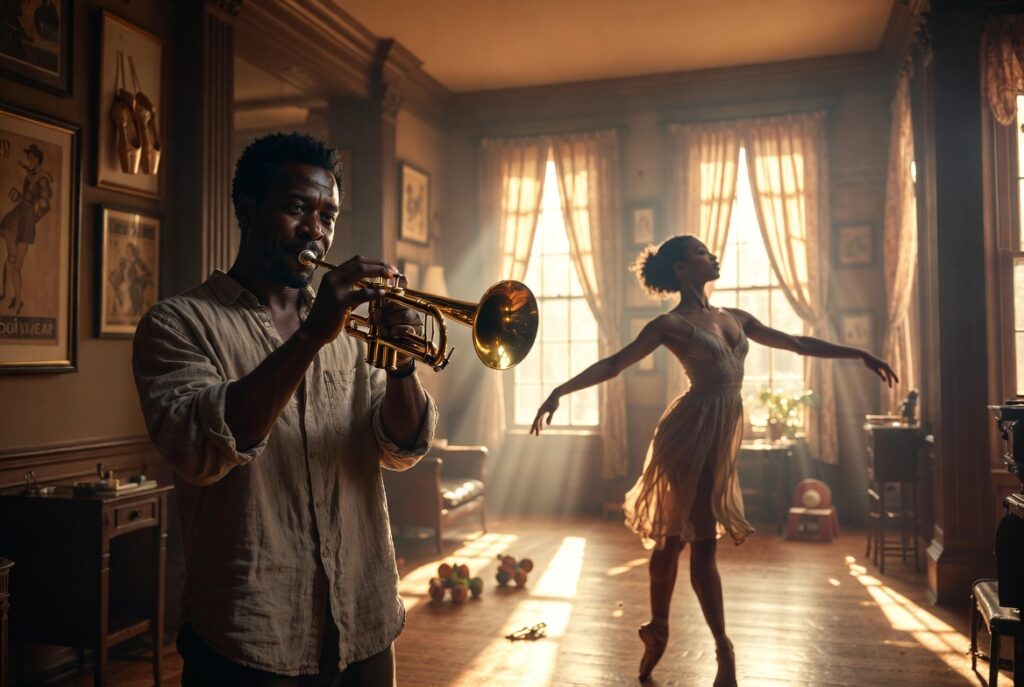
✨ Welcome to “Brownstone Symphony” ✨
Dim the lights, settle into your favorite chair, and let the golden warmth of Harlem fill the room. Before you begin reading, press play on the soundtrack.
The First Note (Meeting)
The Village Vanguard was thick with smoke and possibility on a wet October night in 2019. Miles Davis’s ghost still lingered in the brick walls, but the stage belonged to Julian “Jules” Moreau that evening. He was thirty-two, trumpet in hand, fingers dancing over valves like they were old friends. His set was pure Harlem swing reborn—bright, bouncing, full of life even when the world felt heavy.
In the third row sat Lena Voss, twenty-eight, still wearing the faint scent of rosin and stage lights from her final dress rehearsal at Lincoln Center. The New York City Ballet had just cut her contract after a stress fracture in her right ankle refused to heal on their timeline. She had come to the club alone, nursing a warm bourbon and the quiet ache of watching her body betray the only dream she’d ever had.
Jules launched into an original called “Uptown Echoes.” The melody rose, playful and insistent, horns laughing against the rhythm section’s strut. Lena closed her eyes. For three minutes the music lifted the weight off her injured foot. When the last note faded, she found herself standing, clapping harder than anyone else in the room.
Their eyes met during the break. Jules, wiping sweat from his brow with a handkerchief embroidered with tiny musical notes, smiled the easy, crooked smile that would eventually become her favorite sight in the world.
“You look like someone who just heard good news,” he said, sliding onto the stool beside her.
“I heard hope,” she answered.
They talked until the club closed. He told her about growing up above a Harlem jazz club where his grandmother played piano until 2 a.m. She told him about dancing since she was four, how ballet had been both salvation and prison. When the lights came up, Jules walked her to the subway and handed her a cassette tape labeled “For rainy days and new beginnings.”
That night, Lena fell asleep with headphones on, Jules’s trumpet cradling her into dreams where her body still moved without pain.
The Weight of Broken Things (Sorrow)
Three months later they were inseparable, but sorrow had already shown its teeth.
Lena’s ankle surgery failed. The surgeon was blunt: “Professional dance is over.” She spent weeks on her couch in a tiny fourth-floor walk-up in Hell’s Kitchen, staring at pointe shoes she couldn’t wear. The silence in her apartment was deafening. No music. No movement. Just the slow drip of grief.
Jules had his own ghosts. His younger brother, Theo, a promising sax player, had died two years earlier from an overdose after years of chasing the wrong kind of high in the jazz scene. Jules carried the guilt like a mute on his horn—everything he played now sounded a little too bright, as if volume could outrun memory. He performed six nights a week, slept little, and smiled for the crowd while his soul felt paper-thin.
One bitter January night, Lena found Jules on her fire escape, trumpet silent in his lap, tears freezing on his cheeks.
“I keep thinking if I’d stayed home that night instead of gigging, I could’ve stopped him,” he whispered.
Lena limped out in her robe and sat beside him, resting her head on his shoulder. “And I keep thinking if I’d rested when my body begged me to, I wouldn’t be broken now.”
They held each other in the cold until the city lights blurred. For the first time, neither tried to fix the other with words. They simply stayed.
Healing in Minor Keys (Healing Each Other)
Spring arrived with tentative green on the trees and tentative hope in their hearts.
Lena began teaching little girls at a community center in Harlem on Saturdays. Watching their clumsy pliés and shining eyes reminded her why she had fallen in love with dance. Jules started composing again—not for clubs, but for healing. He wrote a piece called “Lena’s Waltz,” a gentle 3/4 that let her sway without pain. She choreographed simple movements for seniors at the center, finding joy in bodies that moved for pleasure, not perfection.
They healed in small, ordinary ways.
Jules would come home from late gigs and find Lena had left him a new pair of dancing shoes—soft leather slippers so she could move around the apartment without agony. Lena would wake to Jules playing soft scales in the kitchen while coffee brewed, the notes wrapping around her like a warm blanket.
On warm evenings they danced in her tiny living room—his arms around her waist, her bare feet on his sneakers, laughing when she stumbled. The sorrow didn’t vanish; it simply made room for joy beside it. Their love became a duet: two broken instruments learning new harmonies.
By summer they were talking about forever. Not in grand gestures, but in quiet plans whispered between kisses.
The Brownstone (Buying Their First Home)
The brownstone on West 122nd Street had been empty for eight years. Its stoop sagged, the windows were boarded, and the realtor warned them it needed “love and a miracle budget.”
They fell in love with it anyway.
It sat in the heart of Harlem, three stories of faded red brick and possibility. The previous owner had been a jazz photographer from the 1960s; faded prints still hung crooked on the walls. Lena ran her fingers over the worn banister and felt history humming beneath her touch. Jules stood in the empty living room, trumpet case at his feet, and played one clear, ringing note that echoed up the staircase like it had found its true home.
Buying it was terrifying. Their combined savings, gig money, teaching income, and a small inheritance from Jules’s grandmother barely covered the down payment. They fought with the bank, with each other, with doubt. One night Lena cried in the empty kitchen, “What if we ruin this?” Jules pulled her close and said, “Then we’ll fix it together. That’s the whole point.”
They closed in October 2021. The first night they slept on an air mattress in the middle of the living room, wrapped in blankets, listening to the city outside and the creaks of their new old house inside. Jules played a soft, celebratory riff on his trumpet at midnight. Neighbors banged on walls in protest, then laughed and cheered when they realized it was a love song.
Canvas and Crescendo (Happily Ever After)
Five years later, the brownstone glowed.
The parlor floor became a gallery of their lives: Lena’s framed pointe shoes mounted beside Jules’s first trumpet. A wall of windows let in golden afternoon light that danced across polished hardwood. Upstairs, a small dance studio with a sprung floor allowed Lena to teach private students and move for joy again. Downstairs, Jules built a recording nook where he composed for films, albums, and the pure pleasure of creation.
Their daughter, Theo-Lena “Tilly” Moreau, was born in the upstairs bedroom during a summer thunderstorm in 2024. She came into the world to the sound of her father humming “Lena’s Waltz” through the door while the midwives worked.
On warm evenings the family spills onto the stoop. Jules plays for the block—light, upbeat, swinging jazz that makes old heads nod and children dance. Lena teaches neighborhood kids simple ballet steps on the sidewalk, her limp barely noticeable now. Tilly toddles between them, tiny hands reaching for both music and movement.
The sorrow still visits sometimes. On Theo’s birthday they light a candle and play his favorite records. On hard days Lena’s ankle aches and Jules’s grief feels fresh. But now the brownstone holds them. Its walls have absorbed laughter, arguments, lullabies, and trumpet solos. Every repaired crack and fresh coat of paint tells the story of two people who chose healing over perfection.
At night, after Tilly is asleep, Jules and Lena often dance slowly in the living room while an old record spins. No spotlight. No audience. Just two bodies that found their way home.
And somewhere in the walls of that Harlem brownstone, the music keeps playing—bright, resilient, and full of tomorrow.
The End
Reflection: The Music We Make in the Houses We Mend
Some homes are not found. They are built — note by note, step by step, crack by crack.
“Brownstone Symphony” began as a quiet imagining: What if two artists, each carrying the kind of wound that silence makes louder, decided to create a life together inside four old walls in Harlem? What if a trumpet and a pair of ballet slippers could teach each other how to heal?
In writing Julian and Lena’s story, I kept returning to one truth: home is the ultimate collaborative artwork. It is never perfect when you first step inside. The floors creak. The light falls strangely. There are ghosts in the plaster and sorrow in the corners. But with enough love, patience, and jazz in the background, those same walls begin to sing.
Lena’s journey mirrors what so many of us feel when a dream breaks — when the body, the career, or the plan we built our identity on suddenly says “no.” Julian’s grief reminds us that loss doesn’t leave quietly; it lingers until we give it a new melody. Their brownstone became the place where sorrow was allowed to stay, but joy was invited to move in louder.
This story is for anyone renovating more than just a house — whether you’re healing a heart, restarting a creative life, or simply learning to dance again in a body (or a world) that no longer moves the way it used to.
The greatest art we ever make isn’t hung on walls. It’s lived in. It’s the slow waltz in the living room at midnight, the trumpet solo at golden hour, the laughter of a child echoing down a hallway you once thought too empty to ever feel like home.
So put on that upbeat jazz playlist. Let the horns lift you. And remember: every beautiful home begins with two imperfect people choosing to stay, to mend, and to make music anyway.
Welcome to the brownstone. May it feel like home.
— With warmth and swing, Your storyteller, Steve Schappert
